by Rupert Wolfe Murray | 6 Apr, 2020 | Journeys
At first I was like Trump – in denial – but when it became clear, except to the most diehard conspiracy theorists, that this wasn’t just another seasonal flu I realised that self-isolation and lockdown were essential.
“Easy,” I thought, “I’ve been here before. I’ve lived in post-revolution Romania and post-war Bosnia. I can keep calm in a crisis and I’ve experienced nationwide food shortages. Surely the NHS will value this experience when assembling teams to deal with the crisis.”
Then came the call for NHS volunteers and, along with about 700,000 others, I applied. But they only requested minimal information (name, address, driving licence number) and I wasn’t surprised that there was no reply. If they’d had a more detailed form they could have worked out our skills, experience and availability and assigned us to nearby hospitals, but now they have over half a million application forms and it will take them until Doomsday to go through them all. I also applied to a private sector ad, for “NHS IT Volunteers”, as well as a local charity, – but no response from either of them.
All this has made me face up to reality which is that my aid agency days are over, and they were so long ago (1990 to ’95) that any recruiter would think I’m deranged to think I could apply for something similar in this day and age.
In preparation for my heroic career as a “front line” NHS volunteer I set up camp in my aunt’s little garden in Brighton (I rent her attic-flat). The idea was that I’d return from a 12 hour shift in the Accident and Emergency department, or driving ambulances at high speed through an empty city, and live in the garden in order to not bring the virus into the house. I dug a compost toilet, eat all my meals outside, sleep in a tipi tent and avoid going inside the house.
But my call from the NHS never came and I’ve moved on.
I think everyone has time to reflect these days and one of the things I’ve realised is that my rush to become an NHS volunteer is only partly a desire to help people; it’s also an urge to escape the boredom of isolation. It’s much more exciting to become part of a team in a crisis than being stuck in a garden for weeks on end.
It was also an attempt to escape my real purpose in life, which I recently told myself was to write books. The truth is that this time of lockdown and isolation is an ideal moment to finish all the books I’ve written but not yet published. All I have to do is focus on writing, editing and publishing every day, work out the intricacies of self-publishing on Amazon (they’re surprisingly simple if you have patience) and avoid distractions.
But when faced with a new creation, a new book, all sorts of fears come to the fore – will it be a failure? – and it’s so much easier to give in to procrastination, rush off to an emergency where the action and excitement will suck me in and enable me to postpone doing what I really should be doing.
So here I am, in my aunt’s pottery studio, writing this article and about to self-publish the paperback edition of my new travel book on Nepal. Next up is a book on Romania and soon after that I’ll dust down and finish off a book about the evils of international adoption.
My intention is to get all the books I’ve written but not published out there, in the public domain, so that I can forget all about them and move on. I’ve got so many ideas for new books, and can write them quickly, but the problem is I get bogged down in the Dreaded Swamp of Procrastination – where thousands of great books have met their doom. I don’t have Writer’s Block, I have what could be called Publisher’s Block – I find the production and especially the promotional side really depressing and tend to avoid it, resulting in finished manuscripts sitting around for years.
During this current crisis, and thanks to the NHS for not dragging me into their chaos, I’ve been able to find the time – and the determination – to overcome this block. Every day this week I’ve been working on Amazon’s Kindle service where all the tools to self-publish and promote a book are available for free. All it takes is a bit of patience and, most importantly, the will to banish the demon of procrastination back to his pit.
A key factor in enabling me to write was the realisation that my books don’t need to succeed – this simple truth hit me with the power of a revelation. It really doesn’t matter if nobody buys them, if they disappear without trace on Amazon’s vast sprawl. That’s not the point. My aim is just to share a story and then move onto the next one. Feedback is important but I mustn’t let a lack of it hold me back. I imagine comedians and musicians playing to empty halls and carrying on anyway despite the vote of no confidence. They must go on to the next gig or they wouldn’t be artists.
The real key to writing is very simple: self-discipline. What this means in practice is sitting down and writing for up to four hours a day. It’s really hard to actually do this as there are distractions everywhere and the evil twins of procrastination and complacency can often seem so very attractive; but once you get going it become self-perpetuating; a daily routing gets easier the longer you do it.
Every book I’ve seen about How to Write mentions this four hour a day rule and I’ve known about it for about 30 years. But I’ve allowed myself to get distracted by emergency situations, difficult jobs, complacency and, in recent years, the galaxy of online entertainment that is waiting in my pocket. My whole life nearly went by without having written a word, without having left any stories behind.
Two things have changed all that and enabled me to write, publish, rinse and repeat. First of all this coronavirus pandemic has kept me in the same place for long enough to stop making excuses and face up to my life’s purpose.
The second thing that has kicked me into gear is a rather dubious deal I’ve made with a writer friend, who also struggles with the evil twins and is sitting on a pile of great, unpublished, gems. I told him “If I don’t write four hours a day I will pay you £40. If I write one hour a day I’ll pay you £30; in other words I’ll pay you £10 an hour for every hour I don’t write.”
The final thing that has turned me from couch-potato into productive writer-cum-self-publisher is turning off the phone, which I do every evening and it only get turned on after I’ve done my 4 hours a day (usually about lunchtime). Considering how many distractions are in a modern phone, and how easily it sucks you in during a moment of weakness, this really helps me focus. And when it comes to turning the thing back on again I assume there will be a ton of missed calls and unanswered messages but no – during this lockdown, at least in my experience, people are communicating less.
My writer friend probably thinks I’m insane but it’s actually working like a dream. The last thing I want to do is give him any money at all, let alone £40 a day – in this time of economic shutdown it would be madness – and it’s motivating me more effectively than anything I’ve tried in the last 30 years. This is the third day I’ve been doing it and I’m approaching my third hour today; and my last hour will end neatly at 1.20PM which is exactly lunchtime.
If you’ve read this far I’d really appreciate it if you would buy my new travel book on Amazon: Himalayan Bus Plunge, and other stories from Nepal.
Every time someone buys a copy it’s like a vote of confidence, another member of the audience for that struggling musician, and a review is like when a particularly keen fan comes up to the performer afterwards and tells him how much he enjoyed it. Even bad reviews are good because it shows that people are engaging, and that’s all we can expect.
I did say I don’t really care if people buy the book and that’s true – but an equally valid truth is that it would be wonderful if people did.
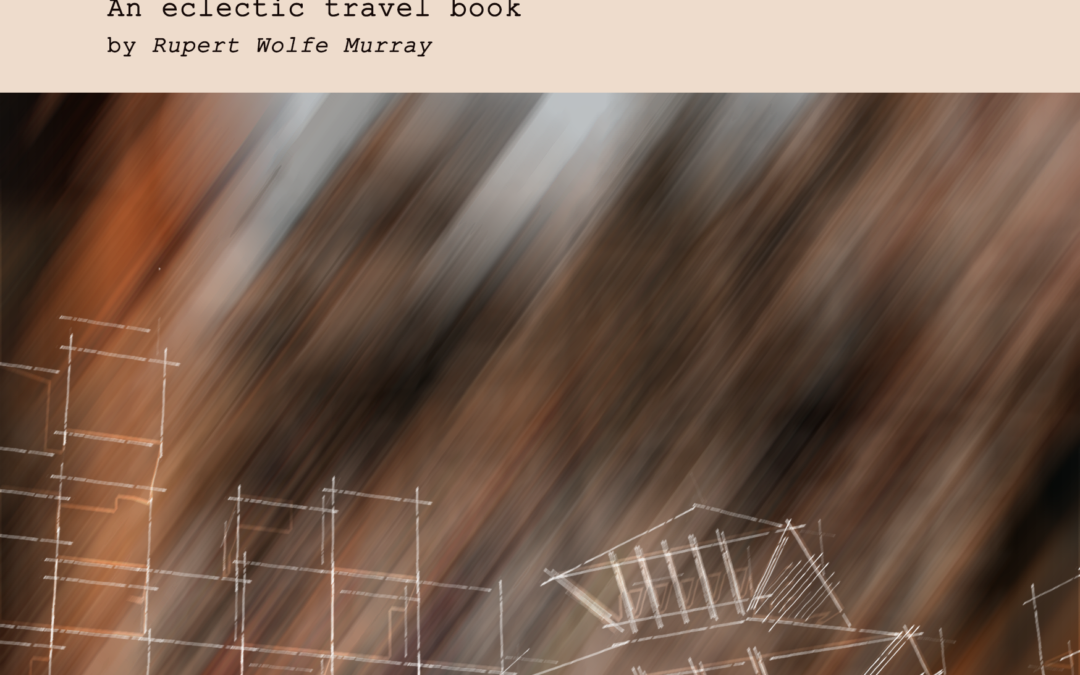
N.B. The image used with this article was the first cover proposal by the Maria Tanasescu. The trouble with working with great designers like Maria is that one has to choose from a series of great designs and it’s difficult and painful. Looking at this image now I’m thinking “this is better than the one I chose…”
by Rupert Wolfe Murray | 20 Mar, 2020 | Reviews
Here’s the press release for my new travel book:
Escape the virus (at least for a few hours) with Rupert Wolfe Murray’s new travel book: Himalayan Bus Plunge — And other stories from Nepal.
In his introduction to Wolfe Murray’s first travel book, Alexander McCall Smith wrote: “We are there with Mr Wolfe Murray, experiencing his discomfort and anxiety, but sharing, too, his insights.”
Read about the author’s fear of going off a cliff on a rickety Nepalese bus, his horror of going home (“Culture Shock!”), and meet a unusual cast of characters: a gardener who translates for aid agencies; a brain surgeon who drives like a demon; and the Tibetan doctor who diagnosed the author’s fever as “fire in the belly”.
“My original aim was to offer travellers to Nepal a complement to the Lonely Planet type guidebooks,” said Rupert Wolfe Murray, who is currently based in Brighton. “Then along came Coronavirus and I was told now is a terrible time to publish a travel book as nobody is making any travel plans. I’m sure that’s true but I also think this is a good time to publish as people are stuck at home looking for something new to read.”
Pre-publication feedback:
“Stories that are funny and always compelling. Rupert Wolfe Murray is a throwback to an earlier bolder time, like finding Hemingway alive and well on Oxford Street.” Chris Stephen, journalist and war reporter
“Your written prose is strong and well crafted. You have a very interesting personal history in the Himalayas and a deeply involved, embedded brother there. This adds rare insight.
“You connect to people but keep an almost third person perspective: unemotional observation of those with whom you interact. I came away with a deeper understanding of the region.”
Peter Mair, Retired Federal Prosecutor (USA)
#
If you’d like to get copy of this new book on Nepal just click here.
by Rupert Wolfe Murray | 26 Mar, 2019 | Journeys
Kathmandu was the first Asian city I had seen that wasn’t built of concrete.
This small city seemed genuinely ancient and the centre was full of Hindu temples, each one a hive of activity. Some were covered with elaborate stone statues of Hindu Gods penetrating their consorts with massive stone penises. The streets were narrow and packed with crowds, people selling fruit and all manner of foods, sacred cows wandering freely and helping themselves to the produce of the fruit sellers who would get infuriated but were unable to do anything. There were more hippies per square yard than I had seen anywhere in my life and their expressions told me there were plenty of cheap drugs available. Everywhere you looked Nepalese men would be hustling, offering hotel rooms, cheap restaurants, tours to the mountains, rupees, precious stones, antiques, temple visits and, of course, hashish. It was pouring with rain and everything felt damp.
At 70 pence a night, the Trekkers’ Lodge was the cheapest place I found to stay. The boys in charge of the guesthouse walked me up some dark stairs, along a gloomy corridor and showed me into a small grubby room with three beds. The boys thought they were doing me a big favour by putting me in a room with two Englishmen. We entered the room and two shabby looking travellers glanced up from their fat paperbacks and tried to look welcoming. Mosquitoes circled the sole light bulb and a towel was stuffed into the small, broken window. I took the free bed by the door.
Richard was dark and good-looking and he had the bed by the window. He sounded like an upper class Englishman but he claimed to have worked as a brickie before going to study at East Anglia University. He fervently believed in the British Labour Party and put all his energy into convincing us that Neil Kinnock, the leader of the party, was different and would transform society when he became Prime Minister. His diatribes were fascinating and I learned more about British politics than I had done at university, where I had studied the subject, but I didn’t believe in party politics, or ideologies of any stripe. I told them that my view of parliamentary elections was based on some graffiti I once saw in Liverpool: Whoever you vote for, Government wins!
Adrian was in the middle bed. He was thin, witty, had a whispy beard and was a seasoned traveller from the West Midlands. He showed me a photo of his mates back home, lined up outside the pub, a grotesque glimpse into another world. Adrian had lived in Greece where he had witnessed the Socialist Party getting elected based on a promise of expelling the American troops from their country, a promise they had failed to deliver. Nothing could convince him that any political party delivers on its promises, Neil Kinnock being no exception, and so they had endless material for debate.
We would go for meals together in cheap restaurants with pastel drapes and nice decor, endlessly talking about world politics while eating westernised food at a tenth of the price. Prices are a big topic among travellers and I noticed how our understanding of money changed to suit local prices. The restaurant we frequented most often sold delicious bean burgers, with all the trimmings, for just twenty rupees which is one British pound. If we went to another restaurant and saw bean burgers on the menu for thirty rupees we would consider it extortionate and leave in disgust.
I had to get a Chinese visa and I wanted it quickly. Neither of my roommates had a clue where I should begin, but across the landing a chatty Chinese American girl with chubby cheeks and a bright smile told me where to go. At the Chinese Embassy, an inscrutable official sent me packing: I didn’t have the relevant papers and couldn’t possibly get a visa for China. They told me to get one in London. This isn’t what I was told in that bar in Budapest.
I then ran into a haggard looking American journalist who told me how to go about it: send a telex to Beijing requesting permission to visit the People’s Republic of China and to issue the visa in Kathmandu. Then send a telex to the Bank of China, New York branch, to pay for Peking’s reply. Whatever the reason behind this ludicrous procedure it took ages, cost far too much, and left me twiddling my thumbs in Kathmandu for the next two weeks.
My new Chinese American friend had travelled overland from Tibet with a horde of young people from Hong Kong. I noticed that Hong Kong Chinese people, when travelling together, can be incredibly loud and also rather exclusive: they seemed to ignore everyone around them and are self-contained in a rather selfish way. I had tried to share a dormitory with them, as they occupied the biggest and cheapest room at Trekkers’ Lodge, but they had specifically told the boys in charge that they didn’t want to share with anyone. I later noticed that Hong Kong Chinese people behave totally differently from their compatriots in the People’s Republic, where people seemed more friendly and humble.
But my Chinese American friend was different; she had all the openness and warmth of the Americans and was keen to talk. She had been brought up by an American family in the Midwest (I presume she had been adopted) and only learned Chinese when she went to live in Taiwan for two years. Her recent trip from Hong Kong through China and Tibet was the most potent experience of her life. She described her best moment as watching the Potala Palace, a vast and ancient structure that overshadows Lhasa, at sunset, while listening to country and western music on her Walkman. Her description of Lhasa’s street life was far more vivid that anything I had read in in the guidebooks. She talked of playful monks, dogs snoozing on the streets, the infectious friendliness of the people, children running alongside the tourist buses and demanding sweeties. She told me that Tibet was quite backward compared to China proper but the effect of western tourism was spreading fast.
Our conversation inspired me to find out more about Tibet and as I began devouring guidebooks, with their short potted histories, I realised my knowledge of Tibet was virtually non-existent. My only source had been Tintin in Tibet, a cartoon book involving a plane crash in the Himalayas, some amusing encounters with Tibetan monks and a showdown with the Yeti, the Abominable Snowman.
I learned that Tibet had been a medieval country until the 1950s. Neither China, home of ancient technology, nor Britain, the scourge of Asia, had introduced anything more than a radio set to this ancient abode of Lamas, or Buddhist priests. It seemed inconceivable that such a strategic country, located between the Chinese, Russian and British Empires, had managed to evade colonisation for so long. Tibet’s policy towards its imperial neighbours had been simple: ignore them. Incredibly, this policy had worked and they had been left in relative peace for almost a thousand years. When a Chinese dynasty got powerful it would install an ambassador in Lhasa and encourage trade in silk and tea, and when the dynasty grew weak their influence would wane and the ambassador would go hungry. Not until the 1950s did China conquer Tibet and incorporate it fully within their border.
By the nineteenth century Britain was raping China, selling them vast quantities of Indian opium and setting up fortified trading ports where huge profits could be made. Meanwhile, to the west, Russia was expanding into the vast deserts of central Asia, butting up against the outer rim of the Chinese area of influence and conquering the ancient kingdoms that had ruled the region for centuries. China’s ruling Ching dynasty couldn’t cope with all this. For hundreds of years they had considered themselves to be the centre of the universe – they called themselves the Middle Kingdom as they believed their land was between heaven and earth. When foreign kings would visit they would be expected to kowtow: prostrate themselves on the floor in a gesture of total submission. Unlike the Japanese, the Chinese were unable to adapt to modern technology and, as a result, the western powers were able to humiliate them. The Chinese didn’t know how to cope with the arrogant Brits who not only refused to kowtow to the emperors, but undermined Chinese society with opium, made a mockery of their armies and destroyed the exquisite Summer Palace in Peking, a vast playground of parks, pagodas and ponds, in an outrageous act of vandalism.
As the twentieth century approached, Tibet’s importance as a strategic buffer zone grew. In 1904 a British force marched into Tibet, fired a few volleys against medieval troops and met virtually no opposition. They found that rumours of Russian influence had been exaggerated, there were no foreign representatives in Lhasa, and they quickly withdrew. But they did sign a treaty, lay a telegraph line and install a trade representative in the city of Gyantse. The Tibetans started to realise that they couldn’t go on ignoring the rest of the world and they tried to sign a treaty with China, but the Ching Dynasty was disintegrating at the time and they were unable to make any progress in this regard.
The chaos of the Second World War enabled Mao Tse Tung and the Communist Party to seize control of China and by the late 1940s they turned their attention to Tibet. They considered Tibet to be another part of the Chinese Motherland that needed to be liberated. They didn’t need to fight their way in as they made a promise that Tibet’s autonomy would be honoured, that the Dalai Lama could remain as leader and that its unique cultural integrity, including a distinct language, would be respected. A treaty was signed in 1951, under duress, and for the first few years the Communists did carry out some useful reforms. By 1959 Chinese heavy-handedness had become unbearable to the Tibetans, and especially to the Dalai Lama, who was nominally in charge. It became clear that the Chinese would only tolerate Tibet’s culture for as long as it took to install the Red Army and their oppressive system of administration.
In 1959 there was a general uprising in Lhasa. The unarmed Tibetans didn’t stand a chance and thousands were killed. The Dalai Lama, followed by about 80,000 Tibetans, fled over the Himalayas and eventually set up a government-in-exile in the Indian village of Dharamshala. The darkest period in Tibet’s history was still to come: in the 1960s over a million were displaced or killed, villages starved, collectivisation was brutally installed and, during the Cultural Revolution, Tibet’s vast network of monasteries was destroyed and the monastic way of life abolished.
But this had all changed when China’s new leader, Hu Yaobang, visited Tibet in 1980 and publicly apologised to the Tibetans for the mistakes that had been made. He decreed that Beijing’s grip on Tibet should be loosened and that Tibetans would have a say in its governance. Part of the reform process that followed included the opening up of Tibet to international tourism.
At that point I still retained some faith in Chinese Communism, which I believed to be more benign than the East European and Soviet variety. I wanted to believe that Communism could work somewhere on this planet as it is such a great theory. I became fascinated by Tibet and refused to believe all the horror stories I was hearing. I wanted to find out the truth for myself.
The more I found out the more questions I had: why wasn’t Tibet even mentioned at university where, in my final year, I had studied The Western Powers and Asia? Why did all the other tourists in Kathmandu seem to know the history of Tibet back to front? Did people in the west know this story? Was I completely wrong in thinking that the Peoples Republic of China was the one place where socialism hadn’t been so terrible? Were the guidebooks wrong? Was the potted history I had just learned nothing but capitalist propaganda? Was Mao Tse Tung really such a baddie?
#
This is an extract from 9 Months in Tibet — the eBook — which will be published soon. It was about a journey that happened in 1986 and 1987. If you’d like to reserve a copy just email me at wolfemurray@gmail.com (or post a short comment under this article).
by Rupert Wolfe Murray | 21 Sep, 2018 | Nepal and Tibet, Opinions
This article about DFID was first published in the Scottish newspaper The National (a paper which supports Scottish independence, which I don’t, but they also support freelance journalism which I do).
*
The London media have said little of interest about Penny Mordaunt, the new Secretary of State for the Department of International Development (DFID): the Times calls her a “joker”, the Mail describes her as a “magician’s assistant” and the Express urges her to “reduce UK’s £13-billion-a-year bill.”
As someone who has worked on DFID projects in Eastern Europe , I would like to offer Ms Mordaunt some PR advice about her new role.
I worked for DFID as a PR consultant and, for years, have been frustrated by this department’s chronic inability to tell their story and promote themselves. It’s the one government department that does great work, is totally transparent but is unknown by the public.
Behind the headline-grabbing challenges that Penny Mordaunt has done in her past, such as competing on Splash, a TV reality swimming show, the media seem to have missed a part of her background that is surely worth an in-depth article: she worked as Head of Foreign Press for George W. Bush’s 2000 and 2004 presidential campaigns. I’d love to know more about that job.
As a PR heavyweight with useful military experience, Penny Mordaunt is in a good position to project the Department of International Development into the mainstream. Priti Patel, the former secretary of state who was ejected last week, continued the department’s lamentable tradition of burying their heads in the sand while the Express, Mail and Telegraph vilify them about wasting taxpayers money and denounce the one good thing that David Cameron did: commit Britain to spending 0.7% of the state budget on international development.
I’m hoping that Ms Mordaunt has the proverbial balls to stand up to the tabloids, use the facts to refute their shockingly dishonest articles, invite journalists to visit the projects and not take any nonsense from the right wing Tory backbenchers who would happily close down DFID if they could (even though it could be used to show that Britain still has global influence after the Brexit debacle).
What is DFID?
Bearing in mind that the Department for International Development is one of the least known government departments, some background would be useful.
The department dates back to the early sixties when Britain was in the process of closing down its Colonial Office and setting up new structures to maintain connections with those parts of the world it had previously governed. The Overseas Development Administration was set up in 1961 and it quickly gained a reputation in Africa, Latin America and Asia as an efficient supplier of emergency aid. The acronym ODA became a well-known brand in many parts of the world.
One of the key principles of good branding is to value an existing name and not change it without sufficient consultation and investment (the oil companies spend millions every time they adjust their logos). The newly elected Labour government of 1997 ignored this and, perhaps unaware of the value of the ODA name, changed the departments name to DFID. Rather than use this as a “re-branding” opportunity they didn’t invest anything in telling people their name had changed. This chronic inability to promote itself has continued to this day, despite other parts of government becoming increasingly media savvy.
The tabloids go on the offensive
For over 10 years DFID went about its business more or less under the radar, rather like a secret intelligence agency. During the nineties it funded useful projects in Bosnia (including several that I was involved in) and offered a wide range of practical assistance to the countries that were emerging from the Soviet Union. On the ground, it got the reputation of being the least bureaucratic bi-lateral aid agency.
In terms of PR, it all seemed to go wrong under Cameron’s coalition government (2010 to 2015). George Osborne had promised to cut every government department except two – DFID and the NHS. For the tabloids, forever on the hunt for a big victim, they couldn’t attack the NHS as everyone has a personal stake it in – but DFID represented an ideal target: it was relatively unknown and the beneficiaries of its budgets were, shock horror, Johnny Foreigner!
For the last few years the Mail and the Express have carried out a series of outrageous attacks against DFID, accusing it of supporting dictators in Africa, funding terrorists in Palestine and paying for nuclear weapons in India. They do this by quoting the amount we give a particular country, ignoring the details of the project itself, and highlighting the most scandalous story about that nation.
With the EU the tabloids bang the drum about the mythical £350 million a week and with DFID they have an even bigger target to aim for – their £12 billion annual budget, which represents just 0.7% of the national budget. “We believe,” said the Express, “the 0.7% budget commitment can be spent on the struggling NHS and social care services in Britain.”
The irony of these tirades are that they are based on the detailed information that DFID itself makes public about its international operations. In fact, DFID has been praised as the most transparent of all government departments as it’s the only one with all their accounts online.
Penny Mordaunt’s Opportunity of a Lifetime
Ms Mordaunt should be grateful that she wasn’t appointed as the new Minister of Defence, a poisoned chalice if ever there was one. The role would have involved lobbying her own government to stop cutting budgets and with very little decent PR collateral.
The DFID job is a gift from PR heaven: it has the most inspiring story that’s never been told. All it needs is someone with the guts to stand up to the tabloids and the nationalist Tory backbenchers. It reminds me of the old American saying “if you need a man for a job – get a woman.”
DFID-funded projects in sub-Sahara Africa and the Middle East are vital for people in those regions to get water, food and livelihoods. They are also one of the few investments going on in those areas that give people some hope, some work and help to prevent the waves of migrants heading towards Western Europe.
At donor meetings around the world, DFID has earned its place at the top table with the UN, EU, Japanese and American government aid agencies. The only other European country with this level of influence is Norway.
But DFID have almost no PR staff and when I was in Nepal earlier this year, trying to visit their projects and write about them, I was met with confusion. Nobody in their Kathmandu office knew how to deal with me.
If Ms Mordaunt adopts an aggressive approach to this she could have immediate impact. She could take on the tabloids in the mainstream media, destroy their arguments with simple facts, order every DFID mission to invite journalists to visit projects – and tell the nationalists in her own party that helping poor people get on their feet is the best thing we can do to protect our own country. She could also be a regular visitor to Scotland as DFID’s main administrative base is in East Kilbride.
by Rupert Wolfe Murray | 26 Jan, 2018 | Journeys, Nepal and Tibet
My brother’s house in Kathmandu is old, narrow and tall. At the bottom of the house is a dark room which doubles up as an entrance hall and bicycle garage. This is where I am, getting ready to cycle across town.
I’m wearing good trousers (I’m going to a meeting) and want to protect them from the oily chain so I put on bike clips. Then I put on one of those futuristic (and, in my view, quite useless*) bike helmets and a dust mask.
Standing in the semi-darkness, gripping the handlebars of the borrowed mountain bike, I feel tough and fit (even though I’m neither). I open the double wooden doors and step out into the bright sunlight, putting on my brother’s sunglasses and completing what is effectively a mask. Nobody can see who I am and I relish the anonymity; I can pretend to be a local as I prepare to dive into the flowing mass of vehicles that pumps through Kathmandu like a great river.
I take off the mask for a moment and inhale the morning air in the yard; it feels damp and fresh and there is a whiff of incense and rotting rubbish. A proud chicken struts across the yard, puffed up and arrogant, ignoring the stray dog that lies curled up in a ball by the wall. The dog would be white if it was washed but nobody would do such a thing as it doesn’t belong to anyone; it’s the local stray and it’s always here in the yard — sleeping by day and barking all night.
Now I’m on a narrow street that leads up to the centre of Patan, the ancient part of Kathmandu where my brother lives. There are old buildings in this part of town but most of the city has been rebuilt in concrete. Motorbikes fly by constantly and the occasional car or small van thrusts through, holding up traffic and bringing the speed down to walking pace.
If Kathmandu was a body these little streets would be the capillaries — small, narrow, anonymous and legion — and the main roads would be the arteries. During the day streets are packed with vehicles, all the time, as hundreds of thousands of people hurry to and fro, doing their business, going to work. Two million people live in this ancient city that was built for a tenth of that number. A taxi driver told me that more and more people are buying cars with easy bank loans, but the government isn’t improving the roads and soon the traffic will come to a standstill: gridlock. Pollution hangs like a blanket over the city.
Soon I reach the main road and I plunge in, like a minnow joining a fast flowing river that is full of racing fish.
When I first got to Kathmandu I looked at the traffic and wondered how anyone could survive it; so many vehicles, no traffic lights and no rules. It looks like complete chaos. But when I join the flow of traffic, catch up with them, and go at their speed, it feels totally different.
I am now part of the flow and I realise several things: we are moving quite slowly; all the motorbikes and cars are going the same speed as the bikes. There are no white lines marking different lanes, but this is no problem as everyone is keeping an eye on what’s going on in front of them and we form lanes naturally, as if following some natural law. If someone changes lanes, slows down or stops at the side of the road those behind react accordingly and momentarily make a space for them.
The way that cows and people are treated by the traffic are testament to the safety of the system. I made this 40 second video of some calves sitting in the middle of a busy road, chewing the cud, talking among themselves, while four lanes of traffic roar past on both sides. These beasts are sacred to Hindus and all drivers avoid hitting them. The same goes for people — nobody wants to hit them — and I’ve seen women cross an incredibly busy road, chatting gaily to one another, not looking left nor right, and crossing over with the absolute confidence that they will get to the other side unharmed.
It feels exciting and I am in a race with the other vehicles. Can I beat that motorbike through this tangle of cars? (Yes! I am nimbler in traffic than his much more powerful machine.) Is my humble bike faster than that flash car? Yes! Lumbering buses and taxis are easy to beat and I’m approaching a bicycle ahead so I accelerate, overtake and leave him in my wake.
In mindfulness and meditation they say you should try and be in the present moment, but this is a lot easier said than done; stopping your thoughts is like trying to get a classroom of young children to be quiet . But when cycling in Kathmandu you can’t dwell in the past or worry about the future; you need to focus all your energy on what’s going on around you at that very moment — so you can react accordingly. My life depends on seeing what the vehicles around me are doing. My eyesight, instinct and hearing perform at levels they have never done before (hearing is essential — the sound of screaming engines, or brakes, is a danger signal).
I accelerate past a slow cyclist. Ten seconds earlier he had filled my field of vision, overtaking him was my sole purpose in life; but now he’s gone and I’ve already forgotten about him. I feel like a medieval soldier, with sword and shield, hacking my way through enemy ranks, not sparing a thought for those I strike down.
I’m now fully focused on my next move. I’m riding between a battered taxi on my left and a packed bus on my right; I need to get out of this moving corridor; but changing lanes isn’t easy as you must ensure that the drivers see you — this is the key rule — if you are seen you are safe — and that means getting ahead of them a few metres. The ability to accelerate is key.
The safest place to be is on the left, the slow lane, but it’s frustrating there as you butt into pedestrians, cows, muddy potholes and the occasional parked vehicle. It’s also far too slow. The most exciting place to be is in the middle of the road, on the invisible line between the oncoming traffic.
The oncoming traffic is being held up by a traffic policeman and a gap appears on the other side of the road. I take advantage and leap into the empty space, racing ahead of my plodding competitors. I race forward on the wrong side of the road and my brain calculates the best moment to dive back into my side.
I reach my meeting with Mercy Corps, an Edinburgh-based aid agency, ahead of time and have a few minutes to dismount, cool down and get into the right frame of mind for chatting to people. I go into the yard of the NGO and lock up my bike with a thin chain, perfectly useless against a proper bike thief; but locking a bike is a ritual for me and it puts my mind at rest. They say that few bikes are stolen in Kathmandu and everyone uses these spindly locks.
I love cycling in Kathmandu but assume most people wouldn’t. Many people I have talked to about cycling in cities complain about cars and believe that the only safe riding is on dedicated cycle lanes. My view is that cyclists must constantly observe, adapt and treat all cars, as well as pedestrians, as hazards. No point whining about them; it’s like complaining about the weather.
As far as I am concerned a bike is just another means of transport that must share the road with cars, buses and trucks. Drivers have no intention of knocking cyclists down, if only because it might result in a long jail sentence; if they can see you, and you’re on a predictable line, they will treat you with respect.
My rules for safe city cycling — in Scotland as well as in Nepal — are to be seen and to understand the behaviour of vehicles. The fact that I have driven cars for many years means that I know how drivers react, and this makes cycling so much safer. As long as you keep the main rule in mind — be seen by the drivers — then you will be safe.
There are certain types of cyclists who, I think, would appreciate the challenge of riding a bike in somewhere like Kathmandu. These are mountain bikers and BMX riders, all of whom know how to instantaneously react to obstacles. Those types of riders have to live in the present, they must react in milliseconds and they do things that most people think are insane. I think their type of riding is similar to riding in the Orient and they will know there is absolutely no point in blaming others when things go wrong.
#
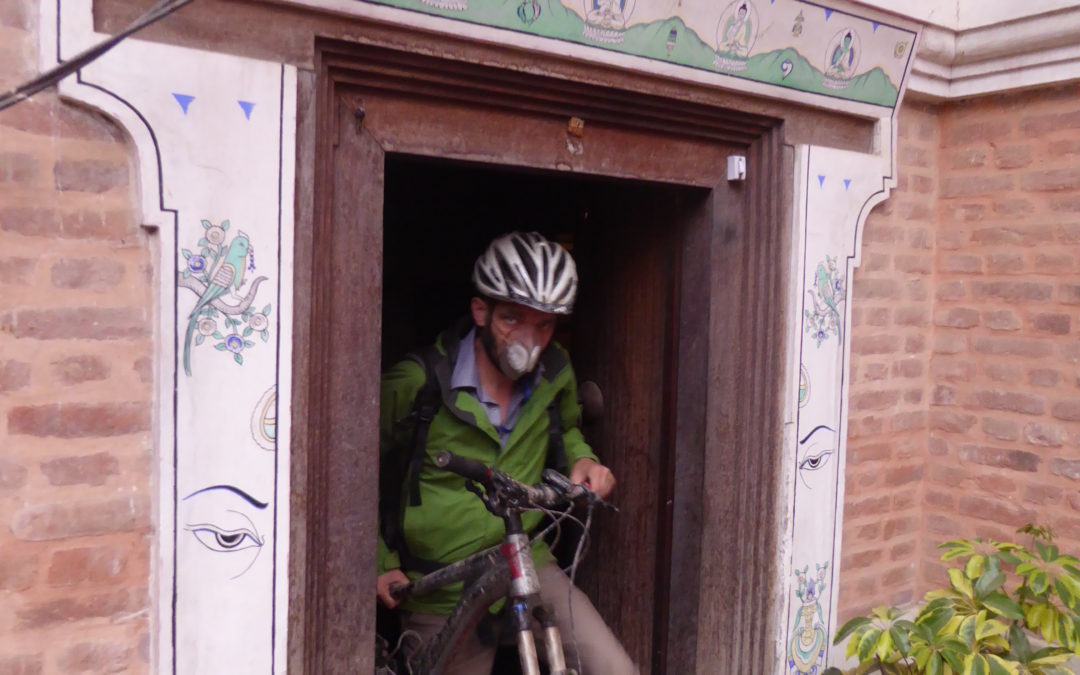
Photo of my brother Magnus coming out of his house in Patan, Kathmandu. Taken by Yours Truly (with his camera).
* I said bike helmets are “useless” and here’s why: they are loose, they slide around your head and offer no protection to the side of your head. They might offer some protection if you somehow landed on the top of your head. All they do is create the illusion of safety. Compare them to motorbike or rock climbing helmets, which are clamped on firmly and would protect every part of your noggin. But I do use bike helmets as they are ideal sun hats; the big chunks of compressed polystyrene that they are made from can protect you from the sun’s rays and also let plenty of fresh air in.
A shorter version of this article was published by the Sunday Herald in Glasgow, with this by-line: “Rupert Wolfe Murray is a freelance writer living near Selkirk. His trip to Nepal was not funded by a travel agency, resort, bike company or any other sponsor.”
In case you’re wondering, I am now living in Edinburgh and commuting to a new job in Stirling (I’m editing this article on the train). I work for an outfit called The Writer and I’m really enjoying it. This article is about a trip I did to Nepal last year. I’d love to get your feedback, however rude or negative. Please add a comment. It’s what keeps me going.

