by Rupert Wolfe Murray | 21 Sep, 2018 | Nepal and Tibet, Opinions
This article about DFID was first published in the Scottish newspaper The National (a paper which supports Scottish independence, which I don’t, but they also support freelance journalism which I do).
*
The London media have said little of interest about Penny Mordaunt, the new Secretary of State for the Department of International Development (DFID): the Times calls her a “joker”, the Mail describes her as a “magician’s assistant” and the Express urges her to “reduce UK’s £13-billion-a-year bill.”
As someone who has worked on DFID projects in Eastern Europe , I would like to offer Ms Mordaunt some PR advice about her new role.
I worked for DFID as a PR consultant and, for years, have been frustrated by this department’s chronic inability to tell their story and promote themselves. It’s the one government department that does great work, is totally transparent but is unknown by the public.
Behind the headline-grabbing challenges that Penny Mordaunt has done in her past, such as competing on Splash, a TV reality swimming show, the media seem to have missed a part of her background that is surely worth an in-depth article: she worked as Head of Foreign Press for George W. Bush’s 2000 and 2004 presidential campaigns. I’d love to know more about that job.
As a PR heavyweight with useful military experience, Penny Mordaunt is in a good position to project the Department of International Development into the mainstream. Priti Patel, the former secretary of state who was ejected last week, continued the department’s lamentable tradition of burying their heads in the sand while the Express, Mail and Telegraph vilify them about wasting taxpayers money and denounce the one good thing that David Cameron did: commit Britain to spending 0.7% of the state budget on international development.
I’m hoping that Ms Mordaunt has the proverbial balls to stand up to the tabloids, use the facts to refute their shockingly dishonest articles, invite journalists to visit the projects and not take any nonsense from the right wing Tory backbenchers who would happily close down DFID if they could (even though it could be used to show that Britain still has global influence after the Brexit debacle).
What is DFID?
Bearing in mind that the Department for International Development is one of the least known government departments, some background would be useful.
The department dates back to the early sixties when Britain was in the process of closing down its Colonial Office and setting up new structures to maintain connections with those parts of the world it had previously governed. The Overseas Development Administration was set up in 1961 and it quickly gained a reputation in Africa, Latin America and Asia as an efficient supplier of emergency aid. The acronym ODA became a well-known brand in many parts of the world.
One of the key principles of good branding is to value an existing name and not change it without sufficient consultation and investment (the oil companies spend millions every time they adjust their logos). The newly elected Labour government of 1997 ignored this and, perhaps unaware of the value of the ODA name, changed the departments name to DFID. Rather than use this as a “re-branding” opportunity they didn’t invest anything in telling people their name had changed. This chronic inability to promote itself has continued to this day, despite other parts of government becoming increasingly media savvy.
The tabloids go on the offensive
For over 10 years DFID went about its business more or less under the radar, rather like a secret intelligence agency. During the nineties it funded useful projects in Bosnia (including several that I was involved in) and offered a wide range of practical assistance to the countries that were emerging from the Soviet Union. On the ground, it got the reputation of being the least bureaucratic bi-lateral aid agency.
In terms of PR, it all seemed to go wrong under Cameron’s coalition government (2010 to 2015). George Osborne had promised to cut every government department except two – DFID and the NHS. For the tabloids, forever on the hunt for a big victim, they couldn’t attack the NHS as everyone has a personal stake it in – but DFID represented an ideal target: it was relatively unknown and the beneficiaries of its budgets were, shock horror, Johnny Foreigner!
For the last few years the Mail and the Express have carried out a series of outrageous attacks against DFID, accusing it of supporting dictators in Africa, funding terrorists in Palestine and paying for nuclear weapons in India. They do this by quoting the amount we give a particular country, ignoring the details of the project itself, and highlighting the most scandalous story about that nation.
With the EU the tabloids bang the drum about the mythical £350 million a week and with DFID they have an even bigger target to aim for – their £12 billion annual budget, which represents just 0.7% of the national budget. “We believe,” said the Express, “the 0.7% budget commitment can be spent on the struggling NHS and social care services in Britain.”
The irony of these tirades are that they are based on the detailed information that DFID itself makes public about its international operations. In fact, DFID has been praised as the most transparent of all government departments as it’s the only one with all their accounts online.
Penny Mordaunt’s Opportunity of a Lifetime
Ms Mordaunt should be grateful that she wasn’t appointed as the new Minister of Defence, a poisoned chalice if ever there was one. The role would have involved lobbying her own government to stop cutting budgets and with very little decent PR collateral.
The DFID job is a gift from PR heaven: it has the most inspiring story that’s never been told. All it needs is someone with the guts to stand up to the tabloids and the nationalist Tory backbenchers. It reminds me of the old American saying “if you need a man for a job – get a woman.”
DFID-funded projects in sub-Sahara Africa and the Middle East are vital for people in those regions to get water, food and livelihoods. They are also one of the few investments going on in those areas that give people some hope, some work and help to prevent the waves of migrants heading towards Western Europe.
At donor meetings around the world, DFID has earned its place at the top table with the UN, EU, Japanese and American government aid agencies. The only other European country with this level of influence is Norway.
But DFID have almost no PR staff and when I was in Nepal earlier this year, trying to visit their projects and write about them, I was met with confusion. Nobody in their Kathmandu office knew how to deal with me.
If Ms Mordaunt adopts an aggressive approach to this she could have immediate impact. She could take on the tabloids in the mainstream media, destroy their arguments with simple facts, order every DFID mission to invite journalists to visit projects – and tell the nationalists in her own party that helping poor people get on their feet is the best thing we can do to protect our own country. She could also be a regular visitor to Scotland as DFID’s main administrative base is in East Kilbride.
by Rupert Wolfe Murray | 26 Jan, 2018 | Journeys, Nepal and Tibet
My brother’s house in Kathmandu is old, narrow and tall. At the bottom of the house is a dark room which doubles up as an entrance hall and bicycle garage. This is where I am, getting ready to cycle across town.
I’m wearing good trousers (I’m going to a meeting) and want to protect them from the oily chain so I put on bike clips. Then I put on one of those futuristic (and, in my view, quite useless*) bike helmets and a dust mask.
Standing in the semi-darkness, gripping the handlebars of the borrowed mountain bike, I feel tough and fit (even though I’m neither). I open the double wooden doors and step out into the bright sunlight, putting on my brother’s sunglasses and completing what is effectively a mask. Nobody can see who I am and I relish the anonymity; I can pretend to be a local as I prepare to dive into the flowing mass of vehicles that pumps through Kathmandu like a great river.
I take off the mask for a moment and inhale the morning air in the yard; it feels damp and fresh and there is a whiff of incense and rotting rubbish. A proud chicken struts across the yard, puffed up and arrogant, ignoring the stray dog that lies curled up in a ball by the wall. The dog would be white if it was washed but nobody would do such a thing as it doesn’t belong to anyone; it’s the local stray and it’s always here in the yard — sleeping by day and barking all night.
Now I’m on a narrow street that leads up to the centre of Patan, the ancient part of Kathmandu where my brother lives. There are old buildings in this part of town but most of the city has been rebuilt in concrete. Motorbikes fly by constantly and the occasional car or small van thrusts through, holding up traffic and bringing the speed down to walking pace.
If Kathmandu was a body these little streets would be the capillaries — small, narrow, anonymous and legion — and the main roads would be the arteries. During the day streets are packed with vehicles, all the time, as hundreds of thousands of people hurry to and fro, doing their business, going to work. Two million people live in this ancient city that was built for a tenth of that number. A taxi driver told me that more and more people are buying cars with easy bank loans, but the government isn’t improving the roads and soon the traffic will come to a standstill: gridlock. Pollution hangs like a blanket over the city.
Soon I reach the main road and I plunge in, like a minnow joining a fast flowing river that is full of racing fish.
When I first got to Kathmandu I looked at the traffic and wondered how anyone could survive it; so many vehicles, no traffic lights and no rules. It looks like complete chaos. But when I join the flow of traffic, catch up with them, and go at their speed, it feels totally different.
I am now part of the flow and I realise several things: we are moving quite slowly; all the motorbikes and cars are going the same speed as the bikes. There are no white lines marking different lanes, but this is no problem as everyone is keeping an eye on what’s going on in front of them and we form lanes naturally, as if following some natural law. If someone changes lanes, slows down or stops at the side of the road those behind react accordingly and momentarily make a space for them.
The way that cows and people are treated by the traffic are testament to the safety of the system. I made this 40 second video of some calves sitting in the middle of a busy road, chewing the cud, talking among themselves, while four lanes of traffic roar past on both sides. These beasts are sacred to Hindus and all drivers avoid hitting them. The same goes for people — nobody wants to hit them — and I’ve seen women cross an incredibly busy road, chatting gaily to one another, not looking left nor right, and crossing over with the absolute confidence that they will get to the other side unharmed.
It feels exciting and I am in a race with the other vehicles. Can I beat that motorbike through this tangle of cars? (Yes! I am nimbler in traffic than his much more powerful machine.) Is my humble bike faster than that flash car? Yes! Lumbering buses and taxis are easy to beat and I’m approaching a bicycle ahead so I accelerate, overtake and leave him in my wake.
In mindfulness and meditation they say you should try and be in the present moment, but this is a lot easier said than done; stopping your thoughts is like trying to get a classroom of young children to be quiet . But when cycling in Kathmandu you can’t dwell in the past or worry about the future; you need to focus all your energy on what’s going on around you at that very moment — so you can react accordingly. My life depends on seeing what the vehicles around me are doing. My eyesight, instinct and hearing perform at levels they have never done before (hearing is essential — the sound of screaming engines, or brakes, is a danger signal).
I accelerate past a slow cyclist. Ten seconds earlier he had filled my field of vision, overtaking him was my sole purpose in life; but now he’s gone and I’ve already forgotten about him. I feel like a medieval soldier, with sword and shield, hacking my way through enemy ranks, not sparing a thought for those I strike down.
I’m now fully focused on my next move. I’m riding between a battered taxi on my left and a packed bus on my right; I need to get out of this moving corridor; but changing lanes isn’t easy as you must ensure that the drivers see you — this is the key rule — if you are seen you are safe — and that means getting ahead of them a few metres. The ability to accelerate is key.
The safest place to be is on the left, the slow lane, but it’s frustrating there as you butt into pedestrians, cows, muddy potholes and the occasional parked vehicle. It’s also far too slow. The most exciting place to be is in the middle of the road, on the invisible line between the oncoming traffic.
The oncoming traffic is being held up by a traffic policeman and a gap appears on the other side of the road. I take advantage and leap into the empty space, racing ahead of my plodding competitors. I race forward on the wrong side of the road and my brain calculates the best moment to dive back into my side.
I reach my meeting with Mercy Corps, an Edinburgh-based aid agency, ahead of time and have a few minutes to dismount, cool down and get into the right frame of mind for chatting to people. I go into the yard of the NGO and lock up my bike with a thin chain, perfectly useless against a proper bike thief; but locking a bike is a ritual for me and it puts my mind at rest. They say that few bikes are stolen in Kathmandu and everyone uses these spindly locks.
I love cycling in Kathmandu but assume most people wouldn’t. Many people I have talked to about cycling in cities complain about cars and believe that the only safe riding is on dedicated cycle lanes. My view is that cyclists must constantly observe, adapt and treat all cars, as well as pedestrians, as hazards. No point whining about them; it’s like complaining about the weather.
As far as I am concerned a bike is just another means of transport that must share the road with cars, buses and trucks. Drivers have no intention of knocking cyclists down, if only because it might result in a long jail sentence; if they can see you, and you’re on a predictable line, they will treat you with respect.
My rules for safe city cycling — in Scotland as well as in Nepal — are to be seen and to understand the behaviour of vehicles. The fact that I have driven cars for many years means that I know how drivers react, and this makes cycling so much safer. As long as you keep the main rule in mind — be seen by the drivers — then you will be safe.
There are certain types of cyclists who, I think, would appreciate the challenge of riding a bike in somewhere like Kathmandu. These are mountain bikers and BMX riders, all of whom know how to instantaneously react to obstacles. Those types of riders have to live in the present, they must react in milliseconds and they do things that most people think are insane. I think their type of riding is similar to riding in the Orient and they will know there is absolutely no point in blaming others when things go wrong.
#
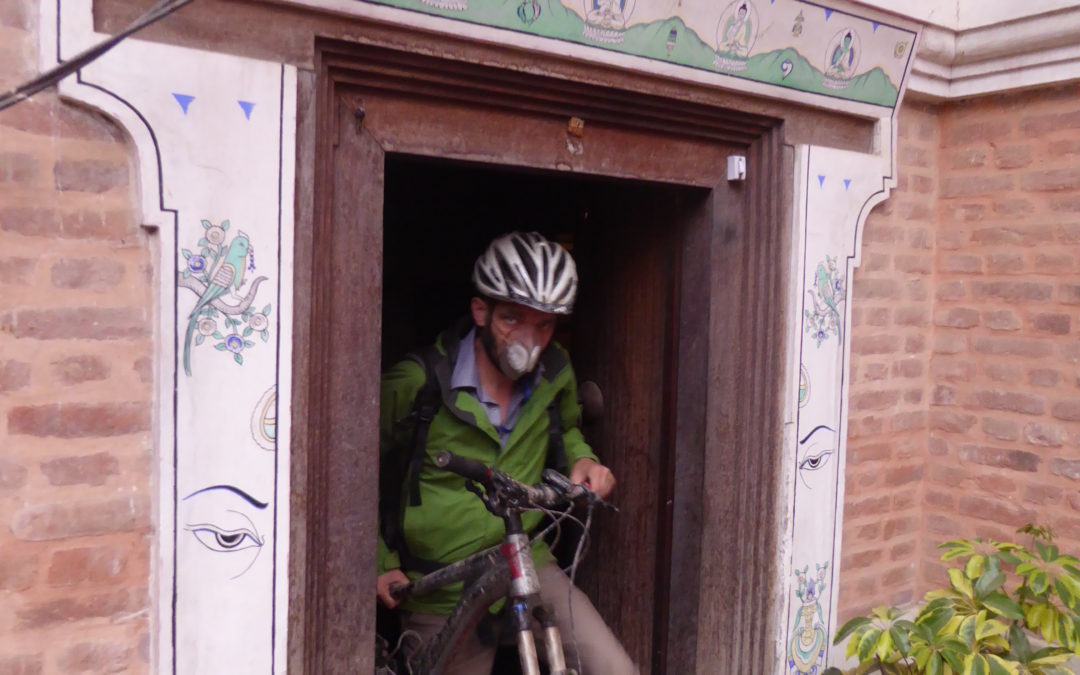
Photo of my brother Magnus coming out of his house in Patan, Kathmandu. Taken by Yours Truly (with his camera).
* I said bike helmets are “useless” and here’s why: they are loose, they slide around your head and offer no protection to the side of your head. They might offer some protection if you somehow landed on the top of your head. All they do is create the illusion of safety. Compare them to motorbike or rock climbing helmets, which are clamped on firmly and would protect every part of your noggin. But I do use bike helmets as they are ideal sun hats; the big chunks of compressed polystyrene that they are made from can protect you from the sun’s rays and also let plenty of fresh air in.
A shorter version of this article was published by the Sunday Herald in Glasgow, with this by-line: “Rupert Wolfe Murray is a freelance writer living near Selkirk. His trip to Nepal was not funded by a travel agency, resort, bike company or any other sponsor.”
In case you’re wondering, I am now living in Edinburgh and commuting to a new job in Stirling (I’m editing this article on the train). I work for an outfit called The Writer and I’m really enjoying it. This article is about a trip I did to Nepal last year. I’d love to get your feedback, however rude or negative. Please add a comment. It’s what keeps me going.

