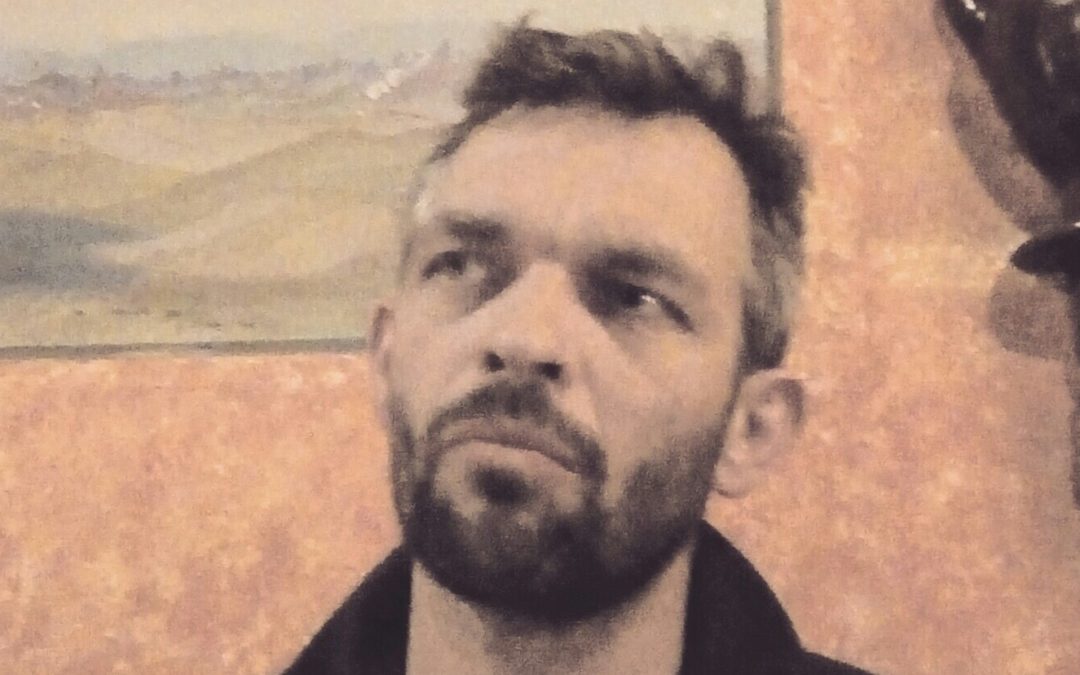
by Rupert Wolfe Murray | 12 Apr, 2017 | Other People's Stories
This portrayal of an extraordinary aid worker is included in the new travel book Himalayan Bus Plunge — & Other Stories from Nepal
05:30 – Alarm goes off and Magnus gets up. Quick wash but no time for breakfast. Onto his Giant mountain bike and off into the narrow streets of Kathmandu. We ride fast, keeping up with the small Hero Honda motorbikes that are imported from India. We meet with a friend and head into the foothills that surround the capital of Nepal.
We pass scores of thin men pushing old-fashioned bicycles into town, each one stacked high with hundreds of kilos of potatoes, onions and other vegetables that are grown in the vicinity.
Magnus and his friend reach a high point in the foothills and wait impatiently for their unfit, inexperienced companion (me) and then launch themselves off a steep drop back down into town. They bounce and skid and tear through the pinewoods, as fast as horses and as nimble as rabbits. I fall off repeatedly, lag behind and feel like a tortoise.
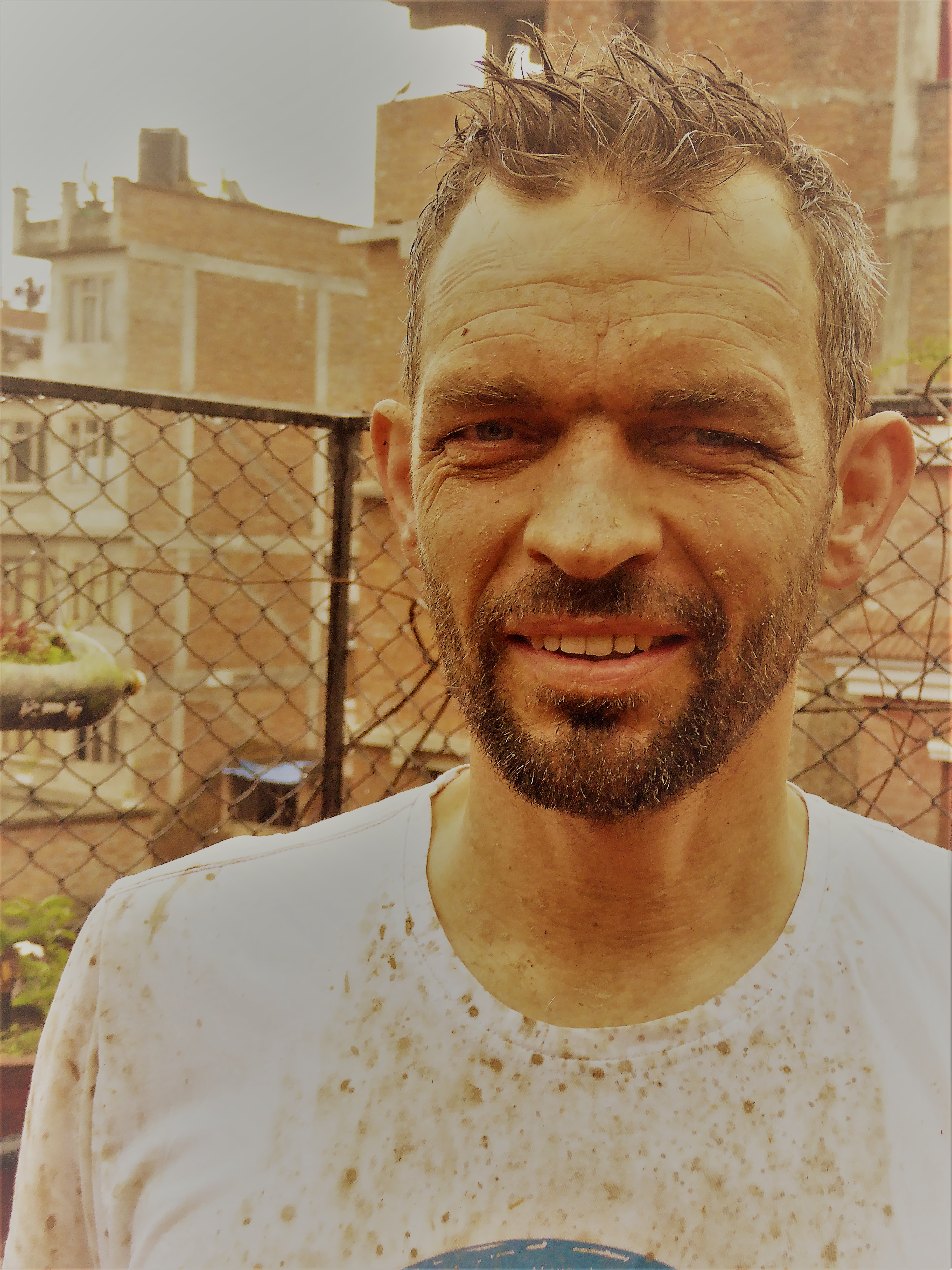
08:00 – Breakfast is Magnus’ main meal of the day, the fuel for his tremendous energy. When not mountain biking, it is preceded by about 20 minutes of exercise on the rooftop. Breakfast comes in two parts: a bowl of muesli, yoghurt, milk, tropical fruits and various protein supplements in jars; this goes with rich brown toast from the German bakery, who also supply wonderful butter; we add honey, jam and a boiled egg to the mix. Three copies of the New York Times are delivered daily with a local paper (Republica) and this gives us plenty of interesting material to read about Trump and his descent into hell.
09:00 – Magnus jumps back on his bike and weaves at speed through the crowds of vehicles and people in Kathmandu’s narrow streets. Cycling in this town is like being inside a video game. He gets to the fortified entrance of the British Government’s Department for International Development (DFID) where he works as a humanitarian advisor. He helps organise the reconstruction of thousands of houses after the devastating 2015 earthquake and is passionate about “retrofitting”, which means reinforcing damaged buildings at a fraction of the cost of rebuilding them.
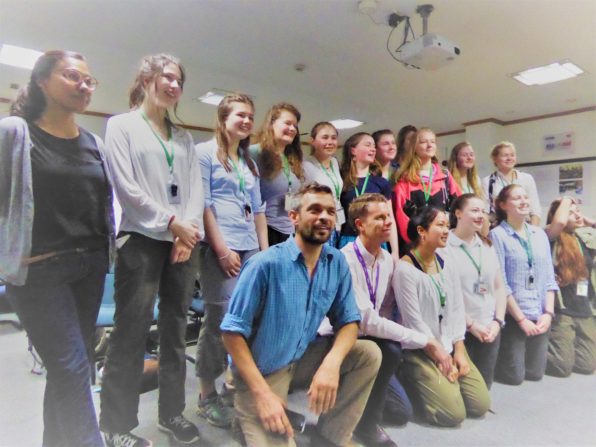
Magnus at DFID Nepal with visitors from Godolphin School, Salisbury
11:30 – Magnus is addressing a group of adult-looking schoolgirls from the Godolphin school in Salisbury (England). They are on a two-week trip to Nepal and are now learning about British aid to Nepal. Magnus tells them about what’s being done to help the victims of the earthquake, especially those in the high mountains where there are no roads. He says 5-6 million people were affected by the quake and they work in 4 districts. The quake cut off water supplies all over the region and DFID have re-connected over 150,000 people with fresh water.
One of DFID’s most impressive activities is rebuilding paths between villages, so that mules can use them and get building materials and other essentials up to the villages. DFID have funded the rebuilding of 125 kilometres of footpaths, and I imagine the logistical challenge of getting stone slabs and other materials up into the Himalayas.
18:30 – Magnus comes home to change out of his work clothes. He grabs a cup of tea and we head out to his evening yoga class. We’re running late (we’re always running late) and so speed is of the essence. On our nimble mountain bikes, we can overtake everything in Kathmandu’s choked and lumbering traffic. We leave the chaos of the streets behind us and take refuge in a yoga class, located within an oasis of calm and greenery. Then we go to a barber shop, where Magnus gets a haircut and an intense head and shoulders massage for about £2.
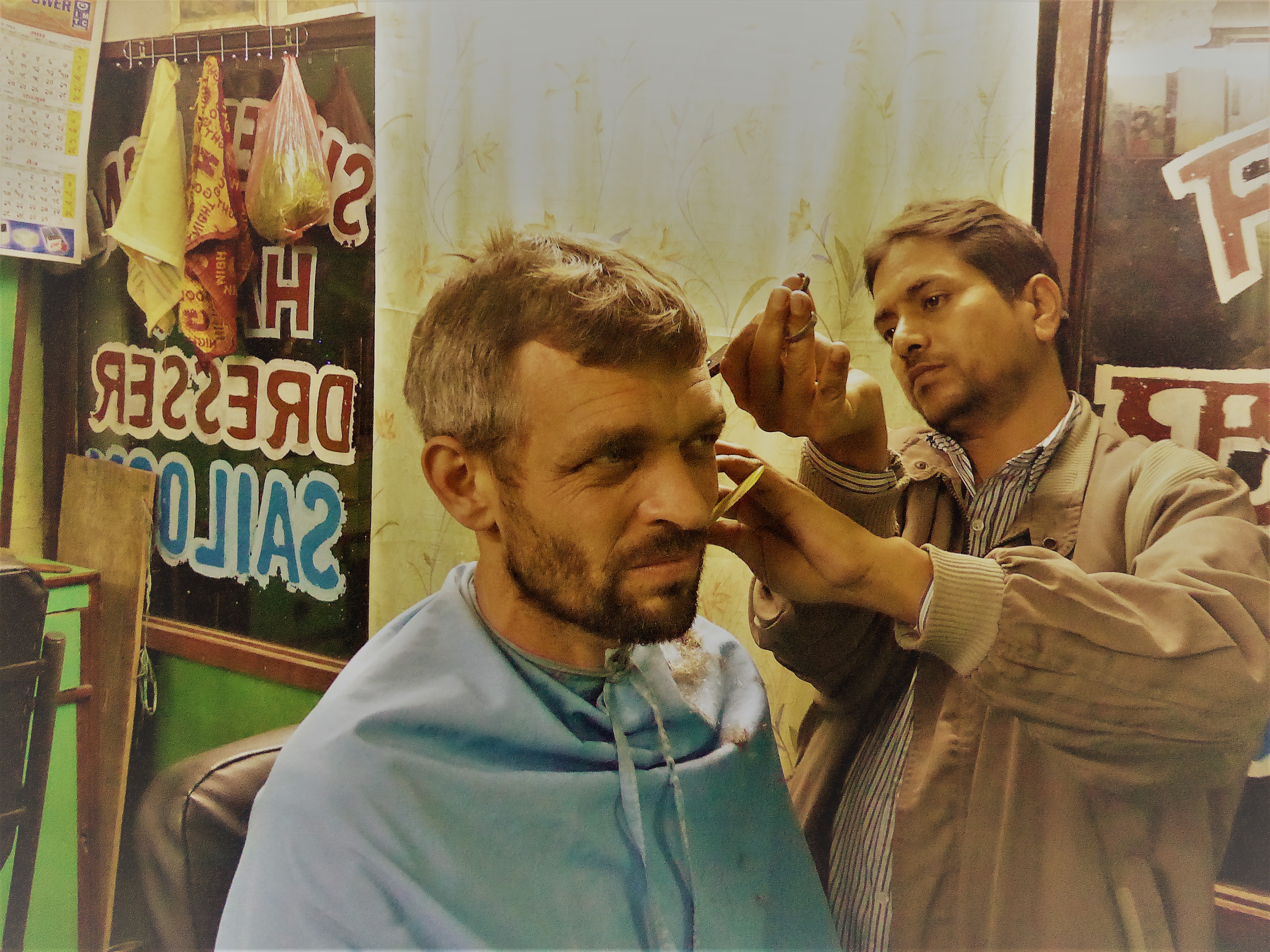
Magnus Wolfe Murray at his Kathmandu barber. Photo by RWM.
20:30 – back to the house. Quick change of transport. We drop off the push bikes and get on his new Royal Enfield Himalaya motorbike. Magnus has invested in this beast so he can get to the mountains easier, but it’s also suitable for night riding around the city. We roar off and get to a mellow restaurant called Evoke where we eat pasta and fried paneer (cheese) but we’re in a hurry and the bill comes too slowly. They’re too laid back. Then we go to a rougher-looking place called Base Camp where we meet some of Kathmandu’s literati – including a literary translator called Nayan and a writer of short stories called Prawin Adhikari.
00:00 – the city is dead quiet by this time. The thick pollution that hovers over the streets by day is gone by midnight. We get home in no time. Quick cup of tea. Magnus takes out his laptop, starts making plans for tomorrow and deals with emails. I’m off to bed. I can’t keep up with this level of energy.
N.B. Magnus only gets up at 05:30 on a Wednesday morning, when the ex-pats go for a mountain bike ride before work. On the other mornings of the week he lies in bed till about 07:00 Wednesday is his busiest day as he also has the yoga class that evening.
by Rupert Wolfe Murray | 24 Mar, 2017 | Journeys
I want to describe my last visit to Nepal, a fascinating little Himalayan country.
Thirty years have passed since I was last in Kathmandu. My presence there was both dramatic — I had been kicked out of Tibet — but also depressing: I was broke, my dream of living in Tibet had been shattered and I couldn’t afford to fly home to Scotland.
I didn’t want to be in Nepal and I didn’t really notice it (yesterday I told a Nepalese man that I was here 30 years ago and he said “that was the golden time” before uncontrolled building development and pollution). Back then I didn’t take in the ancient buildings and culture and spent my time writing an article for the Daily Telegraph — an article that got me £500, a ticket home and a foothold in journalism.
The last chapter of my memoir, 9 Months in Tibet, describes the political situation in Tibet that led to my expulsion. But there are some things which I never wrote about, one of them being the government poster that appeared all over Lhasa on the 3rd of October 1987 — offering a sort of amnesty to the rioters.
The poster, which is the subject of this article, hasn’t been reproduced anywhere as far as I’m aware and so, in a small way, maybe this article is a historical document about the Chinese occupation of Tibet (for those of you who don’t know what happened, the Tweetable version is this: China invaded Tibet in 1949. They promised autonomy, killed millions and destroyed the culture. The Dalai Lama fled in 1959 and set up a Government in exile in India.)
3rd October 1987: the Government Poster in Tibet
It was badly written, typeset in the old fashioned way and printed on thin white paper. I ripped a copy off the wall and smuggled it out of the country — oblivious to the risk of getting caught.
The poster was just text and its title was simple:
No. 3 Announcement by the People’s Government of the City of Lhasa. October 3rd 1987
The first part of the poster sounded diplomatic in tone, but if it had been drafted by diplomats they weren’t very good at English. My rendering of the poster is verbatim, in other words I didn’t correct their spelling.
By the end of the text the anger the Chinese felt towards the Tibetan protesters, and us foreigners, became clear.
Here is the full text:
In order to ensure the smooth Implementation of the opening police, to promote the development of tourism industry in our region, to increase our economic and technical exchange and cooperation with different countries in the World,to avoid appearance of displeasure in foreign affair’s work, the city announces as follows:
- We extende welcome to friends from the different countries in the World who come to our region for sightseeing, tour, visit, work, trade discussion and economic cooperation.
- Who ever comes to our region must respects our State sovereignty, abide by the lows of our country. They are not allowed to interfere in internal affairs of our country and engage in activities that are incompatible with their status.
- Foreigners are not allowed to crowd around watching and photographing the disturbances manipulated by a few splittists,and they should not do any distorted propaganda concerning disturbances, which is not in agreement with the facts.
- In accordance with our lows, we shall mete out punishment to the trouble-makers who stir up, support and participate in the disturbance manipulated by a few splittists.
*
Points three and four remind me of the story of the riot and the Chinese reaction to it.
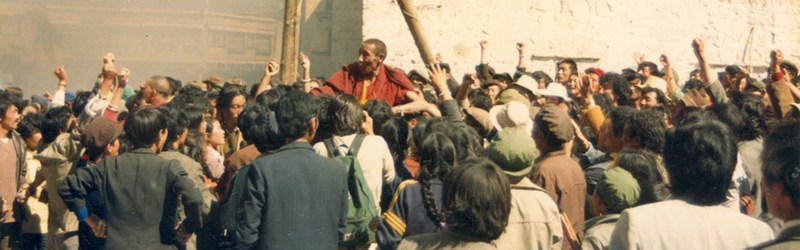
This is what happened: some monks protested against Chinese rule, the police opened fire, killed several protesters and arrested others. A Tibetan mob stormed the police station where the prisoners were being held and burned the place down. I turned up towards the end of the riot, saw a boy shot dead in front of me and spent the next few days working out what had happened.
A lot of foreign travellers were in Lhasa that day (1st of October 1987) as well as some journalists. Not only were photos and testimonials taken but they were smuggled out (the Chinese police were naive in the ways of the wily foreign journalists back then and they didn’t search those leaving). The international media told the story in gory detail and it was headline news for a few days. I remember thinking that the Chinese government would have felt humiliated by this outbreak of bad news and their revenge on the Lhasa population would be terrible.
The Chinese police were outraged that the Tibetans had protested against what they consider to be an enlightened regime. They assumed the rioters had been organised by the “Dalai Lama clique” and foreign spies like me (I was an English teacher in Lhasa but I always fancied myself as the next James Bond). They also invented a new word; “splittist”, meaning someone who wants to split Tibet away from the Chinese motherland.
The Chinese police gave the Tibetans a few days to confess all, hand themselves in and benefit from an amnesty. None of the Tibetans I spoke to trusted this amnesty and I don’t think anyone handed themselves in.
Soon enough the police cracked down, abducted people at night and tortured them in Lhasa’s notorious prison. They fulfilled point 4 of their foreign language poster: In accordance with our lows, we shall mete out punishment to the trouble-makers who stir up, support and participate in the disturbance manipulated by a few splittists.
A few days later I was arrested, told to write a self-criticism, which I refused to do, and ordered to leave China within 4 days. I organised a bus to the Nepalese border, a journey that took 4 days over unpaved roads, and ended up feeling glum in Kathmandu.
I wrote about my experiences in Tibet and this helped me to move on. I didn’t want to carry the terrible burden of Tibet’s tragedy for the rest of my life and so I didn’t get involved in the Free Tibet movement. I got into journalism instead, covered the Romanian revolution and spent the next 20 years in Eastern Europe.
Now that I am back in Nepal I can lay the ghost of the past (I don’t want to go back to Tibet in this lifetime), and I can look at this little Himalayan country with fresh eyes: in 1987 I saw Nepal as a transit point and safe haven; now I see it as a fascinating country in its own right and a place I intend to explore.
You can join me by reading these articles and adding a comment. I’d like to know what you think about all this.
Photo credit: The Middle Way Approach (the photo shows Jampa Tenzin, a Tibetan Lama who was rescued from the burning police station on the 1st of October 1987).

