by Rupert Wolfe Murray | 20 Nov, 2019 | Opinions
Dear Boris,
Did you know that you’re facing what may be the biggest political opportunity of our generation – to turn the world green.
A majority of the Great British public realise that global warming is a problem and you could appeal to a large slice of the electorate if you came up with green policies that were more than hot air.
I have never voted Conservative, but I would do if you urgently acted on the IPCC’s warning to cut carbon emissions in half within 12 years. Even the Trump-loving Fox News reported accurately on the warning, showing that there is PR value in this story even on the right.
The real prize here is to seize the moral high ground by standing up to the fossil fuel industry. Imagine the political value of a Conservative Party that stood up to Big Oil rather than help them pollute the planet; apart from anything else it would be true to the original Conservative values of supporting individuals, families and small businesses. You’d be unbeatable.
It’s not only the Tories who are useless at environmental policy – Labour and the Lib Dems are equally guilty of talking-up green policies when in opposition and discreetly avoiding Big Oil when in office. I realise it’s hard to confront these lobbies – not only are they deeply embedded in government and the media, but most of us are addicted to their products and giving up our comforts and conveniences (like cars) is incredibly difficult. But things can start changing when a national leader says “Enough! We have to accept there is a problem, take responsibility and change our ways.”
Go Beyond Politics
I know your lot don’t like Extinction Rebellion but are you aware that they’re non-aligned politically? I love their ethos that climate change is bigger than any one political party. The whole movement marches under the banner of “Beyond Politics” – and what that means is that any political party, or any opportunistic Prime Minister for that matter, could simply scoop up the ideas and make them his/her own. The great religions of the world used to do this when swallowing up the indigenous religions – they would adopt some of their practices (like the harvest festival) and gather up their followers while they’re at it.
And the demands of Extinction Rebellion are remarkably simple: tell the truth; aim for carbon zero by 2025; and organise a “big tent” to create environmental policy.
You recently said that Margaret Thatcher was the first British PM to raise this issue. I also remember her prediction that we’d have to “tighten our belts” before anything would get better. The only other political leader I can think of who promised suffering rather than plenty was Winston Churchill. Maybe this is your chance to join them in the Conservative pantheon?
If you were to take up the challenge of telling the truth regarding global warming, you could bluntly tell the electorate that we must end our addiction to fossil fuels. Such an approach would cause uproar among the Great British Driving Public but when you take something away it’s always replaced by something else – in this case electric vehicles, bikes and better public transport. It would also result in an economic boom in all parts of the economy where fossil fuel needs to be replaced: Britain could become a world leader in this transition and then share its experience with the world.
An assault on Big Oil could go a long way to reducing our carbon footprint, perhaps making the 2025 target feasible. The £2.4 billion your government has allocated to international oil drilling projects would be handy if invested in things like real bike lanes (rather than random colours on disconnected pavements). According to Mary Creagh, the MP for Wakefield, most of this money goes to poor countries, “potentially locking them into decades of dependency on oil and gas.”
The bizarre thing about your government is its pledge to reduce greenhouse gas emissions by 80% by 2050 alongside an industrial policy that states, in this press release, “Oil and gas strategy will promote billions worth of new investment.” Isn’t that what non-political people call hypocrisy? Surely, if that 80% target means anything you should, at the very least, tell the public that it’s a real problem and we need to start thinking about making big changes – starting with keeping fossil fuels in the ground. Changing attitudes is the first step in changing habits and, eventually, the world.
As regards the “big tent” demand, I know it might sound outlandish to some of your party members (images of bickering Afghan tribesmen may come to mind) but it’s quite a handy technique for managing divisive issues like this. The proper term for this is actually “citizens assembly” and it’s been used very effectively in Ireland and many other places.
Also, you have a former colleague who advocated for citizens assembly very convincingly in the recent Tory Party election: Rory Stewart. Couldn’t you bring him back into the fold?
Am I a traitor to the cause?
I was one of those unwashed protesters who camped out in central London last month, as I believe that we must change our ways before destroying our life support systems. There will be plenty of Extinction Rebellion supporters who will read this letter and consider me a traitor for asking you to take up their precious cause.
But I would quote back to them their own slogan of beyond politics and also point out that the Conservative Party was founded on the ethos of “conserving” the traditional lifestyle that was being threatened by the industrial revolution. Also, this issue will never become mainstream if all parties don’t adopt the key demands.
The most depressing thing about this whole issue is the way government departments, and large companies, make green policies that are nothing more than good intentions, grand statements and token gestures. Even the holier-than-thou Scandinavians are at it: Did you see what Greta Thunberg said on Instagram when she was offered the Nordic Council’s environmental award: “The Nordic countries have a great reputation around the world when it comes to climate and environmental issues. There is no lack of bragging about this. There is no lack of beautiful words. But when it comes to our actual emissions, and our ecological footprint per capita – if we include our consumption, our imports as well as aviation and shipping – then it’s a whole other story.”
The world needs a political leader who can show genuine leadership on this issue; a leader who has the courage to tell the public, and Big Oil, that we need to change our ways immediately.
Many people ask what can a small nation like ours do about such a massive global problem? The answer is that over the last few centuries we’ve provided the world with economic models – from colonialism to Thatcherism – and who better to persuade a confused and sceptical world that we need to make an about-turn before going over the precipice.
The good news is that going green is easier than one would have thought. I know this as I recently got rid of my car – it was really hard to do but going around by bike is much more fun and I’m saving up for one of those electric jobs. I also went vegan which was a lot easier than I had imagined it would be; they say that cutting out meat and dairy is the most powerful thing an individual can do to reduce greenhouse gases (the mountains of animal waste emit massive amounts of methane, which a far stronger greenhouse gas than carbon dioxide).
I’m posting you this letter from Romania, where I’m doing a couple of wee jobs for the EU. I’ve decided to follow Greta’s example and not fly home. I asked my Facebook friends what the best way to get home overland would be and got back some useful comments, as well as one which reminded me of Norman Tebbit MP: “get on your bike.”
All the best
Rupert Wolfe Murray
by Rupert Wolfe Murray | 4 Oct, 2019 | Opinions
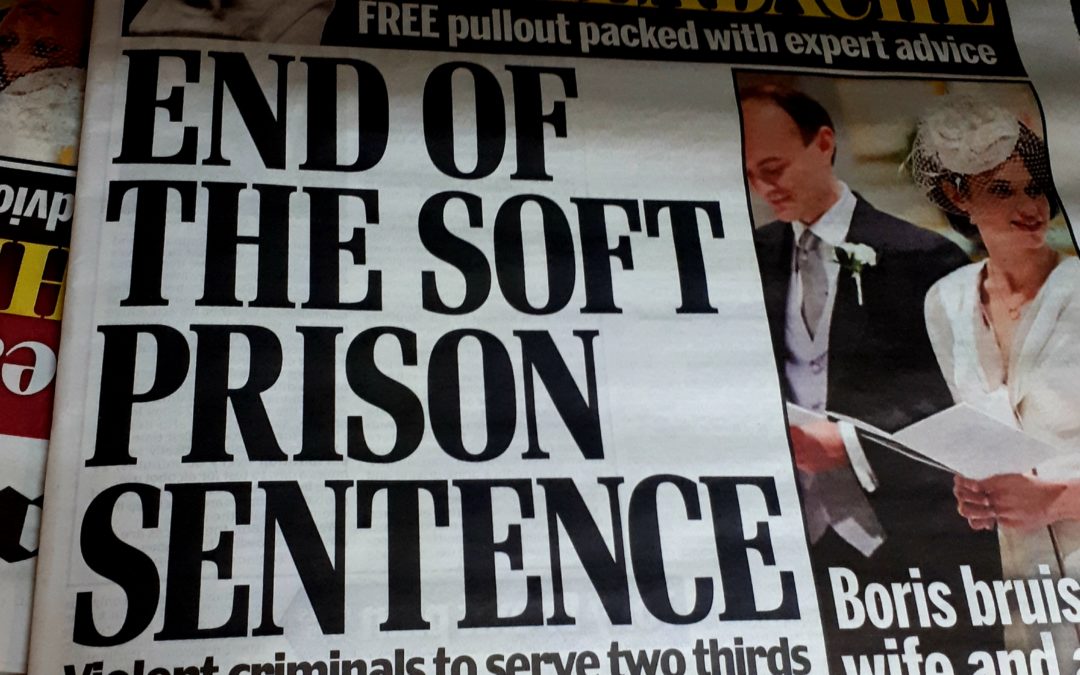
This week, in the English village of Flore, I was quite shocked by the tabloid headlines about increasing prison sentences and realised that Boris Johnson is similar to Slobodan Milosevic: he is a blatant opportunist. Both of these leaders can be explained by this single word: opportunism.
I’m not saying that Boris is planning to carry out any of the atrocities that Milosevic organised, or that he is “responsible for the most violent, destructive and genocidal wars since the Holocaust during World War II” — to quote the Urban Dictionary. He’s a funny chap, would be a great dinner party guest and I really don’t think he has some evil masterplan to exploit us all on behalf of big business. But he’s still an opportunist, as some kids are who will use any opportunity to get what they want. He’s using harsher prison sentences to appeal to the tabloids, and peoples’ base instincts.
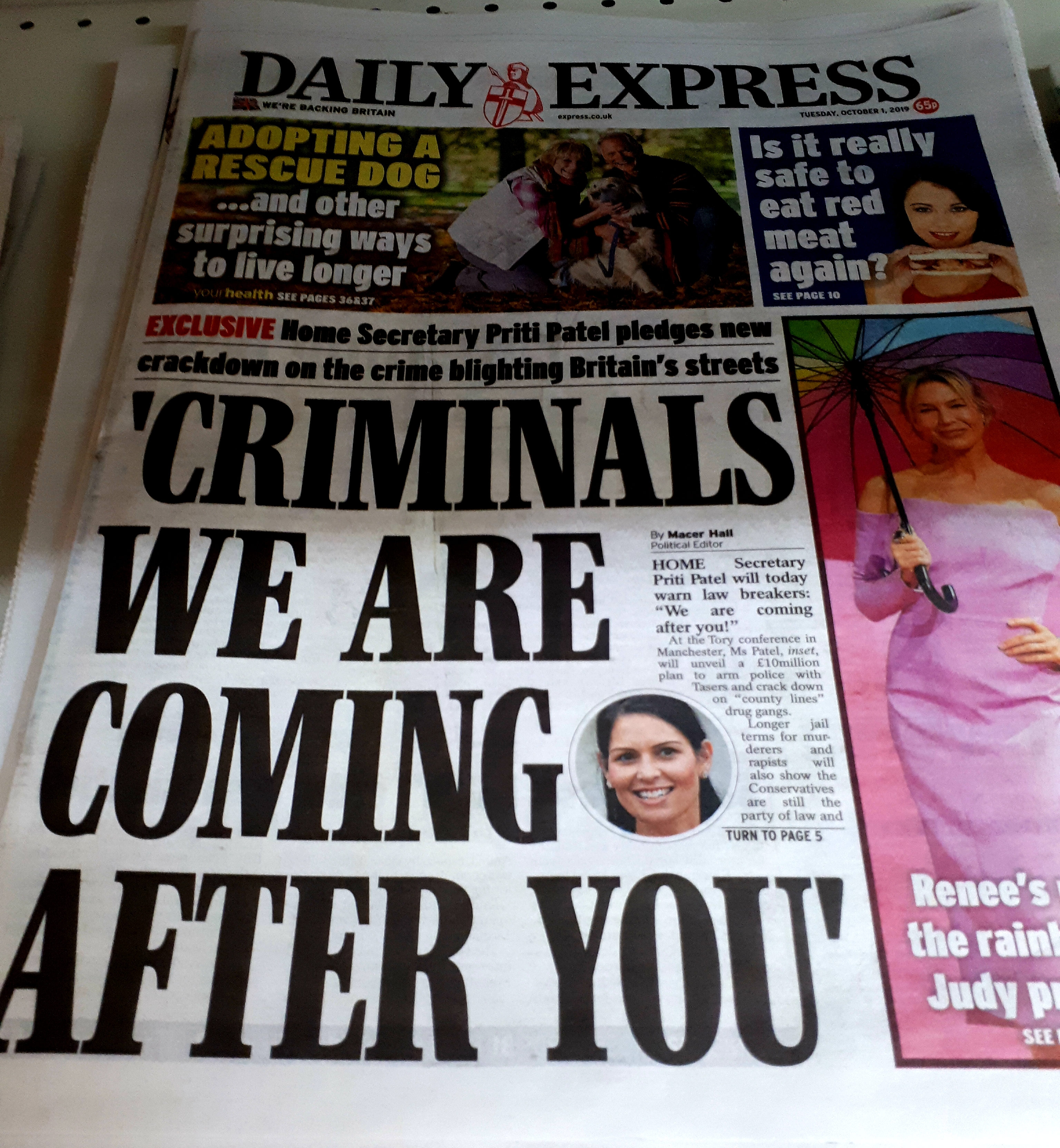
Check out this cover from the Daily Express of the 1st of October 2019:
Milosevic the opportunist
I spent a few years in Bosnia, just after their civil war (1992-95), trying to work out how it all went so wrong and who was to blame. My conclusion was that Milosevic started it but the Croat leader (Tudjman) soon followed suit and carried out a series of atrocities; and even the Bosnian Muslims weren’t as innocent as they’re sometimes portrayed.
The Urban Dictionary’s description of Milosevic is quite funny and generally correct, but they’re wrong to say “Milosevic the son-of-a-bitch wanted all of Yugoslavia for his own rule.” What really happened was that Milosevic wanted to control all parts of the former Yugoslavia that had a Serbian minority — and this idea gave him a greenlight to invade, terrorise and occupy chunks of Bosnia and Croatia and treat Kosovo like a rebellious colony. Once he’d carved out his chunk of those countries (about 51% of Bosnian territory and about 20% of Croatia) he would happily let the other ethnicities run what was left. With American help, the Croatian army were able to expel the Serbs but 51% of Bosnia is still controlled by an ethnically pure Serb entity.
The opportunist part of all this is quite clear: Milosevic became president of Serbia in 1989, just as the whole Yugoslav construct was falling apart. He initially tried using Communism as a method of rule but found that it wasn’t working. He would have considered a western democratic method but, presumably, assumed it would have been too difficult to get the masses on board — so he turned to nationalism.
Nationalism made, and then destroyed, both Milosevic and Yugoslavia. The methodology was simple and, because it was based on fear, was incredibly popular. Serbs were told they were being victimised by the Albanians (in Kosovo), the Croats, the Bosnian Muslims , as well as the Americans and Germans. With such an array of apparent enemies it didn’t take much to cook up a storm of fear and anxiety — leading to Milosevic authorising a series of military actions (seizing chunks of neighbouring countries) as a pre-emptive strike.
Boris as opportunist — this week’s evidence
Ever since Boris changed sides in the Brexit referendum, after he wrote that Brexit could result in the “breakup of the UK”, it’s been clear that he’s an opportunist; in other words he has no real moral compass and just goes with what he thinks will bring him more power.
This weeks announcement from the Tory Party conference that they’ll make sure people stay a lot longer in jail fits this behaviour perfectly: on the one hand the Tories know perfectly well that the prisons are full to bursting and that jail time is a complete waste of time as those who emerge are marginalised and turn to crime in order to earn a living. But they also know that the public have been stirred up by endless tabloid stories of crime and a politician who promises a a harsh crackdown will get votes.
It seems to be working. His opportunism translates easily into optimistic promises of throwing money at health, police and education; and his nonsensical approach on Brexit doesn’t seem to matter as we’re all bored to the back teeth of it and just want it over. I checked the YouGov polling data today and it says Johnson is “the most popular Conservative politician” today, with a rating of 33%.
What’s most interesting about this is that some of the most extreme dictators would curry favour with their populations with spendthrift policies like this. Hitler ordered that the public shouldn’t be deprived of anything during the war, whereas in Britain the whole population had a military-type routine imposed on them.
Equally interesting is that the most famous opportunist of the twentieth century was probably Benito Mussolini who started out as a Marxist and then turned to fascism as he was able to use it more effectively to appeal to people’s most basic instincts.
Why are they so relaxed?
A final point is that all of these nationalist/opportunistic leaders — and I’m thinking about Putin in this category — seem to go about things in such a relaxed style. None of them seem to suffer from the stress that other politicians do (just think of Theresa May compared to Boris). Milosevic never seemed to be rattled and he was expert at dismissing, and ridiculing, the endless accusations of atrocity that came his way. As with Putin, he was always ready with a conspiracy theory regarding who was really to blame.
I remember when the Serbs bombed the market place in Sarajevo, killing hundreds, the official Serb story was that the Muslims did it on their own people in order to curry favour with the west. Putin does the same with the Ukraine — he doesn’t admit that he’s done anything except react to American and EU pressure.
I realise you can’t put Boris in the same pot as regards that level of criminality — he’s on a far milder level than the others — but just look at the way he seems to be enjoying the chaos he’s causing over Brexit. In my opinion these opportunists are able to treat the whole thing as a game, which is in fact invigourating rather than stressful. I think their lack of basic morality allows this.
What can be done? All we can do is be aware of the problem, and remember the old adage “knowledge is power”. I’m sure the answer will present itself before long and the pendulum will swing back to a more moral-based politics.
The End.
I wrote this story as I’d been researching prison reform. You might like to see this article I wrote about an incredibly successful experiment in prison reform — so successful that the Scottish government closed it down.
As always, I’d be very grateful for any comments under here.

by Rupert Wolfe Murray | 28 Sep, 2019 | Opinions, Reviews
If a great artist met a convicted murderer I wouldn’t expect much to come of it. In most cases, I assume, nothing more than an ordinary conversation would happen for the simple reason that the prisoner wouldn’t be open to the artist. The prisoner might view the artist with suspicion.
The prisoner might be friendly, he might be grateful for the attention being paid to him, but he wouldn’t risk lowering the barriers that are so essential for his survival on the “inside”.
But when Jimmy Boyle – once known by the Scottish tabloids as “Scotland’s most dangerous criminal” – met Joseph Beuys who, according to The Tate Gallery is “widely regarded as one of the most influential artists of the second half of the 20th century,” the results were remarkable.
The meeting was part of Boyle’s transformation into a celebrated artist, but it’s a complicated story to tell as there are, as far as I’m aware, no written records of the meeting. Also, there’s virtually no written records of the most successful experiment in prison reform I’ve ever heard about – the Barlinne Special Unit, where Scotland’s “most dangerous” criminals were on equal terms with the prison officers and their “therapeutic community” was a runaway success. Luckily, the artworks, press clippings and writings that emerged from the Special Unit are held in various private collections around the country.
Tragically, the reactionary officials in charge of Scotland at the time were embarrassed by the success of the Special Unit and they did nothing to stand up to the daily assaults by the tabloids, who screamed of sex and drugs and luxury for the most violent prisoners in the land. In 1994, 20 years after the unit had opened, it was quietly closed down. Not even the most basic written evaluation was done.
I just checked the website of Scottish Prison Service and the only reference I could find for the Special Unit were the following words in their list of historical events at Barlinne Prison: “1972 Special Unit in Female block (until 1994).” Is that really it? Looking at their website I realise that the only thing that has changed over the last half century is the language they use to present themselves; now the prison service talks about “individuals in our care” and their main slogan is “Unlocking potential. Transforming lives.” As my kids would say with a roll of their eyes, “Really?”
Scotland’s puritan leaders may have thought they succeeded in burying this success story, but it got out. The success of the Special Unit’s therapeutic community model reached less closed-minded governments in Scandinavia and the Netherlands where, according to my sources, similar units were set up. Also, the prison in Hull set up a large art class that was inspired by the Special Unit. Bill Beech, one of the artists who has kept this flame alive, organised the current exhibition of Special Unit artworks in Hull. Apparently, there is also a prisoner at Hull who dresses and acts like Joseph Beuys (presumably he also does experimental art works).
Back to the Boyle and Beuys story…
Before getting to the meeting between Boyle and Beuys I need to describe more background (as I said, it’s a complicated story, but it’s a great one so stay with me).
Both of these men have the most incredible backstories; Jimmy Boyle’s can be read in his two autobiographies – A Sense of Freedom and The Pain of Confinement. What I find most remarkable about these books is his ability to be so open and descriptive about the poverty he grew up in; I had assumed that they were ghost-written as they’re written with such confidence but I asked his former wife, Sara Trevelyan, and she said “No. Jimmy definitely wrote them on his own”.
Joseph Beuys’ backstory reminds me of a Greek myth: a man falls from the sky in a ball of flame; he survives the fall and is buried in snow; later he’s discovered by nomads who wrap him in grease and felt, carry him off, nurse him back to health; he goes on to great things.
The Wikipedia version of the story makes it clear that this story is probably just fantasy, but the known facts are equally incredible: Beuys joined the Luftwaffe (Hitler’s air force); he was stationed in Crimea during the German occupation of the USSR; he was a rear gunner on one of the most terrifying weapons of the Second World War – the Stuka dive bomber. It’s also interesting that the supposedly heartless German’s sent out a search party to find him and the pilot who, according to Beuys’ version, was “atomised” when their plane crashed.
Beuys’s later wrote: “Had it not been for the Tartars I would not be alive today. They were the nomads of the Crimea, in what was then no man’s land between the Russian and German fronts, and favoured neither side…Their nomadic ways attracted me of course, although by that time their movements had been restricted. Yet, it was they who discovered me in the snow after the crash, when the German search parties had given up….I remember voices saying ‘Voda’ (Water), then the felt of their tents, and the dense pungent smell of cheese, fat and milk. They covered my body in fat to help it regenerate warmth, and wrapped it in felt as an insulator to keep warmth in.”
In terms of art, the above story is referred to as Beuys’ inspiration for using a lot of felt and other natural materials, like stone, in his work. The clothes he wore were also influenced by this experience – his trademark clothing was a felt suit, a stick and a felt hat.
In terms of the Jimmy Boyle connection, I see this story as the experience that connected them. What I mean is that Beuys was a form of prisoner in the Second World War, an unwitting participant in a brutal system that had much in common with the guiding philosophy of modern prisons: to remove peoples’ liberty and enforce a rigid daily routine that instils fear and destroys individuality.
I’m not saying that the Scottish Prison Service can be compared to the Nazis in terms of human rights abuses, but you can compare the underlying philosophy which is that denying people liberty and applying a strict military routine is morally justifiable.
My assumption is that these shared experiences – of deprivation, horror, death, redemption – brought the two men together in a deeply profound way that would not have been possible between people who didn’t share those type of traumatic experiences.
Enter the coyote
Joseph Beuys went on to become one of the most influential artists of his age. Beuys’ saw himself as a teacher, or shaman, who could guide society in a new direction.
He was thrown out of the Düsseldorf Art School, where he taught sculpture, for getting rid of the entry requirements and advocating a policy of letting anyone interested into his classes – a direct challenge to the art world’s ethos that art is only for an intellectual elite. His most relevant work in this regard was a performance art “Action” called How to explain pictures to a dead hare, when he explained art for three hours to a dead hare. The idea was to show “the difficulty of explaining things” to people who aren’t educated in the language and history of art – in other words the general public. This was part of his overall belief that “everyone is an artist”.
In the early seventies Beuys was invited to put on an exhibition in the USA. He refused because he was an opponent of the Vietnam War and would not set foot in the country that was perpetuating such horrors on a less technologically advanced people. But the Renne Block Gallery, in New York City, persisted and they came to a compromise out of which a quite remarkable exhibition resulted.
The exhibition was called I like America and America likes me and it had a powerful influence on the American artworld of the seventies, particularly performance art. The idea was that Beuys would not set foot on American soil and so when he arrived at the airport (in May 1974) he was met by an ambulance, wrapped in felt, laid on a stretcher, driven into NYC and carried up to the gallery.
Inside the Renne Block gallery prison-style bars had been built around one of the rooms, creating a sort of cage. Inside that room was some straw and a coyote. Beuys moved in with the coyote and lived with it for three days, wrapping himself in felt and getting a daily delivery of newspapers for the animal to defecate on and chew up. Visitors would come and look at them.
Two powerful slogans emerged from this exhibition: I am the Coyote and The Most Reviled Creature in America. The idea was that Beuys had found common cause with the coyote as being the “most reviled” creatures in America.
Here you can see a photo of Beuys wrapped in felt and the coyote looking on:
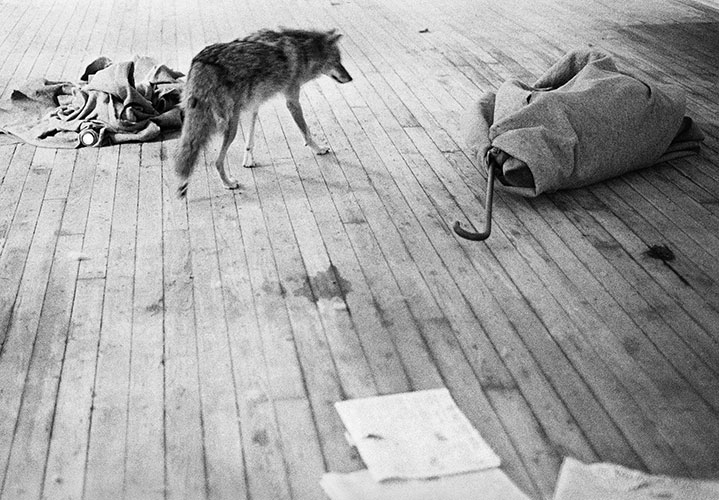
Photo by Caroline Tisdall
This is where my limited knowledge of all this runs out; I wish I knew more the fascinating ideas behind this exhibition but, as with the Special Unit artworks, there’s very little online about it and the people who know are either dead (Beuys died in 1986) or unobtainable (Jimmy Boyle lives between France, Morocco and Thailand and doesn’t answer emails).
But I searched the terms “coyote symbolism” and came across some extraordinary material. According to the Spirit Animal website: “The coyote totem is strikingly paradoxical and is hard to categorize. It’s a teacher of hidden wisdom with a sense of humor, so the messages of the coyote spirit animal may paradoxically appear in the form of a joke or trickery. Don’t be tricked by the foolish appearances. The spirit of the coyote may remind you to not take things too seriously and bring more balance between wisdom and playfulness.”
Did Beuys know about the symbolism of the coyote? It goes a long way to explain his approach which, on the one hand is very down to earth and simple, open to all; but on the other hand he was a very divisive figure who was rejected by much of the art establishment of Germany. Even to this day he is divisive; in 2019 Richard Demarco put on a retrospective of his work at the Edinburgh Festival and to this day people ask: “is this art?”
Jimmy Boyle opens the floodgates
Meanwhile, back in Scotland, a dam had burst – that is how Jimmy Boyle describes his outpouring of creativity when he got into sculpture and writing. In Barlinne Prison’s Special Unit he was able to divert his tremendous energy from fighting the system to creating artworks. But it almost never happened.
One of the best-known stories from the Special Unit was when Boyle arrived the head warder, an enlightened prison officer called Ken Murray, gave him a pair of scissors to open a parcel. To give “Scotland’s most dangerous criminal” a pair of scissors – a potentially lethal weapon – was an act of faith that showed Jimmy Boyle he was being trusted for the first time in years. It worked, and Boyle became one of the leading lights in the therapeutic community where prisoners and staff would together organise their schedule, menu and visiting hours.
Boyle rapidly integrated into the small community of ten prisoners, all of whom had been classified as “most dangerous” but he was nowhere near ready to do art. He later recalled that he saw art as almost something alien, a million miles from the macho culture he’d grown up in.
Scotland’s first art therapist – Joyce Laing – started visiting the unit and tried to get the inmates interested in practicing art. But it wasn’t working: the prisoners would sit round watching but they weren’t engaging. Joyce had decided to give it one last try and then she was going to give up, but before leaving she left a lump of clay and said, “maybe one of you can do something with this.”
When she came back for her last art class, Joyce was delighted to find that Boyle had created a sculpture out of the clay – a stick figure sitting down, surrounded by spear-like bars of a cage. I’m not sure exactly what happened next but the artworks came pouring out; not only sculptures, but also an avalanche of writing – not just the book that made him famous (A Sense of Freedom), but a series of stream-of-consciousness writings on all sorts of materials (paper was in short supply) written in a handwriting that was so small it’s barely possible to read. I’ve seen some of this material in one of the private archives and I’m pretty sure none of it has been published.
Enter Richard Demarco
Meanwhile, over in Edinburgh, Richard Demarco had been organising his own creative flood: he was to the Scottish arts establishment what Beuys was to the Germans – an annoying impresario who didn’t play by the rules, didn’t respect the arts establishment and kept coming up with new ideas, introducing new artists from all over the world and generally shaking things up. If you look at this link, Demarco’s CV-cum-biography, you’ll see the incredible amount of action he created on the Scottish arts scene over the last 50 years. 1974 was a particularly productive year.
Demarco picked up on the creative energy that was coming out of the Special Unit – the first time a prison had allowed such an outpouring of artistic expression – and was allowed to visit the unit with groups of artists. I presume this was also unprecedented and was, no doubt, one of the factors that the Scottish prison authorities disapproved of and used as an argument to shut it down in 1994.
In August 1974 Richard Demarco organised an exhibition in Edinburgh that was part of his sprawling Edinburgh Arts events. The exhibition included some sculptures by Jimmy Boyle who was still, at the time, very much in prison for murder.
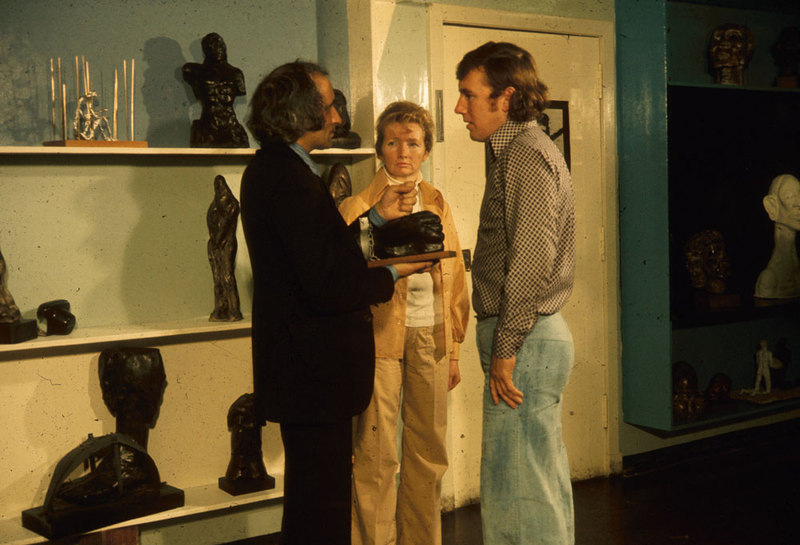
Here you can see a photo of Boyle, Demarco and the art therapist Joyce Laing (note the bronze copy of Boyle’s first sculpture on the upper left):
Thanks to the Richard Demarco Gallery for the photo.
The fact that Jimmy Boyle was allowed out of prison to attend this event was, presumably, unprecedented in Scottish prison history – and the forces of reaction at the prison service and Scottish government must have been furious.
The other extraordinary thing that happened at that exhibition was that Jimmy Boyle met Joseph Beuys, who had recently come over from New York after his coyote exhibition.
Boyle had presumably been told about the coyote exhibition by a mutual friend – Caroline Tisdall, an art critic for the Guardian and the photographer at the coyote exhibition. She was also a regular visitor to Boyle in the unit, and one of his most powerful advocates.
The story I heard from one of the artists who had been there was that Boyle went up to Beuys and said “I am the coyote!” I’m sure that those words, and their respective approaches to art, created a powerful bond that broke through all the conventional hierarchies of the art world.
Joseph Beuys went on to do some important work in Scotland. He also visited the Special Unit and represented Jimmy Boyle at a press conference that presented Boyle’s exhibition In Defence of the Innocent, at the Richard Demarco Gallery in 1976.
The most extraordinary thing that Beuys did for Boyle was go on hunger strike in 1980 – in protest at the prison services inexplicable transfer of Jimmy Boyle from the Special Unit to a “normal” prison at Saughton, Edinburgh.
The Scottish Prison Service, still feeling the humiliation that the Special Unit had brought down on them by showing signs of free expression, that they were determined to crack down. They didn’t yet have the political courage to close the unit down – that would happen about 14 years later – but by removing Jimmy Boyle and the enlightened head warder, Ken Murray, they were able to emasculate it. Their public intention was to “test” Boyle and make him “prove” that he could behave properly in a jail with the usual harsh military routines. Boyle survived this episode, but he was no longer allowed to practice his art and have free access to visitors. It must have been devastating and was, I’m sure, one of the factors that resulted in Boyle leaving Scotland soon after he was set free.
Two things bring all these historical events up to date: firstly, almost nothing has happened in terms of prison reform in UK, apart from a PR makeover, and surely the Special Unit deserves looking at in a serious way as they have a lot to learn from the experience (I think they should set up a permanent exhibition and archive in Glasgow).
Secondly, in 2019 there was an exhibition at the University of Hull with some of the artworks that were produced around the Special Unit in that incredible year (1974). I had posted a link to the exhibition but it’s been taken down.
I wrote this article as a supplement to a short piece I published in The Sunday National newspaper, a Scottish newspaper, which is worth looking at as it asks the question, why do we imprison people?
#
Postscript: This article was written from all sorts of fragments I picked up over the last 50 years – starting with my own visit to the Special Unit with my Mother, who published Jimmy Boyle’s books, conversations with Bill Beech who was behind the recent exhibition in Hull and also the scriptwriter for a great film that came out of that period: Silent Scream (1990).
I’d also like to thank Richard Demarco for making these photos available.
I took the above photo outside the exhibition in Hull. It was taken in 1974 and on the left you can see Richard Demarco, the impresario who introduced this prison experiment to the art world. On the right is the great Joseph Beuys.
Finally, here are some really interesting videos
This is an old documentary (1980s) about Jimmy visiting his home turf in Glasgow and asking if opportunities for young people have improved: Jimmy Boyle larchgrove & castlemilk – YouTube
And here’s a conversation between Jimmy and Ricky Demarco, shot in 2018: 1) Demarco and Boyle in coversation Dec 19 version – YouTube
by Rupert Wolfe Murray | 1 Dec, 2018 | Opinions
There’s a ton of material online about how to publish an ebook and I’ve been rummaging through it for ages. Some of it’s quite confusing but if I can understand it, anyone can. I’ll publish my first ebook (a fairy tale) soon and that, I’m sure, will be my best learning experience.
Meanwhile, I’d like to share with you what I’ve learned so far and try to get across my main point, which is that everyone should be doing this. I’d also love to talk to anyone who wants to do do an ebook and needs a friendly voice to talk them through the options (something I would have really valued over the last year). What I don’t discuss is the tricky subject of how to write a book but this article looks at writer’s block, the main reason for not doing it.
Five reasons to publish an ebook
- It’s easy: If you can’t get publishers to give you the time of day (I know the feeling) this is an easy way to get your books out there. All you need is a manuscript, a blurb and a cover. Apart from publicity, the one tricky phase is typesetting but this is getting easier and a new e-book distributor – draft2digital.com — have a programme which makes it easy for anyone to do it. Kindle have also introduced a new programme for typesetting your own book.
- You’ve got nothing to lose: I have an inner voice telling me that my next book will fail. It’s held me back for years but when I accepted that I’m not going to get rich and famous, I was able to tackle the ebook challenge and now I’m about to publish my first one, and that will be followed by many more. Even if nobody buys a copy I can list it on my CV and this blog. If you’re not convinced, think about this question: would you rather your manuscript (or academic paper) sits on a shelf for the rest of your life or gets published?
- They’re great for families, students and organisations: there are some great stories in my family and I’m sure there are in yours too. Why don’t we write them down? I suspect it’s because our celebrity culture tells us it must be a bestseller or it’s a nothing. I’ve come to realise that, for family books, my family is my audience. As for organisations, why not turn your specialist reports into ebooks? And students — just organise your essays into themes, whack them into order and Bob’s your uncle (I wish I’d done that rather than chucking them all out).
- You can go global: the most exciting thing about ebooks is that you can get instant global distribution. People in Peking, Penang and Pennsylvania can download your ebook. Smashword is particularly useful for having signed up e-book distributors in other countries, like Flipkart in India. Rather than bitch and moan about Amazon’s attempted take over of world markets, why not take advantage and jump on the bandwagon? In fact, you can be like me and do both.
- You can actually earn money: the secret to selling ebooks has little to do with social networks (non-celebrity authors confirm that their online ‘friends’ don’t buy their books and it makes sense as they’re not real friends after all). It’s all about niche and categories within the actual platform (e.g. Amazon). If you publish a novel or a poetry book you’re competing against millions of others and it may vanish without trace. But if you publish an ebook about fishing on the River Ythan you might find that you’re one of a select few who have an e-book on that issue (actually there are probably loads as the Ythan is a great Scottish salmon river and fishing is a subject that seems to generate millions of words).
If you’re wondering about publishing your tome in ebook form and would like some friendly advice just get in touch with me at wolfemurray [at] gmail.com or call me on 0747 138 1973 (a UK number). I’m keen to write books for other people as well as from my rich imagination..
by Rupert Wolfe Murray | 8 Nov, 2018 | Opinions
Journalism works like this: a story “breaks” and all the media channels start writing (or talking) about it. For a few days it’s all over the media. Then it’s forgotten. An interesting question is: who says what stories are relevant? But I’m not going to get into that as it’s the road to conspiracy theories (and that is where madness lies).
Outside the media organisations are thousands of people like me (freelance writers, PR consultants) clamouring to get stuff published. We’re offering ideas for articles or TV programmes and trying to promote things. “Go away,” is the universal reply from the media, “we’re very busy and important and you’re not. Piss off. We set the news agenda and your pathetic pitch doesn’t fit. Go and buy some advertising.”
What the freelance writer needs to do is keep an eye on the media and see if he (or she) can add something to the latest news story. Trouble is the media’s revenues have been taken away by the likes of Facebook and Google so the Guardian, for example, pay the same pittance (£80) for a long feature article as they did in the 1990s. It’s so hard to make a living out of journalism that I gave up trying years ago.
But sometimes a news story comes up where I really do have something to say and the first part of this article is my take on the Cambridge Analytica scandal. The bastards tried to recruit me and I look back now with a sigh of relief that I managed to dodge that particular bullet. I mentioned it on Facebook, spoke to the Associated Press and for a day my story was all over the Romanian news (I got my fifteen minutes of fame). Then Craig Turp, who runs a “think tank” in Romania called Emerging Europe, asked me a simple question that resulted in the following article. He asked me “what happened” and you can see the result on his website (here) or below the next paragraph.
The second part of this article is about my ethical code, the thing that saved me from Cambridge Analytica. I imagine that being recruited by them would be like joining the mafia or an intelligence agency – you’d never be able to move on; even if they would let you go you’d be unable to find ethical work as your reputation would be in ruins.
My ethical code has its roots in the ancient religions and now it has been tested by the most modern technologies; how did it cope? I’ve used it for over 30 years but this is the first time I’ve written about it.
Part 1: Cambridge Analytica tried to recruit me
I’m grateful to Cambridge Analytica for reinforcing a valuable lesson: the importance of having my own code of ethics.
Without this I could have been sucked into all manner of corrupt opportunities that came my way in Romania, where I worked for 17 years.
The main rule of my ethical code is to refuse work from companies that seem dubious, or that involve doing things I’d have to lie about.
So when Mark Turnbull, one of the directors of SCL, the company that owns Cambridge Analytica, asked me to work with them on Romania’s 2016 election my suspicions were raised.
Who would the client be? I asked, and what would the work involve?
He told me the client would be PSD, the most dubious political party in Romania. They were pitching to be their election fixers and I could be part of the team.
In an email dated 3rd August 2016, Turnbull described the job:
“What we have offered is to embed a two-person team into the current campaign team — a political strategist and a communications specialist, but effectively with similar skill sets/roles — to provide ongoing strategic advice and assistance across the campaign (branding, copywriting, PR, media relations, digital outreach etc) over the next 2-3 months.”
I told him there was no way that I’d work for a Romanian political party. I’d spent 17 years building up a good reputation as a problem solver and PR consultant, and I didn’t want to throw it all away.
And that was the end of our conversation. But the PSD party went on to win the Romanian elections (in December 2016) where they have caused outrage by undermining anti-corruption laws in order to stop investigations into their rich supporters. The leader of the PSD party is barred from office for criminal charges of corruption.
By this time I had moved to Liverpool where I set up shop as a PR consultant. My foreign work experience didn’t count for much in the UK so Mr Turnbull’s offer was a tempting one, but I knew that association with these people could taint my reputation.
The Channel Four Expose
Then I saw Mark Turnbull on Channel Four News. His colleague, Alexander Nix, talked about an undercover operation in an East European country that was so secretive that nobody even knew they were there.
I realised with a shock that the country they were referring to was perhaps Romania, and that I could have been part of an undercover team to subvert democracy. At that moment I felt like I had dodged a bullet. My next thought was that I had to share my experience with people in Romania, so at least they would know who had been trying to target them.
What’s the best way to inform people in a whole country about something like this? Facebook of course, where I have hundreds of personal connections with Romanians. Problem is that I only used the platform to post personal stuff, and share links, and don’t usually get much feedback
Also, I was considering deleting my Facebook account due to their role in this scandal, and so it came as a real surprise that when I told this story in a short post I came across some of the most interesting people I’ve ever met on the platform. Several highly intelligent Romanians that I’d barely heard from until now – including journalists, political analysts and financial experts – replied with brilliant insights into the opaque world of Romanian politics and the role of Israeli fixers in the last election.
I also emailed Mark Turnbull to ask if they’d got the job on the last Romanian election and, to my surprise, he quickly replied. He said they’d never worked for a Romanian political party. The head of PSD, Romania’s ruling party, also denied the connection. This doesn’t mean it’s not true as Cambridge Analytica themselves said on Channel 4 that their role in the un-named East European election was through a subcontractor.
Whether or not they influenced the last Romanian election isn’t really the main point here.
The key issue is that companies like this, which use military-grade psychology to manipulate whole populations, are allowed free reign across the world to coerce, deceive, blackmail and enable the highest bidder to win.
Carole Cadwalladr, the journalist who first uncovered the Cambridge Analytica story, wrote “we are in the midst of a massive land grab for power by billionaires via our data. Data which is being silently amassed, harvested and stored. Whoever owns this data owns the future.”
Saved by my ethical code
The more one looks into the details of this story the more complicated it becomes. After reading all about it, and chatting with Romania’s intelligentsia on Facebook, I felt like my brain had been fried. I had to go to bed in order to process it all.
But now I feel safe behind the protective wall of my personal ethical code. It has enabled me to avoid the wrong decisions when working in Albania, Bosnia, Romania and Tibet. I’ve also used it to avoid the temptation of beautiful young women in poor countries who offer their bodies for hire, as I’m aware that the promise of secrecy would be undermined by my own knowledge of what I’d done.
Rupert Wolfe Murray is a travel writer, PR consultant and author of 9 Months in Tibet. He lives on a houseboat on the River Thames.
Part Two – My ethical code
Before getting into this I want to make an important point: Big Data is getting the blame for Brexit and the election of Trump. I’m sure it played a role, as did Cambridge Analytica, but the other villains in the room (at least in the UK) are the tabloid newspapers.
Millions of Brits buy four daily newspapers that are not only rabidly anti-EU but they have been for over 10 years. It’s hard to know which of these rags is the worse but it’s clear who they are: the Express, the Mail, the Sun and the Daily Telegraph.
These papers have been drip feeding the British public a daily dose of hate, fear and xenophobia and the Brexit campaign was the ideal opportunity to stir up these negative emotions. I’m convinced that it was the tabloids that persuaded the Brits to vote for Brexit (politicians obviously helped, as did Facebook, but none of them were able to serve page after page of well edited opinion on a daily basis). I’m amazed the tabloids got away with it.
Okay, back to my ethical code.
I’ve had an ethical code for over 30 years but until this year I’d never written about it, or even discussed it with anyone. People are wary about anything that sounds like personal advice and it’s so easy to come across as sanctimonious.
I remember the exact moment when it started. I was in a car in Edinburgh with a redheaded woman whose name I have forgotten. She told me she has her own moral code and I remember thinking ‘you seem too immoral to have a moral code’. At that time I was preparing to hitchhike to Shanghai, get hired as an English teacher and stay away from Scotland for as long as possible. In order to do these things I needed to prepare psychologically and part of that process was adopting an ethical code.
So what is my ethical code?
This is where it gets a bit awkward because, you see, erm…I don’t have anything written down. There is no handy list of points I can stick on the wall. I don’t even have a book I can mention as the source of all this. The truth is that my ethical code is an amalgamation of lessons learned over the last 30 years and even though it’s not written down it does feel very clear and it gives me very good guidance in difficult times.
I was brought up a Christian and I suppose my code includes the main ethical guidelines found within the good book; I say “I suppose” because it wasn’t a conscious process and Christianity wasn’t forced down my throat. I particularly like what the Bible says about love and forgiveness but hate what political leaders have done in the name of my religion. Religion and ideologies are very similar, they are noble ideas that end up getting used as weapons of war by political leaders. You could argue that religions are the old fashioned form of psy-ops; psychological tools to manipulate people.
I spent a lot of time in Buddhist monasteries in Tibet and they had an influence on me too – but I find them difficult to describe. The word that springs to mind is karma, a concept that feels like one of the foundation stones of my code. But what is karma? I looked it up and found this definition on the BBC: “Teachings about karma explain that our past actions affect us, either positively or negatively, and that our present actions will affect us in the future.”
I also remember the phrase: “do unto others as you would have them do unto you”. This too is a foundation stone in my code. But I need to make an important point here about religions; they all have similar ethical codes and religions have more in common with each other than differences. I feel I have taken the best bits from various religions but I don’t feel weighed down with guilt or the other negative by-products of the God business.
I just found a handy ethical code that I agree with, and it’s worth looking at that link as there’s a Cowboy Code that has something often missing from this issue: humour. I like the fact that my code is unwritten because I can adapt it to any situation without compromising its integrity. Essentially, my code is just an intention to do no harm.
Also, if I had written it up it would have removed the element of mystery and this is a very important part of my life. Each day is a mystery to me, as is the future; it’s what makes me happy. It’s also the way I travel. When I got to Tibet I knew nothing about the country except that I was going to hitch hike through it en-route to Shanghai. Because I was starting from a place of pure ignorance I was open to everything, I learned constantly (picking up the language in the process), and each time I found a temple or monastery it felt like a mystery was being revealed before my eyes.
And why should I write it down? I created this ethical code for myself and I don’t want to impose it on others. If it became tangible there might be a tendency to try and apply it rigidly, and that’s where things like this just don’t work (think of all those diet books and “how to” books we have lying around, neglected after a moment of enthusiasm).
This makes me wonder: what would have happened if the bible had never been written? Could the stories and ethics of Christianity have been handed down verbally? Would the religion have survived or was the fact that there was a huge book, with great stories, the key to its success? Did other religions die out because of their lack of literature?
I once suggested to a Romanian political analyst called Alina Mungiu-Pippidi that if politicians had their own ethical code corruption wouldn’t be so rife. She agreed but said an ethical code should be imposed on them. But these sorts of codes are in force at every big organisation and people are expert at avoiding rules they don’t believe in. The same isn’t true for your own code as you believe in it, you developed it and you know it’s in your own best interest to follow it.
Environmental policy is a good illustration of avoiding ethical rules. Endless laws are passed in order to save the planet, but they all have one problem that undermines them – they’re imposed by a political body that the majority don’t respect. As a result they’re just another set of rules to be ignored or (if you’re a politician) paid lip service to.
If I was a world leader I’d try and get agreement that if we carry on living as we are the world as we know it will come to an end. If we could all agree on this, the result would be real political will to do something – and that’s what’s been missing as the interests of big business and the comfort of individuals always trump what’s best for the environment.
If we could all agree that the end is nigh, we could then act on the following simple question which could change things immediately: is the thing we’re doing (or proposing) good for the planet? If the answer is no then don’t do it, or change it. This could apply to me as I throw my coffee grinds into the bin, rather than the compost, or a major corporation about to build a new office on a green field. It would also give everyone, and every party, the flexibility to do the right thing in their own way, and the rationale needed to make sacrifices.
The importance of self-interest
There is a strong element of self-interest in my ethical code and I think it’s important to embrace this rather than be ashamed of it. It boils down to the simple rule that I try not to do things that will have a negative impact on me in the future. This really explains it all; don’t be nasty to people or it will come back to you; don’t work with dodgy companies or your reputation will suffer; be honest at all times as lies have a nasty habit of coming back to haunt us.
I’ve spent a lot of my life in Communist and post-Communist countries. These places are full of people who don’t trust each other and often assume that I must be a spy for MI6 (some have even asked me if I am a spy and my standard reply is ‘I wish I was as I could do with the money’). On the one hand I liked the association – I’d always wanted to be like James Bond – and on the other I found it a useful discipline: if the local intelligence service is listening to everything I say, and maybe even following me around the streets, I’d better make sure I don’t say, write or do anything compromising. That experience has made it easy for me to transition into the new world of mass surveillance by FAMGA (Facebook, Amazon, Microsoft, Google and Amazon). I don’t have any secrets.
This was all tested when I was married to someone I didn’t want to live with anymore. I had an affair and started to live a lie. I was breaking my own ethical code and it was unbearable. I felt myself being pulled in two. I became a liar and a cheat but I couldn’t sustain it. Before long I was divorced. Looking back on that unhappy period I can say that my ethical code won through.
I don’t think an ethical code can stop you from doing the wrong thing but it’s always there to quietly remind you that you have done something wrong – it’s a guilty conscience – and that you’d better do something about it or you’ll end up more unhappy than you are now.
by Rupert Wolfe Murray | 21 Sep, 2018 | Nepal and Tibet, Opinions
This article about DFID was first published in the Scottish newspaper The National (a paper which supports Scottish independence, which I don’t, but they also support freelance journalism which I do).
*
The London media have said little of interest about Penny Mordaunt, the new Secretary of State for the Department of International Development (DFID): the Times calls her a “joker”, the Mail describes her as a “magician’s assistant” and the Express urges her to “reduce UK’s £13-billion-a-year bill.”
As someone who has worked on DFID projects in Eastern Europe , I would like to offer Ms Mordaunt some PR advice about her new role.
I worked for DFID as a PR consultant and, for years, have been frustrated by this department’s chronic inability to tell their story and promote themselves. It’s the one government department that does great work, is totally transparent but is unknown by the public.
Behind the headline-grabbing challenges that Penny Mordaunt has done in her past, such as competing on Splash, a TV reality swimming show, the media seem to have missed a part of her background that is surely worth an in-depth article: she worked as Head of Foreign Press for George W. Bush’s 2000 and 2004 presidential campaigns. I’d love to know more about that job.
As a PR heavyweight with useful military experience, Penny Mordaunt is in a good position to project the Department of International Development into the mainstream. Priti Patel, the former secretary of state who was ejected last week, continued the department’s lamentable tradition of burying their heads in the sand while the Express, Mail and Telegraph vilify them about wasting taxpayers money and denounce the one good thing that David Cameron did: commit Britain to spending 0.7% of the state budget on international development.
I’m hoping that Ms Mordaunt has the proverbial balls to stand up to the tabloids, use the facts to refute their shockingly dishonest articles, invite journalists to visit the projects and not take any nonsense from the right wing Tory backbenchers who would happily close down DFID if they could (even though it could be used to show that Britain still has global influence after the Brexit debacle).
What is DFID?
Bearing in mind that the Department for International Development is one of the least known government departments, some background would be useful.
The department dates back to the early sixties when Britain was in the process of closing down its Colonial Office and setting up new structures to maintain connections with those parts of the world it had previously governed. The Overseas Development Administration was set up in 1961 and it quickly gained a reputation in Africa, Latin America and Asia as an efficient supplier of emergency aid. The acronym ODA became a well-known brand in many parts of the world.
One of the key principles of good branding is to value an existing name and not change it without sufficient consultation and investment (the oil companies spend millions every time they adjust their logos). The newly elected Labour government of 1997 ignored this and, perhaps unaware of the value of the ODA name, changed the departments name to DFID. Rather than use this as a “re-branding” opportunity they didn’t invest anything in telling people their name had changed. This chronic inability to promote itself has continued to this day, despite other parts of government becoming increasingly media savvy.
The tabloids go on the offensive
For over 10 years DFID went about its business more or less under the radar, rather like a secret intelligence agency. During the nineties it funded useful projects in Bosnia (including several that I was involved in) and offered a wide range of practical assistance to the countries that were emerging from the Soviet Union. On the ground, it got the reputation of being the least bureaucratic bi-lateral aid agency.
In terms of PR, it all seemed to go wrong under Cameron’s coalition government (2010 to 2015). George Osborne had promised to cut every government department except two – DFID and the NHS. For the tabloids, forever on the hunt for a big victim, they couldn’t attack the NHS as everyone has a personal stake it in – but DFID represented an ideal target: it was relatively unknown and the beneficiaries of its budgets were, shock horror, Johnny Foreigner!
For the last few years the Mail and the Express have carried out a series of outrageous attacks against DFID, accusing it of supporting dictators in Africa, funding terrorists in Palestine and paying for nuclear weapons in India. They do this by quoting the amount we give a particular country, ignoring the details of the project itself, and highlighting the most scandalous story about that nation.
With the EU the tabloids bang the drum about the mythical £350 million a week and with DFID they have an even bigger target to aim for – their £12 billion annual budget, which represents just 0.7% of the national budget. “We believe,” said the Express, “the 0.7% budget commitment can be spent on the struggling NHS and social care services in Britain.”
The irony of these tirades are that they are based on the detailed information that DFID itself makes public about its international operations. In fact, DFID has been praised as the most transparent of all government departments as it’s the only one with all their accounts online.
Penny Mordaunt’s Opportunity of a Lifetime
Ms Mordaunt should be grateful that she wasn’t appointed as the new Minister of Defence, a poisoned chalice if ever there was one. The role would have involved lobbying her own government to stop cutting budgets and with very little decent PR collateral.
The DFID job is a gift from PR heaven: it has the most inspiring story that’s never been told. All it needs is someone with the guts to stand up to the tabloids and the nationalist Tory backbenchers. It reminds me of the old American saying “if you need a man for a job – get a woman.”
DFID-funded projects in sub-Sahara Africa and the Middle East are vital for people in those regions to get water, food and livelihoods. They are also one of the few investments going on in those areas that give people some hope, some work and help to prevent the waves of migrants heading towards Western Europe.
At donor meetings around the world, DFID has earned its place at the top table with the UN, EU, Japanese and American government aid agencies. The only other European country with this level of influence is Norway.
But DFID have almost no PR staff and when I was in Nepal earlier this year, trying to visit their projects and write about them, I was met with confusion. Nobody in their Kathmandu office knew how to deal with me.
If Ms Mordaunt adopts an aggressive approach to this she could have immediate impact. She could take on the tabloids in the mainstream media, destroy their arguments with simple facts, order every DFID mission to invite journalists to visit projects – and tell the nationalists in her own party that helping poor people get on their feet is the best thing we can do to protect our own country. She could also be a regular visitor to Scotland as DFID’s main administrative base is in East Kilbride.

