by Rupert Wolfe Murray | 21 Oct, 2018 | Journeys
How long can I stand in the burn until my feet go numb? Too long. Better to keep throwing stones into the deep bit. Maybe I’ll wake up a fish. I wonder where all this water comes from? Up that hill I suppose.
I can hear Daddy shouting my name. What does he want? It’s probably breakfast time. But they can wait. They know I spend all day out here by the burn, exploring, filling up and emptying my aluminium coffee pot. There’s so much to do; so many rocks to examine, so much sand to filter through my fingers, so much brown water that I can make clear by pouring through my pot.
Why does everyone who comes to stay with us seem so surprised by the brown water? Isn’t all water brown when it comes out of the burn? They especially love the sight of a bath full of brown water. I remember one lady from London saying how strange it is to find out that brown water is clean when she’d always thought it was dirty.
And what does The Highlands mean? Our guests always talk about The Highlands but I don’t understand what it is. Mummy tried to explain but I didn’t understand. What’s England and what’s Scotland?
I think The Highlands is the place at the top of the hill. Or maybe it’s on top of Sgurr na Lapaich which I can see from here. Kim said that Sgurr na Lapaich is the biggest mountain in the world and we could never get up it. We’d drop down dead half way up, he said. I’m only five.
I can see Daddy walking towards me now. He’s coming fast and he looks angry. The little sheep Rhyl is running after him. He follows Daddy everywhere but he’s not allowed in the house because Mummy says it makes a mess, so he waits outside bleating. The dogs are following him too. He looks so angry that he’ll probably smack me. Now he’s shouting:
“Rupert. You’re a very naughty boy! I’ve been calling for ages. You have to get changed and go to school. It’s your first day.”
I look at him and lots of thoughts are flying around my head, like the midges that like to buzz around us when it’s damp. He’s standing on the bank which is quite high above the burn. I can see that he doesn’t want to jump down and get me because he’ll get wet.
Why do I have to go to school? I like it here and there’s so much of the burn that I still need to explore. Kim can go instead. He likes it there and he loves reading books too. He’s so clever.
I know what to do. I’ll move like the little fishes do when I sneak up on them – I’ll stay very still so that Daddy doesn’t suspect what I’m up to, then I’ll drop the coffee pot and run down the burn as fast as I can. I know every rock and nobody can jump across them as quickly as me. When I reach the big rhododendron bush I’ll hide and won’t be able to catch me.
I’m trapped in the back of a car and we’re going down the glen. My face is wet and sticky from tears and I’m so angry I could die. I’m like the little fishes Daddy sometimes puts in a jar full of water. Now I know how they feel – stuck in a tiny space and not understanding why they’re there.
There are two other children on the back seat of the car with me. I hate them. I don’t want to talk to them, ever. In fact, I don’t want to talk to anyone ever again. This is so unfair. I especially hate the lady who is driving this grey car. She has horrible purple glasses that are pointy at the sides. They make her look mean and nasty. Her hair is tied up into a ball and it looks like brown wool. I’d like to cut it off and throw it out the window.
I was too slow. Too stupid. Daddy caught me. I ran down the burn really fast but he followed me along the bank and was quicker because he didn’t have to jump across the rocks. When I was about to reach the rhodedendrons he grabbed me and carried me to the car. I wriggled as hard as I could, I scratched him and tried to bite him but he didn’t let go. He’s so big and strong.
Now I’m sitting at a little table next to hundreds of other children. I hate them all and will run away into The Highlands as soon as I can. I don’t understand why I’m here. What’s that old woman at the front talking about? Everyone else understands what she’s saying and they seem to be enjoying themselves. Some of them are smiling. This place makes them happy but it makes me angry and sad and bored. Does that mean I’m very stupid?
by Rupert Wolfe Murray | 28 Aug, 2018 | Journeys
I travel a lot by plane even though it’s environmentally destructive and increasingly boring. Airports in places like Bucharest or Tirana used to be so different from anything we’d seen in the west – the airport terminal in Tirana, a European capital city, was no bigger than a cowshed when I went there in 1999 and the road was made of mud – but now it’s a modern glass cube at the end of a motorway. (more…)
by Guest Blogger | 13 Jul, 2018 | Journeys, Other People's Stories
By Tom Wigan
The taxi wound through Transylvanian forest and dropped me in Brasov. I ducked through slim alleys into an underground restaurant. Over pickles, polenta and goulash, a couple described bears swaggering down streets, sniffing the air and picking any tit bits they fancied. Drunk men have been attacked in the past. There was local uproar when a policeman shot a bear walking down the street. (more…)
by Gabriel Pioaru | 14 Mar, 2018 | Journeys
The original name of this blog was “The Psychology of Travel”.
But what does this term mean? Is it some weird form of therapy? Am I a shrink? The answer to these questions is NO but I sometimes get mistaken for a therapist as I do freelance PR for rehab clinics.
The psychology of travel is a means of preparing mentally for independent travel. I think it’s the most important thing to do before embarking on a long journey. It took me years and I wrote about it in my first travel book, 9 Months in Tibet.
When travelling for up to a year, maybe on your own, you need to prepare psychologically. This is very different from “normal” travelling when you know exactly where you’re going and for how long. When you go on holiday, or a short trip, you don’t need to make any internal changes to the way you approach life.
I developed the term after getting back from a trip to Thailand and India and suffering what is known as “culture shock”. Thailand had been so exotic and India so amazing that getting back to a grim and freezing homeland (Scotland) was really depressing. I also wanted to avoid what happened to me after that trip which was to become a pub bore on travelling in Asia, and that’s why I started writing.
Phases of Independent Travel
My intention with this article is to advise you how to prepare psychologically for the three phases of independent travel:
- Before – Mentally preparing for your journey into the unknown;
- During – The attitudes you need when you’re on the road;
- After – How to deal with the shock of coming home after a long time in somewhere totally different.
Each one of these phases is critical for the independent traveller: if you don’t learn how to “let go” of things at home you’ll never get away; if you don’t develop the right attitude towards people you’ll meet on the road you risk getting ripped off ; and if you don’t prepare for the psychological shock of coming home you could end up in a depression.
If you want to travel independently you’ll need to develop a series of skills that will help you to cruise through these challenges, but like any new skills you need to practice them.
When I first wanted to travel independently I had three big problems: fear, no cash and no source of inspiration. I overcame my fear by a series of near-death experiences, all described in my Tibet book; I earned cash by driving a truck (and realised this was the easiest problem to overcome) and found inspiration by reading Bruce Chatwin and Ryszard Kapuscinski.
If you need inspiration to get up and go you might like the following articles, all of which have been written for people who want to start travelling independenly.
Sources of Inspiration for future travellers
Get in Touch
I set up this blog to inspire people to travel independently and then write about it. I’m keen to write more articles about the psychological issues around travel, so I’d be very grateful if you would suggest a topic you’d like me to write about.
If you run a blog or publication and want an article (or interview) about the psychology of travel just get in touch.
The best way to contact me is to leave a comment under one of my articles. I approve them all manually, it adds to what’s written in the article and I’d really appreciate it. My email address is wolfemurray [at] gmail.com, my phone number is +44 747 138 1973 and if you want to send me a card or letter (the best way of communicating) my current address is Whittington’s Boathouse, River Thames, Reading, RG4 8DH, UK
In terms of social networks, I’m most active on Twitter and I’d be grateful if you followed me @wolfemurray
Rupert Wolfe Murray
March 2018
by Rupert Wolfe Murray | 26 Jan, 2018 | Journeys, Nepal and Tibet
My brother’s house in Kathmandu is old, narrow and tall. At the bottom of the house is a dark room which doubles up as an entrance hall and bicycle garage. This is where I am, getting ready to cycle across town.
I’m wearing good trousers (I’m going to a meeting) and want to protect them from the oily chain so I put on bike clips. Then I put on one of those futuristic (and, in my view, quite useless*) bike helmets and a dust mask.
Standing in the semi-darkness, gripping the handlebars of the borrowed mountain bike, I feel tough and fit (even though I’m neither). I open the double wooden doors and step out into the bright sunlight, putting on my brother’s sunglasses and completing what is effectively a mask. Nobody can see who I am and I relish the anonymity; I can pretend to be a local as I prepare to dive into the flowing mass of vehicles that pumps through Kathmandu like a great river.
I take off the mask for a moment and inhale the morning air in the yard; it feels damp and fresh and there is a whiff of incense and rotting rubbish. A proud chicken struts across the yard, puffed up and arrogant, ignoring the stray dog that lies curled up in a ball by the wall. The dog would be white if it was washed but nobody would do such a thing as it doesn’t belong to anyone; it’s the local stray and it’s always here in the yard — sleeping by day and barking all night.
Now I’m on a narrow street that leads up to the centre of Patan, the ancient part of Kathmandu where my brother lives. There are old buildings in this part of town but most of the city has been rebuilt in concrete. Motorbikes fly by constantly and the occasional car or small van thrusts through, holding up traffic and bringing the speed down to walking pace.
If Kathmandu was a body these little streets would be the capillaries — small, narrow, anonymous and legion — and the main roads would be the arteries. During the day streets are packed with vehicles, all the time, as hundreds of thousands of people hurry to and fro, doing their business, going to work. Two million people live in this ancient city that was built for a tenth of that number. A taxi driver told me that more and more people are buying cars with easy bank loans, but the government isn’t improving the roads and soon the traffic will come to a standstill: gridlock. Pollution hangs like a blanket over the city.
Soon I reach the main road and I plunge in, like a minnow joining a fast flowing river that is full of racing fish.
When I first got to Kathmandu I looked at the traffic and wondered how anyone could survive it; so many vehicles, no traffic lights and no rules. It looks like complete chaos. But when I join the flow of traffic, catch up with them, and go at their speed, it feels totally different.
I am now part of the flow and I realise several things: we are moving quite slowly; all the motorbikes and cars are going the same speed as the bikes. There are no white lines marking different lanes, but this is no problem as everyone is keeping an eye on what’s going on in front of them and we form lanes naturally, as if following some natural law. If someone changes lanes, slows down or stops at the side of the road those behind react accordingly and momentarily make a space for them.
The way that cows and people are treated by the traffic are testament to the safety of the system. I made this 40 second video of some calves sitting in the middle of a busy road, chewing the cud, talking among themselves, while four lanes of traffic roar past on both sides. These beasts are sacred to Hindus and all drivers avoid hitting them. The same goes for people — nobody wants to hit them — and I’ve seen women cross an incredibly busy road, chatting gaily to one another, not looking left nor right, and crossing over with the absolute confidence that they will get to the other side unharmed.
It feels exciting and I am in a race with the other vehicles. Can I beat that motorbike through this tangle of cars? (Yes! I am nimbler in traffic than his much more powerful machine.) Is my humble bike faster than that flash car? Yes! Lumbering buses and taxis are easy to beat and I’m approaching a bicycle ahead so I accelerate, overtake and leave him in my wake.
In mindfulness and meditation they say you should try and be in the present moment, but this is a lot easier said than done; stopping your thoughts is like trying to get a classroom of young children to be quiet . But when cycling in Kathmandu you can’t dwell in the past or worry about the future; you need to focus all your energy on what’s going on around you at that very moment — so you can react accordingly. My life depends on seeing what the vehicles around me are doing. My eyesight, instinct and hearing perform at levels they have never done before (hearing is essential — the sound of screaming engines, or brakes, is a danger signal).
I accelerate past a slow cyclist. Ten seconds earlier he had filled my field of vision, overtaking him was my sole purpose in life; but now he’s gone and I’ve already forgotten about him. I feel like a medieval soldier, with sword and shield, hacking my way through enemy ranks, not sparing a thought for those I strike down.
I’m now fully focused on my next move. I’m riding between a battered taxi on my left and a packed bus on my right; I need to get out of this moving corridor; but changing lanes isn’t easy as you must ensure that the drivers see you — this is the key rule — if you are seen you are safe — and that means getting ahead of them a few metres. The ability to accelerate is key.
The safest place to be is on the left, the slow lane, but it’s frustrating there as you butt into pedestrians, cows, muddy potholes and the occasional parked vehicle. It’s also far too slow. The most exciting place to be is in the middle of the road, on the invisible line between the oncoming traffic.
The oncoming traffic is being held up by a traffic policeman and a gap appears on the other side of the road. I take advantage and leap into the empty space, racing ahead of my plodding competitors. I race forward on the wrong side of the road and my brain calculates the best moment to dive back into my side.
I reach my meeting with Mercy Corps, an Edinburgh-based aid agency, ahead of time and have a few minutes to dismount, cool down and get into the right frame of mind for chatting to people. I go into the yard of the NGO and lock up my bike with a thin chain, perfectly useless against a proper bike thief; but locking a bike is a ritual for me and it puts my mind at rest. They say that few bikes are stolen in Kathmandu and everyone uses these spindly locks.
I love cycling in Kathmandu but assume most people wouldn’t. Many people I have talked to about cycling in cities complain about cars and believe that the only safe riding is on dedicated cycle lanes. My view is that cyclists must constantly observe, adapt and treat all cars, as well as pedestrians, as hazards. No point whining about them; it’s like complaining about the weather.
As far as I am concerned a bike is just another means of transport that must share the road with cars, buses and trucks. Drivers have no intention of knocking cyclists down, if only because it might result in a long jail sentence; if they can see you, and you’re on a predictable line, they will treat you with respect.
My rules for safe city cycling — in Scotland as well as in Nepal — are to be seen and to understand the behaviour of vehicles. The fact that I have driven cars for many years means that I know how drivers react, and this makes cycling so much safer. As long as you keep the main rule in mind — be seen by the drivers — then you will be safe.
There are certain types of cyclists who, I think, would appreciate the challenge of riding a bike in somewhere like Kathmandu. These are mountain bikers and BMX riders, all of whom know how to instantaneously react to obstacles. Those types of riders have to live in the present, they must react in milliseconds and they do things that most people think are insane. I think their type of riding is similar to riding in the Orient and they will know there is absolutely no point in blaming others when things go wrong.
#
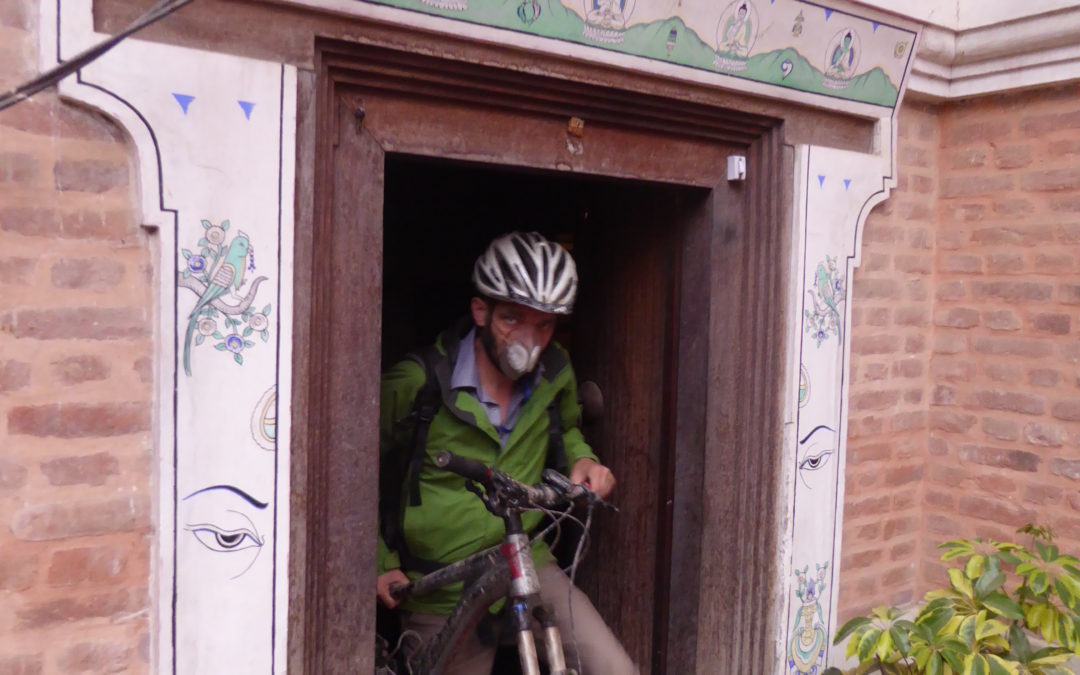
Photo of my brother Magnus coming out of his house in Patan, Kathmandu. Taken by Yours Truly (with his camera).
* I said bike helmets are “useless” and here’s why: they are loose, they slide around your head and offer no protection to the side of your head. They might offer some protection if you somehow landed on the top of your head. All they do is create the illusion of safety. Compare them to motorbike or rock climbing helmets, which are clamped on firmly and would protect every part of your noggin. But I do use bike helmets as they are ideal sun hats; the big chunks of compressed polystyrene that they are made from can protect you from the sun’s rays and also let plenty of fresh air in.
A shorter version of this article was published by the Sunday Herald in Glasgow, with this by-line: “Rupert Wolfe Murray is a freelance writer living near Selkirk. His trip to Nepal was not funded by a travel agency, resort, bike company or any other sponsor.”
In case you’re wondering, I am now living in Edinburgh and commuting to a new job in Stirling (I’m editing this article on the train). I work for an outfit called The Writer and I’m really enjoying it. This article is about a trip I did to Nepal last year. I’d love to get your feedback, however rude or negative. Please add a comment. It’s what keeps me going.
by Rupert Wolfe Murray | 24 Mar, 2017 | Journeys
I want to describe my last visit to Nepal, a fascinating little Himalayan country.
Thirty years have passed since I was last in Kathmandu. My presence there was both dramatic — I had been kicked out of Tibet — but also depressing: I was broke, my dream of living in Tibet had been shattered and I couldn’t afford to fly home to Scotland.
I didn’t want to be in Nepal and I didn’t really notice it (yesterday I told a Nepalese man that I was here 30 years ago and he said “that was the golden time” before uncontrolled building development and pollution). Back then I didn’t take in the ancient buildings and culture and spent my time writing an article for the Daily Telegraph — an article that got me £500, a ticket home and a foothold in journalism.
The last chapter of my memoir, 9 Months in Tibet, describes the political situation in Tibet that led to my expulsion. But there are some things which I never wrote about, one of them being the government poster that appeared all over Lhasa on the 3rd of October 1987 — offering a sort of amnesty to the rioters.
The poster, which is the subject of this article, hasn’t been reproduced anywhere as far as I’m aware and so, in a small way, maybe this article is a historical document about the Chinese occupation of Tibet (for those of you who don’t know what happened, the Tweetable version is this: China invaded Tibet in 1949. They promised autonomy, killed millions and destroyed the culture. The Dalai Lama fled in 1959 and set up a Government in exile in India.)
3rd October 1987: the Government Poster in Tibet
It was badly written, typeset in the old fashioned way and printed on thin white paper. I ripped a copy off the wall and smuggled it out of the country — oblivious to the risk of getting caught.
The poster was just text and its title was simple:
No. 3 Announcement by the People’s Government of the City of Lhasa. October 3rd 1987
The first part of the poster sounded diplomatic in tone, but if it had been drafted by diplomats they weren’t very good at English. My rendering of the poster is verbatim, in other words I didn’t correct their spelling.
By the end of the text the anger the Chinese felt towards the Tibetan protesters, and us foreigners, became clear.
Here is the full text:
In order to ensure the smooth Implementation of the opening police, to promote the development of tourism industry in our region, to increase our economic and technical exchange and cooperation with different countries in the World,to avoid appearance of displeasure in foreign affair’s work, the city announces as follows:
- We extende welcome to friends from the different countries in the World who come to our region for sightseeing, tour, visit, work, trade discussion and economic cooperation.
- Who ever comes to our region must respects our State sovereignty, abide by the lows of our country. They are not allowed to interfere in internal affairs of our country and engage in activities that are incompatible with their status.
- Foreigners are not allowed to crowd around watching and photographing the disturbances manipulated by a few splittists,and they should not do any distorted propaganda concerning disturbances, which is not in agreement with the facts.
- In accordance with our lows, we shall mete out punishment to the trouble-makers who stir up, support and participate in the disturbance manipulated by a few splittists.
*
Points three and four remind me of the story of the riot and the Chinese reaction to it.
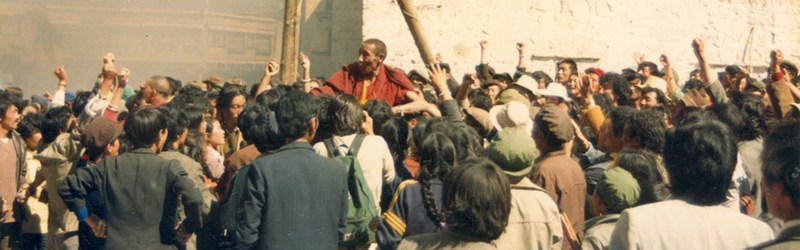
This is what happened: some monks protested against Chinese rule, the police opened fire, killed several protesters and arrested others. A Tibetan mob stormed the police station where the prisoners were being held and burned the place down. I turned up towards the end of the riot, saw a boy shot dead in front of me and spent the next few days working out what had happened.
A lot of foreign travellers were in Lhasa that day (1st of October 1987) as well as some journalists. Not only were photos and testimonials taken but they were smuggled out (the Chinese police were naive in the ways of the wily foreign journalists back then and they didn’t search those leaving). The international media told the story in gory detail and it was headline news for a few days. I remember thinking that the Chinese government would have felt humiliated by this outbreak of bad news and their revenge on the Lhasa population would be terrible.
The Chinese police were outraged that the Tibetans had protested against what they consider to be an enlightened regime. They assumed the rioters had been organised by the “Dalai Lama clique” and foreign spies like me (I was an English teacher in Lhasa but I always fancied myself as the next James Bond). They also invented a new word; “splittist”, meaning someone who wants to split Tibet away from the Chinese motherland.
The Chinese police gave the Tibetans a few days to confess all, hand themselves in and benefit from an amnesty. None of the Tibetans I spoke to trusted this amnesty and I don’t think anyone handed themselves in.
Soon enough the police cracked down, abducted people at night and tortured them in Lhasa’s notorious prison. They fulfilled point 4 of their foreign language poster: In accordance with our lows, we shall mete out punishment to the trouble-makers who stir up, support and participate in the disturbance manipulated by a few splittists.
A few days later I was arrested, told to write a self-criticism, which I refused to do, and ordered to leave China within 4 days. I organised a bus to the Nepalese border, a journey that took 4 days over unpaved roads, and ended up feeling glum in Kathmandu.
I wrote about my experiences in Tibet and this helped me to move on. I didn’t want to carry the terrible burden of Tibet’s tragedy for the rest of my life and so I didn’t get involved in the Free Tibet movement. I got into journalism instead, covered the Romanian revolution and spent the next 20 years in Eastern Europe.
Now that I am back in Nepal I can lay the ghost of the past (I don’t want to go back to Tibet in this lifetime), and I can look at this little Himalayan country with fresh eyes: in 1987 I saw Nepal as a transit point and safe haven; now I see it as a fascinating country in its own right and a place I intend to explore.
You can join me by reading these articles and adding a comment. I’d like to know what you think about all this.
Photo credit: The Middle Way Approach (the photo shows Jampa Tenzin, a Tibetan Lama who was rescued from the burning police station on the 1st of October 1987).

