by Rupert Wolfe Murray | 19 Mar, 2024 | Opinions, Psychology of Travel
I first published this article in May 2022, just after the Russian Empire invaded Ukraine and I’m re-posting it now as the points I raised here are still very relevant (not much has changed in the Ukraine War).
It’s hard to imagine what could be worse than the barrages that are raining down on Ukrainian cities right now, but the rocket and artillery fire will eventually stop. A more long term risk for Ukraine, one that will permanently hobble its chances of recovery, is a bad peace treaty.
A good peace treaty would recognise Ukraine’s territorial sovereignty and the independence of its government, thus enabling it to rebuild. International aid would pour in and the country could quickly recover. A bad treaty, on the other hand, would disable Ukraine’s government, enshrine outside power brokers, and ensure that the country was so dysfunctional that it could never prosper or defend itself with a powerful army.
But surely a peace treaty is just what’s needed for Ukraine? Surely, anything that ends the war is good? That was the thinking in November 1995 when the leadership of Bosnia Herzegovina was bullied into signing the Dayton Agreement, a deal that is nicely summed up by Wikipedia: “The agreement has been criticized for creating ineffective and unwieldy political structures and entrenching the ethnic cleansing of the previous war.”
One of the problems with the Dayton Agreement was that it created a state within a state – the Serb controlled Republika Srpska – which includes the territory on which (according to international courts and tribunals) Bosnian Serbs committed genocide over the mostly Muslim population. The Serb-controlled entity has been blocking Bosnia’s progress ever since the deal and is now demanding independence. After a decade-long slumber, the Western powers are finally waking up to the risk of Russian/Serb mischief in Bosnia and are reinforcing their paltry armed force based there.
The peace treaty itself is “discriminatory” according to Almira Delibegović -Broome KC, a Bosnian/British lawyer based in Edinburgh. Bosnia’s constitution was drafted as part of the Dayton Agreement and the problem is that it assigns “privileged status” to three main ethnicities – Croat, Serb and Bosniak/Muslim. This means that if you are from a minority, Roma or Jewish for example, or even just want to call yourself a ‘Bosnian citizen’ “you cannot stand for the highest political office in the country, be a member of the presidency or the upper house of parliament”. It also ensures that Bosnia’s neighbours, Croatia and Serbia, have powerful levers of control over Bosnia’s triple-headed presidency. An example of this was when Republika Srpska vetoed Bosnia’s attempts to sanction Russia after they invaded Ukraine.
According to Vehid Šehić, founder of the Tuzla Citizens’ Forum in northeast Bosnia, another problem with the Dayton Agreement was that it made all three warring parties – the Croats, Bosniaks and Serbs – responsible for ongoing peace and development: “It’s not natural that the nationalist political parties that were active during the war were then made responsible for implementing the peace. It’s completely irrational. This is why we are still living in the wartime period of 1992 to 1995.”
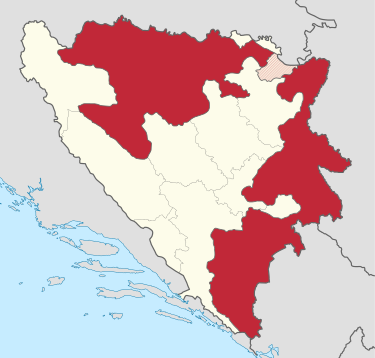
This map shows the extent of Serb-controlled territory within Bosnia Herzegovina. The Serb area is marked in red
Russia learned some valuable lessons at Dayton
Russia was going through one of its rare moments of liberalism at the time of the Dayton Agreement in 1995. Boris Yeltsin was in power and Russia’s Prime Minister, Victor Chernomyrdin (later to be ambassador to Ukraine) witnessed the treaty’s signature alongside the leaders of France, Germany, Spain, the UK and of course the USA. This so-called “Contact Group” of nations followed the USA, which was driving the whole process forward.
In 1995 Russia and the USA were closer than they had been in a century and when the massive NATO “Implementation Force” (IFOR) was imposed on Bosnia Herzegovina the Russians participated with a paratroop brigade, were given an Area of Responsibility in Northeast Bosnia and, extraordinarily, were under the military command of the overall NATO commander, US General Nash. This proves that Russia and NATO forces can work together perfectly well if there is a sensible leader in the Kremlin.
Things seemed to go well in Bosnia Herzegovina for the following years. All sides were glad the fighting was over and, initially, the Bosnian Serb leader (Milorad Dodik) was a gushing advocate of peace and reconciliation with the Bosnian Muslims and Croats. But when he realised that the West was losing interest, and he was losing popularity, he played the nationalist card and started portraying the Croats, Muslims and Western powers as the enemy. Needless to say, he’s very close to the Russians and who knows what advice, arms and propaganda support they give him.
The irony is that a liberal (Yeltsin) handed over the keys of the Kremlin to a man who believes in a governing style that has more in common with Ivan the Terrible. But it has to be said that Putin flirted with liberalism in his early years and had no objection to NATO expansion — as did Dodik and Victor Orban (flirting with liberalism seems to be a way for modern tyrants to get established).
I imagine that Russia’s former KGB operatives observed the Dayton Agreement with fascination; they would have seen how the West, with the best of intentions, enforced a treaty on a nation that has resulted in a totally dysfunctional state. The Russians can’t be blamed for the Dayton shambles, but they almost certainly learned from it and may see it as a useful model for stirring up trouble elsewhere. Maybe their plan in Ukraine is to rain down death and destruction, exhaust all parties, and then present a peace treaty that is based on “special rights” for the Russian minority as well as a large chunk of “autonomous” Kremlin-controlled territory. It would be a cheap way of controlling a large country: no need for an occupying army when you can veto anything you don’t like. This is what they tried to do with the Minsk Accord and after that failed to deliver Russia a suitable puppet, they invaded.
It would compound the tragedy of Ukraine if the Western powers were to bully Ukraine into signing a treaty with the aggressor that would debilitate them for generations to come. There is a tendency to assume that all parties come to peace treaties with good intentions. Such a mistake could be fatal for Ukraine.
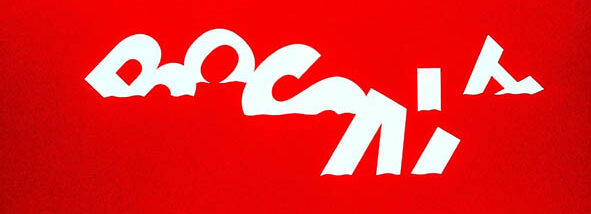
The image associated with this article was designed by the esteemed Bosnian/American graphic designer Čedomir Kostović. This poster appeared in the graphic history book Bosnian War Posters, by Daoud Sarhandi, published by Interlink on May 3rd 2022.
by Rupert Wolfe Murray | 19 Feb, 2024 | My books, Opinions, Psychology of Travel
Art books can be beautiful but often I get a gradual sense of boredom as I turn from one perfect image to another. Too much art, beauty and perfection can be overwhelming.
I don’t like the way art is presented. What bugs me are those convoluted, oh-so-clever texts that are displayed as you walk into exhibitions; texts that are often so full of obscure words that often I think you need to study art at university in order to understand the gobbledegook that curators sometimes write.
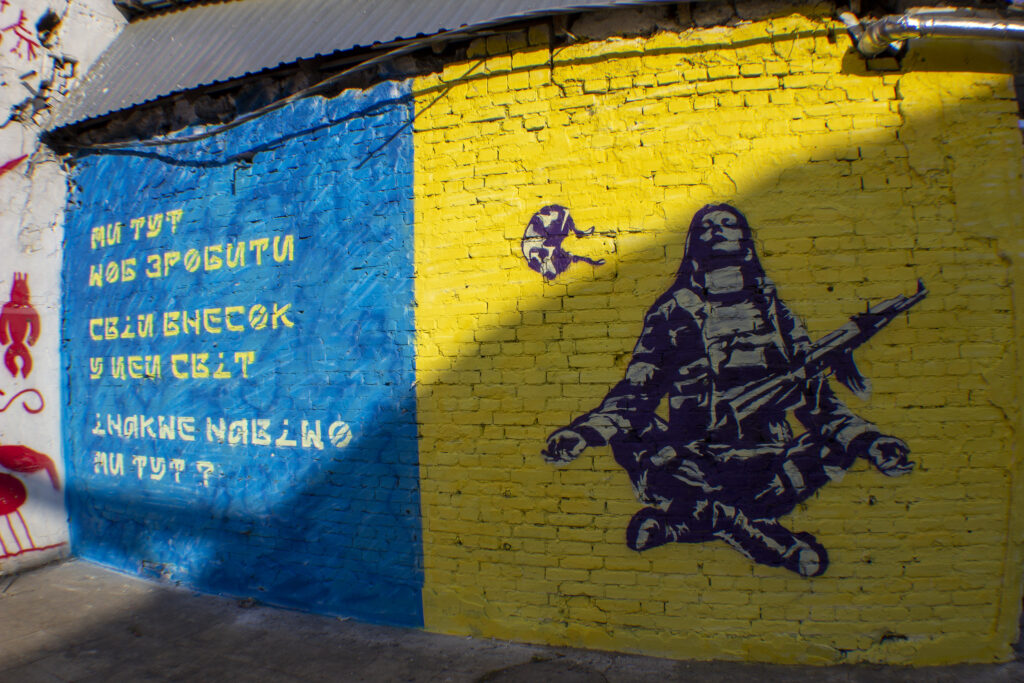
Daoud Sarhandi-Williams, the editor and designer, has avoided these linguistic problems in his latest book — Ukraine at War, Street Art, Posters + Poetry. His descriptions of the street art that he photographed in wartime Kyiv are clear and simple. He guides us through 300 pages of Ukrainian street art — some traditional, some modern — like a friendly local, guiding me (or you) through the medieval backstreets of an ancient Italian city; sharing a deeply personal and light-hearted commentary that’s so much more gratifying than the spiel the official tour guide says every day to the latest batch of tourists.
Since visiting Zaporizhzhia last summer, where I worked as a volunteer, I’ve read several books on Ukraine. The only one I’d recommend is called In Wartime; Stories from Ukraine by Tim Judah. One is a novel called Death and the Penguin by Ukraine’s most famous novelist, Andrey Kurkov. Apparently it’s quite a famous tome among the literati but I found it glum and disappointing. It has black humour in spades but none of the sparkles of joy and humour that can be found in the works of the great Ukrainian-born author, Mikhail Bulgakov, a master of black humour and author of The Master and Margarita.
But I shouldn’t be too harsh on Andrey Kurkov as he did write an excellent foreword for this wonderful book I’m reviewing. Here’s an extract: “Ukraine at War: Street Art, Posters + Poetry will guide you through today’s Ukraine more honestly than any future history might…What this book shows is the restorative power of art in a time of war…Art let’s us look at today’s pain from the viewpoint of the future, so there can be a future.”
It’s not just the images that make this book worth reading. The concise words that accompany the street art transform it into a great book. I don’t think I’ve ever seen an art book like this, with such a subtle written guide easing us through the images, and the tragic modern history of Ukraine. How did this come about? Why isn’t it presented like every other art book — just image after image but no narrative to pull us along.
To answer that question we need to look to the author, an old friend I used to work with in Bosnia: Daoud Sarhandi-Williams. Daoud trained as a film editor at the BBC in London during the late 1980s, when the BBC had a lot more creative freedom than it does now. You might be wondering “What’s this got to do with it?” My answer is “everything”, as he not only wrote the text for this book, he also did the graphic design. (The book was published by Interlink in the USA and is distributed globally by Simon and Schuster).
Daoud’s method is to put together art books in the same way he’d put together a film: selecting images and words that create tension, make highs and lows, and drive the narrative forward. And it works, just as a good film will keep you glued to the screen for two hours. I was pulled through the pages of the book as if by a string.
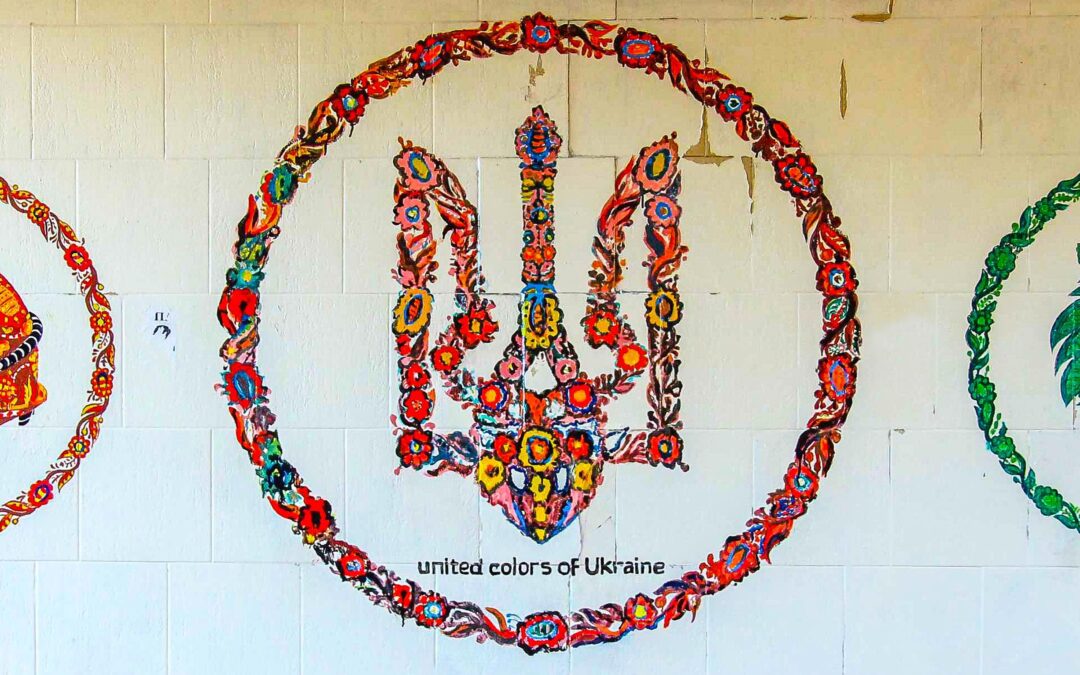
The bulk of the book covers issues like historic statues being covered with sandbags to protect them against Russian bombs (an image of Dante’s indignant face, peeping out from a pile of sandbags, pops into mind), modern street art and graffiti, traditional Ukrainian folk-art being adapted to a modern setting (like painting flowers on tank traps); a massive display of captured Russian tanks on show in Kyiv’s main boulevard in the summer of 2022, anti-war graphics; and, the most beautiful chapter “Murals, Murals Everywhere” which consists of massive paintings covering the sides of entire blocks of flats. To my surprise, few of these murals show images of war, they tend to portray people, nature and beautiful images from the artist’s fantasy. There’s a lot of children in the book, making their own art and sometimes selling it, and plenty of flowers which are, the author writes, “cherished in Ukraine.” There are photos of people celebrating, having a good time, proving that life goes on despite the war.
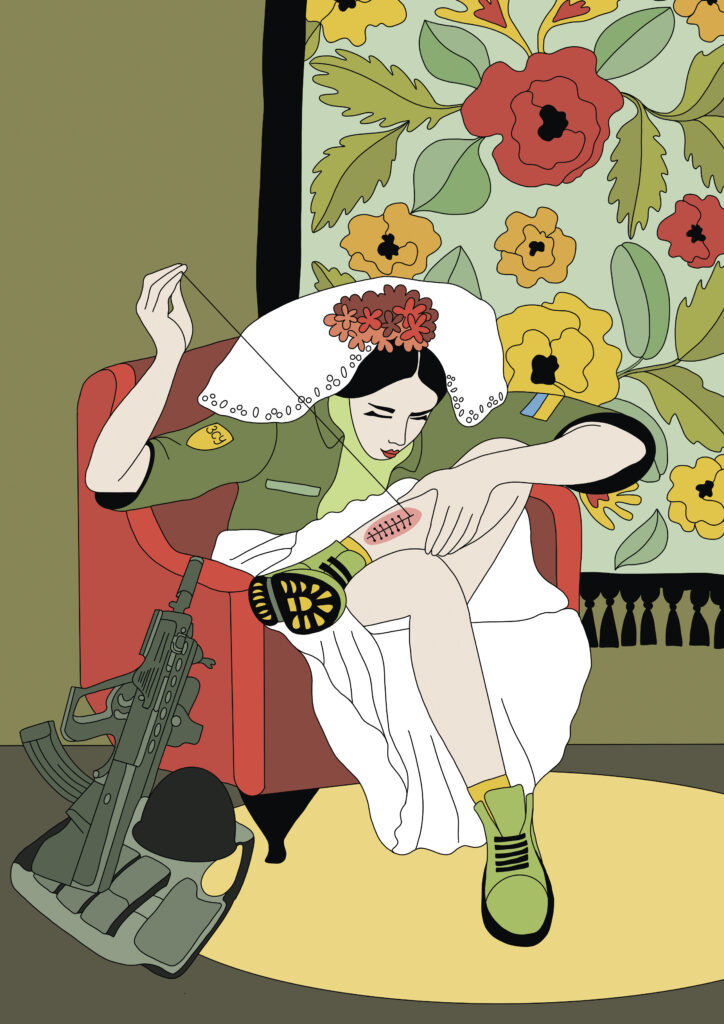
If there is a message in this book it is that artists, and presumably the people of Ukraine, don’t want to dwell on the horrors that the Russian Empire has inflicted on them; they want to celebrate their independence, their freedom, and their ancient culture. A deeper message that I picked up is that the Ukrainian people will never give up. Now they’ve got their independence from the Russian tyrant, there is no way they’ll give it up. Some Western pundits say “If Trump gets in the war is over!” But I don’t buy that line. I’m sure they will fight on, just as the Bosnians did when they were invaded by the much-more-powerful Serbian army and despite the fact they were denied Western arms to defend themselves.
The Museum Blues
By now your attention may be flagging, you may have reached the point that I call “Museum Blues” — when the exhibition, or art book (or this article), has overwhelmed you. When this happens to me, as it often does, in museums and galleries, I feel exhausted.
At this point in the Ukraine book Daoud, the film editor, makes his move. He changes the pace and retains our attention as only the best films succeed in doing.
For me, the chapter on murals was the high point and I needed a break. I was also wondering “How are they made?” Like a butler who anticipates his master’s every need, Daoud plunges the reader into two chapters that give a different perspective: he tells the story of how a group of artists paint a massive mural of “the ghost of Kyiv”, a heroic pilot who stood up to the Russian Air Force when they tried to capture Kyiv in early 2022. The next chapter is a documentary-style presentation of a group of graffiti artists who use their skills to paint camouflage on vehicles which have been donated to the war effort. These chapters are the equivalent of the “making of” documentaries that sometimes accompany films.
Most books of this nature, and most films for that matter, end with a slight sense of disappointment. But Daoud Sarhandi-Williams knows that he must end with a bang. Endings are really important for filmmakers but, I suspect, they’re not for those who make art books. The concluding chapter is titled “To End a Book: In Conclusion”, and it’s a play on the title of a book called To End a War, by Richard Holbrooke, the US Diplomat who coordinated the ending of the Bosnian War in a way that didn’t resolve anything and now, thirty years later, Bosnia is still stuck economically and politically. Holbrooke’s mistake was to award the Serb aggressors with 49% of Bosnia’s territory and force this “solution” on the Bosnians. Subsequently, the same Serbs who ran a war of genocide against their neighbours then set up a racially pure Serbian mini-state within the current nation of Bosnia Herzegovina. What could possibly go wrong?
I agree totally with what Daoud writes in the conclusion: “Russia must be vanquished before any meaningful diplomacy can begin– lest it ends up with a Bosnia-style lethal peace deal. Ukraine fights on with awe-inspiring courage. This quality extends throughout the population…Such bravery and resilience — as well as faith in the power of art — still has the capacity to surprise us. As T.P. Cameron wrote in the trenches of the First World War:
Two things have altered not
Since first the world began
The beauty of the wild green earth
And the bravery of man.
From Magpies in Picardy, published posthumously in 1919.”
N.B. I had no intention of writing a review of Daoud’s Ukraine book as I’d seen it in proof form (I helped in various small ways) and rarely write book reviews. But when I read through the hardback version I released it was quite different, and much better, than the version I’d seen on my screen. It’s a gripping and fascinating insight into a country that is managing to stand up to the world’s biggest bully. It’s also a surprising book in that I had no idea such great street art was being produced in Ukraine, that the local authorities encourage it, and this work may well be the testament to Ukraine’s indomitable spirit, in the future, when they finally break the grip of Russia’s rotten empire.
Ukraine at War, Street Art, Posters + Poetry, by Daoud Sarhandi-Willians, was published in 2023 by Interlink Books. You can get a copy from the publisher here or from Amazon here.
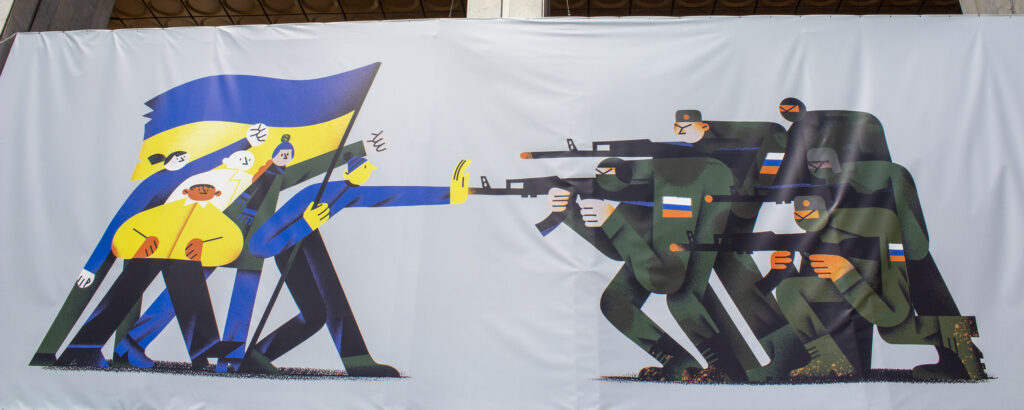
All the photos in this article were taken by the author/designer: Daoud Sarhandi-Williams.