by Rupert Wolfe Murray | 24 Nov, 2021 | Journeys
I’ve just been travelling round the Balkans and want to share my impressions in the hope that you will feel inspired to do the same. Accommodation, transport and food are cheap, the people are friendly, parts of it are stunning (see the photo below) and it’s as safe as anywhere in the world.
Here’s a photo I took from a bus window in the southern part of Serbia, the Sand Jack region where people of the Muslim faith are in the majority. If I could take such a nice photo from the bus window, using my old phone, imagine what you could do on the ground with a decent camera.
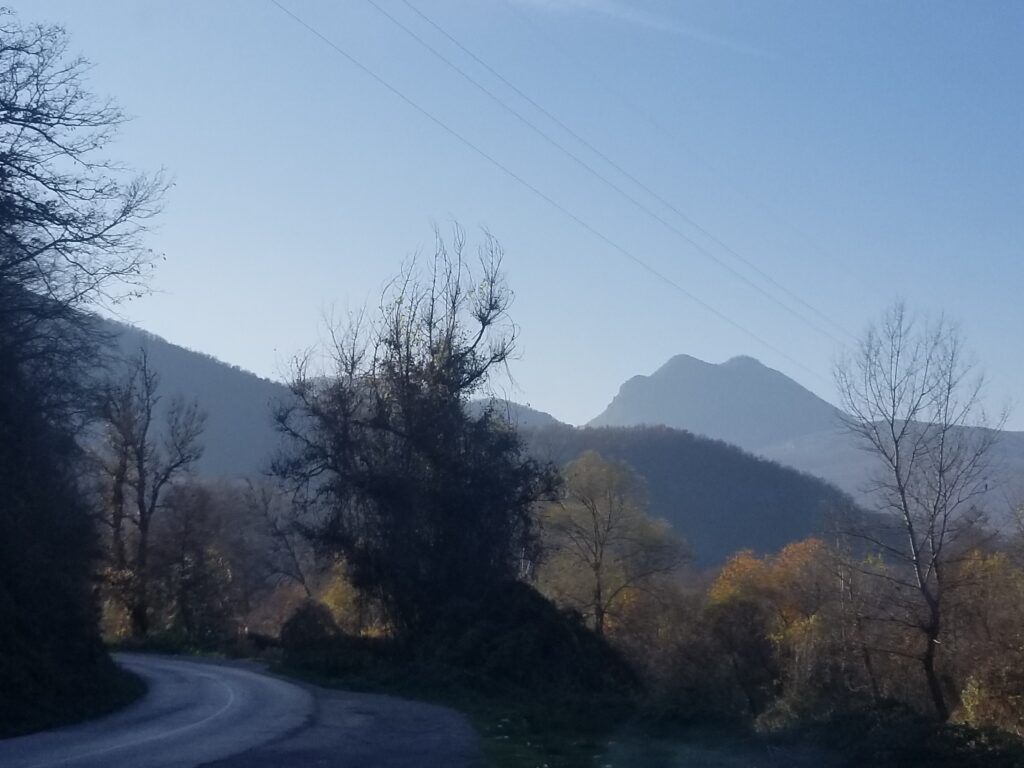
Photo of the Sand Jack by Rupert Wolfe Murray
I’m currently living in Sarajevo and I went to visit some friends in Bucharest. The quickest overland route is via Belgrade. I decided to come back a longer but more beautiful route: through Bulgaria, North Macedonia, Kosovo and the Sand Jack region of Serbia. It was a big loop through the Balkans.
What’s the Best way to travel round the Balkans?
This depends on your approach and budget. If you’re loaded and like to avoid strangers you’ll want to hire a car but if you’re like me – skint but always open to meeting new people – there are only two options: bus and train. Buses are the main option in the former Yugoslavia and although they’re cheap please don’t rely on bus information you find online as it’s almost certainly out of date. I got into the habit of arriving at a bus station and immediately buying my next bus ticket. Trains are also cheap, but slow and only really an option in Romania and Bulgaria, as there aren’t many train lines in Greece or the former Yugoslavia.
Hitching is a useful back-up method for when the bus doesn’t go in your direction, as happened when I tried to get from Belgrade into Romania (you can read about that experience here). I love hitching as it’s a good way of meeting people, learning a few words in a new language, and (sometimes) getting an insight into the driver’s dysfunctional country. Most people I’ve met in the region are friendly, interesting, cynical and fun. But, if you’re hitching, offer them some money – the equivalent of a bus fare – and I’m ashamed to say that I didn’t offer my last driver anything when he took me from the Serb/Romanian border into Timisoara.
Is it safe to travel in the Balkans?
Even though the Balkans are beautiful – lots of ancient cities, spectacular mountains, and beaches to die for – many people think it’s dangerous. It was dangerous during the Bosnian and Croatian wars but that finished over 25 years ago and the people of this region are far less aggressive, on the streets, than you would experience in the UK – where aggro seems to be baked into our DNA. I’ve travelled around the Balkans many times over the last 30 years and I can’t remember once feeling scared, even during the Bosnian war when I visited the city of Tuzla twice.
In my experience, the most friendly people in the Balkans are the Romanians and the least friendly are the Bulgarians. Overall, they’re quite polite even if they can be a bit rude and cold in restaurants and shops. If you ask a young person directions on any street in the Balkans the chances are high that they’ll speak decent English and be keen to practice it. They’ll also look after you – there’s an ancient tradition of looking after guests – and that’s why I can assure you that travelling in the Balkans is totally safe. You’ll be safer in the Balkans than you would be on a Friday night in many British cities I can think of.
5 reasons why I love hostels
If you’re like me and living on a low budget the only real option is to stay in a hostel, but some people hate the idea of sharing a room with smelly strangers and they worry their stuff will be robbed – which doesn’t happen as a sort of collective security goes on in shared rooms: nobody wants their gear nicked so they’re not going to steal yours. It’s the same process at work in offices: people don’t steal each others stuff as an unspoken system of mutual respect is at work.
- Hostels are dirt cheap
The only cheaper option is to camp, and I like camping even more than hostels; but the Balkans is crap for camping as it’s illegal in some countries (I’m looking at you Croatia), frowned upon by locals and there’s very few campsites around.
Having just stayed in a series of hostels in the region, I can tell you that the average price for a bed in a shared room is about 7 Euro. A good place to book a bed is on Hostelworld as you don’t have to register or download their App. The website Booking.com are muscling into this market but they piss me off as they have cancellation fees and keep trying to force me into hotels.
- Hostels have a sense of community
Even when I have money to blow on a hotel I’d rather stay in a hostel as there’s something sad and lonely about a middle-aged guy shutting himself into a hotel room (why do I think of prostitutes?) Sure, if you’re a couple I can understand why you’d prefer your own room but, let’s face it, most couples don’t really need that intimacy that was so wonderful during their honeymoon; I think many of them would prefer to chat with friendly travellers, but are so stuck in the routine of booking their own private room at four times the price that changing it would be unthinkable.
I live and travel on my own and am rarely lonely. I love being with people and like working somewhere where there are people around, like a shared hub-type office, or even a café. I like being around strangers even if they don’t want to talk to me.
Hostels give me a sense of community. When I recently stayed in a hostel in Bucharest there were two other people in the room. I’ve no idea who they were as we didn’t talk once over a period of 3 days. There were no bad vibes, no unfriendly glances, but we all kept to ourselves and had very different sleeping times. My point is that it’s nice to be around other people and the hostel is a great place to experience that. Usually there are a mix of friendly people and those who want to keep to themselves. Over time, I’ve learned to tell the difference and only engage if I think the other person really wants to. In this way I can enjoy a sense of community – and anonymity.
- Hostels can be really interesting
I think most hostels are really different from each other but most hotels, especially the posh ones, are the same. In a hotel you always have a “them and us” scenario which starts as soon as you walk in the door and talk to the receptionist; she may be friendly and polite but you can’t get away from the fact that she’s doing a job, following a set of rules (one of which is to not get too friendly with the clients), and serving you. In the hotel restaurant it’s the same – people are serving you and you can’t really break away from the master/servant dynamic.
This dynamic is usually absent from hostels where the staff sometimes live in one of the shared rooms, alongside the rest of us, and in the evening they hang out with the more gregarious guests. When I stayed in a hostel in Sofia the receptionist/manager invited me to a noisy party on the top floor; I didn’t go but I did appreciate the invite. In the bigger hostels, the people working there are often travellers getting free accommodation in return for some reception duty – and they’re keen to chat with you as soon as the formalities are out of the way.
Because hostels are sometimes just the size of an apartment, they don’t need as much real estate as a hotel. As a result they’re often in superb locations. In all these cities I recently visited all the hostels were located in the city centres, at a quarter of the price of a hotel.
Interesting hostel experiences on my recent trip through the Balkans: in Bucharest the hostel was full of immigrant workers from Sri Lanka – a really gentle crowd, with none of the macho tendencies of some Balkan men; in Belgrade the overweight receptionist had a shouting match with a skinny woman from Hong Kong (both of whom seemed to be long-term residents and were like an old married couple); in Skopje the hostel was located in the vast basement of a hotel and 100 Japanese-style cubicles had been built – offering much more privacy than is usually available in a bunk bed. I thought it a brilliant idea to locate a hostel within a hotel as they can attract two very different types of clients. And it feels great to experience the up-market services on offer at the hotel while only paying a fraction of the normal hotel price. In the Skopje hostel, I wandered into the hotel spa and got a cheap massage from an Albanian lady who’d been trained in Switzerland.
Perhaps the most interesting thing about hostels is the people. When sharing a room with others you’re bound to come across some weird and wonderful characters. On this trip the person who stands out most in my memory was a skinny Irishman in Prishtina, with the mad eyes and straggly beard of a hermit. At dawn a mobile phone rang in the bed above me and this chap leapt out of bed, stark naked, and screaming: “Turn that bloody thing off! I’ve paid good money to stay here… ” The phone was silenced and the guy above didn’t say a word, the Irishman got back into bed, and I went back to sleep.
- Hostels are a lot better than they used to be
Hostels used to be really grim. In the UK they were the simplest form of accommodation, rather like military barracks, and in Eastern Europe they were even worse. All that has changed but many people seem to assume that they’re still grim, filthy and dangerous.
What’s happened is that business people have realised there’s good money to be made from cheap accommodation; you don’t need to be a rocket scientist to work out that big bucks can be made by packing 8 to 12 people in a room, especially in the Western capitals where (hostel) prices are treble what they are in the Balkans. But these investors have to offer something more than an old style bunkroom so they’ve unleashed the architects and now you can find some really beautiful hostels, especially in the fancy Western capitals. In North London we once stayed in the cells of an old police station; I think it’s called The Clink. In Brussels I stayed in a superbly converted old beer factory, with hundreds of beds.
A lot of hostels also use the language of the surfer dude when writing notices, toilet and kitchen rules, and all the information they need to convey. In Timisoara, where I stayed in a small but beautifully designed hostel, there were little blackboards everywhere with instructions written in the voice of a Californian stoner. Although this tone is sometimes a bit annoying, it’s better than the dense legalese texts you find in hotels.
Even the worst hostels – and there are some really crap ones around – have a basic kitchen and cooking your own meals can save you a King’s Ransom.
- Hostels are a good place to write books
Writers need to find a quiet, peaceful place to write their next epic. How is this possible, you may be wondering, in a hostel where the young crowd (and the hostel management) may be partying late into the night? I once had a really well-paid job for the EU in Bucharest, with enough cash to stay in a hotel. But I chose to stay in a scruffy city-centre place called Midland Hostel as I liked the community and didn’t mind the noisy rabble who would drink and smoke on the balcony until God knows what time in the morning.
Within the late night action at the hostels I have found the ideal working place: early mornings in the kitchen. As far as I’m concerned the later my fellow-residents go to bed the better as they’re likely to get up really late – and that means that I’ve got the whole place to myself in the morning. When I stay in hostels I try and get up as early as possible, ideally around 5am, and for the next four hours the chances are that the only person I’ll see will be the cleaning lady – or, in the case of the Midland Hostel in Bucharest, it was the manager himself who showed up early and cleaned the place.
Travelling gives me energy
At the end of my journey I got back to Sarajevo, but I was buzzing with energy that two weeks of travel had given me. I had to keep going and so I went to Split, Croatia, for the weekend, using the one good train line in Bosnia – Sarajevo to Mostar – and then the bus. It was great to get a glimpse of the sea and I took a decent photo which shows the Dalmatian Coast, i.e. when the mountains fall into the sea. Here it is:
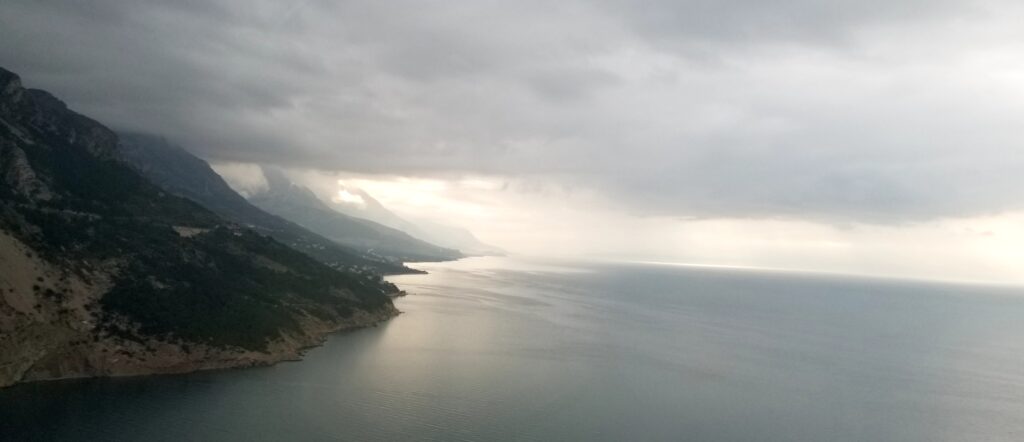
Croatia’s Dalmatian Coast by Rupert Wolfe Murray
Postscript: My Airbnb Nightmare
Until I reached Novi Pazar, in Serbia’s Sand Jack region, all my experiences with Airbnb were good. Airbnb apartments are more expensive than hostels, and usually better. But when I got to Novi Pazar I soon realised that the only options were Airbnb or an expensive hotel. The Airbnb place I booked only cost 12 Euro and the other option was a hotel where it cost 50 Euro for a room.
But my Airbnb experience in Novi Pazar was bizarre. The listing made it sound great and I saw images of a modernised chalet on a hill, very central and dirt cheap. What could possibly go wrong? First of all, finding the place was difficult as the address had no sign or street number on it, but that was the least of my problems and is normal for Airbnb. The host, who was bursting with friendliness at getting a guest (I was his first), told me to wait in his family’s cafe/bar while he went to sort out the accommodation. Then he locked the door, turned off the lights and vanished for almost half an hour. He’d left me in a dingy bar with his friends and a big TV screen blaring out the news. I later found out that all pubs, bars and restaurants had to close at 9pm due to some law in Serbia that was supposed to stop the spread of Coronavirus – quite how, I’ve no idea but I didn’t care; I just wanted to sleep.
Under normal circumstances, I don’t mind being stuck in a shitty bar for half an hour but it helps if they tell you why you’re having to wait for so long. But the real problem was that one of my host’s friends was obviously a madman: every time the newsreader would say something he would scream and shout at the TV with such insane rage that he looked like he was ready to kill. Was this the sort of Serb extremist who would go into Bosnia and Croatia and kill innocent people? Luckily he didn’t even notice me, which was lucky as I am a citizen of one of the countries that bombed Serbia in 1999.
Eventually my grinning host returned, didn’t seem to even notice his raving lunatic of a friend, and said “follow me.” My grasp of Serbian/Bosnian/Croatian is basic, but fine for this kind of circumstance.
He then led me to the back of the house and pointed to a metal fence, which we had to climb over; my host said his neighbour had promised to cut through it but hadn’t done so. This was my first inclination that this guy’s building project was nowhere near finished. We were then standing at the bottom of a mud cliff, with rough notches dug into them. Bricks had been placed in these notches but they weren’t fixed and so each step was a wobble; luckily there were a few saplings to grab hold of. I had a big rucksack and struggled to make it to the top, and only did so because I have some rock climbing experience; I couldn’t imagine how a family could get up there or an older person. This path is dangerous and I assume that Airbnb don’t bother inspecting the properties that they list, and neither does the local authority. Do they just leave it to the reviewers to warn others it’s dangerous and unfit for human habitation?
When we reached the top of the cliff he proudly showed me his shed. At first glance it looked fine but on closer inspection I realised the thin boards that the walls were made of had gaps between them and the freezing night air was whistling in. I asked him if it was insulated and he said “of course” and pointed to a thin sheet of plastic that was wrapped round the building. He obviously has no idea what thermal insulation is.
The bed was built on a high platform but it was so rickety I thought I might crash to the floor; it would been lethal for a couple or an overweight person. The only way he could heat the place was to balance an electric blow heater on the bed; but the heat was pouring out of the gaps in the walls so I had to keep it on all night, at the risk of burning the whole place to the ground. If only I’d had a four-season sleeping bag I could have slept on the floor in great comfort, but I had to make do with his smelly bedding and my own summer sleeping bag.
The best bit was the bathroom which was just a pile of junk lying around outside. He’d collected an old bath, toilet and sink, plus boxes of tiles and all the other stuff you need for a bathroom, and it was lying around outside, exposed to the elements. It looked like a bomb had gone off, scattering the items around the muddy hillside. My host pointed to the junkpile and said with a grin: “Bathroom!” That was one of his few words of English. I didn’t know if I should laugh or cry.
Luckily I got away in one piece and considering how friendly the host was I didn’t want to write a review on Airbnb, as it could only be devastating. But then he sent me messages saying I hadn’t paid him – not realising you can’t stay in an Airbnb without paying for it first, on the App, but the payment takes a few days to reach the host – he started sending me angry text messages. Maybe he would unleash his ad friend and hunt me down? So I unfriended him on social media and posted a review on Airbnb.
In my review I wrote, “This place is unfit for human habitation…it’s like sleeping in a shed…it should be withdrawn from Airbnb.”
Over two weeks have passed since I stayed at that place in Novi Pazar. I just checked the Airbnb site and can confirm that the hellhole I stayed at (Vikendica Sanac) is still listed as a viable accommodation option. This proves, to me at least, that Airbnb don’t give a damn about their listings. How could they if they let a place that is dangerous, and reported as such by my review, still be available online?
All of which goes to show that the best option, for those at the low end of the travel budget spectrum, is to stay in a hostel. It has to be said, however, that most Airbnb options are really good and the dive I stayed in was an exception.
A final word: I’ve just heard the news that 46 people were killed on a bus travelling on the same route I just went on, from Bulgaria into North Macedonia. My heart goes out to the families of those unfortunate victims. I’m really sad about it. I know the buses in this region are generally old but the drivers are usually good and there’s never been such a big tragedy like this in the region. I don’t understand how it happened. Hopefully it will lead to stricter measures regarding the old buses that connect the cities of the Balkans.
Thanks for reading this article, which is far longer than I had planned. I’d really appreciate it if you would add a comment below, even if it’s short or critical. If you have any questions, or would like any advice about travelling in the Balkans, or independent travel in general, this is the perfect place to ask — the comment section below — as then it’s available to anyone else who may be interested.
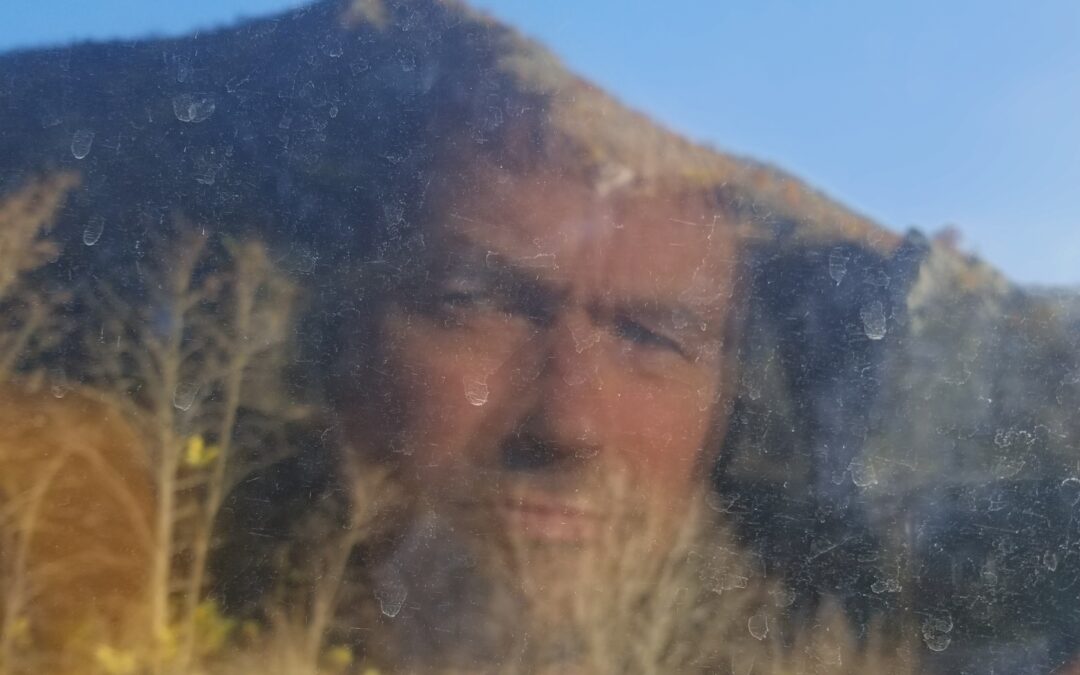
Final, final, final note: the main photo of this article (my reflection in a bus window, against a backdrop of a mountain) was taken on a bus across the Sand Jack region of Serbia. Although I cropped this photo I didn’t edit it otherwise, and you can see the dirty marks on the window. The other photos in this article were also taken from bus windows, which I find remarkable as so many times I’ve taken landscape shots and been disappointed. I guess photography is all about being in the right place at the right time, i.e. when the light is just right.
by Rupert Wolfe Murray | 31 Jan, 2021 | Opinions
I first published this article in 2021 but now (2025) it still seems relevant.
Here’s the article:
During the 2014 referendum I was against independence but now I’m in the unclaimed centre ground, the no-man’s land, the “Don’t Knows”. I’m open to persuasion.
I could have been a Yes voter first time round but two things put me off: Alex Salmond’s bulldozing through of Donald Trump’s application to destroy a Site of Special Scientific Interest, to create a golf course near Aberdeen; and the fact that my questions about Scottish independence were met with abuse on social media.
For many years I worked on EU-funded projects in Central and Eastern Europe and in 2006 I spent a frantic month helping the Romanian government (successfully) negotiate the most difficult part of EU-accession: the chapter on Justice and Home Affairs. I naively thought this experience would be of interest to Yes supporters, but whenever I asked how Scotland would re-join the EU I got shot down in flames (this comment I wrote in Huffington Post caused outrage on social networks).
New Questions
This time round Brexit and the shambolic way the British government have managed the pandemic has pushed me back into the centre.
But my questions are different now: how will Nicola Sturgeon handle Donald Trump in the future; and can Scotland show genuine leadership regarding climate change?
Although the SNP distanced themselves from Trump after his 2016 presidential election victory, they are currently faced with an embarrassing question: will the Scottish Government seek an Unexplained Wealth Order (UWO)? Where did he get the cash to buy two Scottish golf courses? If they acted on this issue, the SNP would show that they don’t tolerate rich crooks.
My biggest concern is the climate emergency which is more serious than Brexit and the Covid 19 pandemic combined. If the SNP could show any real leadership on the issue I would be their biggest fan. But the Scottish government just follow the tired old formula used by Boris Johnson: recognise the problem, set up commissions, agree targets, fund small pilot projects – kick the issue along the road, claim success and, above all, do nothing to upset the status quo.
The Scottish government’s web page on climate change claims it is, “winning international respect for our ambition and leadership on climate change. Scotland’s greenhouse gas emissions have already been reduced by almost half from the 1990 baseline.”
But the latest report by the Climate Change Committee says two thirds of these reductions in carbon emissions were due to closing a few coal-fired power stations, and: “Emissions from all other sectors outside of electricity generation have fallen by just 14%.”
The real elephant in the room is Big Oil. As with Trump, it comes down to raw political courage: will the SNP have the guts to stand up to the oil companies and – equally difficult – tell the people of Scotland that we all need to start making plans for a carbon-free future?
Writing in The National, Mark Ruskell says New Zealand recently ended new offshore oil and gas exploration and the government was rewarded at the polls: “Jacinda Ardern won a landslide and her Green Party allies increased their share of the vote while climate-ambivalent parties saw their vote share decrease.”
Perhaps the Scottish government could be the first European country that tells its people “Enough! No more oil! No more plastic! No more pollution! On your bikes!” That sort of leadership would inspire the continent and even big business would have to comply.
The one good thing about Covid 19 is that it has shown what governments can do – close down whole economies – if they feel the problem is serious enough. Whichever European leader has the guts to make this call will instantly become a leader in the new green economic revolution.
#
This article was also published in the (pro-independence) Scottish newspaper, The National, in 2021. Here’s the link.
It was written in parallel with another article I wrote on the issue: Could Scotland Provide the Leadership Needed to Save the Planet?
What do you think about Scottish independence? I’d love to know, even if you live on the other side of the world. Please leave a comment below.
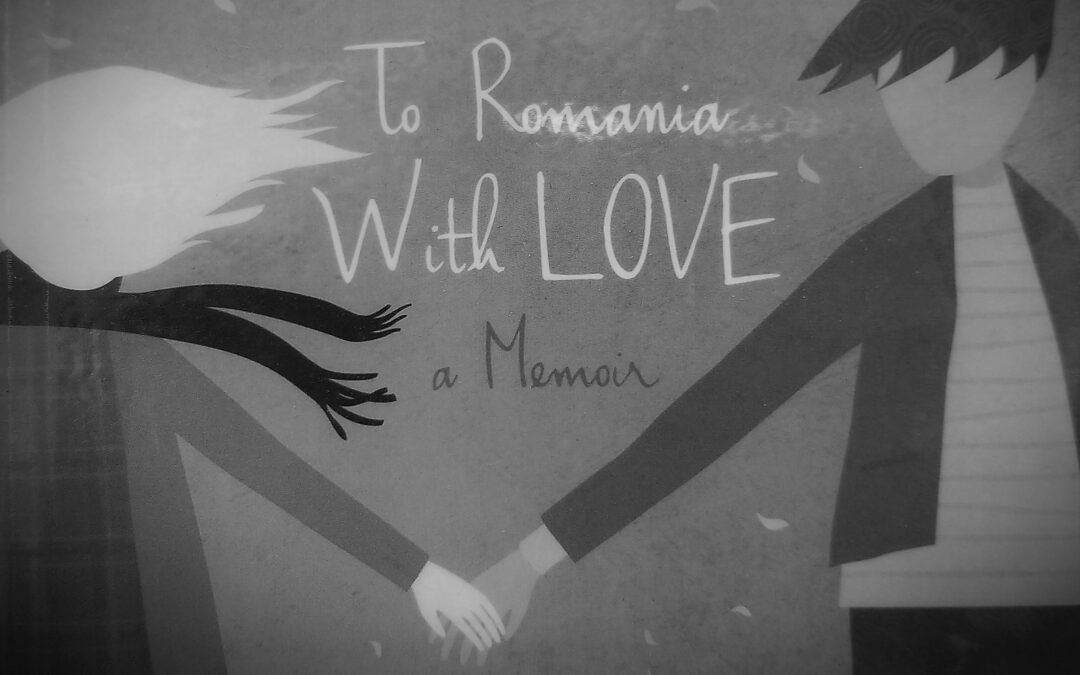
by Rupert Wolfe Murray | 27 Jan, 2021 | Reviews
I sometimes review* books on this blog — either because they are totally brilliant or really bad. This one is a bit of both. This is my view of Tessa Dunlop’s To Romania with LOVE, which was published in 2012
This is a book that should never have been published — the author’s introverted husband tried to stop it and is probably still cringing — but I’m glad it was because it’s a snapshot of a particular time in Romanian history and the details of an Anglo-Romanian relationship (endless family misunderstandings, Britain’s horrendous visa application system pre-Brexit, as well as wildly different attitudes towards money, work, leisure) are fascinating.
Now that we’re out of the EU maybe Britain will go back to imposing deliberately opaque immigration rules on people the British tabloids don’t approve of. Maybe it’s the end of easy cross-border marriages and divorces?
On one level I wouldn’t recommend this book to anyone as it’s badly edited (why didn’t they delete all the Romanian words she uses, without translation, plunging all non-Romanian speakers into confusion?); but on the other hand I’d recommend it to all those having a relationship with a Romanian. It offers an insight into their history of poverty and Communism, and the resulting behavioural patterns.
I almost didn’t get past the first few chapters, which are set in Romania, as they really grated. I know the area she describes, and worked in a nearby village at the same time (almost 30 years ago), and while there were no factual errors I didn’t like her style, pace and observations. She’s much better when describing things in the UK.
This rather breathless book is full of things that wouldn’t make sense to anyone who doesn’t know the locations. For example, on page 205 she writes “He almost ran down Jules Michelet…” Surely any normal reader would assume that he had almost “run down” someone with a French name with his car? Fortunately I happen to to know that Strada Jules Michelet is the location of the British Embassy in Bucharest.
What are editors and publishers for if not to spot such problems? Isn’t it obvious that if things only make sense to people who know the Romanian words that fill the book, not to mention the locations, they are drastically reducing their audience?
When I used to run a charity in Romania many of our volunteers would write reports using Romanian words, words like caruta (cart) that we would use daily; but they were writing for an internal audience in a small charity, not a big publishing house like Quartet.
There are also incidents in the UK that don’t make any sense: for example near the end of the book they go to visit her parents in Scotland; they hire a car and then, quite near the parents’ house, crash it; not only is there no mention of any detail of the actual accident; but in the next scene they are in Weston Super Mare — beyond Bristol, 500 miles to the south. Suddenly, in the very next scene, they are arriving at their parents house in the Highlands of Scotland, in a car that has a Tardis-like quality of repairing itself and being in two places at once.
None of this seems to bother the rave reviewers you can see on Goodreads, Amazon and on the back of the book. Toby Clements, of the Daily Telegraph, says “a rare, brave and honest account of finding love and holding on to it.”
The common theme running through all this praise is “honesty” and I have to agree with them. Despite my criticisms I liked this book and felt close to all the characters Tessa so lovingly described. Yes, they are all deeply flawed but aren’t we all? And, come to mention it, aren’t most marriages what the Americans would call “a train wreck”?
Tessa Dunlop not only shows great honesty in writing about a difficult relationship but also a lot of courage. This book should never have been written as one doesn’t write (or even Tweet) about relationship difficulties — it’s not the decent thing — so that bloke Clements from the Telegraph is right in saying that such courage in publishing stories like this is “rare”.
Reading this book makes me feel closer to Tessa, who I met a few times in Bucharest, and her introverted Romanian husband (who I never met and probably never will). Tessa clearly loves Romania as she’s produced a series of short YouTube videos about Great Romanians which are really very good — she has something of the delectable Joanna Lumley on screen — and I’m keen to read her next book which is about Romania’s stylish and clever Queen Marie “of Edinburgh”, who reigned in the inter-war period.
I’ve just realised the parallels between Tessa Dunlop and Queen Marie — both were upper class Scots who married Romanians in difficult circumstances; and I expect that as many people predicted the royal marriage wouldn’t work as said that Tessa’s love affair was just “another of her projects” and she would soon drop him.
As far as I know Tessa has managed to keep her marriage on the road, unlike me (I also married a Romanian) — and for this she deserves a lot of praise. Not only is it hard to keep any marriage together in this day and age, when divorce is so easy, but it’s especially hard when you marry a foreigner from a country that was put through the mill by the Communists.
A shorter version of this review was first published on Goodreads.
*A word about reviews: I only do them for books that inspire or infuriate me. Some of them are very old; books that I’ve stumbled across by chance; but books that are worth knowing about. I don’t think I’ve ever reviewed a new book because I don’t want to fork out an inflated amount — and this is my point here: the media only review new books because publishers send them free copies, take them out to lunch (or send them God knows what incentives during lockdown); the whole “review” part of the modern media is built around new things being sponsored, even though most of them are far worse than the classics. “Why not review the classics?” You might ask. You could make a series of in-depth articles out of them. The answer is simple; there’s no charming public-school girl persuading you do to so on the phone, or offering to take you out for a drink later on.
The other way author’s get reviews is call on their friends. This works particularly well when the friend is a journalist, as they have a lot more reach than my pals who can only post something on Amazon or Goodreads. You can spot this happening every time a journalist writes a book as its cover is plastered with praise from…other journalists.
That’s how the cookie crumbles when it comes to promoting books.
by Rupert Wolfe Murray | 11 Dec, 2019 | Journeys
I was cycling down the hill so fast I thought I might fly, like those kids in ET – Steven Spielberg’s classic film – when the alien enables the kids to fly their bikes through the night sky. It’s incredible what speed you can reach when going downhill on a good bike, even without pedalling.
Everything at that moment was perfect: the speed was exhilarating and the bike was handling it well (Bromptons are great at speed). The combination of cool autumn air and sharp sunlight marked a point of perfection in Romania’s calendar when the weather is just right – as if it’s recovering from the crushing heat of summer and preparing for the relentless cold of a long winter.
I was also in a beautiful spot. Surrounding my downhill piste was a thick pine forest that has not yet been pillaged by the Austrian timber companies (every Romanian knows that it’s the Austrians, and their “timber conservation” charities, such as Schweighofer Privatstiftung, who are de-foresting Romania).
And then I nearly died.
The road I was cycling on was the main route between Iasi and Botosani, two cities in north east Romania. I knew the drivers were annoyed, as they are all over the country, for their governments failure to build more than a few token miles of motorway – and in this part of the land there are not even the patches of motorway you find in Transylvania. My impression is that the drivers get their revenge on the system by driving as fast as they can, particularly those people who own the big German cars which are so powerful, and comfortable inside, that driving at high speed doesn’t feel dangerous at all.
There was a column of big cars heading my way, accelerating hard out of the village below and taking advantage of the forest cover ahead to make up for lost time. Suddenly a big BMW sharked out of the column, dropped a gear and put his foot to the floor; the car surged past those ahead and within seconds he was ahead of the pack and ready to get back in lane.
The fact there was a lone cyclist – i.e. me – on the other side of the road, directly in the path of the hurtling BMW, didn’t seem to have registered with the driver when he made his millisecond calculations about the risks of overtaking.
I’ve been cycling on Romania’s roads for over 20 years and it’s been a remarkably safe experience – even though many Romanians have told me “You’re crazy to cycle on our roads because our drivers are all insane,” (a comment which says more about how Romanians regard each other than the actual safety of the road. The fact is that no driver wants to run down a cyclist; not only on humanitarian grounds but the legal punishment for killing someone on the road are severe). In general, I’m very grateful for Romanian drivers for giving me space and letting me live.
But different rules apply to drivers of powerful cars that overtake in remote country locations: when they see an opportunity to overtake, they don’t seem to see cyclists; we become invisible. There is another insidious effect at work here, unique to countries like Romania where a macho driving culture prevails – it’s common to overtake and force oncoming drivers to pull over, slow down or just get out of the way. Truck drivers are prone to this kind of bullying behaviour, as well as beefy businessmen in their black muscle-cars.
In my case, it was all over in milliseconds. I wasn’t particularly aware of the imminent danger to my life but my subconscious (my Guardian Angel) was: I swerved towards my side of the road and the BMW rocketed past. When your life is on the line and the danger is imminent, instinct can kick in and save you. This has happened to me several times (here’s a story, in podcast format, of when I was attacked by three big dogs in Tibet).
I was still moving at what felt like high speed – maybe 30 km/h – and soon enough I was in the village that nestled at the foot of the forest: Copălău, location of a military base and an annual Garlic Festival. The column of big cars was long gone and I doubt that the BMW driver even registered the incident. I pulled over and it was only at this point that fear caught up with me; I had just had a near-death experience!
Enter the film crew
If the incident had been filmed it would have made the most incredible piece of TV footage. Imagine how delighted a TV news editor would be to get high-resolution footage of a road accident; not only would they play it on the news for days – even in slow motion – but they could have sold it abroad and whipped up moral outrage about reckless drivers, bad roads and the dangers that apparently surround us. It would have fed seamlessly into the media’s insatiable hunger for death, depravity and horror – a grotesque form of reality that is surprisingly addictive.
Well, guess what: the whole thing was filmed! I was on camera for most of my downhill run – not on some roadside camera or dashcam on one of the German cars, but on a high-quality lens on a filmmaker’s drone that was flying just ahead of me.
Why the hell, you may me wondering, was a filmmaker flying a drone in front of me as I tore down a country road in north east Romania? A fair question.
The answer is that I’ve been helping make a documentary film about the changes that took place over the last 30 years, since the Romanian revolution. The narrative follows what I did in 1990 (observing the aftermath of the revolution in Bucharest, helping a kids’ home in a Botosani village and working with the Roma minority) up to the present day. I’ve been in Romania on-and-off for most of the last 30 years, working on some really interesting stuff like Roma and child rights, journalism, regional development, helping Romania into the EU and, most recently, as an evaluator for EU projects. I also produced a couple of documentary films, including one about what people were talking about just After the Revolution.
Our new film is being produced by Mihai Dragolea and he’s using some of the footage that was shot by my old friend Laurentiu Calciu, whom I’ve known since 1986 when I first came to Romania; it was he who shot the After the Revolution material as well as my work in the kids home and with the Roma minority. He’s a great documentary filmmaker, but far too modest for his own good. You can see his showreel here.
I tried talking to the two filmmakers about my near-miss but they didn’t really take it in, as they had been so focussed on driving the car in front of me and operating the drone. This was totally fine by me as the last thing I wanted was to make a big deal out of it. The fear that I had felt after the incident soon left, as if part of that convoy of speeding cars.
A couple of hours later the filmmakers were driving down to Bucharest and I had decided to get out of the car at Targu Frumos and hop on the train to Iasi, the former capital of the ancient kingdom of Moldova – a city I wanted to discover. The incident with the BMW in the forest was being filed in my head as a non-traumatic memory.
by Rupert Wolfe Murray | 4 Dec, 2019 | Journeys
Since I first came to Romania in 1986, it’s been clear to me that Romanians don’t understand the full potential of the tourism business.
Over the 17 years I lived in Romania I’ve had countless conversations with people who own pensions, hotels and restaurants; village and city mayors and even a minister of tourism. All these people reacted in the same way to my advice on the tourism business: they get defensive and offer rationalisations about the unchanging nature of tourism.
I’ve never met anyone in Romanian tourism who is interested in my perspective – an individual traveller who wants to tour by bicycle, hitchhike, camp and stay in hostels, or with ordinary families in traditional houses that haven’t been homogenised with mass produced paint and furnishings.
It’s clear that the type of “individual” tourism that I do simply does not register with people in Romania’s tourism sector. They tend to see the business as in terms of “mass tourism”: huge resorts like Mamaia and Poiana Brasov.
Mass tourism certainly does exist in Romania and it’s done rather well. I’ve just been soaking in a sulphur pool in Calimanesti and love the old-Communist-era vibe to the place. A large number of low-income Romanians, such as pensioners, as well as the sick, get free tickets to these spas and that really is excellent. In my country (UK) I don’t think anyone gets a free holiday and, as a result, those who need one most – the poor, elderly and sick – don’t get them.
The missing opportunity
Tourism is one of the biggest business sectors in the world, accounting for about 10% of global GDP. The UN’s World Tourism Organization says “the business volume of tourism equals or even surpasses that of oil exports, food products or automobiles…This growth goes hand in hand with an increasing diversification…”
By not understanding the industry, and focusing exclusively on mass tourism, Romania is missing out on this huge business opportunity. By dismissing the sort of individual tourism I love – staying in traditional houses in the Moldavian countryside for example – thousands of potential micro-business ideas are dismissed by “experts” and never get off the ground. Imagine if every village had at least one traditional guest house and one campsite – all of which could be promoted on Google Maps and other free online services.
But people who own houses in beautiful locations are told they must tear it down and build a modern hotel if they want tourists – because we all (apparently) want standard modern buildings, cable TV, air conditioning and a bar. But from the business point of view why invest in a huge new building when all you need to do is tidy up the spare room and share the meals that you’re already making? We want to eat sarmale, ciorba, fresh veg from the market and tea from the garden; not frozen food and fizzy drinks from Kaufland.
About campsites: whenever I’ve suggested to village mayors, or rural householders, that they should organise a campsite they always think of reasons why it wouldn’t work. The most common rebuttal is that “nobody would come,” and if I say “I would,” they laugh dismissively. Then they say they’d need to build a “bloc sanitar” which is basically a toilet and washroom. I say they don’t need to build anything as travellers like me are used to “wild camping” — when you just put your tent up in a forest or somewhere out of sight — and having a designated location would be great.
Very few Romanian villages have campsites and those which exist are massive, noisy, smoky, crowded and horrible. The campsites could be set up in a simple field by a family that is willing to share their toilet and offer water and catering services. If nobody came then there would be no losses but if the site was registered on Google Maps and other (free) online services I think they’d get plenty of visitors. Thousands of bums like me are criss-crossing their beautiful land every summer.
Introducing the hostel
The other business opportunity that is appearing in Romania is the hostel – almost a century after they were common in west European cities. A hostel is an apartment (or house) with bunk beds in the rooms, shared bathrooms and an open kitchen. The cost is usually around 10 Euro a night, security is good (I’ve never heard about a robbery in a hostel) and I actually prefer hostels to hotels as the chances of meeting people are much higher.
The west European hostels I’ve stayed in tend to be massive, and sometimes very stylish, but many of the Romanian ones are in single apartments – which is fine. Every town and city in the land should have at least one as they are a useful low-cost option for visitors (as is Airbnb, but that’s a different kettle of fish I’m not going to discuss here).
I’ve stayed in two hostels in Bucharest, one of which (Midlands Hostel) has a great atmosphere and is very central; and one of which behaved towards me with an arrogance I found surprising (Umbrella Hostel). The other guests were foreign “backpackers” who like to party at night and sleep during the day – which was ideal for me as I would get up early and use the empty kitchen as my temporary writing office.
In Iasi I stayed in Andrei Hostel which is just behind the hospital on Copou, and is what we Brits call “Cheap and cheerful”. The guests were Romanian villagers coming to town for some nasty medical operation and Arab students using it as a temporary base before they rented a flat. We all got on fine and what I liked best was the owners had an “honesty box” for your registration form and 50 RON-a-night fee. What a great way to save money on personnel costs!
My hope is that Romanians can stop thinking of the tourism business as requiring millions of Euros, backed up by major strategic investments in infrastructure, and realise that there are many people who would love to stay in a traditional village house, or camp in a forest meadow, and take the opportunity that we in the west lost many generations ago – to get closer to nature.
#
What do you think? I’d be really grateful if you added a comment below — even negative comments are inspiring as we can debate the issue.

