by Rupert Wolfe Murray | 28 Oct, 2021 | Journeys
Bewilderment is the word which best describes my feelings when I got to Belgrade’s main station and found it to be abandoned. A flimsy wire fence was the only sign that this once-busy station, the hub of rail travel in the Balkans, has been closed down. Was I in the wrong place? No, I recognised the crumbling old buildings and the big outdoor panel that used to show arrivals, departures and foreign city names like Athens, Munich and Vienna. What had happened?
I’d just arrived by bus from Sarajevo, a slow but satisfying journey that took in the endless forests and mountains of Bosnia and a glorious, almost oriental in its beauty, river that runs along the Bosnian Serb border. I should have suspected something was up when the bus was arriving in Belgrade and we passed what seemed like mile-upon-mile of advertising hoardings showing well-lit, happy, handsome couples. I didn’t realise at the time that these happy-go-lucky images of wealth and success were hiding the vast tract of land that had once been the railway lines from the six republics of the former Yugoslavia converging on what was the most important station in the land.
My carefully laid plan of onward travel to Romania was now being flushed down the toilet. Where was the station? How would I get to Timisoara? For years I had come to this station from Romania, where I used to live, and gone on to Bosnia, or Montenegro. I knew the layout: I knew where to leave my luggage, where to get information and tickets. And once these arrangements were made there was usually time to visit the centre of Belgrade, an architectural collage of Paris, London and Vienna, visit the wonderful bookshops and eat something delicious.
My bus had arrived in a sort of no-mans-land between a vast building site and the abandoned railway station. Half the passengers went one way, away from the old railway station, and the rest of us went towards it. Nobody else was standing still, lost in memories about the dead station. They just headed towards a gap in the fence and, trailing behind like a lost puppy, I followed them out onto the main street.
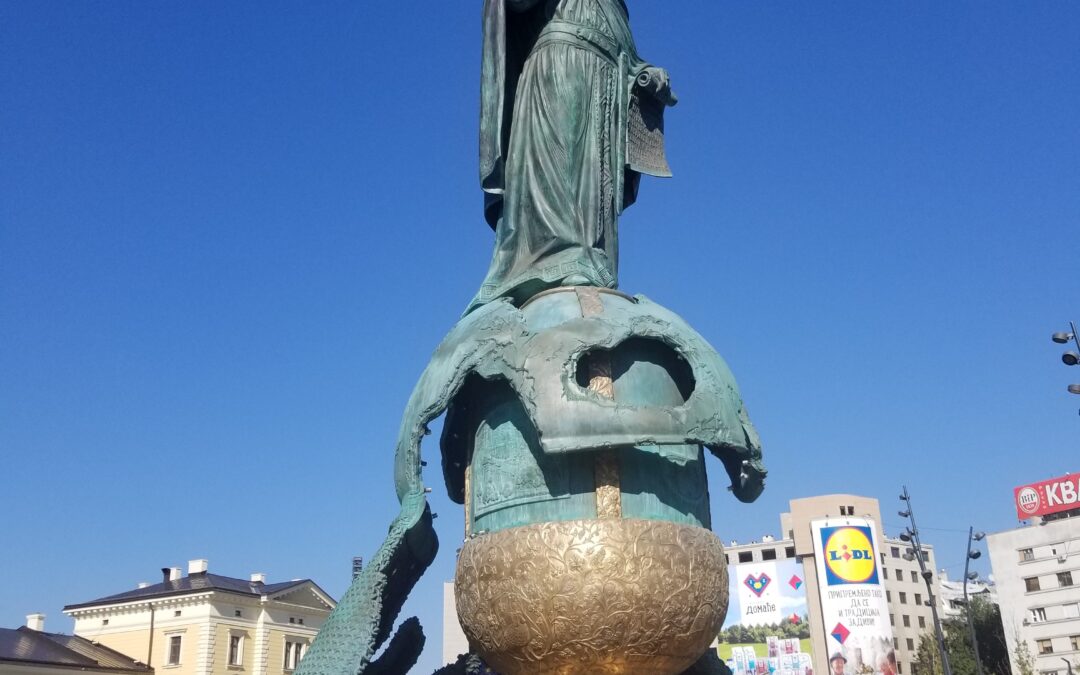
Monument to Gandalf
Although the inside of Belgrade’s station looked ready for the wrecking ball a coat of paint had been slapped on the outside, as if to remind hopeful travellers that all is well and soon they’ll be able to get their tickets and board the train. It reminded me of an aging prostitute who had applied lipstick and makeup in an attempt to recreate the vigour of a lost youth. Gone were the gypsy musicians of yore, with their raucous brass band, the beefy taxi drivers jostling for business, old buses belching diesel fumes, the noisy stalls selling cheap Chinese goods and grilled meat. The absence of the sounds I’d been expecting was eery. In the space once occupied by taxis and buses was now a crude attempt at a formal garden: strips of bright green turf had been laid and, to me, it felt out of place.
Towering above this rather awkward new space is a 12 metre high statue of a fierce-looking priest in a robe, holding aloft a massive sword. Was this an homage to Gandalf or the white-robed character played by Christopher Lee in Lord of the Rings? The druid-warrior was standing on two rounded objects, one of which looked like a helmet and the other was either a skull or a globe. The skull made me wonder if the sculptor, who’d obviously been given a big budget as the whole monstrosity had been cast in bronze, liked heavy metal music.
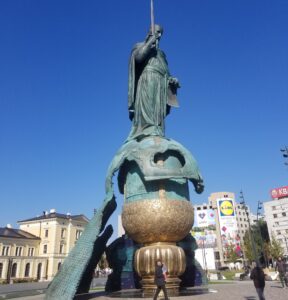
A vast new statue has been raised to Serb nationalism
I wondered what this strange new sculpture represented and looked for an explanatory notice but the only sign was in the Cyrillic alphabet, which I can partially understand, but it was written in the archaic form and so its meaning was lost to me. Immediately I jumped to my own conclusion: they had built a massive new statue to the Serbian Orthodox Church, which had stood proudly behind President Milosevic who had unleashed the forces of extreme nationalism resulting in years of bloody war in Croatia, Bosnia and Kosovo.
Needless to say my assumption was totally wrong. Later on that day I met an old friend, a sculptor, artist and documentary filmmaker. He laughed at my naïve understanding of the statue, agreed that it was far too big and on the kitsch side, but told me the character being portrayed was an ancient Serbian king who had stood up to the Roman empire and carved out a homeland for the Serbs many eons ago.
He also told me there were no longer any public transport links with Romania, one of Serbia’s main neighbouring countries. Gone was the old-fashioned sleeper train that would trundle over the border and slowly make its way, through the night, to Bucharest. Gone too was the public bus service to Timisoara, Romania’s nearest city, and even the private minibuses that used to leave for Romania frequently. The message was clear: the poor don’t matter. Serbia’s capitalist government, like so many in Eastern Europe, was throwing away the Communist-era endowment of good public transport infrastructure and leaving open only two options for travel: car or plane.
My friend said the only way to reach Romania was to get a bus to the town of Vrsac (pronounced Verr Shatz) and then hitch hike or get a taxi to the border. I realised I’d have to spend a night in Belgrade, which would be a pleasure as it’s a beautiful city and went off to find a hostel.
We reconvened that night at an unusual vegan restaurant and I got the full story of the missing railway station. Realising the enormous value of the land occupied by the station and, especially, the large number of tracks coming into it, the city council had decided to sell it to building developers and move the station several miles away. The deal must have been worth billions. Assuming that most of these local politicians were either rich, or in the process of getting rich, I’m sure not much time was spent discussing the inconvenience to ordinary people of moving the station from the centre to the periphery.
What surprised me most about this sorry tale is that the building contractors who were in charge of the destruction were from Turkey, the nation that Serb nationalist’s rail against and blame for 500 years of Ottoman Empire occupation.
Understanding Serb nationalists
The next morning I caught the early bus to Vrsac and then a taxi to the Serb Romanian border. The taxi driver was a cheery old drunk and he roared with laughter when I told him I’m from Scotland. What was I doing here, on this once-busy road that had been emptied of all traffic by the pandemic? He told me to watch out for thieves in Romania.
The Serbian border post seemed deserted. An angry policewoman appeared and told me to wait by an empty booth, where I could see a half-read novel and a mobile phone. Eventually a young policeman showed up and took his time to arrange everything in his booth, presumably to make sure he gave off the right aura of officialdom. The problem was the booth was made of glass and I could see everything he was doing. I noticed he put away the paperback and the mobile phone, turned on his PC and put everything in its correct place. After stamping my passport he spent far longer than necessary examining it as if looking for a clue that I was, in fact, an international criminal.
The customs official laughed when I asked if there were any buses, trains or taxis nearby so I picked up my rucksack and walked towards Timisoara, over 60 kilometres away, hoping to hitch a lift. But there was hardly any traffic and when a truck did pass it would be going at such a high speed that I could understand why they wouldn’t want to lose that momentum for a hitch hiker.
After about three kilometres I reached a village where I hoped to find something to eat, if not some information about public transport. By this point I had realised that nobody was going to give me a lift, having forgotten that one of the rules of hitch hiking is that it’s only when you give up all hope does a vehicle actually stop. I was just saying to myself “What I need is a miracle” when an old man in a Fiat Panda with Serb plates pulled up and gave me a lift. He was friendly, as most Serbs are, but my store of words in his language soon ran out and we resorted to Romanian which both of us speak fluently. He’d married a Romanian woman, had two kids, lived in Romania for seventeen years, as had I, and was now retired in Serbia. He drove me to the outskirts of Timisoara where he passed me over to his son, an estate agent, who took me into the city.
The old man was so generous and friendly that when he started spouting the Serb nationalist view of the wars of the 1990s I didn’t want to challenge him. So I just listened, hoping to get an insight into the Serb view of the breakup of Yugoslavia. His main point was that America “wanted to break up Yugoslavia” and did so by causing the war. My only intervention was to ask why would America want to break up what was a big market where they could sell goods and services? Surely it’s easier to sell into one market rather than 7 independent nations (Croatia, Bosnia, Kosovo, North Macedonia, Montenegro, Serbia and Slovenia)?
“No,” he replied, “America was afraid of the Yugoslav National Army, one of the biggest armies in Europe, and they had to break it up.” Also, he claimed, that one of the results of this breakup was the liberalisation of the smuggling routes from Asia into Europe, “all of which go through Serbia and the Balkans.”
I often come across this kind of thinking in the Balkans: all the disasters that happened to Yugoslavia are the fault of evil outsiders; the wars in Croatia, Bosnia and Kosovo were orchestrated by a secretive group of power brokers who control the whole world for their own profit. The advantage of this nationalistic approach is that you have one simple narrative that explains everything and you never need to take responsibility for your nation’s own actions. It goes hand in hand with a victim complex – namely that the Serbs were the victim of these wars rather than the initiators. This isn’t to say that the other combatant nations didn’t do evil things too, or that the outside powers didn’t intervene and mess things up further, but I think it’s helpful for each country’s development, and each person, to take responsibility. A culture of denial and blame is toxic.
I want to end this article and not get deeper into Serb nationalism as it’s a can of worms. Apart from anything else the Serbs are a friendly and intelligent people and if you avoid these subjects you can have a wonderful time in Belgrade. But I will refer you to this piece I wrote for Quora which looks at an American historian whose claim that the USA “ordered” the breakup of Yugoslavia is contradicted by his own evidence. If you’re interested you can read all about it here.
I’d really appreciate it if you’d add a comment below. What do you think about all this? What’s your experience or understanding of nationalism?
by Rupert Wolfe Murray | 5 Jan, 2020 | Journeys
My Romanian sister in law was rather horrified to hear that I wanted to take her 12-year old daughter hitching. But she’s open-minded enough to realise that the chances of robbery, rape or abduction — or any of the horrors that the media feed us — are negligible in the Scottish Borders which is, after all, a scarcely populated wilderness where everyone knows everyone else.
She also knows that I’ve hitched hiked in Romania, and alo Asia, (see Hitching into Tibet), and that I’d be unlikely to sell her daughter into slavery.
Hitching is a great way to go. Not only is it a cheap means of transport but it’s a guaranteed way to meet people. It requires an element of humility and that’s something we all need. The risks are low, probably less than cycling, but the media love to sensationalise any isolated incident resulting in unfounded fears about this most brilliant way of getting around.
What makes hitching particularly relevant today is that it’s an excellent method of travel without producing carbon emissions. Of course you could say that by getting in someone else’s vehicle you are, in fact, emitting hundreds of grammes of carbon per kilometre — but these people will criticise, dissemble and rationalise anything you do to reduce your carbon footprint. It’s their form of defending the status quo.
Is hitching really so great?
The problem with hitching is that, more often than not, you end up at the side of the road — in the Scottish cold and rain or the baking heat of Romania’s summer — for hours on end; and the longer you don’t get a lift, the more you lose faith in human nature.
But when you do get a lift you get a rush of joy and your faith in humanity is instantly restored.
So when my niece and I got a lift, within a few minutes of standing at the side of the road, I was amazed. This just doesn’t happen to me; usually I have to walk for miles, or wait for hours and sometimes I cheat by hopping on a bus. But, looking at it from the driver’s point of view, picking up an adult with a kid is helpful and community-minded but picking up a lone, weird-looking man probably seems to the driver more risky (half remembered news stories of men with knives, and fragmented memories from horror films, probably flashes through their minds).
The kindly lady-driver took us for a few miles, left us at a junction and after walking a few hundred yards we got another lift — and then things started to get really interesting, as often happens when hitching.
Learning about dogs and war
My niece got into the back of a large estate car and was immediately covered in friendly dogs; she didn’t complain. I got in front and started chatting with the overweight driver, who looked like he was about 60 and sounded English. We drove on through the hills.
“You know what the fastest animal on Earth is,” he asked.
“Er…isn’t it the leopard?”
“You need to re-frame the question. The answer is ‘Over what distance?’”
“Eh? I don’t understand.”
“It’s like this. The leopard can reach the fastest speed over short distances, but it soon runs out of steam. Over a medium distance the dog is the fastest; but can you guess what’s fastest over long distances?”
“Er…a horse.”
“No. It’s a human. A man can run more or less indefinitely. Did you know that the American Indians used to hunt deer by chasing them for day after day, until the poor beast dropped with exhaustion? And they used to tame wild horses by chasing them until the animal just gave up, turned towards the pursuing man and accepted his domination.”
This guy was fascinating and I was an eager listener. As my niece was being used as a dog bed in the back seat I was plying him with more questions, trying to learn more about the wisdom of indiginous people — from whom we can learn a lot about protecting our planet. But he changed tack and started talking about the 1982 Falklands War, when Maggie Thatcher sent our armed forces to the other side of the world to reclaim some sheep-filled islands the Argentians had occupied.
“I was in the air force back then,” he explained. “I was in charge of supplying our base in the Ascension Islands which is half way between the UK and the Falklands.” These islands are located in the middle of the Atlantic Ocean, but they’re so small as to be almost invisible.
He then told me something truly amazing, that I’ve never seen mentioned elsewhere in all the books and films I’ve seen on the issue. He explained that all the fuel needed for the Falklands War was stored in huge rubber envelope-shaped containers that were laid out by the sea-shore on the Ascension Islands. I know the kind of containers he meant as the aid agencies used to install them on hospital roofs during the Bosnian war, as vast water tanks.
“If the Argentinians had known about this fuel dump,” he said, “and if they’d had a few daring commandos in a rubber dinghy, they could have turned up with a mortar and blown the whole lot up. It would have been game-over in an instant.”
I love stories like these — offering an inside view and a new insight into an event that you think you already understood. It turns your knowledge on its head and makes you realise that you only ever really know a fraction of the full story (and, as long as you can accept that you don’t need to know everything, it’s fine).
It was also a reminder that hitching is one of the most friendly and interesting modes of transport, as you are more likely to have a conversation than on the bus, train or plane — and sometimes these conversations are fascinating.