by Rupert Wolfe Murray | 11 Dec, 2019 | Journeys
I was cycling down the hill so fast I thought I might fly, like those kids in ET – Steven Spielberg’s classic film – when the alien enables the kids to fly their bikes through the night sky. It’s incredible what speed you can reach when going downhill on a good bike, even without pedalling.
Everything at that moment was perfect: the speed was exhilarating and the bike was handling it well (Bromptons are great at speed). The combination of cool autumn air and sharp sunlight marked a point of perfection in Romania’s calendar when the weather is just right – as if it’s recovering from the crushing heat of summer and preparing for the relentless cold of a long winter.
I was also in a beautiful spot. Surrounding my downhill piste was a thick pine forest that has not yet been pillaged by the Austrian timber companies (every Romanian knows that it’s the Austrians, and their “timber conservation” charities, such as Schweighofer Privatstiftung, who are de-foresting Romania).
And then I nearly died.
The road I was cycling on was the main route between Iasi and Botosani, two cities in north east Romania. I knew the drivers were annoyed, as they are all over the country, for their governments failure to build more than a few token miles of motorway – and in this part of the land there are not even the patches of motorway you find in Transylvania. My impression is that the drivers get their revenge on the system by driving as fast as they can, particularly those people who own the big German cars which are so powerful, and comfortable inside, that driving at high speed doesn’t feel dangerous at all.
There was a column of big cars heading my way, accelerating hard out of the village below and taking advantage of the forest cover ahead to make up for lost time. Suddenly a big BMW sharked out of the column, dropped a gear and put his foot to the floor; the car surged past those ahead and within seconds he was ahead of the pack and ready to get back in lane.
The fact there was a lone cyclist – i.e. me – on the other side of the road, directly in the path of the hurtling BMW, didn’t seem to have registered with the driver when he made his millisecond calculations about the risks of overtaking.
I’ve been cycling on Romania’s roads for over 20 years and it’s been a remarkably safe experience – even though many Romanians have told me “You’re crazy to cycle on our roads because our drivers are all insane,” (a comment which says more about how Romanians regard each other than the actual safety of the road. The fact is that no driver wants to run down a cyclist; not only on humanitarian grounds but the legal punishment for killing someone on the road are severe). In general, I’m very grateful for Romanian drivers for giving me space and letting me live.
But different rules apply to drivers of powerful cars that overtake in remote country locations: when they see an opportunity to overtake, they don’t seem to see cyclists; we become invisible. There is another insidious effect at work here, unique to countries like Romania where a macho driving culture prevails – it’s common to overtake and force oncoming drivers to pull over, slow down or just get out of the way. Truck drivers are prone to this kind of bullying behaviour, as well as beefy businessmen in their black muscle-cars.
In my case, it was all over in milliseconds. I wasn’t particularly aware of the imminent danger to my life but my subconscious (my Guardian Angel) was: I swerved towards my side of the road and the BMW rocketed past. When your life is on the line and the danger is imminent, instinct can kick in and save you. This has happened to me several times (here’s a story, in podcast format, of when I was attacked by three big dogs in Tibet).
I was still moving at what felt like high speed – maybe 30 km/h – and soon enough I was in the village that nestled at the foot of the forest: Copălău, location of a military base and an annual Garlic Festival. The column of big cars was long gone and I doubt that the BMW driver even registered the incident. I pulled over and it was only at this point that fear caught up with me; I had just had a near-death experience!
Enter the film crew
If the incident had been filmed it would have made the most incredible piece of TV footage. Imagine how delighted a TV news editor would be to get high-resolution footage of a road accident; not only would they play it on the news for days – even in slow motion – but they could have sold it abroad and whipped up moral outrage about reckless drivers, bad roads and the dangers that apparently surround us. It would have fed seamlessly into the media’s insatiable hunger for death, depravity and horror – a grotesque form of reality that is surprisingly addictive.
Well, guess what: the whole thing was filmed! I was on camera for most of my downhill run – not on some roadside camera or dashcam on one of the German cars, but on a high-quality lens on a filmmaker’s drone that was flying just ahead of me.
Why the hell, you may me wondering, was a filmmaker flying a drone in front of me as I tore down a country road in north east Romania? A fair question.
The answer is that I’ve been helping make a documentary film about the changes that took place over the last 30 years, since the Romanian revolution. The narrative follows what I did in 1990 (observing the aftermath of the revolution in Bucharest, helping a kids’ home in a Botosani village and working with the Roma minority) up to the present day. I’ve been in Romania on-and-off for most of the last 30 years, working on some really interesting stuff like Roma and child rights, journalism, regional development, helping Romania into the EU and, most recently, as an evaluator for EU projects. I also produced a couple of documentary films, including one about what people were talking about just After the Revolution.
Our new film is being produced by Mihai Dragolea and he’s using some of the footage that was shot by my old friend Laurentiu Calciu, whom I’ve known since 1986 when I first came to Romania; it was he who shot the After the Revolution material as well as my work in the kids home and with the Roma minority. He’s a great documentary filmmaker, but far too modest for his own good. You can see his showreel here.
I tried talking to the two filmmakers about my near-miss but they didn’t really take it in, as they had been so focussed on driving the car in front of me and operating the drone. This was totally fine by me as the last thing I wanted was to make a big deal out of it. The fear that I had felt after the incident soon left, as if part of that convoy of speeding cars.
A couple of hours later the filmmakers were driving down to Bucharest and I had decided to get out of the car at Targu Frumos and hop on the train to Iasi, the former capital of the ancient kingdom of Moldova – a city I wanted to discover. The incident with the BMW in the forest was being filed in my head as a non-traumatic memory.
by Rupert Wolfe Murray | 26 Jan, 2018 | Journeys, Nepal and Tibet
My brother’s house in Kathmandu is old, narrow and tall. At the bottom of the house is a dark room which doubles up as an entrance hall and bicycle garage. This is where I am, getting ready to cycle across town.
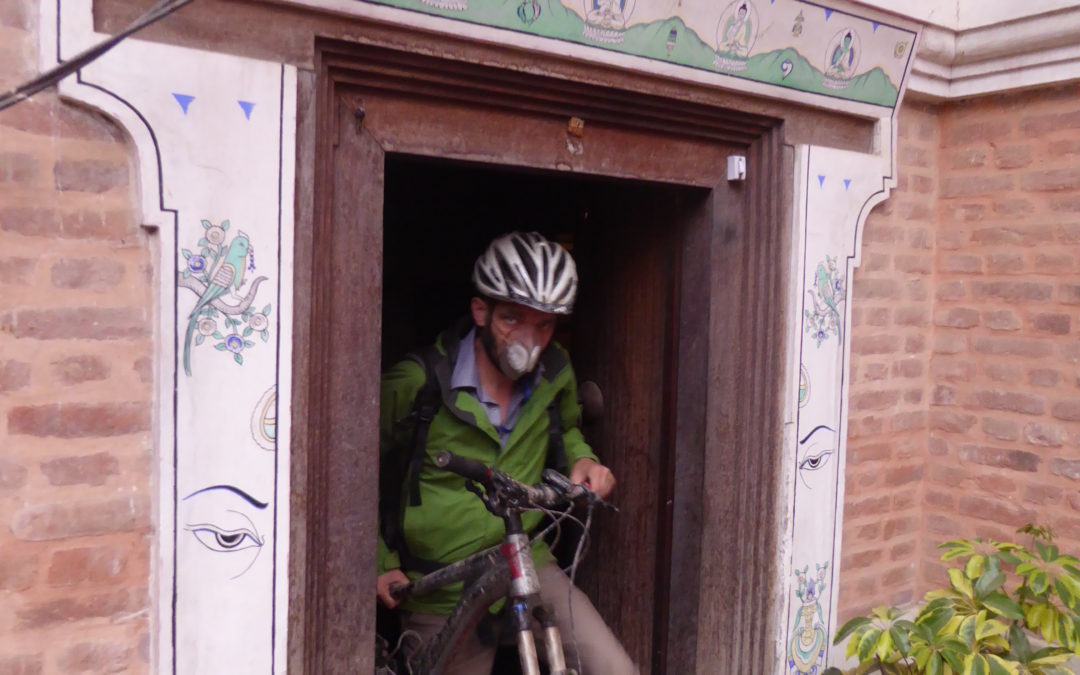
I’m wearing good trousers (I’m going to a meeting) and want to protect them from the oily chain so I put on bike clips. Then I put on one of those futuristic (and, in my view, quite useless*) bike helmets and a dust mask.
Standing in the semi-darkness, gripping the handlebars of the borrowed mountain bike, I feel tough and fit (even though I’m neither). I open the double wooden doors and step out into the bright sunlight, putting on my brother’s sunglasses and completing what is effectively a mask. Nobody can see who I am and I relish the anonymity; I can pretend to be a local as I prepare to dive into the flowing mass of vehicles that pumps through Kathmandu like a great river.
I take off the mask for a moment and inhale the morning air in the yard; it feels damp and fresh and there is a whiff of incense and rotting rubbish. A proud chicken struts across the yard, puffed up and arrogant, ignoring the stray dog that lies curled up in a ball by the wall. The dog would be white if it was washed but nobody would do such a thing as it doesn’t belong to anyone; it’s the local stray and it’s always here in the yard — sleeping by day and barking all night.
Now I’m on a narrow street that leads up to the centre of Patan, the ancient part of Kathmandu where my brother lives. There are old buildings in this part of town but most of the city has been rebuilt in concrete. Motorbikes fly by constantly and the occasional car or small van thrusts through, holding up traffic and bringing the speed down to walking pace.
If Kathmandu was a body these little streets would be the capillaries — small, narrow, anonymous and legion — and the main roads would be the arteries. During the day streets are packed with vehicles, all the time, as hundreds of thousands of people hurry to and fro, doing their business, going to work. Two million people live in this ancient city that was built for a tenth of that number. A taxi driver told me that more and more people are buying cars with easy bank loans, but the government isn’t improving the roads and soon the traffic will come to a standstill: gridlock. Pollution hangs like a blanket over the city.
Soon I reach the main road and I plunge in, like a minnow joining a fast flowing river that is full of racing fish.
When I first got to Kathmandu I looked at the traffic and wondered how anyone could survive it; so many vehicles, no traffic lights and no rules. It looks like complete chaos. But when I join the flow of traffic, catch up with them, and go at their speed, it feels totally different.
I am now part of the flow and I realise several things: we are moving quite slowly; all the motorbikes and cars are going the same speed as the bikes. There are no white lines marking different lanes, but this is no problem as everyone is keeping an eye on what’s going on in front of them and we form lanes naturally, as if following some natural law. If someone changes lanes, slows down or stops at the side of the road those behind react accordingly and momentarily make a space for them.
The way that cows and people are treated by the traffic are testament to the safety of the system. I made this 40 second video of some calves sitting in the middle of a busy road, chewing the cud, talking among themselves, while four lanes of traffic roar past on both sides. These beasts are sacred to Hindus and all drivers avoid hitting them. The same goes for people — nobody wants to hit them — and I’ve seen women cross an incredibly busy road, chatting gaily to one another, not looking left nor right, and crossing over with the absolute confidence that they will get to the other side unharmed.
It feels exciting and I am in a race with the other vehicles. Can I beat that motorbike through this tangle of cars? (Yes! I am nimbler in traffic than his much more powerful machine.) Is my humble bike faster than that flash car? Yes! Lumbering buses and taxis are easy to beat and I’m approaching a bicycle ahead so I accelerate, overtake and leave him in my wake.
In mindfulness and meditation they say you should try and be in the present moment, but this is a lot easier said than done; stopping your thoughts is like trying to get a classroom of young children to be quiet . But when cycling in Kathmandu you can’t dwell in the past or worry about the future; you need to focus all your energy on what’s going on around you at that very moment — so you can react accordingly. My life depends on seeing what the vehicles around me are doing. My eyesight, instinct and hearing perform at levels they have never done before (hearing is essential — the sound of screaming engines, or brakes, is a danger signal).
I accelerate past a slow cyclist. Ten seconds earlier he had filled my field of vision, overtaking him was my sole purpose in life; but now he’s gone and I’ve already forgotten about him. I feel like a medieval soldier, with sword and shield, hacking my way through enemy ranks, not sparing a thought for those I strike down.
I’m now fully focused on my next move. I’m riding between a battered taxi on my left and a packed bus on my right; I need to get out of this moving corridor; but changing lanes isn’t easy as you must ensure that the drivers see you — this is the key rule — if you are seen you are safe — and that means getting ahead of them a few metres. The ability to accelerate is key.
The safest place to be is on the left, the slow lane, but it’s frustrating there as you butt into pedestrians, cows, muddy potholes and the occasional parked vehicle. It’s also far too slow. The most exciting place to be is in the middle of the road, on the invisible line between the oncoming traffic.
The oncoming traffic is being held up by a traffic policeman and a gap appears on the other side of the road. I take advantage and leap into the empty space, racing ahead of my plodding competitors. I race forward on the wrong side of the road and my brain calculates the best moment to dive back into my side.
I reach my meeting with Mercy Corps, an Edinburgh-based aid agency, ahead of time and have a few minutes to dismount, cool down and get into the right frame of mind for chatting to people. I go into the yard of the NGO and lock up my bike with a thin chain, perfectly useless against a proper bike thief; but locking a bike is a ritual for me and it puts my mind at rest. They say that few bikes are stolen in Kathmandu and everyone uses these spindly locks.
I love cycling in Kathmandu but assume most people wouldn’t. Many people I have talked to about cycling in cities complain about cars and believe that the only safe riding is on dedicated cycle lanes. My view is that cyclists must constantly observe, adapt and treat all cars, as well as pedestrians, as hazards. No point whining about them; it’s like complaining about the weather.
As far as I am concerned a bike is just another means of transport that must share the road with cars, buses and trucks. Drivers have no intention of knocking cyclists down, if only because it might result in a long jail sentence; if they can see you, and you’re on a predictable line, they will treat you with respect.
My rules for safe city cycling — in Scotland as well as in Nepal — are to be seen and to understand the behaviour of vehicles. The fact that I have driven cars for many years means that I know how drivers react, and this makes cycling so much safer. As long as you keep the main rule in mind — be seen by the drivers — then you will be safe.
There are certain types of cyclists who, I think, would appreciate the challenge of riding a bike in somewhere like Kathmandu. These are mountain bikers and BMX riders, all of whom know how to instantaneously react to obstacles. Those types of riders have to live in the present, they must react in milliseconds and they do things that most people think are insane. I think their type of riding is similar to riding in the Orient and they will know there is absolutely no point in blaming others when things go wrong.
#
Photo of my brother Magnus coming out of his house in Patan, Kathmandu. Taken by Yours Truly (with his camera).
* I said bike helmets are “useless” and here’s why: they are loose, they slide around your head and offer no protection to the side of your head. They might offer some protection if you somehow landed on the top of your head. All they do is create the illusion of safety. Compare them to motorbike or rock climbing helmets, which are clamped on firmly and would protect every part of your noggin. But I do use bike helmets as they are ideal sun hats; the big chunks of compressed polystyrene that they are made from can protect you from the sun’s rays and also let plenty of fresh air in.
A shorter version of this article was published by the Sunday Herald in Glasgow, with this by-line: “Rupert Wolfe Murray is a freelance writer living near Selkirk. His trip to Nepal was not funded by a travel agency, resort, bike company or any other sponsor.”
In case you’re wondering, I am now living in Edinburgh and commuting to a new job in Stirling (I’m editing this article on the train). I work for an outfit called The Writer and I’m really enjoying it. This article is about a trip I did to Nepal last year. I’d love to get your feedback, however rude or negative. Please add a comment. It’s what keeps me going.

