by Rupert Wolfe Murray | 26 Nov, 2025 | 12Jobsin12Months, Advice for Future Travellers, Journeys, Psychology of Travel, Travel Advice & Skills
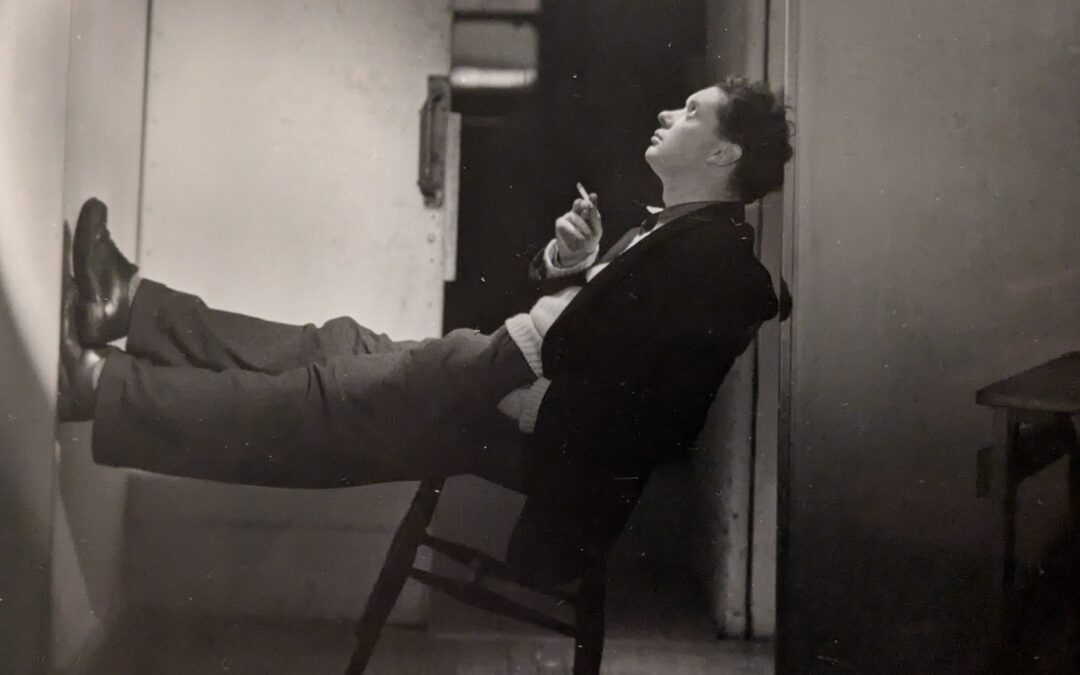
Photo: Dylan Thomas by Lee Miller.
There’s plenty of videos, articles and books about how to write a book, make a video, do any kind of art form, or even learn a trade — and this is great as it gives people enough of an insight to try things out.
But I’ve never come across anything that discusses why we should work. Maybe it’s so embedded in our culture, from our earliest years, all through school and over family meals, that it’s just taken for granted that we simply have to get a job after our educational process. Like walking or breathing, we just do it. But why?
Why do I work?
The starting point for me was when I was 9 years old, the age that I became aware that I was an independent entity and didn’t have to rely on my parents for everything. But I had a problem with school — I didn’t understand why I was there or what was going on. I felt stupid, bored and angry. I took out my frustrations on my three brothers, all of whom got on really well at school, and we fought like cat and dog most days of the week.
I knew I had to get away from the toxic family environment I had created and the first opportunity was to visit my aunt Virginia in England (we lived in Scotland). I was allowed to get the train to visit her and nobody blinked an eyelid that I was travelling alone. This, to me, was excitement and independence and when my cousin taught me how to smoke cigarettes I felt very grown up.
At around that age I realised that work (doing a job) was another means of getting away from my brothers, from boredom, and the expectation to do homework. It was also what adults spent their days doing so it had, for me, a certain allure, an attraction.
My first “job” was more like a short lived company: I would cut down Christmas trees in the local woods — we lived in deep countryside near the Scottish town of Peebles — and sell them to neighbours. It was a powerful moment as I was proving to myself that I could take a step towards independence.
My next big moment was at university in Liverpool where I realised that going to lectures, reading books in the library, and hanging out with my geeky colleagues was really boring. I met a relative at a wedding who put me in touch with a property developer who hired me as a labourer on his building site — and I was in heaven as most of the tradesmen on site were ex-cons and the banter was hilarious. Lunch break consisted of going to the pub and drinking as much beer as we could. One of them later told me, “What we like about you Rupert is that we can take the piss, but you don’t take offence. It’s like water off a duck’s back.” That was high praise from a tough scouser who’d spent three years inside for burglary.
By this stage in life I had worked out how to play the educational game — a minimal effort would see me through. The burden I’d carried through my first 10 years of school — that I’m an idiot — had been replaced with a powerful confidence that I could do anything I put my mind to — and a drive to help others get over those same barriers. The fact that I’d been able to get work easily — driving a truck for my Dad and selling books for my Mum’s publishing company were other jobs I did when a student — added to my self confidence. And confidence is a key requirement when travelling independently or getting jobs.
After university I avoided the siren call of big business and decided to hitchhike to Shanghai, and prove to myself that I’d be able to get a job without the benign influence of my parents. I never made it to Shanghai as I fell in love with Tibet where I found work as an English teacher, got kicked out by the Chinese police and ended up falling into journalism.
Since then I worked as a volunteer aid worker in Romania and Bosnia-Herzegovina and, after getting married, I realised that I needed to earn some real money. I managed to worm my way into working as a consultant for EU and British government projects in Romania, Russia and the former Yugoslavia. I also worked as a PR consultant and, since lockdown, as a painter/decorator and gardener.
If I look back and ask myself why I did all those jobs, and what drove me, the main answer can be summed up in one word: independence. It’s all very well wanting to be independent but how can you survive for more than a few months on your savings? You may have rich parents but they’ll probably be worried, nagging you to come home, find a suitable wife, get a well paid job (“Daddy will arrange it!”) and settle down. You’ll soon realise that the only way to stay on the road, to maintain your independence, is to not only get a job — but learn how to get jobs quickly, anywhere.
But that’s not a complete answer; there’s something else at play here. I need to work or I get bored, lazy and depressed. The fact that work gives me motivation to get up in the morning, and provides an easy-to-follow programme for the day is what I’ve grown up with. It’s a part of my culture.
I first became aware of this problem — the sloth that comes with unemployment — when I finished running an EU project in Romania. The project had been really demanding, it required all my energy and time, and I was looking forward to a few months off when I’d be able to catch up with my sleep, hobbies, house repairs etc. But what happened? Nothing. Doing the most basic tasks seemed to take forever. All my energy, drive, and focus just evaporated. Why? Because I didn’t have anything I had to do every day; I had no reason to get up in the morning. When your intention is to do hobbies or exercises you always have a choice: shall I do it today or not? With work you don’t have that choice — you just have to show up.
In order to stay motivated, structured and focused I realised that I need a job — or an intense project — or I would enable the lazy part of my character, get nothing done and end up being miserable. I need a job of some sort to get out of bed in the morning.
Retirement is a useful concept to end this article on, but I think that it’s a trap. If I stop working in four years time, at the age of 67, as one is supposed to do, it will emotionally disable me and probably lead to an early grave. I intend to work until I drop, or have to be carried off, gibbering and dribbling, to a care home.
So, in conclusion, why work? I do it so I can live happily and longer than I would do otherwise.
Now it’s over to you: Will you leave a comment below? Most comments add to the richness of my articles. Maybe you could explain what motivates you to work? Or not; I’d also be interested in any comments that explains the rationale for not working, or describing something other than work which can provide the daily motivation we all need to go on. Or maybe you could just tell the story of your first job?
My book 12 Jobs in 12 Months will be published in February 2026, by Stone Books (Edinburgh).
Final note: the photo associated with this article is of the great Welsh poet Dylan Thomas, by Lee Miller.
by Rupert Wolfe Murray | 30 Oct, 2025 | 12Jobsin12Months, Advice for Future Travellers, Travel Advice & Skills
When someone asks me “How did you get 12 Jobs in 12 Months? (the title of my forthcoming book) I go into a rant about the usual approach to getting a job: someone does a CV with the help of AI; it goes to the employer who, with the help of AI, assesses the CV and … ignores it. My friend Steve Harvey calls it “AI tennis!” The result: rejection, anxiety and despair.
But it doesn’t have to be like that.
When I was leaving university, in Liverpool, I decided to avoid the big companies that were hoovering up my friends. I saw a fixed career as a trap, with mortgages and marriage as the manacles. I wanted independence, variety, risk and excitement. My plan was to learn to be an English teacher and hitchhike to Shanghai. I never made it there but I did spend 9 Months in Tibet, 17 years in Romania and I always found work.
I know this life isn’t for everyone and I respect anyone who is happy in their work. But I think it’s important that everyone knows that going freelance, or working for yourself, is a respectable choice. The purpose of this article is to analyse my approach and assure you that a stable, even stellar, income is possible. You don’t have to hit the road, sleep rough and hope for the best. You also don’t need AI to follow this advice/lifestyle.
For this article I worked out the ingredients that enabled me to get job after job over the last 40 years.
Be Positive
This sounds a bit flaky, hippy and new age-ish but I think it’s the most important ingredient of all. There are so many negatives about getting a job that a lot of positive thinking, or self confidence, is needed. It’s comparable to Harry Potter who uses the Patronus Charm, based on a happy memory, to stand up to the Dementors — which represent “the overwhelming feeling caused by depression.”
I can’t offer any advice about how to go from a negative to a positive state of mind; it’s really hard and the usual suggestions seem glib and useless. What I can do is describe how I made that transition.
I still remember clearly the feelings of despair and hopelessness I felt during the first 10 years of my schooling (from the age of 5 to 15). I didn’t understand why I was there or what was going on, and concluded that I must be stupid. I became sullen and aggressive and it was only at the age of 15 did I see a point in school (getting qualifications). When I realised “I can do this,” the following thought was: “I can do anything I put my mind to!” That was the birth of my self-confidence — a realisation that the last 10 years had been hellish because of my negative frame of mind — and I’ve never looked back, or lost that rocket fuel of confidence. Since then I have made a living as a freelance journalist, aid worker, PR consultant and, since lockdown, painter and decorator.
Help People
Working for someone because you want to help them is so much more motivating than doing a job just to make money. Why is this? If you’re just doing a job for money you’ll soon see the defective way the organisation is run, the boss may get on your nerves, you’ll probably join in the bitching and moaning that goes on in most workplaces and you might end up feeling depressed about your own role in it all.
My motivation in life is to help people and if I look back over my career I did journalism, writing and PR consultancy (informing people), aid work (helping the most disadvantaged) and, recently, painting and decorating (helping people transform their homes).
One of the reasons I suggest people should learn a trade is because you can work for real people, individual home-owners, not managers of big building companies who often don’t really believe in what they’re doing. The owner of a house knows exactly what they want — for example painting a bedroom — and they’ll probably show a lot more gratitude than you’d get from a big company. I always feel a great sense of satisfaction after jobs for real people.
Build Reputation
People often ask me “How did you get that job?” and the answer is based on my reputation, in other words the last person I worked for said I was a hard worker.
If you work your guts out on whatever job you’ve got, not only will it help the time pass quicker but your efforts will be noticed — and the boss may recommend you to another employer. This is how I’ve gone from job to job over the last 40 years. Marketing experts say that “word of mouth” is the best marketing method ever..
But reputation is useless when it comes to applying for jobs online, as you’re up against hundreds of competitors and the HR (Human Resources) people learn to be sceptical as so many applicants lie in their CVs. Recommendations, by someone who has actually worked with you, are far more reliable. AI is also useless at helping you build a reputation for reliability, cheeriness and hard work.
Networking
For me, networking is simply telling people that I’m looking for a job. This works incredibly well for two reasons: people are kind and they want to help; and also because it’s unusual — very few people ask others to help them find work. How many people do you know who have asked for your help in finding a job? None? It seems that looking for work is a solitary, lonely process, not one that should be shared with friends. This turns a potentially exciting task into a stretch in solitary confinement.
I’ve been to a few “networking events” and they were a nightmare, as everyone in the room was looking for a job. To me, these formal events aren’t real networking — they’re just an opportunity for someone to make money from us gullible job seekers paying an entrance fee. Real networking is free and, in my experience, highly effective.
One of the main things I do when looking for work is to avoid competition and the bureaucracy of HR departments. I’ve never got a job — or even a simple answer — by applying formally. The closest I came was when I was invited to join consultancy teams for EU-funded projects in Eastern Europe, and I would then have to get my CV into a particular format and prove that everything written there was true.
There’s so much opportunity when you speak (network) with people individually. There’s so much work to be done and every boss seems to complain about how hard it is to find good staff. Clearly, the oh-so-clever-AI-enabled HR systems aren’t working. They just create more bureaucracy, confusion and depression.
Not sure what to do? Just tell someone you’re looking for a job, or ask me! You can write a comment below, telling me what sort of job you want and maybe I can offer some advice.
Some more key words: flexibility and follow-up. Although you should have an idea of what work you’re looking for, you need to be flexible when networking. If a slightly different opportunity comes up — grab it with both hands. Especially if it sounds good and will burnish your reputation — even if it’s a crappy job you should do it as you’ll learn something and most bosses want to hire people who are currently working somewhere. Every job is a precious step towards your ideal job. And follow people up. So many times I’ve heard people recommend a job, an opportunity, a contact and the person I’m with nods or shrugs but doesn’t take down the all important contact details. Get a small notebook and always have it on you. Without follow-up, networking is useless.
Be Humble
For me, this is the secret sauce. I went from advising the Romanian government, being paid big bucks by the EU, getting invited to embassy parties in Bucharest and Moscow, to clearing gardens, painting houses and dressing like a tramp. If it wasn’t for my humility I would have felt like a failure as conventional wisdom says that you shouldn’t get work that is “below your station”.
In fact the transition from consultancy to manual labour, which happened during lockdown, has been a joy. I’ve long been aware that the high-flying-well-paid consultancy work I used to do came with a risk of vanity and arrogance, and so I worked on my humility: be grateful for what I have, appreciate simple things like camping (or helping people), be aware that some people have nothing — we have so much compared to people in Gaza or Sudan. The result: I’m grateful when I get offered the simplest, dirtiest job and I do them all with a spring in my step and a smile on my face. It’s also a joy to work outside even if it’s cold and wet — if you’re working hard you won’t feel the cold, and if you’re gardening you’ll appreciate the rain.
Finally, a note about my latest book: 12 Jobs in 12 Months. If you read the book’s initial introduction you’ll see that it came about through networking, flexibility, blind faith and relentless follow up. It has nothing to do with AI.
Now it’s over to you. I’d love to hear your story. What was your first job? Have you found it hard to get hired? What has been the most challenging aspect of getting a job as a student? And if you have ever felt stuck in your job, what helped you get unstuck? Do you have any advice for people looking for a job? Please add a comment below.