by Rupert Wolfe Murray | 6 Apr, 2020 | Journeys
At first I was like Trump – in denial – but when it became clear, except to the most diehard conspiracy theorists, that this wasn’t just another seasonal flu I realised that self-isolation and lockdown were essential.
“Easy,” I thought, “I’ve been here before. I’ve lived in post-revolution Romania and post-war Bosnia. I can keep calm in a crisis and I’ve experienced nationwide food shortages. Surely the NHS will value this experience when assembling teams to deal with the crisis.”
Then came the call for NHS volunteers and, along with about 700,000 others, I applied. But they only requested minimal information (name, address, driving licence number) and I wasn’t surprised that there was no reply. If they’d had a more detailed form they could have worked out our skills, experience and availability and assigned us to nearby hospitals, but now they have over half a million application forms and it will take them until Doomsday to go through them all. I also applied to a private sector ad, for “NHS IT Volunteers”, as well as a local charity, – but no response from either of them.
All this has made me face up to reality which is that my aid agency days are over, and they were so long ago (1990 to ’95) that any recruiter would think I’m deranged to think I could apply for something similar in this day and age.
In preparation for my heroic career as a “front line” NHS volunteer I set up camp in my aunt’s little garden in Brighton (I rent her attic-flat). The idea was that I’d return from a 12 hour shift in the Accident and Emergency department, or driving ambulances at high speed through an empty city, and live in the garden in order to not bring the virus into the house. I dug a compost toilet, eat all my meals outside, sleep in a tipi tent and avoid going inside the house.
But my call from the NHS never came and I’ve moved on.
I think everyone has time to reflect these days and one of the things I’ve realised is that my rush to become an NHS volunteer is only partly a desire to help people; it’s also an urge to escape the boredom of isolation. It’s much more exciting to become part of a team in a crisis than being stuck in a garden for weeks on end.
It was also an attempt to escape my real purpose in life, which I recently told myself was to write books. The truth is that this time of lockdown and isolation is an ideal moment to finish all the books I’ve written but not yet published. All I have to do is focus on writing, editing and publishing every day, work out the intricacies of self-publishing on Amazon (they’re surprisingly simple if you have patience) and avoid distractions.
But when faced with a new creation, a new book, all sorts of fears come to the fore – will it be a failure? – and it’s so much easier to give in to procrastination, rush off to an emergency where the action and excitement will suck me in and enable me to postpone doing what I really should be doing.
So here I am, in my aunt’s pottery studio, writing this article and about to self-publish the paperback edition of my new travel book on Nepal. Next up is a book on Romania and soon after that I’ll dust down and finish off a book about the evils of international adoption.
My intention is to get all the books I’ve written but not published out there, in the public domain, so that I can forget all about them and move on. I’ve got so many ideas for new books, and can write them quickly, but the problem is I get bogged down in the Dreaded Swamp of Procrastination – where thousands of great books have met their doom. I don’t have Writer’s Block, I have what could be called Publisher’s Block – I find the production and especially the promotional side really depressing and tend to avoid it, resulting in finished manuscripts sitting around for years.
During this current crisis, and thanks to the NHS for not dragging me into their chaos, I’ve been able to find the time – and the determination – to overcome this block. Every day this week I’ve been working on Amazon’s Kindle service where all the tools to self-publish and promote a book are available for free. All it takes is a bit of patience and, most importantly, the will to banish the demon of procrastination back to his pit.
A key factor in enabling me to write was the realisation that my books don’t need to succeed – this simple truth hit me with the power of a revelation. It really doesn’t matter if nobody buys them, if they disappear without trace on Amazon’s vast sprawl. That’s not the point. My aim is just to share a story and then move onto the next one. Feedback is important but I mustn’t let a lack of it hold me back. I imagine comedians and musicians playing to empty halls and carrying on anyway despite the vote of no confidence. They must go on to the next gig or they wouldn’t be artists.
The real key to writing is very simple: self-discipline. What this means in practice is sitting down and writing for up to four hours a day. It’s really hard to actually do this as there are distractions everywhere and the evil twins of procrastination and complacency can often seem so very attractive; but once you get going it become self-perpetuating; a daily routing gets easier the longer you do it.
Every book I’ve seen about How to Write mentions this four hour a day rule and I’ve known about it for about 30 years. But I’ve allowed myself to get distracted by emergency situations, difficult jobs, complacency and, in recent years, the galaxy of online entertainment that is waiting in my pocket. My whole life nearly went by without having written a word, without having left any stories behind.
Two things have changed all that and enabled me to write, publish, rinse and repeat. First of all this coronavirus pandemic has kept me in the same place for long enough to stop making excuses and face up to my life’s purpose.
The second thing that has kicked me into gear is a rather dubious deal I’ve made with a writer friend, who also struggles with the evil twins and is sitting on a pile of great, unpublished, gems. I told him “If I don’t write four hours a day I will pay you £40. If I write one hour a day I’ll pay you £30; in other words I’ll pay you £10 an hour for every hour I don’t write.”
The final thing that has turned me from couch-potato into productive writer-cum-self-publisher is turning off the phone, which I do every evening and it only get turned on after I’ve done my 4 hours a day (usually about lunchtime). Considering how many distractions are in a modern phone, and how easily it sucks you in during a moment of weakness, this really helps me focus. And when it comes to turning the thing back on again I assume there will be a ton of missed calls and unanswered messages but no – during this lockdown, at least in my experience, people are communicating less.
My writer friend probably thinks I’m insane but it’s actually working like a dream. The last thing I want to do is give him any money at all, let alone £40 a day – in this time of economic shutdown it would be madness – and it’s motivating me more effectively than anything I’ve tried in the last 30 years. This is the third day I’ve been doing it and I’m approaching my third hour today; and my last hour will end neatly at 1.20PM which is exactly lunchtime.
If you’ve read this far I’d really appreciate it if you would buy my new travel book on Amazon: Himalayan Bus Plunge, and other stories from Nepal.
Every time someone buys a copy it’s like a vote of confidence, another member of the audience for that struggling musician, and a review is like when a particularly keen fan comes up to the performer afterwards and tells him how much he enjoyed it. Even bad reviews are good because it shows that people are engaging, and that’s all we can expect.
I did say I don’t really care if people buy the book and that’s true – but an equally valid truth is that it would be wonderful if people did.
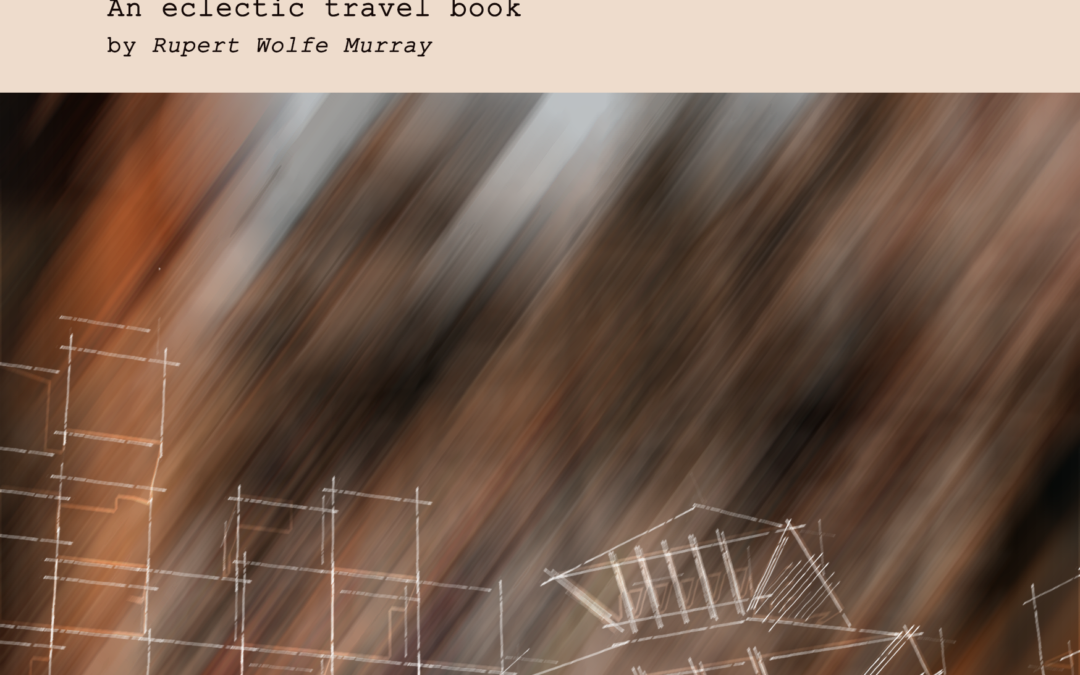
N.B. The image used with this article was the first cover proposal by the Maria Tanasescu. The trouble with working with great designers like Maria is that one has to choose from a series of great designs and it’s difficult and painful. Looking at this image now I’m thinking “this is better than the one I chose…”
by Rupert Wolfe Murray | 5 Jan, 2020 | Journeys
My Romanian sister in law was rather horrified to hear that I wanted to take her 12-year old daughter hitching. But she’s open-minded enough to realise that the chances of robbery, rape or abduction — or any of the horrors that the media feed us — are negligible in the Scottish Borders which is, after all, a scarcely populated wilderness where everyone knows everyone else.
She also knows that I’ve hitched hiked in Romania, and alo Asia, (see Hitching into Tibet), and that I’d be unlikely to sell her daughter into slavery.
Hitching is a great way to go. Not only is it a cheap means of transport but it’s a guaranteed way to meet people. It requires an element of humility and that’s something we all need. The risks are low, probably less than cycling, but the media love to sensationalise any isolated incident resulting in unfounded fears about this most brilliant way of getting around.
What makes hitching particularly relevant today is that it’s an excellent method of travel without producing carbon emissions. Of course you could say that by getting in someone else’s vehicle you are, in fact, emitting hundreds of grammes of carbon per kilometre — but these people will criticise, dissemble and rationalise anything you do to reduce your carbon footprint. It’s their form of defending the status quo.
Is hitching really so great?
The problem with hitching is that, more often than not, you end up at the side of the road — in the Scottish cold and rain or the baking heat of Romania’s summer — for hours on end; and the longer you don’t get a lift, the more you lose faith in human nature.
But when you do get a lift you get a rush of joy and your faith in humanity is instantly restored.
So when my niece and I got a lift, within a few minutes of standing at the side of the road, I was amazed. This just doesn’t happen to me; usually I have to walk for miles, or wait for hours and sometimes I cheat by hopping on a bus. But, looking at it from the driver’s point of view, picking up an adult with a kid is helpful and community-minded but picking up a lone, weird-looking man probably seems to the driver more risky (half remembered news stories of men with knives, and fragmented memories from horror films, probably flashes through their minds).
The kindly lady-driver took us for a few miles, left us at a junction and after walking a few hundred yards we got another lift — and then things started to get really interesting, as often happens when hitching.
Learning about dogs and war
My niece got into the back of a large estate car and was immediately covered in friendly dogs; she didn’t complain. I got in front and started chatting with the overweight driver, who looked like he was about 60 and sounded English. We drove on through the hills.
“You know what the fastest animal on Earth is,” he asked.
“Er…isn’t it the leopard?”
“You need to re-frame the question. The answer is ‘Over what distance?’”
“Eh? I don’t understand.”
“It’s like this. The leopard can reach the fastest speed over short distances, but it soon runs out of steam. Over a medium distance the dog is the fastest; but can you guess what’s fastest over long distances?”
“Er…a horse.”
“No. It’s a human. A man can run more or less indefinitely. Did you know that the American Indians used to hunt deer by chasing them for day after day, until the poor beast dropped with exhaustion? And they used to tame wild horses by chasing them until the animal just gave up, turned towards the pursuing man and accepted his domination.”
This guy was fascinating and I was an eager listener. As my niece was being used as a dog bed in the back seat I was plying him with more questions, trying to learn more about the wisdom of indiginous people — from whom we can learn a lot about protecting our planet. But he changed tack and started talking about the 1982 Falklands War, when Maggie Thatcher sent our armed forces to the other side of the world to reclaim some sheep-filled islands the Argentians had occupied.
“I was in the air force back then,” he explained. “I was in charge of supplying our base in the Ascension Islands which is half way between the UK and the Falklands.” These islands are located in the middle of the Atlantic Ocean, but they’re so small as to be almost invisible.
He then told me something truly amazing, that I’ve never seen mentioned elsewhere in all the books and films I’ve seen on the issue. He explained that all the fuel needed for the Falklands War was stored in huge rubber envelope-shaped containers that were laid out by the sea-shore on the Ascension Islands. I know the kind of containers he meant as the aid agencies used to install them on hospital roofs during the Bosnian war, as vast water tanks.
“If the Argentinians had known about this fuel dump,” he said, “and if they’d had a few daring commandos in a rubber dinghy, they could have turned up with a mortar and blown the whole lot up. It would have been game-over in an instant.”
I love stories like these — offering an inside view and a new insight into an event that you think you already understood. It turns your knowledge on its head and makes you realise that you only ever really know a fraction of the full story (and, as long as you can accept that you don’t need to know everything, it’s fine).
It was also a reminder that hitching is one of the most friendly and interesting modes of transport, as you are more likely to have a conversation than on the bus, train or plane — and sometimes these conversations are fascinating.
by Rupert Wolfe Murray | 17 Dec, 2019 | Journeys
When I was in Romania last month I discovered time travel. I know this sounds ridiculous — isn’t time travel a futuristic, high-tech impossibility used by the likes of Doctor Who and the crazy professor in Back to the Future?
Well yes, time travel is a popular device for filmmakers to dump their characters in imaginative locations, but for me it’s something much more simple: it’s simply travelling overland rather than flying.
How is this time travel? You might ask, quite reasonably. Let me enlighten you.
First of all, I need to explain why I decided to come back to the UK overland rather than by the cheapest, quickest, and easiest-to-arrange method — plane.
I am inspired by the example of Greta Thunberg who cuts through all the crap my generation produces, all the token gestures, empty promises and half measures that are doing nothing towards reversing our relentless march towards climate catastrophe.
If Greta can cross the Atlantic by sailboat then why can’t I cross the continent by train and bus — and, in the future, when I’ve got the right gear, by bike? If all of us stopped flying and insisted on electric vehicles we could transform Big Oil into Big Renewables.
Romanian Trains are Time Machines
I’ve been travelling in Romania for over 20 years and one of the best things about that beautiful and misunderstood country is its train network. Although it’s quite a run-down system — the Romanians have copied the UK and US model of prioritising road over rail — it is the biggest rail network in Central Europe (I wish they would appreciate this more as rail will, hopefully, displace road and become the transport of the future).
When you get on a Romanian train you have a choice: you can get really stressed about how slow it is, how shoddy the trains are, how unfriendly the staff can be, how you can’t rely on it and, despite all this, how expensive it is (for their uber-low salaries).
Or you can do what I do and imagine you’re stepping into a time machine. When I get a Romanian train I let go of my usual framework of time: I let go of the very structured programme that comes with a flight, or a train in the UK for that matter, and just accept the fact that it will take as long as it takes.
Also, if you’re lucky enough to get on a Romanian sleeper train you really are stepping back in time because some of the wagons were built over 50 years ago — many in East Germany which is a country that no longer exists — and each sleeper wagon has its own butler. Some of the cabins have pre-war wood panelling, a sink, a place to hang your suit and two single beds with cotton sheets and old fashioned blankets.
Despite the shuddering, the scream of the whistle and the noises that old trains make, I always sleep like a log when getting the sleeper train between Romania’s major cities. I sometimes imagine that I’m in the 1940s, grateful for the fact that I’m in a warm bed and not a concentration camp or trench.
So, last month, when I decided to flout convention and come back to the UK overland — starting with a sleeper train to Vienna and then Flixbus to London — I immediately threw away the rigid timetable that comes with a flight. I knew it would take longer, would probably cost more and, until I got to Vienna, I didn’t know how I’d complete the journey. But none of that mattered as I had a week at my disposal.
That, for me, is time travel. It’s simply looking at time differently when travelling.
Learning from Time Travel
There are several things that can be learned from this. First of all, by rejecting the rigid template of airline schedules it’s a much more relaxing experience. As long as I get on the train in time I don’t care how long it takes; I’ve got all the time in the world and I use it to catch up on sleep, read, write and talk to people. It’s wonderful.
Secondly, this approach to time is essential for real independent travel. If you take a year off with a highly detailed schedule you’ll probably have a miserable time; but if you just have some money, a destination and a decent allocation of time you can learn as you go, be flexible, listen to people you meet and, in doing so, discover all sorts of amazing things.
Thirdly, it’s fun to show people that there is an alternative to flying. Because air travel is considered the most efficient way to go, despite its carbon footprint, governments subsidise it and corporations make it easy, cheap and attractive.
But, if you take a different approach to time, all sorts of more environmentally friendly options come up. I plan to get into long-distance cycling next year but what about walking? Why not walk across Europe? It would be a life-changing experience. Or hitching? And what’s the big hurry anyway? Why do we have to get to our destinations as quickly as possible?
The most important thing is that we must stop flying, and using fossil fuels, if we have any chance of reducing greenhouse gases. Again, we have a choice: we can plunge into despair or change the way we travel and live.
The naysayers claim that saving the planet is complicated. It’s not. All we need to do is stop using fossil fuels (and stop eating animals — but that’s another story).
We can despair at the lack of action that governments take or start making changes in our own lives. We can all become examples for those around us, and watch the ripple effect.
by Rupert Wolfe Murray | 11 Dec, 2019 | Journeys
I was cycling down the hill so fast I thought I might fly, like those kids in ET – Steven Spielberg’s classic film – when the alien enables the kids to fly their bikes through the night sky. It’s incredible what speed you can reach when going downhill on a good bike, even without pedalling.
Everything at that moment was perfect: the speed was exhilarating and the bike was handling it well (Bromptons are great at speed). The combination of cool autumn air and sharp sunlight marked a point of perfection in Romania’s calendar when the weather is just right – as if it’s recovering from the crushing heat of summer and preparing for the relentless cold of a long winter.
I was also in a beautiful spot. Surrounding my downhill piste was a thick pine forest that has not yet been pillaged by the Austrian timber companies (every Romanian knows that it’s the Austrians, and their “timber conservation” charities, such as Schweighofer Privatstiftung, who are de-foresting Romania).
And then I nearly died.
The road I was cycling on was the main route between Iasi and Botosani, two cities in north east Romania. I knew the drivers were annoyed, as they are all over the country, for their governments failure to build more than a few token miles of motorway – and in this part of the land there are not even the patches of motorway you find in Transylvania. My impression is that the drivers get their revenge on the system by driving as fast as they can, particularly those people who own the big German cars which are so powerful, and comfortable inside, that driving at high speed doesn’t feel dangerous at all.
There was a column of big cars heading my way, accelerating hard out of the village below and taking advantage of the forest cover ahead to make up for lost time. Suddenly a big BMW sharked out of the column, dropped a gear and put his foot to the floor; the car surged past those ahead and within seconds he was ahead of the pack and ready to get back in lane.
The fact there was a lone cyclist – i.e. me – on the other side of the road, directly in the path of the hurtling BMW, didn’t seem to have registered with the driver when he made his millisecond calculations about the risks of overtaking.
I’ve been cycling on Romania’s roads for over 20 years and it’s been a remarkably safe experience – even though many Romanians have told me “You’re crazy to cycle on our roads because our drivers are all insane,” (a comment which says more about how Romanians regard each other than the actual safety of the road. The fact is that no driver wants to run down a cyclist; not only on humanitarian grounds but the legal punishment for killing someone on the road are severe). In general, I’m very grateful for Romanian drivers for giving me space and letting me live.
But different rules apply to drivers of powerful cars that overtake in remote country locations: when they see an opportunity to overtake, they don’t seem to see cyclists; we become invisible. There is another insidious effect at work here, unique to countries like Romania where a macho driving culture prevails – it’s common to overtake and force oncoming drivers to pull over, slow down or just get out of the way. Truck drivers are prone to this kind of bullying behaviour, as well as beefy businessmen in their black muscle-cars.
In my case, it was all over in milliseconds. I wasn’t particularly aware of the imminent danger to my life but my subconscious (my Guardian Angel) was: I swerved towards my side of the road and the BMW rocketed past. When your life is on the line and the danger is imminent, instinct can kick in and save you. This has happened to me several times (here’s a story, in podcast format, of when I was attacked by three big dogs in Tibet).
I was still moving at what felt like high speed – maybe 30 km/h – and soon enough I was in the village that nestled at the foot of the forest: Copălău, location of a military base and an annual Garlic Festival. The column of big cars was long gone and I doubt that the BMW driver even registered the incident. I pulled over and it was only at this point that fear caught up with me; I had just had a near-death experience!
Enter the film crew
If the incident had been filmed it would have made the most incredible piece of TV footage. Imagine how delighted a TV news editor would be to get high-resolution footage of a road accident; not only would they play it on the news for days – even in slow motion – but they could have sold it abroad and whipped up moral outrage about reckless drivers, bad roads and the dangers that apparently surround us. It would have fed seamlessly into the media’s insatiable hunger for death, depravity and horror – a grotesque form of reality that is surprisingly addictive.
Well, guess what: the whole thing was filmed! I was on camera for most of my downhill run – not on some roadside camera or dashcam on one of the German cars, but on a high-quality lens on a filmmaker’s drone that was flying just ahead of me.
Why the hell, you may me wondering, was a filmmaker flying a drone in front of me as I tore down a country road in north east Romania? A fair question.
The answer is that I’ve been helping make a documentary film about the changes that took place over the last 30 years, since the Romanian revolution. The narrative follows what I did in 1990 (observing the aftermath of the revolution in Bucharest, helping a kids’ home in a Botosani village and working with the Roma minority) up to the present day. I’ve been in Romania on-and-off for most of the last 30 years, working on some really interesting stuff like Roma and child rights, journalism, regional development, helping Romania into the EU and, most recently, as an evaluator for EU projects. I also produced a couple of documentary films, including one about what people were talking about just After the Revolution.
Our new film is being produced by Mihai Dragolea and he’s using some of the footage that was shot by my old friend Laurentiu Calciu, whom I’ve known since 1986 when I first came to Romania; it was he who shot the After the Revolution material as well as my work in the kids home and with the Roma minority. He’s a great documentary filmmaker, but far too modest for his own good. You can see his showreel here.
I tried talking to the two filmmakers about my near-miss but they didn’t really take it in, as they had been so focussed on driving the car in front of me and operating the drone. This was totally fine by me as the last thing I wanted was to make a big deal out of it. The fear that I had felt after the incident soon left, as if part of that convoy of speeding cars.
A couple of hours later the filmmakers were driving down to Bucharest and I had decided to get out of the car at Targu Frumos and hop on the train to Iasi, the former capital of the ancient kingdom of Moldova – a city I wanted to discover. The incident with the BMW in the forest was being filed in my head as a non-traumatic memory.
by Rupert Wolfe Murray | 4 Dec, 2019 | Journeys
Since I first came to Romania in 1986, it’s been clear to me that Romanians don’t understand the full potential of the tourism business.
Over the 17 years I lived in Romania I’ve had countless conversations with people who own pensions, hotels and restaurants; village and city mayors and even a minister of tourism. All these people reacted in the same way to my advice on the tourism business: they get defensive and offer rationalisations about the unchanging nature of tourism.
I’ve never met anyone in Romanian tourism who is interested in my perspective – an individual traveller who wants to tour by bicycle, hitchhike, camp and stay in hostels, or with ordinary families in traditional houses that haven’t been homogenised with mass produced paint and furnishings.
It’s clear that the type of “individual” tourism that I do simply does not register with people in Romania’s tourism sector. They tend to see the business as in terms of “mass tourism”: huge resorts like Mamaia and Poiana Brasov.
Mass tourism certainly does exist in Romania and it’s done rather well. I’ve just been soaking in a sulphur pool in Calimanesti and love the old-Communist-era vibe to the place. A large number of low-income Romanians, such as pensioners, as well as the sick, get free tickets to these spas and that really is excellent. In my country (UK) I don’t think anyone gets a free holiday and, as a result, those who need one most – the poor, elderly and sick – don’t get them.
The missing opportunity
Tourism is one of the biggest business sectors in the world, accounting for about 10% of global GDP. The UN’s World Tourism Organization says “the business volume of tourism equals or even surpasses that of oil exports, food products or automobiles…This growth goes hand in hand with an increasing diversification…”
By not understanding the industry, and focusing exclusively on mass tourism, Romania is missing out on this huge business opportunity. By dismissing the sort of individual tourism I love – staying in traditional houses in the Moldavian countryside for example – thousands of potential micro-business ideas are dismissed by “experts” and never get off the ground. Imagine if every village had at least one traditional guest house and one campsite – all of which could be promoted on Google Maps and other free online services.
But people who own houses in beautiful locations are told they must tear it down and build a modern hotel if they want tourists – because we all (apparently) want standard modern buildings, cable TV, air conditioning and a bar. But from the business point of view why invest in a huge new building when all you need to do is tidy up the spare room and share the meals that you’re already making? We want to eat sarmale, ciorba, fresh veg from the market and tea from the garden; not frozen food and fizzy drinks from Kaufland.
About campsites: whenever I’ve suggested to village mayors, or rural householders, that they should organise a campsite they always think of reasons why it wouldn’t work. The most common rebuttal is that “nobody would come,” and if I say “I would,” they laugh dismissively. Then they say they’d need to build a “bloc sanitar” which is basically a toilet and washroom. I say they don’t need to build anything as travellers like me are used to “wild camping” — when you just put your tent up in a forest or somewhere out of sight — and having a designated location would be great.
Very few Romanian villages have campsites and those which exist are massive, noisy, smoky, crowded and horrible. The campsites could be set up in a simple field by a family that is willing to share their toilet and offer water and catering services. If nobody came then there would be no losses but if the site was registered on Google Maps and other (free) online services I think they’d get plenty of visitors. Thousands of bums like me are criss-crossing their beautiful land every summer.
Introducing the hostel
The other business opportunity that is appearing in Romania is the hostel – almost a century after they were common in west European cities. A hostel is an apartment (or house) with bunk beds in the rooms, shared bathrooms and an open kitchen. The cost is usually around 10 Euro a night, security is good (I’ve never heard about a robbery in a hostel) and I actually prefer hostels to hotels as the chances of meeting people are much higher.
The west European hostels I’ve stayed in tend to be massive, and sometimes very stylish, but many of the Romanian ones are in single apartments – which is fine. Every town and city in the land should have at least one as they are a useful low-cost option for visitors (as is Airbnb, but that’s a different kettle of fish I’m not going to discuss here).
I’ve stayed in two hostels in Bucharest, one of which (Midlands Hostel) has a great atmosphere and is very central; and one of which behaved towards me with an arrogance I found surprising (Umbrella Hostel). The other guests were foreign “backpackers” who like to party at night and sleep during the day – which was ideal for me as I would get up early and use the empty kitchen as my temporary writing office.
In Iasi I stayed in Andrei Hostel which is just behind the hospital on Copou, and is what we Brits call “Cheap and cheerful”. The guests were Romanian villagers coming to town for some nasty medical operation and Arab students using it as a temporary base before they rented a flat. We all got on fine and what I liked best was the owners had an “honesty box” for your registration form and 50 RON-a-night fee. What a great way to save money on personnel costs!
My hope is that Romanians can stop thinking of the tourism business as requiring millions of Euros, backed up by major strategic investments in infrastructure, and realise that there are many people who would love to stay in a traditional village house, or camp in a forest meadow, and take the opportunity that we in the west lost many generations ago – to get closer to nature.
#
What do you think? I’d be really grateful if you added a comment below — even negative comments are inspiring as we can debate the issue.
by Rupert Wolfe Murray | 26 Nov, 2019 | Journeys
It’s easy to feel despair about global warming. The IPCC tells us we have less than 12 years to cut CO2 in half — or face devastating consequences. But wherever you look people are driving more, consuming more and those who say we must change our ways are often ridiculed and marginalised.
I doubt Romania’s new government will take these warnings seriously. Why should they when countries like Sweden, which trumpet their green credentials are, according to Greta Thunberg, hypocrites for ignoring aviation, shipping and the carbon-cost of manufacturing in Asia.
It might seem better in countries like mine, the UK, where the government passed a Climate Change Act in 2008 and, ever since, has been able to “claim the moral high-ground globally on this fast-emerging global issue.” But they haven’t stood up to Big Oil (in fact they subsidise the oil industry with billions of pounds a year) or started on the most important task of all: educating the public about the need for “unprecedented transitions in all aspects of society.”
Instead of changing attitudes about climate change, Boris Johnson’s government is arresting people for challenging their hypocrisy and lack of action. Over 1,300 people were arrested at the recent “October Rebellion” protest in London – and the media portrayed the climate protesters as the problem, for blocking traffic, which enabled them to “shoot the messenger” and avoid discussing the real issue.
I know how hard it is to change. I found it really difficult to give up my car and go around by bike, bus and train – and to stop eating meat (which is one of the biggest contributors to greenhouse gases). It has taken me years to make these modest changes.
When I look at Romanians driving along in their expensive cars I wonder “how can I convince them to switch to electric?” How dare I say that everything he’s been working towards, and saving up for, is wrong? How can I counter his view that electric cars are just as toxic as his one, if he’s read articles like this: Are electric cars actually worse for the environment?
Hamburgers give me hope
It’s hard to find signs of hope in Romania, where car-driving and meat-eating are central to their modern culture, and the whole green issue seems to be of marginal importance (pretty much like in the UK).
But I’m an optimist and, after many years of living in Botosani and Bucharest, I see signs of hope where many Romanians see only despair. And recently I found hope in a very unusual place: the website of METRO, the wholesale supplier to shops and the catering industry all over the country.
I would never have looked at METRO’s website had the editor of Romania’s main weather channel (Meteo.ro) not emailed it to me – by mistake. His autocorrect function inserted it.
I was amazed to find that METRO was promoting a vegetable-based burger to an industry that is well known globally to be highly resistant to change – the waste and pollution that restaurants and hotels emit is biblical in its proportions.
METRO’s description of their veggie burger is well written, convincing and on the front page of their website. Here’s an extract:
“Beyond Meat® is as succulent and delicious as beef … and its production uses 99% less water and 93% less farming land,” [than the production of beef]. “This means 90% less greenhouse gases are produced and 46% less energy consumed.”
These are some of the facts that radical vegans use to convince others to join them. But the problem with vegans is that many are so passionate in their beliefs, so purist in their faith, that it repels people who don’t want to give up meat, fish and dairy. The carnivores become defensive, it becomes what the Americans call a “culture war,” and the whole issue is thus marginalised (and politicised, often casting us into the left wing of politics, whereas these issues are “beyond politics” to quote Extinction Rebellion).
But when a major food supplier can pick up the key points – non-meat farming emits far fewer greenhouse gases – without mentioning veganism or being political – it’s a really encouraging sign that things can change.
Apart from those in the catering industry, think how many people in other parts of the economy will have read that veggie-burger text by METRO and, in doing, have become more informed about one part of the problem (our methane-emitting-agricultural-system).
Although most people are aware that global warming is a big problem, very few know what they can do about it and the tendency is to just shrug and carry on as normal. Now, thousands of people in the heart of Romania’s economy have been provided with a better way.
#
A Romanian language version of this article was published on that country’s main weather site. I’ll be writing a series of articles for that site as they have a unique target audience — people checking the weather — that is refreshingly non-political.

