by Rupert Wolfe Murray | 24 Nov, 2021 | Journeys
I’ve just been travelling round the Balkans and want to share my impressions in the hope that you will feel inspired to do the same. Accommodation, transport and food are cheap, the people are friendly, parts of it are stunning (see the photo below) and it’s as safe as anywhere in the world.
Here’s a photo I took from a bus window in the southern part of Serbia, the Sand Jack region where people of the Muslim faith are in the majority. If I could take such a nice photo from the bus window, using my old phone, imagine what you could do on the ground with a decent camera.
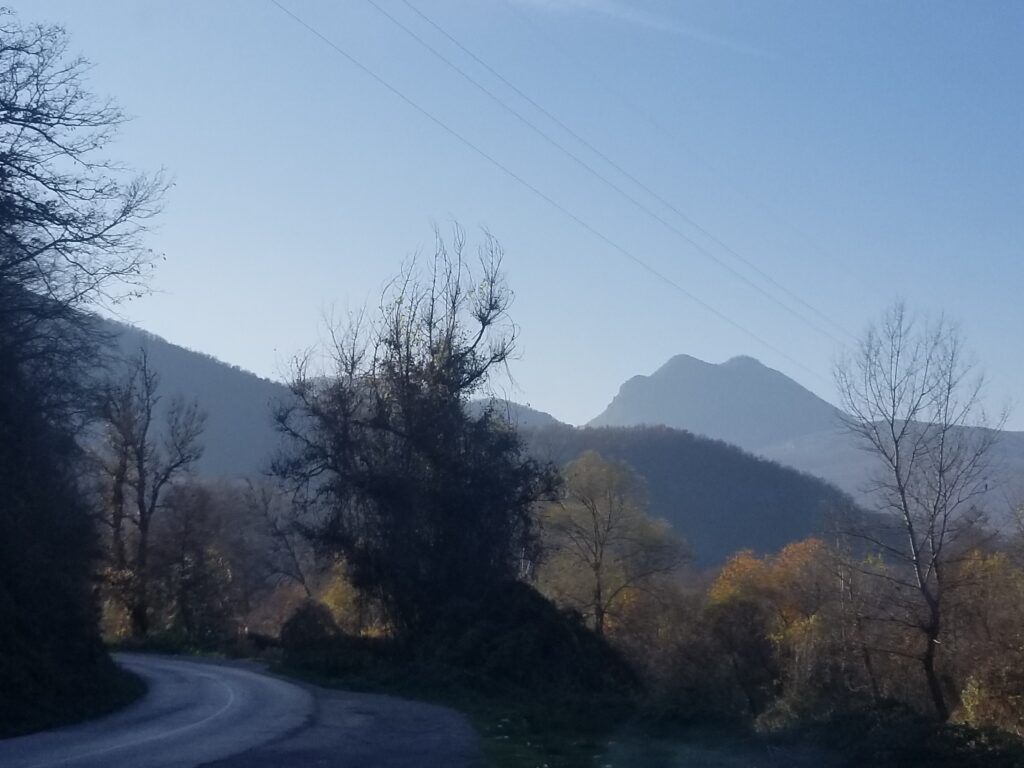
Photo of the Sand Jack by Rupert Wolfe Murray
I’m currently living in Sarajevo and I went to visit some friends in Bucharest. The quickest overland route is via Belgrade. I decided to come back a longer but more beautiful route: through Bulgaria, North Macedonia, Kosovo and the Sand Jack region of Serbia. It was a big loop through the Balkans.
What’s the Best way to travel round the Balkans?
This depends on your approach and budget. If you’re loaded and like to avoid strangers you’ll want to hire a car but if you’re like me – skint but always open to meeting new people – there are only two options: bus and train. Buses are the main option in the former Yugoslavia and although they’re cheap please don’t rely on bus information you find online as it’s almost certainly out of date. I got into the habit of arriving at a bus station and immediately buying my next bus ticket. Trains are also cheap, but slow and only really an option in Romania and Bulgaria, as there aren’t many train lines in Greece or the former Yugoslavia.
Hitching is a useful back-up method for when the bus doesn’t go in your direction, as happened when I tried to get from Belgrade into Romania (you can read about that experience here). I love hitching as it’s a good way of meeting people, learning a few words in a new language, and (sometimes) getting an insight into the driver’s dysfunctional country. Most people I’ve met in the region are friendly, interesting, cynical and fun. But, if you’re hitching, offer them some money – the equivalent of a bus fare – and I’m ashamed to say that I didn’t offer my last driver anything when he took me from the Serb/Romanian border into Timisoara.
Is it safe to travel in the Balkans?
Even though the Balkans are beautiful – lots of ancient cities, spectacular mountains, and beaches to die for – many people think it’s dangerous. It was dangerous during the Bosnian and Croatian wars but that finished over 25 years ago and the people of this region are far less aggressive, on the streets, than you would experience in the UK – where aggro seems to be baked into our DNA. I’ve travelled around the Balkans many times over the last 30 years and I can’t remember once feeling scared, even during the Bosnian war when I visited the city of Tuzla twice.
In my experience, the most friendly people in the Balkans are the Romanians and the least friendly are the Bulgarians. Overall, they’re quite polite even if they can be a bit rude and cold in restaurants and shops. If you ask a young person directions on any street in the Balkans the chances are high that they’ll speak decent English and be keen to practice it. They’ll also look after you – there’s an ancient tradition of looking after guests – and that’s why I can assure you that travelling in the Balkans is totally safe. You’ll be safer in the Balkans than you would be on a Friday night in many British cities I can think of.
5 reasons why I love hostels
If you’re like me and living on a low budget the only real option is to stay in a hostel, but some people hate the idea of sharing a room with smelly strangers and they worry their stuff will be robbed – which doesn’t happen as a sort of collective security goes on in shared rooms: nobody wants their gear nicked so they’re not going to steal yours. It’s the same process at work in offices: people don’t steal each others stuff as an unspoken system of mutual respect is at work.
- Hostels are dirt cheap
The only cheaper option is to camp, and I like camping even more than hostels; but the Balkans is crap for camping as it’s illegal in some countries (I’m looking at you Croatia), frowned upon by locals and there’s very few campsites around.
Having just stayed in a series of hostels in the region, I can tell you that the average price for a bed in a shared room is about 7 Euro. A good place to book a bed is on Hostelworld as you don’t have to register or download their App. The website Booking.com are muscling into this market but they piss me off as they have cancellation fees and keep trying to force me into hotels.
- Hostels have a sense of community
Even when I have money to blow on a hotel I’d rather stay in a hostel as there’s something sad and lonely about a middle-aged guy shutting himself into a hotel room (why do I think of prostitutes?) Sure, if you’re a couple I can understand why you’d prefer your own room but, let’s face it, most couples don’t really need that intimacy that was so wonderful during their honeymoon; I think many of them would prefer to chat with friendly travellers, but are so stuck in the routine of booking their own private room at four times the price that changing it would be unthinkable.
I live and travel on my own and am rarely lonely. I love being with people and like working somewhere where there are people around, like a shared hub-type office, or even a café. I like being around strangers even if they don’t want to talk to me.
Hostels give me a sense of community. When I recently stayed in a hostel in Bucharest there were two other people in the room. I’ve no idea who they were as we didn’t talk once over a period of 3 days. There were no bad vibes, no unfriendly glances, but we all kept to ourselves and had very different sleeping times. My point is that it’s nice to be around other people and the hostel is a great place to experience that. Usually there are a mix of friendly people and those who want to keep to themselves. Over time, I’ve learned to tell the difference and only engage if I think the other person really wants to. In this way I can enjoy a sense of community – and anonymity.
- Hostels can be really interesting
I think most hostels are really different from each other but most hotels, especially the posh ones, are the same. In a hotel you always have a “them and us” scenario which starts as soon as you walk in the door and talk to the receptionist; she may be friendly and polite but you can’t get away from the fact that she’s doing a job, following a set of rules (one of which is to not get too friendly with the clients), and serving you. In the hotel restaurant it’s the same – people are serving you and you can’t really break away from the master/servant dynamic.
This dynamic is usually absent from hostels where the staff sometimes live in one of the shared rooms, alongside the rest of us, and in the evening they hang out with the more gregarious guests. When I stayed in a hostel in Sofia the receptionist/manager invited me to a noisy party on the top floor; I didn’t go but I did appreciate the invite. In the bigger hostels, the people working there are often travellers getting free accommodation in return for some reception duty – and they’re keen to chat with you as soon as the formalities are out of the way.
Because hostels are sometimes just the size of an apartment, they don’t need as much real estate as a hotel. As a result they’re often in superb locations. In all these cities I recently visited all the hostels were located in the city centres, at a quarter of the price of a hotel.
Interesting hostel experiences on my recent trip through the Balkans: in Bucharest the hostel was full of immigrant workers from Sri Lanka – a really gentle crowd, with none of the macho tendencies of some Balkan men; in Belgrade the overweight receptionist had a shouting match with a skinny woman from Hong Kong (both of whom seemed to be long-term residents and were like an old married couple); in Skopje the hostel was located in the vast basement of a hotel and 100 Japanese-style cubicles had been built – offering much more privacy than is usually available in a bunk bed. I thought it a brilliant idea to locate a hostel within a hotel as they can attract two very different types of clients. And it feels great to experience the up-market services on offer at the hotel while only paying a fraction of the normal hotel price. In the Skopje hostel, I wandered into the hotel spa and got a cheap massage from an Albanian lady who’d been trained in Switzerland.
Perhaps the most interesting thing about hostels is the people. When sharing a room with others you’re bound to come across some weird and wonderful characters. On this trip the person who stands out most in my memory was a skinny Irishman in Prishtina, with the mad eyes and straggly beard of a hermit. At dawn a mobile phone rang in the bed above me and this chap leapt out of bed, stark naked, and screaming: “Turn that bloody thing off! I’ve paid good money to stay here… ” The phone was silenced and the guy above didn’t say a word, the Irishman got back into bed, and I went back to sleep.
- Hostels are a lot better than they used to be
Hostels used to be really grim. In the UK they were the simplest form of accommodation, rather like military barracks, and in Eastern Europe they were even worse. All that has changed but many people seem to assume that they’re still grim, filthy and dangerous.
What’s happened is that business people have realised there’s good money to be made from cheap accommodation; you don’t need to be a rocket scientist to work out that big bucks can be made by packing 8 to 12 people in a room, especially in the Western capitals where (hostel) prices are treble what they are in the Balkans. But these investors have to offer something more than an old style bunkroom so they’ve unleashed the architects and now you can find some really beautiful hostels, especially in the fancy Western capitals. In North London we once stayed in the cells of an old police station; I think it’s called The Clink. In Brussels I stayed in a superbly converted old beer factory, with hundreds of beds.
A lot of hostels also use the language of the surfer dude when writing notices, toilet and kitchen rules, and all the information they need to convey. In Timisoara, where I stayed in a small but beautifully designed hostel, there were little blackboards everywhere with instructions written in the voice of a Californian stoner. Although this tone is sometimes a bit annoying, it’s better than the dense legalese texts you find in hotels.
Even the worst hostels – and there are some really crap ones around – have a basic kitchen and cooking your own meals can save you a King’s Ransom.
- Hostels are a good place to write books
Writers need to find a quiet, peaceful place to write their next epic. How is this possible, you may be wondering, in a hostel where the young crowd (and the hostel management) may be partying late into the night? I once had a really well-paid job for the EU in Bucharest, with enough cash to stay in a hotel. But I chose to stay in a scruffy city-centre place called Midland Hostel as I liked the community and didn’t mind the noisy rabble who would drink and smoke on the balcony until God knows what time in the morning.
Within the late night action at the hostels I have found the ideal working place: early mornings in the kitchen. As far as I’m concerned the later my fellow-residents go to bed the better as they’re likely to get up really late – and that means that I’ve got the whole place to myself in the morning. When I stay in hostels I try and get up as early as possible, ideally around 5am, and for the next four hours the chances are that the only person I’ll see will be the cleaning lady – or, in the case of the Midland Hostel in Bucharest, it was the manager himself who showed up early and cleaned the place.
Travelling gives me energy
At the end of my journey I got back to Sarajevo, but I was buzzing with energy that two weeks of travel had given me. I had to keep going and so I went to Split, Croatia, for the weekend, using the one good train line in Bosnia – Sarajevo to Mostar – and then the bus. It was great to get a glimpse of the sea and I took a decent photo which shows the Dalmatian Coast, i.e. when the mountains fall into the sea. Here it is:
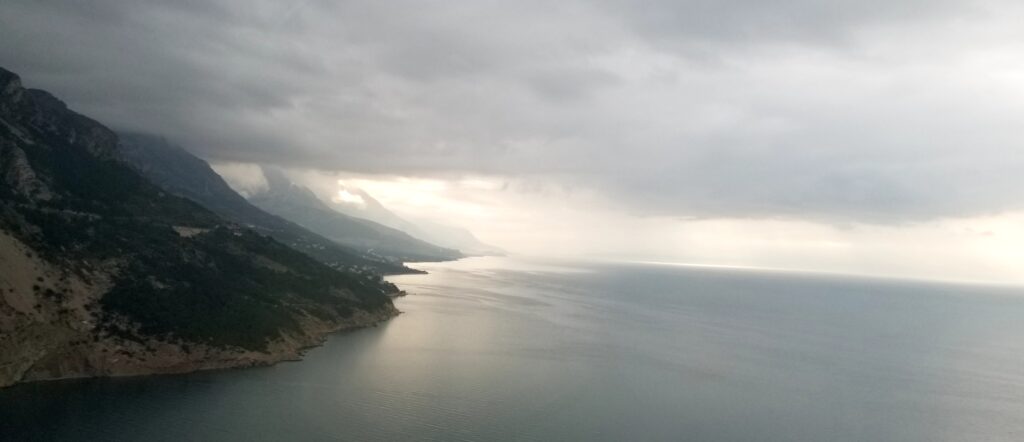
Croatia’s Dalmatian Coast by Rupert Wolfe Murray
Postscript: My Airbnb Nightmare
Until I reached Novi Pazar, in Serbia’s Sand Jack region, all my experiences with Airbnb were good. Airbnb apartments are more expensive than hostels, and usually better. But when I got to Novi Pazar I soon realised that the only options were Airbnb or an expensive hotel. The Airbnb place I booked only cost 12 Euro and the other option was a hotel where it cost 50 Euro for a room.
But my Airbnb experience in Novi Pazar was bizarre. The listing made it sound great and I saw images of a modernised chalet on a hill, very central and dirt cheap. What could possibly go wrong? First of all, finding the place was difficult as the address had no sign or street number on it, but that was the least of my problems and is normal for Airbnb. The host, who was bursting with friendliness at getting a guest (I was his first), told me to wait in his family’s cafe/bar while he went to sort out the accommodation. Then he locked the door, turned off the lights and vanished for almost half an hour. He’d left me in a dingy bar with his friends and a big TV screen blaring out the news. I later found out that all pubs, bars and restaurants had to close at 9pm due to some law in Serbia that was supposed to stop the spread of Coronavirus – quite how, I’ve no idea but I didn’t care; I just wanted to sleep.
Under normal circumstances, I don’t mind being stuck in a shitty bar for half an hour but it helps if they tell you why you’re having to wait for so long. But the real problem was that one of my host’s friends was obviously a madman: every time the newsreader would say something he would scream and shout at the TV with such insane rage that he looked like he was ready to kill. Was this the sort of Serb extremist who would go into Bosnia and Croatia and kill innocent people? Luckily he didn’t even notice me, which was lucky as I am a citizen of one of the countries that bombed Serbia in 1999.
Eventually my grinning host returned, didn’t seem to even notice his raving lunatic of a friend, and said “follow me.” My grasp of Serbian/Bosnian/Croatian is basic, but fine for this kind of circumstance.
He then led me to the back of the house and pointed to a metal fence, which we had to climb over; my host said his neighbour had promised to cut through it but hadn’t done so. This was my first inclination that this guy’s building project was nowhere near finished. We were then standing at the bottom of a mud cliff, with rough notches dug into them. Bricks had been placed in these notches but they weren’t fixed and so each step was a wobble; luckily there were a few saplings to grab hold of. I had a big rucksack and struggled to make it to the top, and only did so because I have some rock climbing experience; I couldn’t imagine how a family could get up there or an older person. This path is dangerous and I assume that Airbnb don’t bother inspecting the properties that they list, and neither does the local authority. Do they just leave it to the reviewers to warn others it’s dangerous and unfit for human habitation?
When we reached the top of the cliff he proudly showed me his shed. At first glance it looked fine but on closer inspection I realised the thin boards that the walls were made of had gaps between them and the freezing night air was whistling in. I asked him if it was insulated and he said “of course” and pointed to a thin sheet of plastic that was wrapped round the building. He obviously has no idea what thermal insulation is.
The bed was built on a high platform but it was so rickety I thought I might crash to the floor; it would been lethal for a couple or an overweight person. The only way he could heat the place was to balance an electric blow heater on the bed; but the heat was pouring out of the gaps in the walls so I had to keep it on all night, at the risk of burning the whole place to the ground. If only I’d had a four-season sleeping bag I could have slept on the floor in great comfort, but I had to make do with his smelly bedding and my own summer sleeping bag.
The best bit was the bathroom which was just a pile of junk lying around outside. He’d collected an old bath, toilet and sink, plus boxes of tiles and all the other stuff you need for a bathroom, and it was lying around outside, exposed to the elements. It looked like a bomb had gone off, scattering the items around the muddy hillside. My host pointed to the junkpile and said with a grin: “Bathroom!” That was one of his few words of English. I didn’t know if I should laugh or cry.
Luckily I got away in one piece and considering how friendly the host was I didn’t want to write a review on Airbnb, as it could only be devastating. But then he sent me messages saying I hadn’t paid him – not realising you can’t stay in an Airbnb without paying for it first, on the App, but the payment takes a few days to reach the host – he started sending me angry text messages. Maybe he would unleash his ad friend and hunt me down? So I unfriended him on social media and posted a review on Airbnb.
In my review I wrote, “This place is unfit for human habitation…it’s like sleeping in a shed…it should be withdrawn from Airbnb.”
Over two weeks have passed since I stayed at that place in Novi Pazar. I just checked the Airbnb site and can confirm that the hellhole I stayed at (Vikendica Sanac) is still listed as a viable accommodation option. This proves, to me at least, that Airbnb don’t give a damn about their listings. How could they if they let a place that is dangerous, and reported as such by my review, still be available online?
All of which goes to show that the best option, for those at the low end of the travel budget spectrum, is to stay in a hostel. It has to be said, however, that most Airbnb options are really good and the dive I stayed in was an exception.
A final word: I’ve just heard the news that 46 people were killed on a bus travelling on the same route I just went on, from Bulgaria into North Macedonia. My heart goes out to the families of those unfortunate victims. I’m really sad about it. I know the buses in this region are generally old but the drivers are usually good and there’s never been such a big tragedy like this in the region. I don’t understand how it happened. Hopefully it will lead to stricter measures regarding the old buses that connect the cities of the Balkans.
Thanks for reading this article, which is far longer than I had planned. I’d really appreciate it if you would add a comment below, even if it’s short or critical. If you have any questions, or would like any advice about travelling in the Balkans, or independent travel in general, this is the perfect place to ask — the comment section below — as then it’s available to anyone else who may be interested.
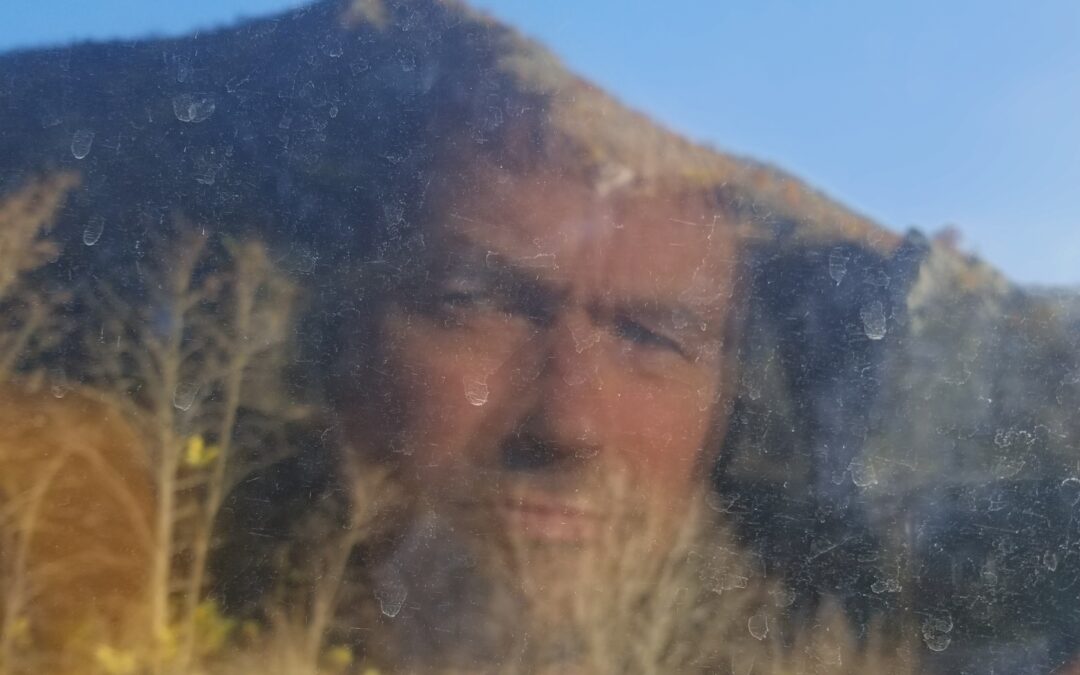
Final, final, final note: the main photo of this article (my reflection in a bus window, against a backdrop of a mountain) was taken on a bus across the Sand Jack region of Serbia. Although I cropped this photo I didn’t edit it otherwise, and you can see the dirty marks on the window. The other photos in this article were also taken from bus windows, which I find remarkable as so many times I’ve taken landscape shots and been disappointed. I guess photography is all about being in the right place at the right time, i.e. when the light is just right.
by Rupert Wolfe Murray | 28 Oct, 2021 | Journeys
Bewilderment is the word which best describes my feelings when I got to Belgrade’s main station and found it to be abandoned. A flimsy wire fence was the only sign that this once-busy station, the hub of rail travel in the Balkans, has been closed down. Was I in the wrong place? No, I recognised the crumbling old buildings and the big outdoor panel that used to show arrivals, departures and foreign city names like Athens, Munich and Vienna. What had happened?
I’d just arrived by bus from Sarajevo, a slow but satisfying journey that took in the endless forests and mountains of Bosnia and a glorious, almost oriental in its beauty, river that runs along the Bosnian Serb border. I should have suspected something was up when the bus was arriving in Belgrade and we passed what seemed like mile-upon-mile of advertising hoardings showing well-lit, happy, handsome couples. I didn’t realise at the time that these happy-go-lucky images of wealth and success were hiding the vast tract of land that had once been the railway lines from the six republics of the former Yugoslavia converging on what was the most important station in the land.
My carefully laid plan of onward travel to Romania was now being flushed down the toilet. Where was the station? How would I get to Timisoara? For years I had come to this station from Romania, where I used to live, and gone on to Bosnia, or Montenegro. I knew the layout: I knew where to leave my luggage, where to get information and tickets. And once these arrangements were made there was usually time to visit the centre of Belgrade, an architectural collage of Paris, London and Vienna, visit the wonderful bookshops and eat something delicious.
My bus had arrived in a sort of no-mans-land between a vast building site and the abandoned railway station. Half the passengers went one way, away from the old railway station, and the rest of us went towards it. Nobody else was standing still, lost in memories about the dead station. They just headed towards a gap in the fence and, trailing behind like a lost puppy, I followed them out onto the main street.
Monument to Gandalf
Although the inside of Belgrade’s station looked ready for the wrecking ball a coat of paint had been slapped on the outside, as if to remind hopeful travellers that all is well and soon they’ll be able to get their tickets and board the train. It reminded me of an aging prostitute who had applied lipstick and makeup in an attempt to recreate the vigour of a lost youth. Gone were the gypsy musicians of yore, with their raucous brass band, the beefy taxi drivers jostling for business, old buses belching diesel fumes, the noisy stalls selling cheap Chinese goods and grilled meat. The absence of the sounds I’d been expecting was eery. In the space once occupied by taxis and buses was now a crude attempt at a formal garden: strips of bright green turf had been laid and, to me, it felt out of place.
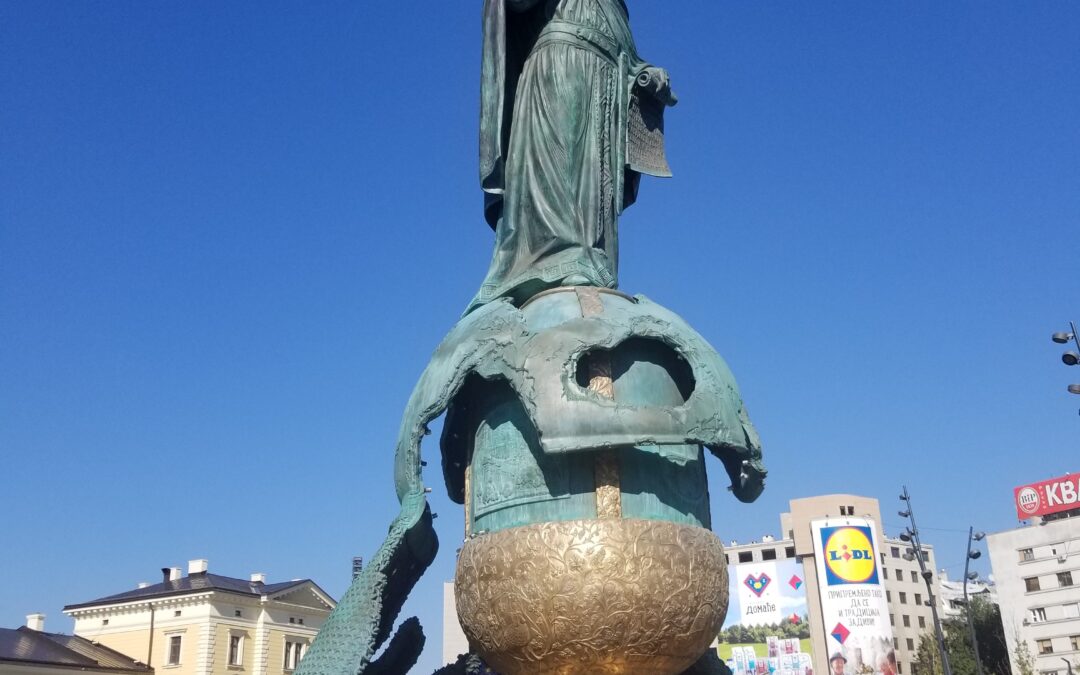
Towering above this rather awkward new space is a 12 metre high statue of a fierce-looking priest in a robe, holding aloft a massive sword. Was this an homage to Gandalf or the white-robed character played by Christopher Lee in Lord of the Rings? The druid-warrior was standing on two rounded objects, one of which looked like a helmet and the other was either a skull or a globe. The skull made me wonder if the sculptor, who’d obviously been given a big budget as the whole monstrosity had been cast in bronze, liked heavy metal music.
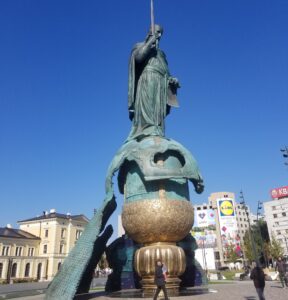
A vast new statue has been raised to Serb nationalism
I wondered what this strange new sculpture represented and looked for an explanatory notice but the only sign was in the Cyrillic alphabet, which I can partially understand, but it was written in the archaic form and so its meaning was lost to me. Immediately I jumped to my own conclusion: they had built a massive new statue to the Serbian Orthodox Church, which had stood proudly behind President Milosevic who had unleashed the forces of extreme nationalism resulting in years of bloody war in Croatia, Bosnia and Kosovo.
Needless to say my assumption was totally wrong. Later on that day I met an old friend, a sculptor, artist and documentary filmmaker. He laughed at my naïve understanding of the statue, agreed that it was far too big and on the kitsch side, but told me the character being portrayed was an ancient Serbian king who had stood up to the Roman empire and carved out a homeland for the Serbs many eons ago.
He also told me there were no longer any public transport links with Romania, one of Serbia’s main neighbouring countries. Gone was the old-fashioned sleeper train that would trundle over the border and slowly make its way, through the night, to Bucharest. Gone too was the public bus service to Timisoara, Romania’s nearest city, and even the private minibuses that used to leave for Romania frequently. The message was clear: the poor don’t matter. Serbia’s capitalist government, like so many in Eastern Europe, was throwing away the Communist-era endowment of good public transport infrastructure and leaving open only two options for travel: car or plane.
My friend said the only way to reach Romania was to get a bus to the town of Vrsac (pronounced Verr Shatz) and then hitch hike or get a taxi to the border. I realised I’d have to spend a night in Belgrade, which would be a pleasure as it’s a beautiful city and went off to find a hostel.
We reconvened that night at an unusual vegan restaurant and I got the full story of the missing railway station. Realising the enormous value of the land occupied by the station and, especially, the large number of tracks coming into it, the city council had decided to sell it to building developers and move the station several miles away. The deal must have been worth billions. Assuming that most of these local politicians were either rich, or in the process of getting rich, I’m sure not much time was spent discussing the inconvenience to ordinary people of moving the station from the centre to the periphery.
What surprised me most about this sorry tale is that the building contractors who were in charge of the destruction were from Turkey, the nation that Serb nationalist’s rail against and blame for 500 years of Ottoman Empire occupation.
Understanding Serb nationalists
The next morning I caught the early bus to Vrsac and then a taxi to the Serb Romanian border. The taxi driver was a cheery old drunk and he roared with laughter when I told him I’m from Scotland. What was I doing here, on this once-busy road that had been emptied of all traffic by the pandemic? He told me to watch out for thieves in Romania.
The Serbian border post seemed deserted. An angry policewoman appeared and told me to wait by an empty booth, where I could see a half-read novel and a mobile phone. Eventually a young policeman showed up and took his time to arrange everything in his booth, presumably to make sure he gave off the right aura of officialdom. The problem was the booth was made of glass and I could see everything he was doing. I noticed he put away the paperback and the mobile phone, turned on his PC and put everything in its correct place. After stamping my passport he spent far longer than necessary examining it as if looking for a clue that I was, in fact, an international criminal.
The customs official laughed when I asked if there were any buses, trains or taxis nearby so I picked up my rucksack and walked towards Timisoara, over 60 kilometres away, hoping to hitch a lift. But there was hardly any traffic and when a truck did pass it would be going at such a high speed that I could understand why they wouldn’t want to lose that momentum for a hitch hiker.
After about three kilometres I reached a village where I hoped to find something to eat, if not some information about public transport. By this point I had realised that nobody was going to give me a lift, having forgotten that one of the rules of hitch hiking is that it’s only when you give up all hope does a vehicle actually stop. I was just saying to myself “What I need is a miracle” when an old man in a Fiat Panda with Serb plates pulled up and gave me a lift. He was friendly, as most Serbs are, but my store of words in his language soon ran out and we resorted to Romanian which both of us speak fluently. He’d married a Romanian woman, had two kids, lived in Romania for seventeen years, as had I, and was now retired in Serbia. He drove me to the outskirts of Timisoara where he passed me over to his son, an estate agent, who took me into the city.
The old man was so generous and friendly that when he started spouting the Serb nationalist view of the wars of the 1990s I didn’t want to challenge him. So I just listened, hoping to get an insight into the Serb view of the breakup of Yugoslavia. His main point was that America “wanted to break up Yugoslavia” and did so by causing the war. My only intervention was to ask why would America want to break up what was a big market where they could sell goods and services? Surely it’s easier to sell into one market rather than 7 independent nations (Croatia, Bosnia, Kosovo, North Macedonia, Montenegro, Serbia and Slovenia)?
“No,” he replied, “America was afraid of the Yugoslav National Army, one of the biggest armies in Europe, and they had to break it up.” Also, he claimed, that one of the results of this breakup was the liberalisation of the smuggling routes from Asia into Europe, “all of which go through Serbia and the Balkans.”
I often come across this kind of thinking in the Balkans: all the disasters that happened to Yugoslavia are the fault of evil outsiders; the wars in Croatia, Bosnia and Kosovo were orchestrated by a secretive group of power brokers who control the whole world for their own profit. The advantage of this nationalistic approach is that you have one simple narrative that explains everything and you never need to take responsibility for your nation’s own actions. It goes hand in hand with a victim complex – namely that the Serbs were the victim of these wars rather than the initiators. This isn’t to say that the other combatant nations didn’t do evil things too, or that the outside powers didn’t intervene and mess things up further, but I think it’s helpful for each country’s development, and each person, to take responsibility. A culture of denial and blame is toxic.
I want to end this article and not get deeper into Serb nationalism as it’s a can of worms. Apart from anything else the Serbs are a friendly and intelligent people and if you avoid these subjects you can have a wonderful time in Belgrade. But I will refer you to this piece I wrote for Quora which looks at an American historian whose claim that the USA “ordered” the breakup of Yugoslavia is contradicted by his own evidence. If you’re interested you can read all about it here.
I’d really appreciate it if you’d add a comment below. What do you think about all this? What’s your experience or understanding of nationalism?
by Rupert Wolfe Murray | 4 Oct, 2021 | Journeys
Croatia has one of the most spectacular coastlines in Europe, with mountains plunging into the sea, countless islands, and Dubrovnik: the ancient port city that features in the epic TV series Game of Thrones.
If you’re mega rich, or connected to Croatia’s government, your visit to the Adriatic islands will involve helicopters, luxury cars and private boats – creating the impression that this country is far better organised than the other former Yugoslav republics.
But if you’re an ordinary tourist and you arrive in Split, Croatia’s second city and its biggest ferry port, you’ll be unable to avoid the bus station.
Welcome to Hell
One thing that communism did rather well was public transport and the old bus stations of the former Yugoslavia are scruffy but spacious. I know this because currently I’m living in Bosnia which, like Croatia, was one of the former republics of Yugoslavia.
The bus station in Split has lost the vast space the former regime endowed it with. Now it’s clogged up with steaming junk food stalls and sprawling kiosks selling flip flops, sun hats, sun cream, rubber rings, postcards, beach mats, towels, travel insurance, car rental, day trips, private boat hire, money exchange and left luggage offices.
When I arrived at Split bus station at the tail end of summer, I thought I’d arrived in hell. Until that moment I’d been enjoying the heat but as I tried to make my way through the narrow space left by the merchants of junk, the temperature became oppressive. And there’s no easy way out — you have to walk for about half a kilometre and squeeze past endless tourists, most of whom seem lost, and overweight, immobile, angry-looking taxi drivers.
How can Croatia, which prides itself on its Austro-Hungarian heritage (it was a part of that empire for centuries) allow its second biggest city to have a bus station that is more like what you might find in the Indian subcontinent? At least in India you know to expect swarms of hustlers every time you get to a bus station, and there is always a good natured banter to the proceedings, but Croatia likes to differentiate itself from the disreputable Balkans by making sure everything’s pukka and ship-shape.
The following day in Split I went to get ferry tickets to the beautiful island of Vis and this involved navigating the same hellish route past the bus station. At this point I realised how bad the situation is in terms of public transport in this major Croatian city: all forms of transport converge in this crowded market of junk. Not only does the airport bus arrive here, but the train station is hidden behind a fast food stand and you can’t get to the ferry terminal without stumbling through all this chaos. To make matters worse there are no signs that say Bus Station, Ferry Terminal, Railway Station or City Centre.
I got chatting with an English-speaking local who told me that Croatia used to have a really good bus service which served all the outlying communities with several buses a day. Now, he said, the whole thing has been privatised and the number of services has been drastically reduced. Getting a ticket is also more confusing now as each bus company has its own ticket office, offering competing routes. He was particularly annoyed with Flixbus, a multinational bus company, for “destroying our public bus system.”
As I came out of the ferry terminal I saw the bus station from afar and started to make sense of it, at least in my own mind. Imagine a long road facing the sea; at one end is the city centre and at the other is the ferry terminal. The bus and railway stations are located along this road and both the pavement and the road itself are rather broad. I crossed the road, measured the width of the pavement and was able to take 7 large strides, in other words 7 metres — more than enough space for crowds of people to pass each other in comfort. But the kiosks of junk, many of which have fridges and stands pushing further into the available space, reduce the room for pedestrians to less than two metres. And the road itself is equally jammed up — with old taxis which never seem to move, not surprising considering their scalping tactics. Most people seem to use Uber or arrange a minibus.
Considering the number of tourists who come to Croatia — almost 20 million in 2019 — surely this valuable piece of real estate should be turned into a modern, spacious bus, train and ferry terminal, with airport-style signs everywhere and a strictly limited number of high class shops. If the design team who turned Zagreb Airport into a triumph of modern design were let loose on this location they could do something brilliant.
Although Split has an incredible old town, with a Roman palace as its centrepiece, it seems to me that the City Council of Split has succumbed to the petty bribery of the local taxi mafia, quick-buck opportunists who have an excess of plastic beach gear and every peddler of junk food in the area. And the local advertising agencies have been allowed to plaster crass ads over every available space, adding to the confusion felt by every hapless tourist who is trying to find a bus, a train, or the city centre. Maybe there are still some lost tourists wandering about there now.
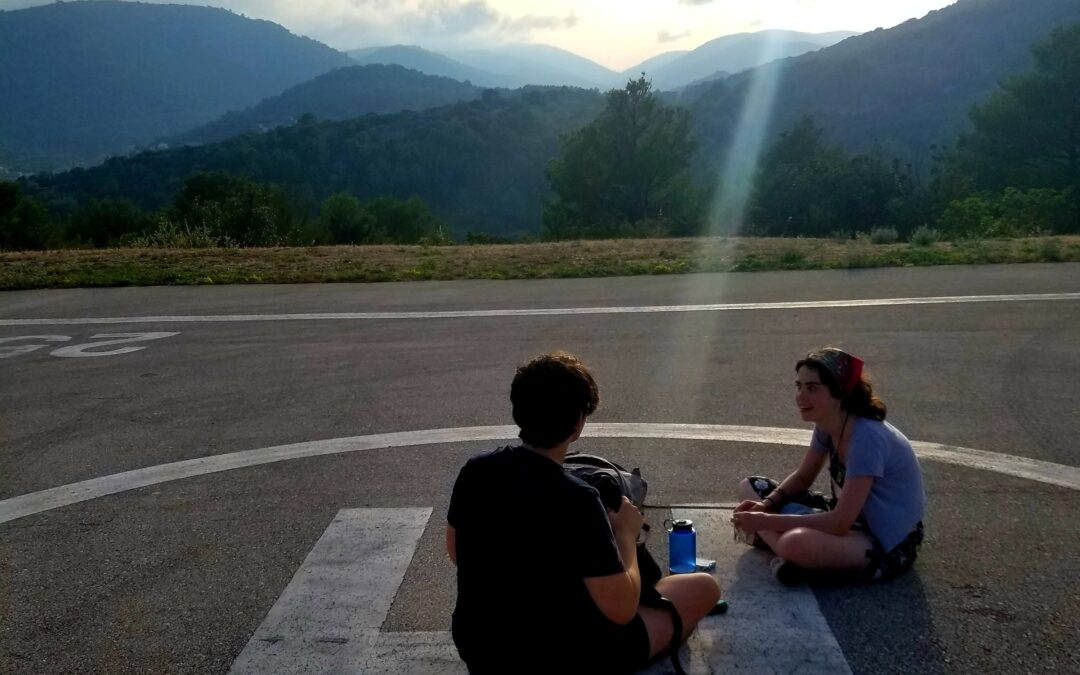
Photo caption: this article has a photo which you can only see on my home page (don’t ask me why). It’s a photo of my son Luca and his girlfriend Lydia on the Croatian island of Vis, taken in September 2021. They kindly invited me to join them on their holiday and we ended up wandering around the hills on the island of Vis which, like all Croatian islands, is stunning. In this photo we were about to start playing cards on a disused helipad.
by Rupert Wolfe Murray | 26 Aug, 2021 | Bosnia, Journeys
Srebrenica is so much more than a small town on the eastern border of Bosnia. It’s a name that is associated with genocide. The number 8,372 is often mentioned alongside the name of the town, as that’s the number of unarmed men and children who were killed there by Serbian forces in July 1995. For me it’s a reminder that extreme nationalism lies dormant within my own country and, if we’re not aware of it, the same thing could happen at home. Brexit and Trump are rather tame examples of what can happen if nationalism is let off the leash.
These were my thoughts on the long bus journey from Sarajevo to Srebrenica. I noticed the date, July 2021, and realised that it was exactly 26 years since the genocide. What would I find there?
My reason for visiting Srebrenica was not very noble: I was looking for dirt. My mission was to photograph graffiti or posters that celebrated the Bosnian-Serb war criminals who had organised the genocide. Some images like this would be useful for the book of Bosnian War Posters that I’m working on. I’d seen plenty of material like this when I was last in Bosnia, over 20 years ago, and assumed it would be plentiful – even though the denial of genocide had just become outlawed in Bosnia (resulting in the Serbian part of the Bosnian government going on strike).
But I didn’t find any nationalist graffiti at all in Srebrenica, even in the grubby backstreets. I was surprised as this town had been emptied of its Muslim majority, populated by Serbs from elsewhere and I assumed it was a hotbed of extreme hatred against Muslims. My expectations were being overturned.
In the centre of town is a vast mural that takes up the whole side of a building. Here’s my photo of it:
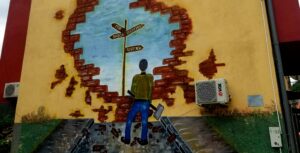
I didn’t pay much attention to this mural when I first saw it as I didn’t really like it, but later on I realised it’s verging on the arrogant to dismiss a mural as it doesn’t fit my personal standards of high art. But when I read the words on the signposts I realised that this is an extraordinary piece of work. The words translate as PEACE, HAPPINESS, THE FUTURE AND SUCCESS.
I had come to Srebrenica looking for evidence of hatred and support of extreme nationalism but what I found was a massive mural celebrating hope and peaceful coexistence. What’s more, there were no traces of graffiti on that mural and, to me, this suggests that it’s accepted by everyone.
And the positive impressions kept on accumulating: I went into a basic restaurant where a Muslim family (the women were wearing white headdresses) were being politely served; there was an elderly Muslim lady waiting outside the supermarket and none of the passers by gave her a dirty look or made sneering comments; and I heard various stories that the small number of Muslims who have returned to the area were fully accepted, even welcomed, by the local Serbs.
Later on I went to the massive graveyard where the 8,372 victims are commemorated. It’s a place of beauty with thousands of carved, marble headstones. On the other side of the road is an empty factory where a superb exhibition about the genocide has been put together, focusing on the UN forces who showed incredible weakness in not standing up to the Serbian aggressors.
Visiting that graveyard is a powerful experience but what impressed me the most was the complete absence of anti-Muslim graffiti outside the site. There were two large security booths but both were empty. I couldn’t help thinking that if this had been in the UK there may well have been all sorts of vicious comments daubed onto every available surface. Although this type of hatred is reasonably well controlled in the UK, I’m under no illusion that there are a lot of people who would like nothing better than to massacre people of a different colour, religion or ethnicity. I feel there is more anger and hatred on the ground in my own country than there is here. That’s why I can’t blame the Serbs for what they did – I blame nationalism. Nationalism is like an intoxicating drug which can make people do things they would normally consider totally irrational. For me, whisky has that effect: give me half a bottle of whisky and I lose all fear and become inflated with wild recklessness.
The positive impressions kept piling up. I had a friend in Srebrenica, a filmmaker called Ado Hasanovic, and he was working with some volunteers at what can best be described as a housing estate: about ten big houses, and some sports grounds, within a large compound. I was introduced to the volunteer manager, Mirela Ahmetbegovic, and she explained that every year between 70 and 90 volunteers are recruited for the summer holidays and they visit single old ladies in the area and do all sorts of building projects. She pointed to the houses and told me that, in prior years, they had all been built by volunteers. During term time the buildings are used to house children from the outlying villages, children who are too remote to attend primary school. What an incredible project and I take my hat off to the charity behind it: The International Forum of Solidarity: Emmaus.
My final positive impression of Srebrenica was hitchhiking, a means of travel that’s virtually impossible in my own country, as people have become too suspicious and fearful. I hitched twice around Srebrenica and on both occasions something unique happened: the first car that went by stopped. I’ve hitchhiked in many countries of Europe as well as in Tibet – the draft title of my first travel book was Hitching to Shanghai – but never has this happened to me before. The first car almost never stops, and it certainly doesn’t happen twice. Anyone who has hitchhiked will know that you don’t get a lift unless you’ve first stood at the side of the road for hours on end and have almost given up the will to live.
Making sense of it all
On my way back to Sarajevo I felt glad that my negative expectations had been replaced with such positive impressions. I was particularly struck by how there was a real atmosphere of tolerance on the ground and no sign of the hatred that had caused such devastation 26 years ago. But how to explain it? How to understand how a peace-loving people had got involved in genocide?
It’s all very well blaming it all on nationalism, but what does that actually mean on the ground? What happened? How did neighbour turn against neighbour? What was the methodology used to activate people’s deepest fears?
The most obvious conclusion is that people who live together in communities – villages, towns and cities – get on with each other whatever the religion, nationality or ethnicity. Ordinary communities have enough flexibility and understanding to overcome the occasional outrage. But when political leaders and sections of the news media get their teeth into extreme nationalism, the results are predictable: as a new version of reality is crafted the truth becomes the first victim; all problems are laid at the door of “the other” as well as imminent threats of attack; people are worked up into such a frenzy of anger, fear and hatred that carrying out acts of violence flows almost naturally. And, like an addiction, stopping nationalist-fuelled-rage is incredibly difficult.
My understanding of how it worked on the ground is based on what I’d heard just after I moved to Tuzla, just after the Bosnian war (1992-95), and also from what I read. Before the war, each village, town and city in Bosnia was made up of people who were associated – by religion – with the Muslim, Croat or Serb identity. During the Yugoslavia era, when Bosnia-Herzegovina was one of 6 republics that made up the nation, all these ethnic groups got on well with each other– despite the horrors that had taken place in the Second World War. But, when the Serbs released the demon of nationalism, these ethnic divisions became the flash points for war.
But these people had been neighbours all their lives and there was no way they were going to turn on each other, drive them out and kill anyone who objected. Apart from anything else, they didn’t have any weapons. The local Bosnian Serbs were decent people and they knew that their Muslim and Croat neighbours were too, despite Serbian propaganda being pumped out at the time that warned of an impending Islamic attack and resurgent Croatian fascism. The Serbian message at the time was: We must attack before we are annihilated!
What mobilised the local Serbs to action was the appearance of the Serbian death squads, like Arkan’s Tigers. These units had been covertly sponsored by the government in Serbia and were made up of experienced soldiers, some with French Foreign Legion experience, all with a hunger for killing. What they would apparently do when they turned up in peaceful, multi-ethnic communities in Bosnia, and Croatia, would be to gather together as many local Serb men as they could. They would warn these men about the imminent danger they were in from the (imaginary) forces of Croatian fascists and Islamic fundamentalists who were about to descend on the town and urge them to take immediate action before it was too late. The death squad would order all Muslims and Croats to leave town and if there were any objections they would start the killing. I’m not sure to what extent the local Serbs were involved in these massacres but that’s not the point – they were implicated. By not standing up to these death squads and their crimes these local Serbs had become complicit in crimes against humanity.
After the death squads left town the local Serbs would be left behind, no doubt with a guilty conscience about what had happened. But what could they do? If they admitted to having seen any atrocities they could be implicated so it must have felt safer to just keep quiet and deny any knowledge of what happened.
The good news is that people on the ground all over this beautiful country want nothing more than to live together in harmony. The problem is that the vast majority of people in Bosnia-Herzegovina don’t vote.
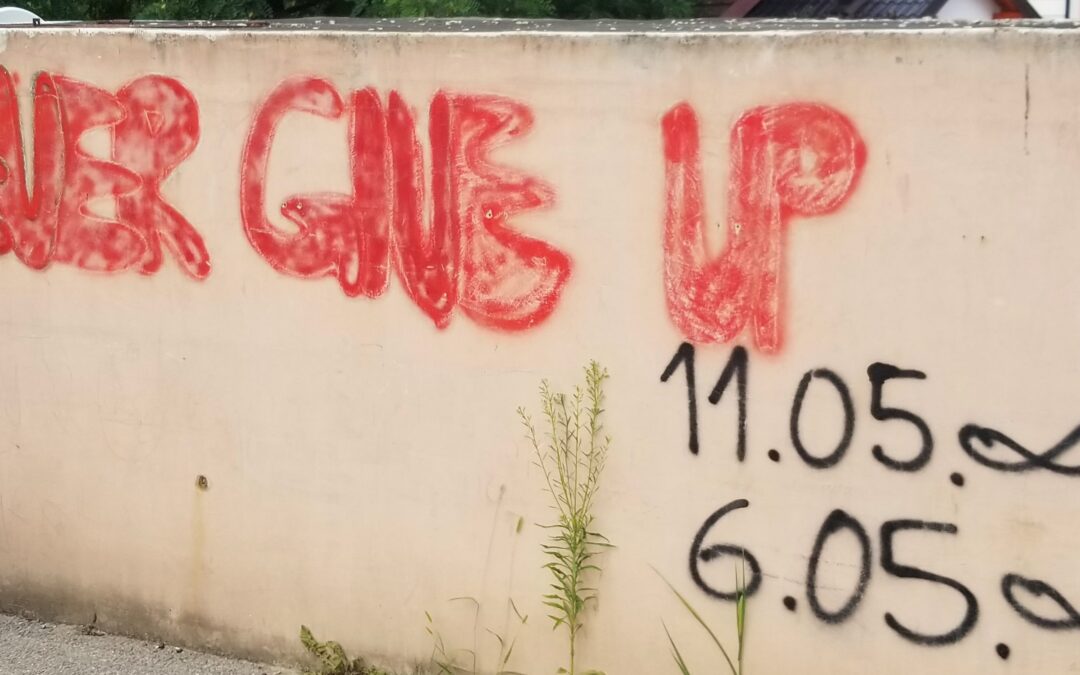
I took the photo linked to this article, of the graffiti saying NEVER GIVE UP, at the EMMAUS volunteer centre in Srebrenica. The dates commemorate the genocide and I was there exactly 26 yeas later, glad to see that the massacre hadn’t been eradicated from the scene of the crime. What I love about the message Don’t Give Up is that it applies to Serb and Muslim alike, it’s relevant to anyone regardless of their ethnicity, religion or gender.
by Rupert Wolfe Murray | 3 Jun, 2021 | Journeys
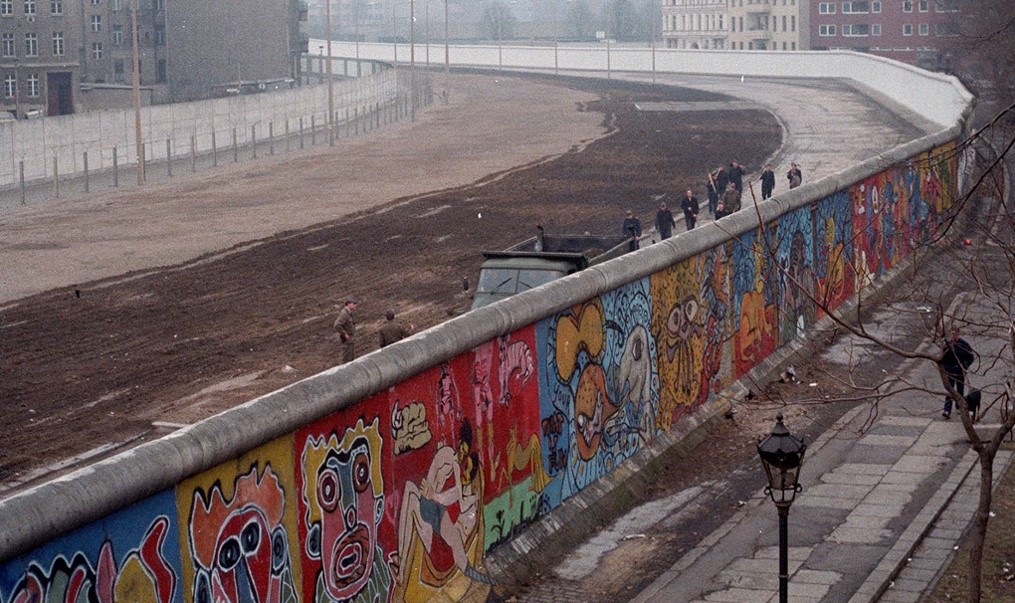
East Berlin was controlled by the Russians until 1989. It no longer exists. I spent some time there many years ago, on my way to Asia. This is how I described it in my first travel book, 9 Months in Tibet.
Berlin back then was entirely surrounded by a high security wall and guarded round the clock by dogs, landmines and thousands of heavily armed soldiers. The whole thing was a bizarre hangover from the Second World War. In 1945 Germany had been occupied by the allied powers and in the areas controlled by America, Britain and France free elections were allowed – and that part became known as West Germany, or the Federal Republic. The Russian army controlled the eastern part of the country – East Germany, officially known as the Democratic Republic of Germany – where Russian-style elections took place and Communism was imposed.
As it was located deep within the Russian zone, one would have thought that Berlin should have become a Communist-controlled city like Dresden or Leipzig. For some reason that I never really understood, Berlin was divided up between the allied powers and this resulted in the western part of Berlin becoming an island of Capitalism in a sea of Communism. The status of West Berlin was backed up by American military muscle, and their nuclear arsenal. By the time I got there the political situation was relatively settled and the city functioned well. It was connected to West Germany by an airport and a fenced-off motorway that was so heavily guarded that you couldn’t stop anywhere without East German troops appearing.
My impression of West Berlin was that it was populated by artists, gays and drifters. If you wanted to avoid the military draft in West Germany you moved to Berlin where that particular law didn’t apply. The West German government was worried about the city becoming depopulated so it offered incentives like this so people would go and live there. We stayed with a Scottish artist called Fiona, a friend of my skateboarding brother Moona. We visited art galleries which I got bored of pretty fast. I was more interested in the nightlife, which started after midnight and went on until nine in the morning. I had never seen anything like it. In Britain the pubs all closed at 11pm, thanks to a law from the First World War that was designed to keep the workforce sober, but in West Berlin there was no such thing as closing time. And the pubs weren’t the smoky, crowded, noisy pits I was used to – they were more like art galleries with smoked-glass tables and great music. They served beer in large, elegant brandy glasses.
My friend Christian was gone after a few days and I was left on my own, feeling a bit disorientated and not quite sure how to start my epic journey round the world. Fiona lived alone in a big flat and said I could stay as long as I wanted.
The most interesting part of the city was East Berlin, the Communist controlled sector, where the architecture was verging on the grotesque. Getting there was exciting. You had to pass through what was probably the most famous border crossing in the world: Checkpoint Charlie. On the western side there were no passport controls at all, just relaxed American soldiers. On the eastern side there were scores of armed military officials who checked passports, searched bags and took the whole thing very seriously. Anyone caught trying to escape from the Communist part would be hunted down by dogs, blown up by landmines or shot. There was an exhibition at Checkpoint Charlie documenting some of the more dramatic escape attempts. People used to dig tunnels, hide in cars and risk their lives to escape the restrictions of East Germany.
One evening on the Eastern side I passed a pub – a thin room, full of smoke, packed with people and roaring with voices – and it reminded me of pubs in Scotland. So different from the smart but staid pubs in West Berlin. The only thing I missed about Scotland was the pubs. To me they represent community.
Berlin has a big underground railway system, the Metro, which was built before the city was divided up by the Allied Powers. An agreement had been made at some point whereby the western side controlled the metro system and the Communist side blocked access to it for their citizens. I wasn’t aware of any of this at the time but I was stunned when the train didn’t stop at an underground station that seemed to be lit with just one fluorescent strip and looked like it hadn’t been swept in years. I saw soldiers in stylish grey jackets which reached down to their hips, thick belts round their waists and high black boots. They each carried a short machine gun on a strap round their shoulders and stood menacingly on the platform with their legs apart, looking at our carriage intently. The Metro had been a popular escape route – people would hang onto the bottom of trains so that they could find freedom in the west.
One of the main reasons I spent so much time in Berlin was to get visas for all the countries I planned to go through: Poland, Czechoslovakia, Hungary, Romania, Bulgaria, not to mention Iran, Pakistan, India and China. I had started this process over the previous few months – visiting spooky embassies in London. The Romanian Embassy was in a huge Victorian villa and looked like something out of a Dracula movie. Getting visas is a time consuming process but the one thing I didn’t have in the UK was time, as I was so busy making money driving a truck. I suspect that if my friend Christian hadn’t insisted I come to Berlin I might never have left. Berlin proved to be a useful staging post where I could prepare for the next leg of my journey. I didn’t need to think about a Chinese visa until I got to Hong Kong — if I ever got there; it still seemed so impossibly far away and the money I had brought with me no longer seemed like such a vast hoard.
The first challenge was to get a visa for the Islamic Republic of Iran, a country that stood right in the middle of my planned hitchhiking route. Iran had been taken over by Islamic Fundamentalists in 1979 and they didn’t have a very good impression of us Brits. Our colonial history there is a shameful one and I wasn’t sure they would give me a visa at all. But I had to try. Several weeks later I stood in the snow outside the Iranian Embassy, clutching my passport with a fresh visa in it. It was time to move on.
Just before leaving Berlin I had an attack of fear and paranoia. It happened late one night in Fiona’s flat, which was large and empty. Fiona was out, as she was most nights. The rooms were cold and dark and the street lights were casting strange shadows. I was smoking a joint on my own and contemplating the future. I had smoked a lot of pot over the last few years and I believed it had made me more aware, but I knew it had also made me lazy and disconnected from university.
I started to feel paranoid. The more I smoked the more scared I became – a horrible, crawling feeling in my stomach and on my skin. The Iranian visa was the spark: around the visa stamp was a lot of Arabic writing and I became convinced that this was my death sentence which said This is a British spy! Arrest him immediately! I imagined being hauled off to a crowded dungeon, put in chains, starved, screamed at, flogged in public, tortured and eventually decapitated.
The Iranian fear was avoidable as I had a choice: I didn’t have to go there. I could fly over Iran. No sooner had I decided to do just that the next shock came marching in: I was trapped in this city and it was surrounded by the Red Army. What if the Russians decided that I was not allowed to leave? Maybe they had talked to the Iranians? Surely they would lock me up and throw away the key?
Fortunately, I managed to sleep and by morning my living nightmare was just a memory. Something good came out of this episode: I gave up smoking cannabis. I realised that if I was going to hitchhike across Europe and Asia it wasn’t in my best interest to use a drug that could make me feel so scared. It wasn’t until that morning in Berlin in 1986 that I realised the importance of giving up dope. I tried some many years later, in the basement flat of a doctor friend in London, but the demons of paranoia came on strong and I realised that I must give up this shit for good.
It was time to hit the road but I was running out of cash. I had spent too much time in this damned city. Even though I was living frugally and wasn’t paying rent, the cash was dripping through my fingers as if it were sand. What could I do? How could I earn some money? The last thing I wanted to do was call home and say Mummy! Please help! I’ve run out of money. It would have been so humiliating. I didn’t know enough German to be able to get a job in Berlin and I wanted out of this town. It was becoming suffocating. I looked at the map and considered my options: Poland, Czechoslovakia, Austria, Hungary; not much chance of getting a job in those parts. The only modern capitalist city on my route was Vienna: Hmm…I wonder…Could I get a job there?
Now that I was finally away from home I had so many questions. Why was I planning to travel by train? Wasn’t I supposed to be hitching? Why was I planning a route through South-East Europe? Wasn’t that a long and complicated way to get to China? How much would all the visas cost? What about exchange rate losses? Why not get the train to Moscow? I could get the legendary Trans-Siberian Express, stop off in Mongolia, and then arrive in Beijing dusty and experienced in the ways of the traveller. I didn’t have a neat answer to my choice of route but I did want to see as many of those strange East European countries as possible.
If I didn’t make some money soon there was no way I would get anywhere near China. I had underestimated how much things cost. I was down to $200 and I needed to build up my stash to over $2,000 before proceeding eastwards. This became my formula: when the cash dropped below $200 I had to get a job; when more than $2,000 was saved – hit the road. Would I be able to get a job in Vienna?
German words are so long, the language seemed impossible and I doubted I could ever learn it. I was also studying Mandarin Chinese with the aid of a book from the 1930s and I remember thinking: Chinese is easier to learn than German – it’s just a series of monosyllables; whereas German words are really long and almost impossible to remember.
Germany has one of the best railway systems in Europe but the trains it deployed for going east, into the Communist world, were old and run-down. My impression of the Communist Bloc, a vast stretch of the northern hemisphere, was that all the nations were the same. They were all toiling under Moscow’s rule, uniformity in all things was the order of the day; they wore the same clothes, drove the same cars, did the same things, learned the same Communist-inspired history and took their orders from Russia. If you had asked me: Why on Earth would you visit such a boring place? I would have told you that I wanted to see for myself how dreadful it really was and if this impression of uniformity was really true.
#
This is an extract from my first travel book 9 Months in Tibet. You can get the eBook here: 9 Months in Tibet eBook: Wolfe-Murray, Rupert, McCall Smith, Alexander: Amazon.co.uk: Kindle Store
by Rupert Wolfe Murray | 19 Apr, 2020 | Journeys
My heart goes out to everyone who’s stuck at home feeling bored and worried.
I’m the only person on the train from Brighton to London. Usually you can’t find a seat at this time of the morning (10:42 departure).
The only people at the station were railway workers and a lone policemen who took a long look at me and decided I wasn’t worth questioning (I was trying hard to look as if I belonged there, hoping he wouldn’t ask why I was pushing a bicycle and trailer).
The ticket inspector looked unfriendly but wasn’t. He was probably just bored, as most people are in this strange time of the virus. I’m standing in front of the ticket barrier, wondering if he’ll open it and let me through without asking for my ticket. He does.
I wonder why the trains are still running if nobody’s travelling? I ask the inspector: “Who’s using the trains these days?”
“Key workers and fare dodgers,” he says. Where did this term “key worker” come from? Sounds like another way of saying Locksmith.
“Fare dodgers?” I asked, “What …?”
“People who don’t have any business being on the trains…”
I walk onto a vast empty platform, feeling quite strange, as if I shouldn’t be there. I’m expecting the policeman to put his hand on my shoulder at any moment.
The train is eerily empty and spotlessly clean.
We stop at station after station and the disembodied lady’s voice comes on and tells me where I am. Nobody gets on. Nobody gets off. There’s nobody at any of the stations except Gatwick Airport where I open the door and stare down the platform – and yes, I see someone; about 200 yards away a figure in fluorescent yellow is bending over a bin.
As we go through the London stations – Clapham Junction, London Bridge – where millions of people normally pass through every day, I see more fluorescent jackets; some look officious and others push a brush. The brush pushers look more relaxed.
I’m surprised Gatwick is so empty as I’d read in a paper that about 15,000 people a day fly into Britain, none of whom are checked for signs of the virus. Britain’s approach to the virus seems over-reliant on the private sector bailing us out: Boris’ hapless government are hoping that Google’s new App will save us; apparently it will beep every time you go near someone who’s admitted to having had the virus. But isn’t that going to make those who’ve had it into instant pariahs? The former boss of MI6, Sir John Sawers, said in the FT: “What’s being envisaged [for contact tracing] would go beyond what we used for security purposes.”
But I don’t let the ramblings of politicians worry me as there’s nothing I can do about the fact that the global economy has been shut down because of our insatiable appetite for meat. All I can do is observe things and, I must confess with a certain amount of guilt (shouldn’t I be depressed and worried?), that I find the whole thing absolutely fascinating.
Perhaps the most interesting thing that has happened is that a simple message – don’t go out – has been picked up by virtually every nation on earth and over seven billion people are staying at home. It shows the incredible power of the media. Some people worry that it’s a plot to control us, but what these people don’t see is that it’s based on consensus; if an overwhelming majority of people didn’t see the point of this lockdown there’s no way it could be enforced. Imagine if they tried to do repeat this trick to stop global warming, which is an even bigger threat than this virus, by banning fossil fuels – it wouldn’t get anywhere.
St Pancras and Kings Cross
I get off the train at St Pancras and see one or two other passengers emerge from what I thought was “my” train. They all wear masks, as do I, and hurry off. Nobody seems to want to talk or even exchange a glance. Someone checks my ticket at the exit barrier and, as I head along the grand concourse of shops, a policeman approaches me; we’re both heading towards each other like in a cowboy movie. I look ahead, going over my cover story in my head (“I’m going home!”), and he walks straight past without even glancing my way. The policeman looks like he’s about 16 years old (apparently, when you think the policemen look young it means that you are getting old).
The main road outside St Pancras and Kings Cross isn’t as empty as I had expected. A few buses, trucks and Lycra-clad men on bikes. Some sign of life.
There’s a bored-looking a guard on the entry to Kings Cross Station but he doesn’t ask me anything as I saunter in with as much “purpose” as I can muster up. There are about 20 people in the whole station, a mixture of “key workers” (whatever they are) and worried-looking passengers. None of us passengers speak to each other. The only person who’s friendly is an Italian station official who tells me the 13:00 to Edinburgh is leaving at 13:30, and not to worry about my reservation as “there will only be about five people on the train.”
The fluorescent clad “key workers” have a gruff banter between themselves. Truncated comments, jokes and gestures are communicated across the station in short bursts. I tried to follow what they were saying but couldn’t. They were communicating in a way that was bypassing us ordinary folk; easy enough when you consider that most of us are consumed by worry.
I find the experience of being in this empty station quite stimulating, almost exciting, but I can’t understand why. I gradually realise that it reminds me of travelling in foreign locations where everything is different – and therefore of great interest. It’s similar to the feeling I get when reading a dystopian novel, when all the things we know about our society have been swept away and a new system has been created.
I remember visiting the Bosnian city of Tuzla during the 1992-95 war; the streets were empty and everyone was hunkered down at home, or in trenches on the front lines. It also reminded me of Tibet in 1986 when there were so few vehicles that people would stand in the middle of the main street and have lengthy conversations. I’m feeling some of that sense of wonder I get when travelling in a place where the normal, western system of life doesn’t apply.
But there’s something else. How can I describe this modern station with scores of empty shops and all the high-tech lighting still functioning? It’s far too well-designed and clean to be in a poor country, or in a post-apocalyptic world, which is what it initially felt like.
Then it struck me; it’s like a huge art gallery which has a few bored officials making sure you don’t do anything untoward, and a handful of visitors who are staring with deep concentration at … the departures board.
The Italian was right; the Edinburgh train only has about five people on it. We all have our own carriage, and I sprawl out over a big table: laptop, papers, book, phone, charging cables, water, lunch. It was a brand-new trains made by Hitachi, the Japanese company that makes electronics. It has the look and feel of a brand new car, a high-end type. I’m in the lap of luxury. The only thing missing is the drinks-and-snacks trolley but I can live without that and am grateful for not wasting money on bad coffee and junk food.
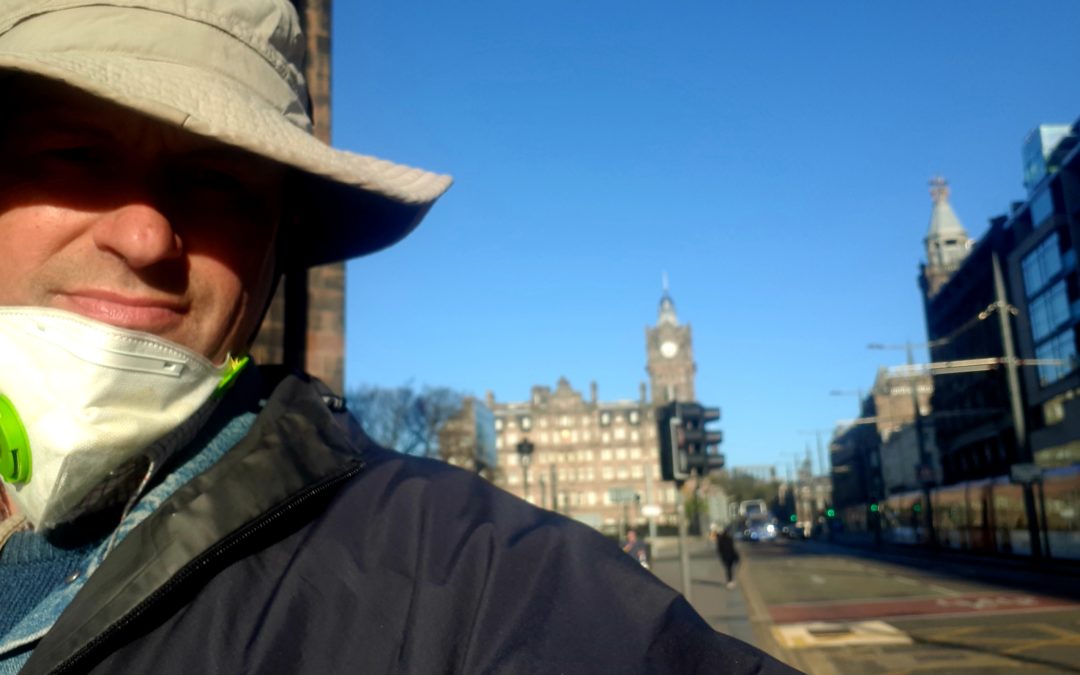
I read my friend’s manuscript about Dracula (“the real story, ” he claims), eat yesterday’s lentil stew, have a nap and, four hours later, arrive in the capital of Scotland which is eerily empty. The only thing moving in the 1-mile sprawl of Princes Street are a few buses – and they’re all empty.
Why am I travelling?
Over the last week I’ve taken a bit of flak from my Facebook friends after asking what’s the best way to get to Edinburgh: train or bike (as in bicycle touring, with trailer and camping gear).
Many of those who responded didn’t answer the question but said “don’t go!”, asking why I plan to break the rules of the lockdown. Some suggested that I just want to go on a jolly. But I did respect their view and didn’t do what I really wanted to do – cycle up the east coast of England and camp on empty beaches every night. That would have been a jolly masking a valid reason to travel.
But I can’t blame them for giving me a hard time as I should have explained why I came to Edinburgh.
It’s quite simple; due to the virus, the flat I own in Edinburgh is now empty and I’m going to live in it for a while as I can’t afford to pay rent in Brighton and have an empty flat in Edinburgh (which is a main source of income for me).
The other reason is to live on my own, in other words self-isolate better. In Brighton I was renting a flat from my aunt and she’s in her seventies; every time I go to the shops I touch all sorts of surfaces and could bring the virus back.
As soon as the situation changes, and I get new people into my flat, I’m going to hit the road with my touring bike and trailer and do that east-coast route; it will hopefully be mid-summer by then and maybe the beaches will still be empty and there will be nobody to complain about a rogue cyclist putting up a tent where he’s not supposed to.
#
Postscript; when looking up the population of the world I came across this compelling website, which shows the minute-by-minute growth of the global population. At the time of writing, a total of 17,688,444 people have died in the world thus far. Two minutes later I checked the figure again and it is now at 17,688,580. If my back-of-the-newspaper maths is correct, 146 people just died.
I find that constantly moving statistic fascinating, but also rather macabre, and wonder if it helps put the corona virus pandemic into some kind of perspective. I think not.
#
If you haven’t yet got a copy of my new travel book you can get it here: Himalayan Bus Plunge — & Other Stories from Nepal
#
Let me know what you think about all this in the comments section below. You can also use this space to share your own corona virus story. How have you been handling it? How are you feeling? What do you think will happen next?

