I would like to share with you two updates from the Edinburgh Book Festival event about my Mother, Stephanie Wolfe Murray. For one beautiful hour in August authors, publishers and my brother Kim gave a series of short talks about a wonderful woman.
Alexander McCall Smith agreed to share the poem he wrote about my Mother and read out at the event. You can see it below.
I don’t know much about poetry but I find this one remarkable; every time I read it I come away with a new understanding. It seems very rich and I will treasure it.
I also got the approval of McCall Smith, Alasdair Gray, Tom Pow, Jamie Byng and the other speakers to share the audio recording of the Book Festival event. It’s worth listening to as their stories are witty and none have the dourness I associate with memorial events. Just click on the little play button above this text.
The only talk from that event that I am publishing on my blog is the one by my big brother Kim. It was a great talk and by putting it on my blog it will sit alongside the eulogy that my brother Gavin gave at the funeral, as well as all the testimonials that formed the basis for the wee book that we did about her.
Here is Alexander McCall Smith’s poem:
A maker of beautiful books
In memory of Stephanie Wolfe Murray, publisher.
A maker of beautiful books
Knows exactly what it is that makes
Paper, card, printer’s ink,
The raw words of the writer
Into that lovely object
We call a book; understands
The subtle work of fonts,
Of leading, of bindings,
That makes a book something
We wish to hold to ourselves,
To keep and cherish, to read
At times when the soul is in need
Of solace, of insight, and art
That can transform the quotidian Into the transcendent.
A maker of beautiful books
Understands that text
Should whisper to us its message
Like a confiding friend,
Not in the trumpet tones
Of the strident, the polemical,
But gently, tactfully,
In private places of exchange
Where the loud and the angry
Have no wish to linger.
A maker of beautiful books
Brings people together In civil and gracious converse,
Crowdfunding is much harder than I had assumed although, on the face of it, what could be easier? Just fill in a form, make a video and Bob’s your uncle – the money starts pouring in.
The process is straightforward, at least on Kickstarter, one of the first crowdfunding platforms, but, in my case, it reduced me to a nervous wreck.
This is what happened:
On 24 June 2017 my mother died. Not only was she the heart and soul of our family but she had worked wonders for Scottish publishing — as well as various aid agencies she’d supported. I loved her as my mother but had not realised how appreciated she was. I got an email from Alexander McCall Smith who said she was “one of the most exceptional people I have ever met,” and Jamie Byng, of Canongate Publishing, wrote “she was an inspirational figure in my life.”
I didn’t know how to mourn. What are you supposed to do? Get sad and gloomy? Go into a depression? I was in denial and, to this day, can’t believe she’s gone. The only thing I wanted to do was write about her but I found that I couldn’t. I was blocked.
I did manage to write a short blog post, asking people to share their anecdotes about her. They came pouring in and soon I had 27 comments, some of which were lengthy and beautiful. With very little effort on my part, her life story was being written in draft form. Maybe I could turn these comments into a book? Hmm…nice idea but I was still being held back by the demons of doubt, sloth and complacency.
The spark came from Nick Barley of the Edinburgh Book Festival who, together with Jamie Byng of Canongate, organised an event about my mother at the Book Festival. It was suggested that a wee booklet about her be organised and I jumped at the opportunity.
I soon realised that doing a booklet or brochure was as much effort as doing a short book. Here was my chance to write about her; not the book that I had in mind (a swirl of self-indulgent ideas and sunny memories), but it was something I could put together quickly. I wrote to Alexander McCall Smith, who had published with my mother before he became famous, asked for a contribution and he agreed – as did Alasdair Gray, William Boyd and many others.
It came together in a few weeks mainly thanks to Jim Hutcheson who, my mother used to say, is the best book designer in Scotland. He agreed to work for free, as did everyone else who helped. All that was needed was £1,600 to print the thing.
Crowdfunding – asking individuals to contribute towards an online project – was the obvious solution and I had used Kickstarter to fund a bike tour round the Highlands, when I published my travel book about Tibet.
Until that point I had been riding a wave of optimism and positive energy. Everyone loved my mother and I had great material; what could possibly go wrong?
But when I got down to the nitty gritty details of Kickstarter, asking people for “rewards”, I was struck by doubt: Maybe I wouldn’t raise enough money? Why would anyone give me money? Who the hell was I to do this book anyway? Surely a proper writer should be doing it? Why the rush?
The darkest moment was when the appeal was ready to go. I felt I had exposed myself and would become a laughing stock. I convinced myself that the project was a failure, my reputation would be in ruins, and it was only with great difficulty that I launched it.
At first nothing happened and the voice in my head said “of course nothing happened. What did you expect?” The next morning I had only raised £30 which was, Kickstarter reminded me, not even 1% of my funding goal. My worst fears were realised. I was doomed.
I was a nervous wreck and I checked Kickstarter every hour. After breakfast it had risen to £120. An hour later it was on £240, and by lunchtime £350. By the end of that first day I had almost reached £900 and with rising optimism I knew I was home and dry. I left the neurotic wreck by the side of the road and became an excited teenager, unable to believe my luck. A week later I had shot past my target, comet-like, and raised £3,270. All the extra cash will go to her three favourite charities.
Conclusions? Crowdfunding is easy if you have a compelling idea, but it can bring out your worst fears. Sharing your hopes and dreams with the public can be terrifying. In my case, the problems were all in my head. Now I know that if you have a good project and a network of people who support it, a crowdfunding project can easily succeed.
You can see the Kickstarter project about my mum here. The books have all sold out and I’m thinking about a reprint. Let me know if you would like a copy.
Since the loss of our darling Mother I have wanted to write about her, but the feelings are too raw and all I can say right now is that grief is a much more confusing process than I had imagined. I thought it was just sadness and gloom but it’s like being bounced around the inside of a pinball machine.
But I have been getting the most remarkable eulogies by email and I want to create a space — under this article — where we can collect up some of this warm and loving material. If we don’t pro-actively collect these tributes they may get lost in the fast flowing currents of modern communication.
If you knew Stephanie, or even just met her once, please would you add a comment below here — an anecdote would be nice, or a memory (even a feeling) as short or as long as you like. My friend Tom Wilson only met her once (in Romania) but he was moved by her interest in his Dad’s unpublished novel. What may seem silly and inane to you might be a real insight to me. It’s all helping me get to know the breadth of my mother’s influence.
It’s really quite remarkable what an impact she had on so many people; to me she was just Mother; I had no idea she transformed so many lives, inspired so many people, was so widely admired — and I don’t think she knew it either as she was very humble.
I want to share with you three messages that I got by email soon after her death. These were the messages that inspired this idea of collecting these tributes
The first one came from Alexander McCall Smith who said “She was one of the most exceptional people I have ever met.”
Then my friend Gardner Molloy wrote to me. Gardner is an artist who carves in stone, lives along the coast from Edinburgh and creates wonderful sculptures for buildings. He’s also a remarkable (but unpublished) writer with an imagination that reminds me of Alasdair Gray. He wrote of an incident I have long since forgotten but it sounds familiar as this is now my approach to cooking:
“I will never forget turning up at society [our house] with you one evening
to find there was no food in the cupboards whatsoever
and her sending you all out to pick armfuls of nettles
and then making a big pot of delicious soup
literally out of nothing
and feeding us all
total earth mother”
My final message offers an insight into her impact on Scottish publishing. The email came from Michael Wigan who used to stay with us when we were kids, and it was only recently that I found out he’s a writer (he wrote a fascinating book about salmon). This is what he sent me:
“She broke the mould in Scottish publishing and I remember well how her innovation, sheer go-and-get-it brio, just swept everyone away in her path. More than a breath of fresh air in rather staid Caledonian publishing, she was a whirlwind. Her charm turned scowling misogynist monosyllabic authors inside out, into grinning schoolboys. I remember everyone did what she wanted, however improbable, without hesitation. Above all, writers were published who would not have been without her, and new reputations made. She galvanised Scotland’s literary culture.”
If you would like to read more, here you can see her obituary in The Times and here you can see a wonderful account of her life by the good folk at Publishing Scotland.
Now it’s over to you. I would really appreciate it if you could share your most joyous, funny or ridiculous memory of Stephanie. It would be a shame if all this wonderful material, this outpouring of love for an exceptional soul, gets lost among the ceaseless chatter of daily emails.
And remember, you can write as much or as little as you like. Whoever you are, if Stephanie touched you, please leave a note here. It’s all valuable.
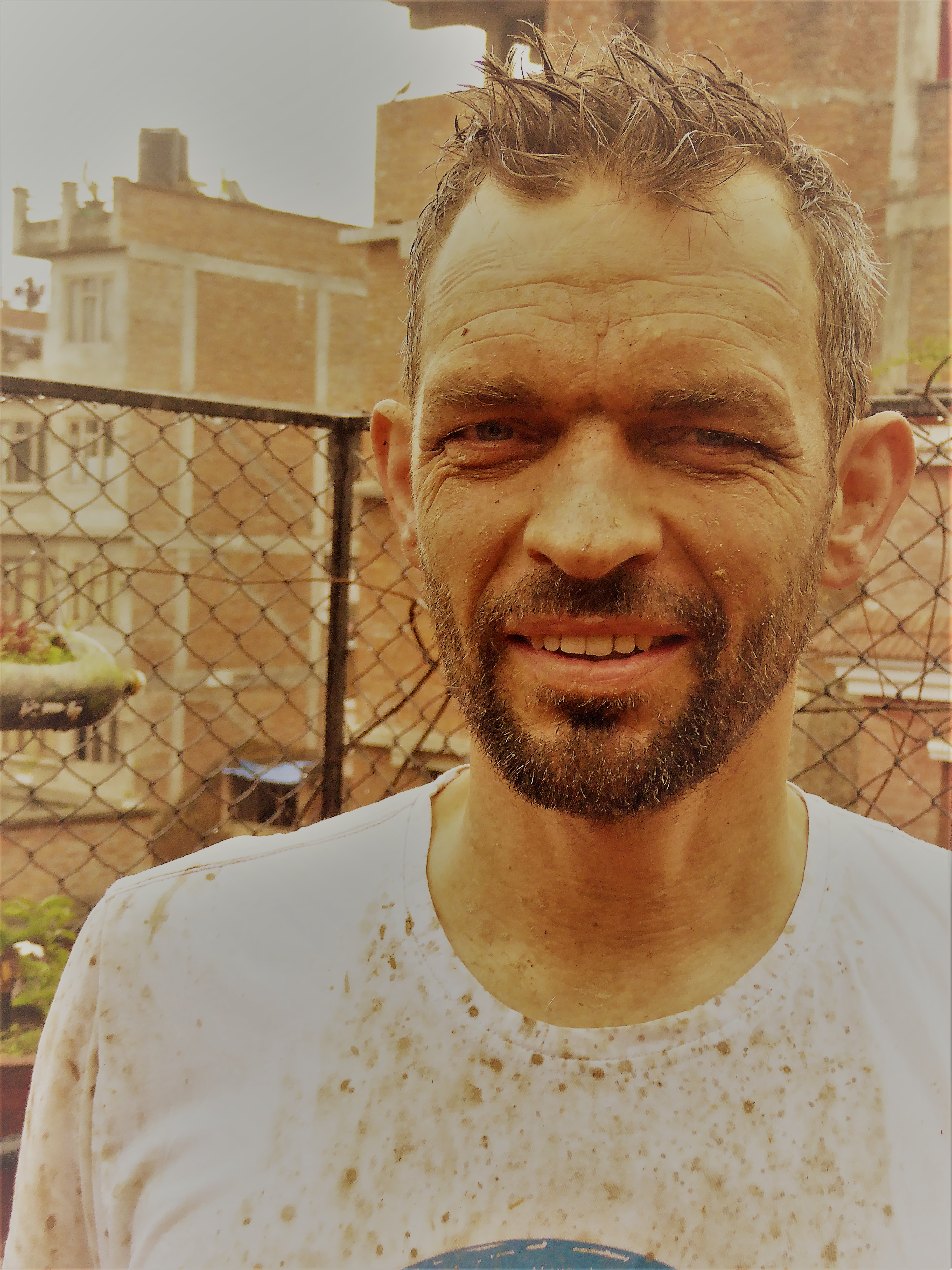
05:30 – Alarm goes off and Magnus gets up. Quick wash but no time for breakfast. Onto his Giant mountain bike and off into the narrow streets of Kathmandu. We ride fast, keeping up with the small Hero Honda motorbikes that are imported from India. We meet with a friend and head into the foothills that surround the capital of Nepal.
We pass scores of thin men pushing old-fashioned bicycles into town, each one stacked high with hundreds of kilos of potatoes, onions and other vegetables that are grown in the vicinity.
Magnus and his friend reach a high point in the foothills and wait impatiently for their unfit, inexperienced companion (me) and then launch themselves off a steep drop back down into town. They bounce and skid and tear through the pinewoods, as fast as horses and as nimble as rabbits. I fall off repeatedly, lag behind and feel like a tortoise.
08:00 – Breakfast isMagnus’ main meal of the day, the fuel for his tremendous energy. When not mountain biking, it is preceded by about 20 minutes of exercise on the rooftop. Breakfast comes in two parts: a bowl of muesli, yoghurt, milk, tropical fruits and various protein supplements in jars; this goes with rich brown toast from the German bakery, who also supply wonderful butter; we add honey, jam and a boiled egg to the mix. Three copies of the New York Times are delivered daily with a local paper (Republica) and this gives us plenty of interesting material to read about Trump and his descent into hell.
09:00 – Magnus jumps back on his bike and weaves at speed through the crowds of vehicles and people in Kathmandu’s narrow streets. Cycling in this town is like being inside a video game. He gets to the fortified entrance of the British Government’s Department for International Development (DFID) where he works as a humanitarian advisor. He helps organise the reconstruction of thousands of houses after the devastating 2015 earthquake and is passionate about “retrofitting”, which means reinforcing damaged buildings at a fraction of the cost of rebuilding them.
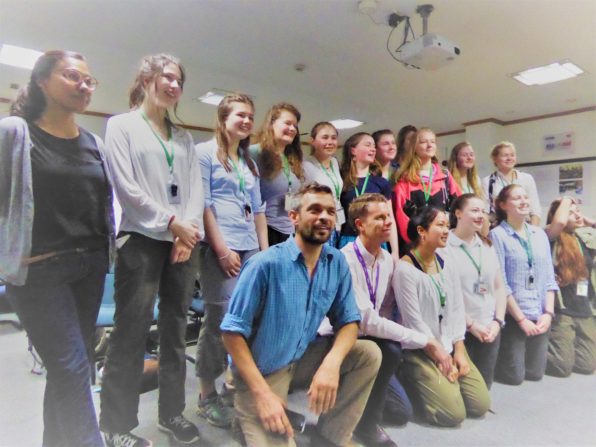
Magnus at DFID Nepal with visitors from Godolphin School, Salisbury
11:30 – Magnus is addressing a group of adult-looking schoolgirls from the Godolphin school in Salisbury (England). They are on a two-week trip to Nepal and are now learning about British aid to Nepal. Magnus tells them about what’s being done to help the victims of the earthquake, especially those in the high mountains where there are no roads. He says 5-6 million people were affected by the quake and they work in 4 districts. The quake cut off water supplies all over the region and DFID have re-connected over 150,000 people with fresh water.
One of DFID’s most impressive activities is rebuilding paths between villages, so that mules can use them and get building materials and other essentials up to the villages. DFID have funded the rebuilding of 125 kilometres of footpaths, and I imagine the logistical challenge of getting stone slabs and other materials up into the Himalayas.
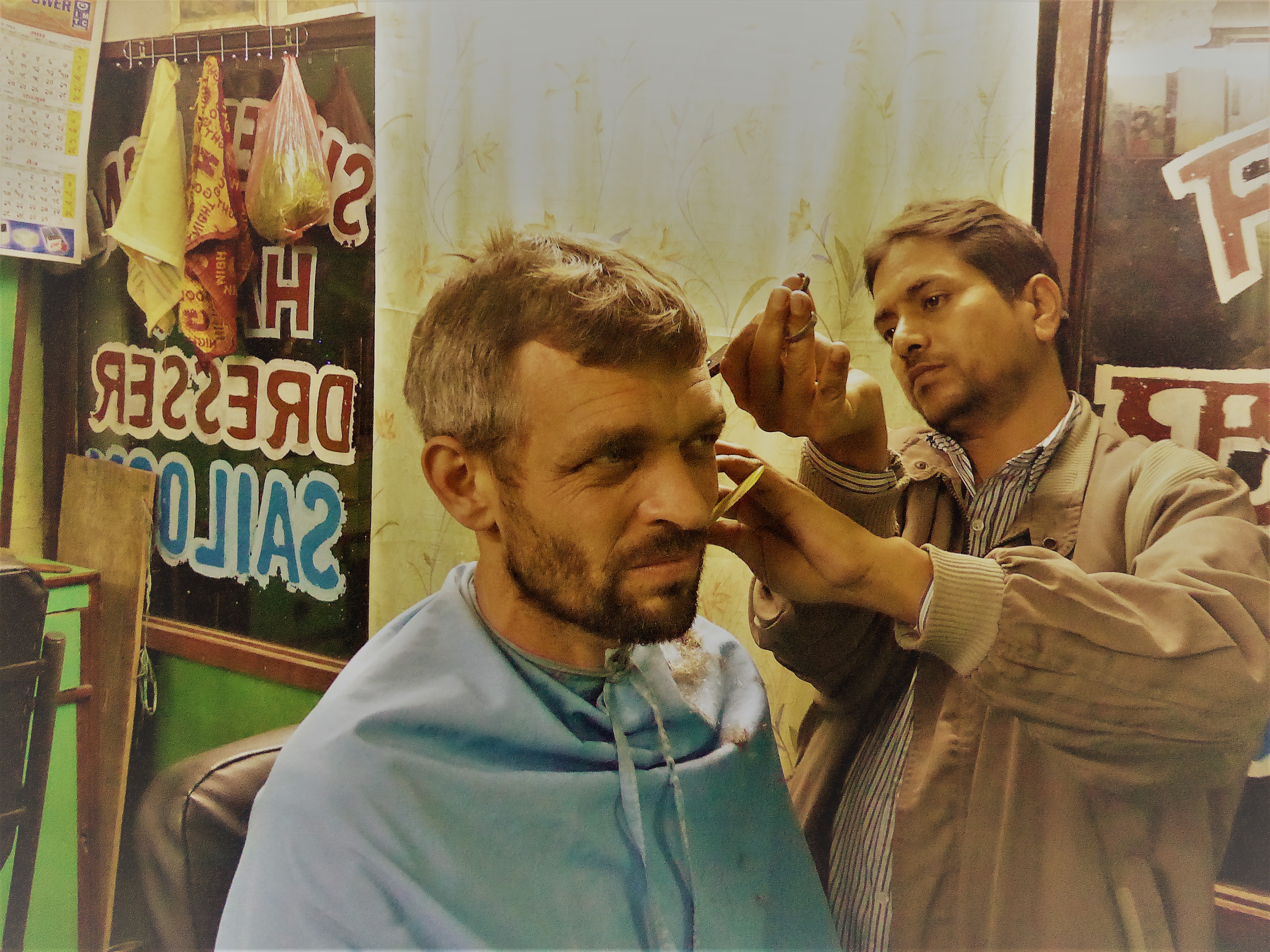
18:30 – Magnus comes home to change out of his work clothes. He grabs a cup of tea and we head out to his evening yoga class. We’re running late (we’re always running late) and so speed is of the essence. On our nimble mountain bikes, we can overtake everything in Kathmandu’s choked and lumbering traffic. We leave the chaos of the streets behind us and take refuge in a yoga class, located within an oasis of calm and greenery. Then we go to a barber shop, where Magnus gets a haircut and an intense head and shoulders massage for about £2.
Magnus Wolfe Murray at his Kathmandu barber. Photo by RWM.
20:30 – back to the house. Quick change of transport. We drop off the push bikes and get on his new Royal Enfield Himalaya motorbike. Magnus has invested in this beast so he can get to the mountains easier, but it’s also suitable for night riding around the city. We roar off and get to a mellow restaurant called Evoke where we eat pasta and fried paneer (cheese) but we’re in a hurry and the bill comes too slowly. They’re too laid back. Then we go to a rougher-looking place called Base Camp where we meet some of Kathmandu’s literati – including a literary translator called Nayan and a writer of short stories called Prawin Adhikari.
00:00 – the city is dead quiet by this time. The thick pollution that hovers over the streets by day is gone by midnight. We get home in no time. Quick cup of tea. Magnus takes out his laptop, starts making plans for tomorrow and deals with emails. I’m off to bed. I can’t keep up with this level of energy.
N.B. Magnus only gets up at 05:30 on a Wednesday morning, when the ex-pats go for a mountain bike ride before work. On the other mornings of the week he lies in bed till about 07:00 Wednesday is his busiest day as he also has the yoga class that evening.
I want to describe my last visit to Nepal, a fascinating little Himalayan country.
Thirty years have passed since I was last in Kathmandu. My presence there was both dramatic — I had been kicked out of Tibet — but also depressing: I was broke, my dream of living in Tibet had been shattered and I couldn’t afford to fly home to Scotland.
I didn’t want to be in Nepal and I didn’t really notice it (yesterday I told a Nepalese man that I was here 30 years ago and he said “that was the golden time” before uncontrolled building development and pollution). Back then I didn’t take in the ancient buildings and culture and spent my time writing an article for the Daily Telegraph — an article that got me £500, a ticket home and a foothold in journalism.
The last chapter of my memoir, 9 Months in Tibet, describes the political situation in Tibet that led to my expulsion. But there are some things which I never wrote about, one of them being the government poster that appeared all over Lhasa on the 3rd of October 1987 — offering a sort of amnesty to the rioters.
The poster, which is the subject of this article, hasn’t been reproduced anywhere as far as I’m aware and so, in a small way, maybe this article is a historical document about the Chinese occupation of Tibet (for those of you who don’t know what happened, the Tweetable version is this: China invaded Tibet in 1949. They promised autonomy, killed millions and destroyed the culture. The Dalai Lama fled in 1959 and set up a Government in exile in India.)
3rd October 1987: the Government Poster in Tibet
It was badly written, typeset in the old fashioned way and printed on thin white paper. I ripped a copy off the wall and smuggled it out of the country — oblivious to the risk of getting caught.
The poster was just text and its title was simple:
No. 3 Announcement by the People’s Government of the City of Lhasa. October 3rd 1987
The first part of the poster sounded diplomatic in tone, but if it had been drafted by diplomats they weren’t very good at English. My rendering of the poster is verbatim, in other words I didn’t correct their spelling.
By the end of the text the anger the Chinese felt towards the Tibetan protesters, and us foreigners, became clear.
Here is the full text:
In order to ensure the smooth Implementation of the opening police, to promote the development of tourism industry in our region, to increase our economic and technical exchange and cooperation with different countries in the World,to avoid appearance of displeasure in foreign affair’s work, the city announces as follows:
We extende welcome to friends from the different countries in the World who come to our region for sightseeing, tour, visit, work, trade discussion and economic cooperation.
Who ever comes to our region must respects our State sovereignty, abide by the lows of our country. They are not allowed to interfere in internal affairs of our country and engage in activities that are incompatible with their status.
Foreigners are not allowed to crowd around watching and photographing the disturbances manipulated by a few splittists,and they should not do any distorted propaganda concerning disturbances, which is not in agreement with the facts.
In accordance with our lows, we shall mete out punishment to the trouble-makers who stir up, support and participate in the disturbance manipulated by a few splittists.
*
Points three and four remind me of the story of the riot and the Chinese reaction to it.
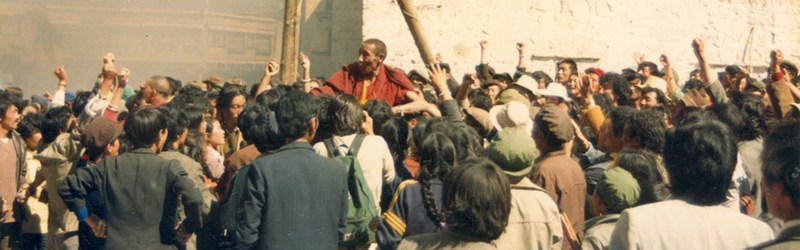
This is what happened: some monks protested against Chinese rule, the police opened fire, killed several protesters and arrested others. A Tibetan mob stormed the police station where the prisoners were being held and burned the place down. I turned up towards the end of the riot, saw a boy shot dead in front of me and spent the next few days working out what had happened.
A lot of foreign travellers were in Lhasa that day (1st of October 1987) as well as some journalists. Not only were photos and testimonials taken but they were smuggled out (the Chinese police were naive in the ways of the wily foreign journalists back then and they didn’t search those leaving). The international media told the story in gory detail and it was headline news for a few days. I remember thinking that the Chinese government would have felt humiliated by this outbreak of bad news and their revenge on the Lhasa population would be terrible.
The Chinese police were outraged that the Tibetans had protested against what they consider to be an enlightened regime. They assumed the rioters had been organised by the “Dalai Lama clique” and foreign spies like me (I was an English teacher in Lhasa but I always fancied myself as the next James Bond). They also invented a new word; “splittist”, meaning someone who wants to split Tibet away from the Chinese motherland.
The Chinese police gave the Tibetans a few days to confess all, hand themselves in and benefit from an amnesty. None of the Tibetans I spoke to trusted this amnesty and I don’t think anyone handed themselves in.
Soon enough the police cracked down, abducted people at night and tortured them in Lhasa’s notorious prison. They fulfilled point 4 of their foreign language poster: In accordance with our lows, we shall mete out punishment to the trouble-makers who stir up, support and participate in the disturbance manipulated by a few splittists.
A few days later I was arrested, told to write a self-criticism, which I refused to do, and ordered to leave China within 4 days. I organised a bus to the Nepalese border, a journey that took 4 days over unpaved roads, and ended up feeling glum in Kathmandu.
I wrote about my experiences in Tibet and this helped me to move on. I didn’t want to carry the terrible burden of Tibet’s tragedy for the rest of my life and so I didn’t get involved in the Free Tibet movement. I got into journalism instead, covered the Romanian revolution and spent the next 20 years in Eastern Europe.
Now that I am back in Nepal I can lay the ghost of the past (I don’t want to go back to Tibet in this lifetime), and I can look at this little Himalayan country with fresh eyes: in 1987 I saw Nepal as a transit point and safe haven; now I see it as a fascinating country in its own right and a place I intend to explore.
You can join me by reading these articles and adding a comment. I’d like to know what you think about all this.
Photo credit: The Middle Way Approach (the photo shows Jampa Tenzin, a Tibetan Lama who was rescued from the burning police station on the 1st of October 1987).
To provide the best experiences, we use technologies like cookies to store and/or access device information. Consenting to these technologies will allow us to process data such as browsing behavior or unique IDs on this site. Not consenting or withdrawing consent, may adversely affect certain features and functions.
Functional
Always active
The technical storage or access is strictly necessary for the legitimate purpose of enabling the use of a specific service explicitly requested by the subscriber or user, or for the sole purpose of carrying out the transmission of a communication over an electronic communications network.
Preferences
The technical storage or access is necessary for the legitimate purpose of storing preferences that are not requested by the subscriber or user.
Statistics
The technical storage or access that is used exclusively for statistical purposes.The technical storage or access that is used exclusively for anonymous statistical purposes. Without a subpoena, voluntary compliance on the part of your Internet Service Provider, or additional records from a third party, information stored or retrieved for this purpose alone cannot usually be used to identify you.
Marketing
The technical storage or access is required to create user profiles to send advertising, or to track the user on a website or across several websites for similar marketing purposes.