by Rupert Wolfe Murray | 8 Nov, 2018 | Opinions
Journalism works like this: a story “breaks” and all the media channels start writing (or talking) about it. For a few days it’s all over the media. Then it’s forgotten. An interesting question is: who says what stories are relevant? But I’m not going to get into that as it’s the road to conspiracy theories (and that is where madness lies).
Outside the media organisations are thousands of people like me (freelance writers, PR consultants) clamouring to get stuff published. We’re offering ideas for articles or TV programmes and trying to promote things. “Go away,” is the universal reply from the media, “we’re very busy and important and you’re not. Piss off. We set the news agenda and your pathetic pitch doesn’t fit. Go and buy some advertising.”
What the freelance writer needs to do is keep an eye on the media and see if he (or she) can add something to the latest news story. Trouble is the media’s revenues have been taken away by the likes of Facebook and Google so the Guardian, for example, pay the same pittance (£80) for a long feature article as they did in the 1990s. It’s so hard to make a living out of journalism that I gave up trying years ago.
But sometimes a news story comes up where I really do have something to say and the first part of this article is my take on the Cambridge Analytica scandal. The bastards tried to recruit me and I look back now with a sigh of relief that I managed to dodge that particular bullet. I mentioned it on Facebook, spoke to the Associated Press and for a day my story was all over the Romanian news (I got my fifteen minutes of fame). Then Craig Turp, who runs a “think tank” in Romania called Emerging Europe, asked me a simple question that resulted in the following article. He asked me “what happened” and you can see the result on his website (here) or below the next paragraph.
The second part of this article is about my ethical code, the thing that saved me from Cambridge Analytica. I imagine that being recruited by them would be like joining the mafia or an intelligence agency – you’d never be able to move on; even if they would let you go you’d be unable to find ethical work as your reputation would be in ruins.
My ethical code has its roots in the ancient religions and now it has been tested by the most modern technologies; how did it cope? I’ve used it for over 30 years but this is the first time I’ve written about it.
Part 1: Cambridge Analytica tried to recruit me
I’m grateful to Cambridge Analytica for reinforcing a valuable lesson: the importance of having my own code of ethics.
Without this I could have been sucked into all manner of corrupt opportunities that came my way in Romania, where I worked for 17 years.
The main rule of my ethical code is to refuse work from companies that seem dubious, or that involve doing things I’d have to lie about.
So when Mark Turnbull, one of the directors of SCL, the company that owns Cambridge Analytica, asked me to work with them on Romania’s 2016 election my suspicions were raised.
Who would the client be? I asked, and what would the work involve?
He told me the client would be PSD, the most dubious political party in Romania. They were pitching to be their election fixers and I could be part of the team.
In an email dated 3rd August 2016, Turnbull described the job:
“What we have offered is to embed a two-person team into the current campaign team — a political strategist and a communications specialist, but effectively with similar skill sets/roles — to provide ongoing strategic advice and assistance across the campaign (branding, copywriting, PR, media relations, digital outreach etc) over the next 2-3 months.”
I told him there was no way that I’d work for a Romanian political party. I’d spent 17 years building up a good reputation as a problem solver and PR consultant, and I didn’t want to throw it all away.
And that was the end of our conversation. But the PSD party went on to win the Romanian elections (in December 2016) where they have caused outrage by undermining anti-corruption laws in order to stop investigations into their rich supporters. The leader of the PSD party is barred from office for criminal charges of corruption.
By this time I had moved to Liverpool where I set up shop as a PR consultant. My foreign work experience didn’t count for much in the UK so Mr Turnbull’s offer was a tempting one, but I knew that association with these people could taint my reputation.
The Channel Four Expose
Then I saw Mark Turnbull on Channel Four News. His colleague, Alexander Nix, talked about an undercover operation in an East European country that was so secretive that nobody even knew they were there.
I realised with a shock that the country they were referring to was perhaps Romania, and that I could have been part of an undercover team to subvert democracy. At that moment I felt like I had dodged a bullet. My next thought was that I had to share my experience with people in Romania, so at least they would know who had been trying to target them.
What’s the best way to inform people in a whole country about something like this? Facebook of course, where I have hundreds of personal connections with Romanians. Problem is that I only used the platform to post personal stuff, and share links, and don’t usually get much feedback
Also, I was considering deleting my Facebook account due to their role in this scandal, and so it came as a real surprise that when I told this story in a short post I came across some of the most interesting people I’ve ever met on the platform. Several highly intelligent Romanians that I’d barely heard from until now – including journalists, political analysts and financial experts – replied with brilliant insights into the opaque world of Romanian politics and the role of Israeli fixers in the last election.
I also emailed Mark Turnbull to ask if they’d got the job on the last Romanian election and, to my surprise, he quickly replied. He said they’d never worked for a Romanian political party. The head of PSD, Romania’s ruling party, also denied the connection. This doesn’t mean it’s not true as Cambridge Analytica themselves said on Channel 4 that their role in the un-named East European election was through a subcontractor.
Whether or not they influenced the last Romanian election isn’t really the main point here.
The key issue is that companies like this, which use military-grade psychology to manipulate whole populations, are allowed free reign across the world to coerce, deceive, blackmail and enable the highest bidder to win.
Carole Cadwalladr, the journalist who first uncovered the Cambridge Analytica story, wrote “we are in the midst of a massive land grab for power by billionaires via our data. Data which is being silently amassed, harvested and stored. Whoever owns this data owns the future.”
Saved by my ethical code
The more one looks into the details of this story the more complicated it becomes. After reading all about it, and chatting with Romania’s intelligentsia on Facebook, I felt like my brain had been fried. I had to go to bed in order to process it all.
But now I feel safe behind the protective wall of my personal ethical code. It has enabled me to avoid the wrong decisions when working in Albania, Bosnia, Romania and Tibet. I’ve also used it to avoid the temptation of beautiful young women in poor countries who offer their bodies for hire, as I’m aware that the promise of secrecy would be undermined by my own knowledge of what I’d done.
Rupert Wolfe Murray is a travel writer, PR consultant and author of 9 Months in Tibet. He lives on a houseboat on the River Thames.
Part Two – My ethical code
Before getting into this I want to make an important point: Big Data is getting the blame for Brexit and the election of Trump. I’m sure it played a role, as did Cambridge Analytica, but the other villains in the room (at least in the UK) are the tabloid newspapers.
Millions of Brits buy four daily newspapers that are not only rabidly anti-EU but they have been for over 10 years. It’s hard to know which of these rags is the worse but it’s clear who they are: the Express, the Mail, the Sun and the Daily Telegraph.
These papers have been drip feeding the British public a daily dose of hate, fear and xenophobia and the Brexit campaign was the ideal opportunity to stir up these negative emotions. I’m convinced that it was the tabloids that persuaded the Brits to vote for Brexit (politicians obviously helped, as did Facebook, but none of them were able to serve page after page of well edited opinion on a daily basis). I’m amazed the tabloids got away with it.
Okay, back to my ethical code.
I’ve had an ethical code for over 30 years but until this year I’d never written about it, or even discussed it with anyone. People are wary about anything that sounds like personal advice and it’s so easy to come across as sanctimonious.
I remember the exact moment when it started. I was in a car in Edinburgh with a redheaded woman whose name I have forgotten. She told me she has her own moral code and I remember thinking ‘you seem too immoral to have a moral code’. At that time I was preparing to hitchhike to Shanghai, get hired as an English teacher and stay away from Scotland for as long as possible. In order to do these things I needed to prepare psychologically and part of that process was adopting an ethical code.
So what is my ethical code?
This is where it gets a bit awkward because, you see, erm…I don’t have anything written down. There is no handy list of points I can stick on the wall. I don’t even have a book I can mention as the source of all this. The truth is that my ethical code is an amalgamation of lessons learned over the last 30 years and even though it’s not written down it does feel very clear and it gives me very good guidance in difficult times.
I was brought up a Christian and I suppose my code includes the main ethical guidelines found within the good book; I say “I suppose” because it wasn’t a conscious process and Christianity wasn’t forced down my throat. I particularly like what the Bible says about love and forgiveness but hate what political leaders have done in the name of my religion. Religion and ideologies are very similar, they are noble ideas that end up getting used as weapons of war by political leaders. You could argue that religions are the old fashioned form of psy-ops; psychological tools to manipulate people.
I spent a lot of time in Buddhist monasteries in Tibet and they had an influence on me too – but I find them difficult to describe. The word that springs to mind is karma, a concept that feels like one of the foundation stones of my code. But what is karma? I looked it up and found this definition on the BBC: “Teachings about karma explain that our past actions affect us, either positively or negatively, and that our present actions will affect us in the future.”
I also remember the phrase: “do unto others as you would have them do unto you”. This too is a foundation stone in my code. But I need to make an important point here about religions; they all have similar ethical codes and religions have more in common with each other than differences. I feel I have taken the best bits from various religions but I don’t feel weighed down with guilt or the other negative by-products of the God business.
I just found a handy ethical code that I agree with, and it’s worth looking at that link as there’s a Cowboy Code that has something often missing from this issue: humour. I like the fact that my code is unwritten because I can adapt it to any situation without compromising its integrity. Essentially, my code is just an intention to do no harm.
Also, if I had written it up it would have removed the element of mystery and this is a very important part of my life. Each day is a mystery to me, as is the future; it’s what makes me happy. It’s also the way I travel. When I got to Tibet I knew nothing about the country except that I was going to hitch hike through it en-route to Shanghai. Because I was starting from a place of pure ignorance I was open to everything, I learned constantly (picking up the language in the process), and each time I found a temple or monastery it felt like a mystery was being revealed before my eyes.
And why should I write it down? I created this ethical code for myself and I don’t want to impose it on others. If it became tangible there might be a tendency to try and apply it rigidly, and that’s where things like this just don’t work (think of all those diet books and “how to” books we have lying around, neglected after a moment of enthusiasm).
This makes me wonder: what would have happened if the bible had never been written? Could the stories and ethics of Christianity have been handed down verbally? Would the religion have survived or was the fact that there was a huge book, with great stories, the key to its success? Did other religions die out because of their lack of literature?
I once suggested to a Romanian political analyst called Alina Mungiu-Pippidi that if politicians had their own ethical code corruption wouldn’t be so rife. She agreed but said an ethical code should be imposed on them. But these sorts of codes are in force at every big organisation and people are expert at avoiding rules they don’t believe in. The same isn’t true for your own code as you believe in it, you developed it and you know it’s in your own best interest to follow it.
Environmental policy is a good illustration of avoiding ethical rules. Endless laws are passed in order to save the planet, but they all have one problem that undermines them – they’re imposed by a political body that the majority don’t respect. As a result they’re just another set of rules to be ignored or (if you’re a politician) paid lip service to.
If I was a world leader I’d try and get agreement that if we carry on living as we are the world as we know it will come to an end. If we could all agree on this, the result would be real political will to do something – and that’s what’s been missing as the interests of big business and the comfort of individuals always trump what’s best for the environment.
If we could all agree that the end is nigh, we could then act on the following simple question which could change things immediately: is the thing we’re doing (or proposing) good for the planet? If the answer is no then don’t do it, or change it. This could apply to me as I throw my coffee grinds into the bin, rather than the compost, or a major corporation about to build a new office on a green field. It would also give everyone, and every party, the flexibility to do the right thing in their own way, and the rationale needed to make sacrifices.
The importance of self-interest
There is a strong element of self-interest in my ethical code and I think it’s important to embrace this rather than be ashamed of it. It boils down to the simple rule that I try not to do things that will have a negative impact on me in the future. This really explains it all; don’t be nasty to people or it will come back to you; don’t work with dodgy companies or your reputation will suffer; be honest at all times as lies have a nasty habit of coming back to haunt us.
I’ve spent a lot of my life in Communist and post-Communist countries. These places are full of people who don’t trust each other and often assume that I must be a spy for MI6 (some have even asked me if I am a spy and my standard reply is ‘I wish I was as I could do with the money’). On the one hand I liked the association – I’d always wanted to be like James Bond – and on the other I found it a useful discipline: if the local intelligence service is listening to everything I say, and maybe even following me around the streets, I’d better make sure I don’t say, write or do anything compromising. That experience has made it easy for me to transition into the new world of mass surveillance by FAMGA (Facebook, Amazon, Microsoft, Google and Amazon). I don’t have any secrets.
This was all tested when I was married to someone I didn’t want to live with anymore. I had an affair and started to live a lie. I was breaking my own ethical code and it was unbearable. I felt myself being pulled in two. I became a liar and a cheat but I couldn’t sustain it. Before long I was divorced. Looking back on that unhappy period I can say that my ethical code won through.
I don’t think an ethical code can stop you from doing the wrong thing but it’s always there to quietly remind you that you have done something wrong – it’s a guilty conscience – and that you’d better do something about it or you’ll end up more unhappy than you are now.
by Rupert Wolfe Murray | 21 Oct, 2018 | Journeys
How long can I stand in the burn until my feet go numb? Too long. Better to keep throwing stones into the deep bit. Maybe I’ll wake up a fish. I wonder where all this water comes from? Up that hill I suppose.
I can hear Daddy shouting my name. What does he want? It’s probably breakfast time. But they can wait. They know I spend all day out here by the burn, exploring, filling up and emptying my aluminium coffee pot. There’s so much to do; so many rocks to examine, so much sand to filter through my fingers, so much brown water that I can make clear by pouring through my pot.
Why does everyone who comes to stay with us seem so surprised by the brown water? Isn’t all water brown when it comes out of the burn? They especially love the sight of a bath full of brown water. I remember one lady from London saying how strange it is to find out that brown water is clean when she’d always thought it was dirty.
And what does The Highlands mean? Our guests always talk about The Highlands but I don’t understand what it is. Mummy tried to explain but I didn’t understand. What’s England and what’s Scotland?
I think The Highlands is the place at the top of the hill. Or maybe it’s on top of Sgurr na Lapaich which I can see from here. Kim said that Sgurr na Lapaich is the biggest mountain in the world and we could never get up it. We’d drop down dead half way up, he said. I’m only five.
I can see Daddy walking towards me now. He’s coming fast and he looks angry. The little sheep Rhyl is running after him. He follows Daddy everywhere but he’s not allowed in the house because Mummy says it makes a mess, so he waits outside bleating. The dogs are following him too. He looks so angry that he’ll probably smack me. Now he’s shouting:
“Rupert. You’re a very naughty boy! I’ve been calling for ages. You have to get changed and go to school. It’s your first day.”
I look at him and lots of thoughts are flying around my head, like the midges that like to buzz around us when it’s damp. He’s standing on the bank which is quite high above the burn. I can see that he doesn’t want to jump down and get me because he’ll get wet.
Why do I have to go to school? I like it here and there’s so much of the burn that I still need to explore. Kim can go instead. He likes it there and he loves reading books too. He’s so clever.
I know what to do. I’ll move like the little fishes do when I sneak up on them – I’ll stay very still so that Daddy doesn’t suspect what I’m up to, then I’ll drop the coffee pot and run down the burn as fast as I can. I know every rock and nobody can jump across them as quickly as me. When I reach the big rhododendron bush I’ll hide and won’t be able to catch me.
I’m trapped in the back of a car and we’re going down the glen. My face is wet and sticky from tears and I’m so angry I could die. I’m like the little fishes Daddy sometimes puts in a jar full of water. Now I know how they feel – stuck in a tiny space and not understanding why they’re there.
There are two other children on the back seat of the car with me. I hate them. I don’t want to talk to them, ever. In fact, I don’t want to talk to anyone ever again. This is so unfair. I especially hate the lady who is driving this grey car. She has horrible purple glasses that are pointy at the sides. They make her look mean and nasty. Her hair is tied up into a ball and it looks like brown wool. I’d like to cut it off and throw it out the window.
I was too slow. Too stupid. Daddy caught me. I ran down the burn really fast but he followed me along the bank and was quicker because he didn’t have to jump across the rocks. When I was about to reach the rhodedendrons he grabbed me and carried me to the car. I wriggled as hard as I could, I scratched him and tried to bite him but he didn’t let go. He’s so big and strong.
Now I’m sitting at a little table next to hundreds of other children. I hate them all and will run away into The Highlands as soon as I can. I don’t understand why I’m here. What’s that old woman at the front talking about? Everyone else understands what she’s saying and they seem to be enjoying themselves. Some of them are smiling. This place makes them happy but it makes me angry and sad and bored. Does that mean I’m very stupid?
by Rupert Wolfe Murray | 21 Sep, 2018 | Nepal and Tibet, Opinions
This article about DFID was first published in the Scottish newspaper The National (a paper which supports Scottish independence, which I don’t, but they also support freelance journalism which I do).
*
The London media have said little of interest about Penny Mordaunt, the new Secretary of State for the Department of International Development (DFID): the Times calls her a “joker”, the Mail describes her as a “magician’s assistant” and the Express urges her to “reduce UK’s £13-billion-a-year bill.”
As someone who has worked on DFID projects in Eastern Europe , I would like to offer Ms Mordaunt some PR advice about her new role.
I worked for DFID as a PR consultant and, for years, have been frustrated by this department’s chronic inability to tell their story and promote themselves. It’s the one government department that does great work, is totally transparent but is unknown by the public.
Behind the headline-grabbing challenges that Penny Mordaunt has done in her past, such as competing on Splash, a TV reality swimming show, the media seem to have missed a part of her background that is surely worth an in-depth article: she worked as Head of Foreign Press for George W. Bush’s 2000 and 2004 presidential campaigns. I’d love to know more about that job.
As a PR heavyweight with useful military experience, Penny Mordaunt is in a good position to project the Department of International Development into the mainstream. Priti Patel, the former secretary of state who was ejected last week, continued the department’s lamentable tradition of burying their heads in the sand while the Express, Mail and Telegraph vilify them about wasting taxpayers money and denounce the one good thing that David Cameron did: commit Britain to spending 0.7% of the state budget on international development.
I’m hoping that Ms Mordaunt has the proverbial balls to stand up to the tabloids, use the facts to refute their shockingly dishonest articles, invite journalists to visit the projects and not take any nonsense from the right wing Tory backbenchers who would happily close down DFID if they could (even though it could be used to show that Britain still has global influence after the Brexit debacle).
What is DFID?
Bearing in mind that the Department for International Development is one of the least known government departments, some background would be useful.
The department dates back to the early sixties when Britain was in the process of closing down its Colonial Office and setting up new structures to maintain connections with those parts of the world it had previously governed. The Overseas Development Administration was set up in 1961 and it quickly gained a reputation in Africa, Latin America and Asia as an efficient supplier of emergency aid. The acronym ODA became a well-known brand in many parts of the world.
One of the key principles of good branding is to value an existing name and not change it without sufficient consultation and investment (the oil companies spend millions every time they adjust their logos). The newly elected Labour government of 1997 ignored this and, perhaps unaware of the value of the ODA name, changed the departments name to DFID. Rather than use this as a “re-branding” opportunity they didn’t invest anything in telling people their name had changed. This chronic inability to promote itself has continued to this day, despite other parts of government becoming increasingly media savvy.
The tabloids go on the offensive
For over 10 years DFID went about its business more or less under the radar, rather like a secret intelligence agency. During the nineties it funded useful projects in Bosnia (including several that I was involved in) and offered a wide range of practical assistance to the countries that were emerging from the Soviet Union. On the ground, it got the reputation of being the least bureaucratic bi-lateral aid agency.
In terms of PR, it all seemed to go wrong under Cameron’s coalition government (2010 to 2015). George Osborne had promised to cut every government department except two – DFID and the NHS. For the tabloids, forever on the hunt for a big victim, they couldn’t attack the NHS as everyone has a personal stake it in – but DFID represented an ideal target: it was relatively unknown and the beneficiaries of its budgets were, shock horror, Johnny Foreigner!
For the last few years the Mail and the Express have carried out a series of outrageous attacks against DFID, accusing it of supporting dictators in Africa, funding terrorists in Palestine and paying for nuclear weapons in India. They do this by quoting the amount we give a particular country, ignoring the details of the project itself, and highlighting the most scandalous story about that nation.
With the EU the tabloids bang the drum about the mythical £350 million a week and with DFID they have an even bigger target to aim for – their £12 billion annual budget, which represents just 0.7% of the national budget. “We believe,” said the Express, “the 0.7% budget commitment can be spent on the struggling NHS and social care services in Britain.”
The irony of these tirades are that they are based on the detailed information that DFID itself makes public about its international operations. In fact, DFID has been praised as the most transparent of all government departments as it’s the only one with all their accounts online.
Penny Mordaunt’s Opportunity of a Lifetime
Ms Mordaunt should be grateful that she wasn’t appointed as the new Minister of Defence, a poisoned chalice if ever there was one. The role would have involved lobbying her own government to stop cutting budgets and with very little decent PR collateral.
The DFID job is a gift from PR heaven: it has the most inspiring story that’s never been told. All it needs is someone with the guts to stand up to the tabloids and the nationalist Tory backbenchers. It reminds me of the old American saying “if you need a man for a job – get a woman.”
DFID-funded projects in sub-Sahara Africa and the Middle East are vital for people in those regions to get water, food and livelihoods. They are also one of the few investments going on in those areas that give people some hope, some work and help to prevent the waves of migrants heading towards Western Europe.
At donor meetings around the world, DFID has earned its place at the top table with the UN, EU, Japanese and American government aid agencies. The only other European country with this level of influence is Norway.
But DFID have almost no PR staff and when I was in Nepal earlier this year, trying to visit their projects and write about them, I was met with confusion. Nobody in their Kathmandu office knew how to deal with me.
If Ms Mordaunt adopts an aggressive approach to this she could have immediate impact. She could take on the tabloids in the mainstream media, destroy their arguments with simple facts, order every DFID mission to invite journalists to visit projects – and tell the nationalists in her own party that helping poor people get on their feet is the best thing we can do to protect our own country. She could also be a regular visitor to Scotland as DFID’s main administrative base is in East Kilbride.
by Rupert Wolfe Murray | 28 Aug, 2018 | Journeys
I travel a lot by plane even though it’s environmentally destructive and increasingly boring. Airports in places like Bucharest or Tirana used to be so different from anything we’d seen in the west – the airport terminal in Tirana, a European capital city, was no bigger than a cowshed when I went there in 1999 and the road was made of mud – but now it’s a modern glass cube at the end of a motorway. (more…)
by Rupert Wolfe Murray | 26 Jan, 2018 | Journeys, Nepal and Tibet
My brother’s house in Kathmandu is old, narrow and tall. At the bottom of the house is a dark room which doubles up as an entrance hall and bicycle garage. This is where I am, getting ready to cycle across town.
I’m wearing good trousers (I’m going to a meeting) and want to protect them from the oily chain so I put on bike clips. Then I put on one of those futuristic (and, in my view, quite useless*) bike helmets and a dust mask.
Standing in the semi-darkness, gripping the handlebars of the borrowed mountain bike, I feel tough and fit (even though I’m neither). I open the double wooden doors and step out into the bright sunlight, putting on my brother’s sunglasses and completing what is effectively a mask. Nobody can see who I am and I relish the anonymity; I can pretend to be a local as I prepare to dive into the flowing mass of vehicles that pumps through Kathmandu like a great river.
I take off the mask for a moment and inhale the morning air in the yard; it feels damp and fresh and there is a whiff of incense and rotting rubbish. A proud chicken struts across the yard, puffed up and arrogant, ignoring the stray dog that lies curled up in a ball by the wall. The dog would be white if it was washed but nobody would do such a thing as it doesn’t belong to anyone; it’s the local stray and it’s always here in the yard — sleeping by day and barking all night.
Now I’m on a narrow street that leads up to the centre of Patan, the ancient part of Kathmandu where my brother lives. There are old buildings in this part of town but most of the city has been rebuilt in concrete. Motorbikes fly by constantly and the occasional car or small van thrusts through, holding up traffic and bringing the speed down to walking pace.
If Kathmandu was a body these little streets would be the capillaries — small, narrow, anonymous and legion — and the main roads would be the arteries. During the day streets are packed with vehicles, all the time, as hundreds of thousands of people hurry to and fro, doing their business, going to work. Two million people live in this ancient city that was built for a tenth of that number. A taxi driver told me that more and more people are buying cars with easy bank loans, but the government isn’t improving the roads and soon the traffic will come to a standstill: gridlock. Pollution hangs like a blanket over the city.
Soon I reach the main road and I plunge in, like a minnow joining a fast flowing river that is full of racing fish.
When I first got to Kathmandu I looked at the traffic and wondered how anyone could survive it; so many vehicles, no traffic lights and no rules. It looks like complete chaos. But when I join the flow of traffic, catch up with them, and go at their speed, it feels totally different.
I am now part of the flow and I realise several things: we are moving quite slowly; all the motorbikes and cars are going the same speed as the bikes. There are no white lines marking different lanes, but this is no problem as everyone is keeping an eye on what’s going on in front of them and we form lanes naturally, as if following some natural law. If someone changes lanes, slows down or stops at the side of the road those behind react accordingly and momentarily make a space for them.
The way that cows and people are treated by the traffic are testament to the safety of the system. I made this 40 second video of some calves sitting in the middle of a busy road, chewing the cud, talking among themselves, while four lanes of traffic roar past on both sides. These beasts are sacred to Hindus and all drivers avoid hitting them. The same goes for people — nobody wants to hit them — and I’ve seen women cross an incredibly busy road, chatting gaily to one another, not looking left nor right, and crossing over with the absolute confidence that they will get to the other side unharmed.
It feels exciting and I am in a race with the other vehicles. Can I beat that motorbike through this tangle of cars? (Yes! I am nimbler in traffic than his much more powerful machine.) Is my humble bike faster than that flash car? Yes! Lumbering buses and taxis are easy to beat and I’m approaching a bicycle ahead so I accelerate, overtake and leave him in my wake.
In mindfulness and meditation they say you should try and be in the present moment, but this is a lot easier said than done; stopping your thoughts is like trying to get a classroom of young children to be quiet . But when cycling in Kathmandu you can’t dwell in the past or worry about the future; you need to focus all your energy on what’s going on around you at that very moment — so you can react accordingly. My life depends on seeing what the vehicles around me are doing. My eyesight, instinct and hearing perform at levels they have never done before (hearing is essential — the sound of screaming engines, or brakes, is a danger signal).
I accelerate past a slow cyclist. Ten seconds earlier he had filled my field of vision, overtaking him was my sole purpose in life; but now he’s gone and I’ve already forgotten about him. I feel like a medieval soldier, with sword and shield, hacking my way through enemy ranks, not sparing a thought for those I strike down.
I’m now fully focused on my next move. I’m riding between a battered taxi on my left and a packed bus on my right; I need to get out of this moving corridor; but changing lanes isn’t easy as you must ensure that the drivers see you — this is the key rule — if you are seen you are safe — and that means getting ahead of them a few metres. The ability to accelerate is key.
The safest place to be is on the left, the slow lane, but it’s frustrating there as you butt into pedestrians, cows, muddy potholes and the occasional parked vehicle. It’s also far too slow. The most exciting place to be is in the middle of the road, on the invisible line between the oncoming traffic.
The oncoming traffic is being held up by a traffic policeman and a gap appears on the other side of the road. I take advantage and leap into the empty space, racing ahead of my plodding competitors. I race forward on the wrong side of the road and my brain calculates the best moment to dive back into my side.
I reach my meeting with Mercy Corps, an Edinburgh-based aid agency, ahead of time and have a few minutes to dismount, cool down and get into the right frame of mind for chatting to people. I go into the yard of the NGO and lock up my bike with a thin chain, perfectly useless against a proper bike thief; but locking a bike is a ritual for me and it puts my mind at rest. They say that few bikes are stolen in Kathmandu and everyone uses these spindly locks.
I love cycling in Kathmandu but assume most people wouldn’t. Many people I have talked to about cycling in cities complain about cars and believe that the only safe riding is on dedicated cycle lanes. My view is that cyclists must constantly observe, adapt and treat all cars, as well as pedestrians, as hazards. No point whining about them; it’s like complaining about the weather.
As far as I am concerned a bike is just another means of transport that must share the road with cars, buses and trucks. Drivers have no intention of knocking cyclists down, if only because it might result in a long jail sentence; if they can see you, and you’re on a predictable line, they will treat you with respect.
My rules for safe city cycling — in Scotland as well as in Nepal — are to be seen and to understand the behaviour of vehicles. The fact that I have driven cars for many years means that I know how drivers react, and this makes cycling so much safer. As long as you keep the main rule in mind — be seen by the drivers — then you will be safe.
There are certain types of cyclists who, I think, would appreciate the challenge of riding a bike in somewhere like Kathmandu. These are mountain bikers and BMX riders, all of whom know how to instantaneously react to obstacles. Those types of riders have to live in the present, they must react in milliseconds and they do things that most people think are insane. I think their type of riding is similar to riding in the Orient and they will know there is absolutely no point in blaming others when things go wrong.
#
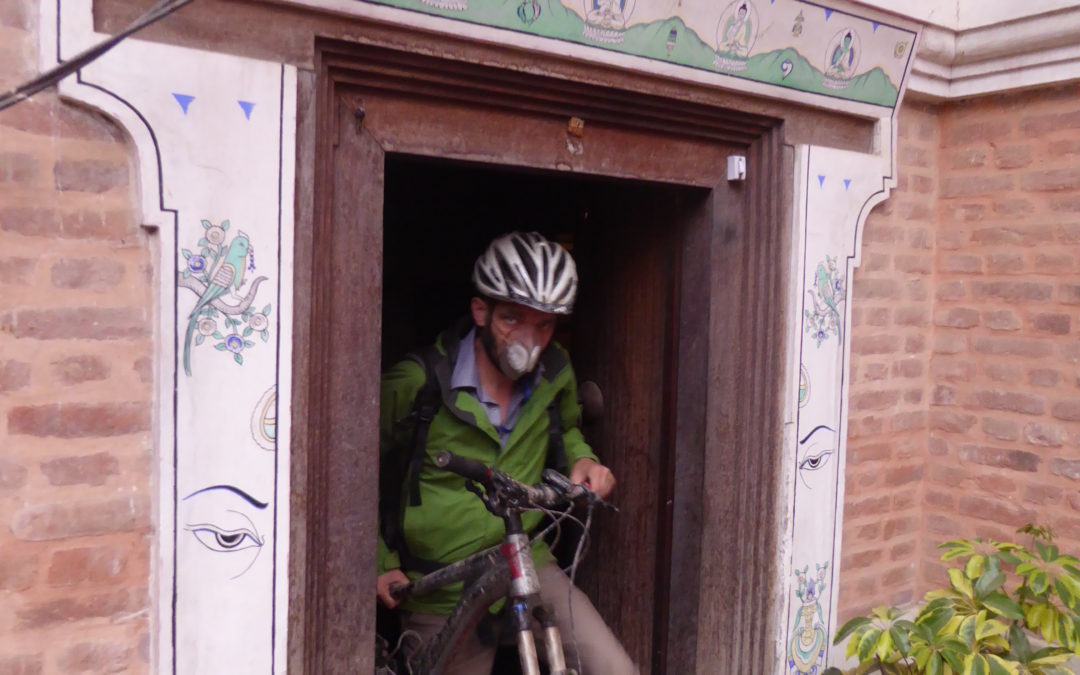
Photo of my brother Magnus coming out of his house in Patan, Kathmandu. Taken by Yours Truly (with his camera).
* I said bike helmets are “useless” and here’s why: they are loose, they slide around your head and offer no protection to the side of your head. They might offer some protection if you somehow landed on the top of your head. All they do is create the illusion of safety. Compare them to motorbike or rock climbing helmets, which are clamped on firmly and would protect every part of your noggin. But I do use bike helmets as they are ideal sun hats; the big chunks of compressed polystyrene that they are made from can protect you from the sun’s rays and also let plenty of fresh air in.
A shorter version of this article was published by the Sunday Herald in Glasgow, with this by-line: “Rupert Wolfe Murray is a freelance writer living near Selkirk. His trip to Nepal was not funded by a travel agency, resort, bike company or any other sponsor.”
In case you’re wondering, I am now living in Edinburgh and commuting to a new job in Stirling (I’m editing this article on the train). I work for an outfit called The Writer and I’m really enjoying it. This article is about a trip I did to Nepal last year. I’d love to get your feedback, however rude or negative. Please add a comment. It’s what keeps me going.

