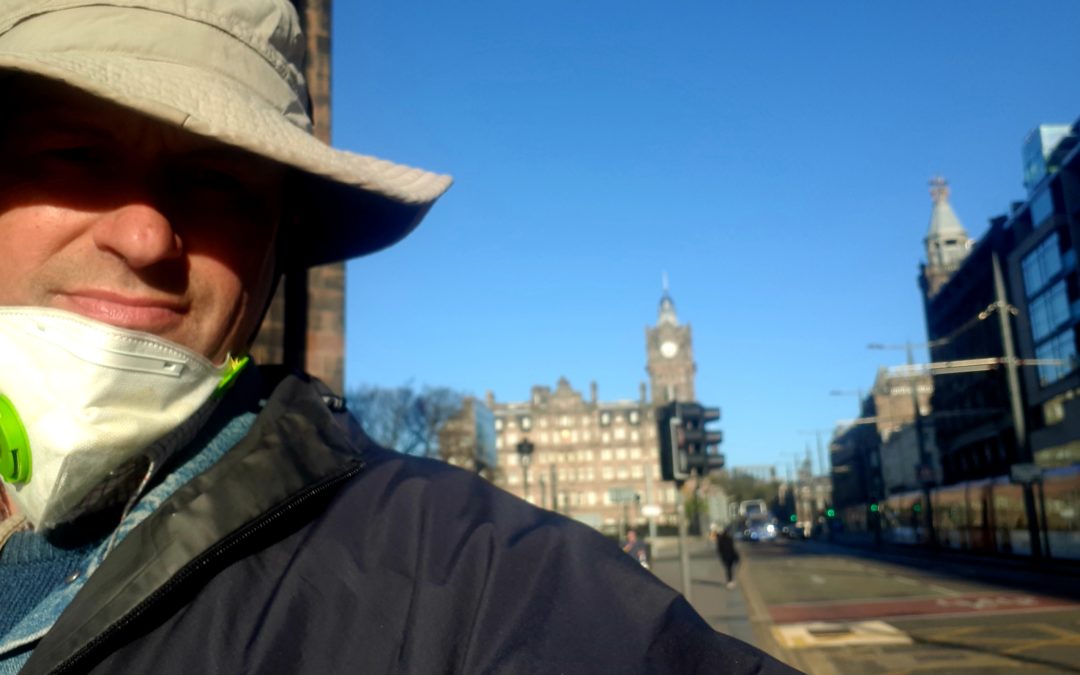
by Rupert Wolfe Murray | 19 Apr, 2020 | Journeys
My heart goes out to everyone who’s stuck at home feeling bored and worried.
I’m the only person on the train from Brighton to London. Usually you can’t find a seat at this time of the morning (10:42 departure).
The only people at the station were railway workers and a lone policemen who took a long look at me and decided I wasn’t worth questioning (I was trying hard to look as if I belonged there, hoping he wouldn’t ask why I was pushing a bicycle and trailer).
The ticket inspector looked unfriendly but wasn’t. He was probably just bored, as most people are in this strange time of the virus. I’m standing in front of the ticket barrier, wondering if he’ll open it and let me through without asking for my ticket. He does.
I wonder why the trains are still running if nobody’s travelling? I ask the inspector: “Who’s using the trains these days?”
“Key workers and fare dodgers,” he says. Where did this term “key worker” come from? Sounds like another way of saying Locksmith.
“Fare dodgers?” I asked, “What …?”
“People who don’t have any business being on the trains…”
I walk onto a vast empty platform, feeling quite strange, as if I shouldn’t be there. I’m expecting the policeman to put his hand on my shoulder at any moment.
The train is eerily empty and spotlessly clean.
We stop at station after station and the disembodied lady’s voice comes on and tells me where I am. Nobody gets on. Nobody gets off. There’s nobody at any of the stations except Gatwick Airport where I open the door and stare down the platform – and yes, I see someone; about 200 yards away a figure in fluorescent yellow is bending over a bin.
As we go through the London stations – Clapham Junction, London Bridge – where millions of people normally pass through every day, I see more fluorescent jackets; some look officious and others push a brush. The brush pushers look more relaxed.
I’m surprised Gatwick is so empty as I’d read in a paper that about 15,000 people a day fly into Britain, none of whom are checked for signs of the virus. Britain’s approach to the virus seems over-reliant on the private sector bailing us out: Boris’ hapless government are hoping that Google’s new App will save us; apparently it will beep every time you go near someone who’s admitted to having had the virus. But isn’t that going to make those who’ve had it into instant pariahs? The former boss of MI6, Sir John Sawers, said in the FT: “What’s being envisaged [for contact tracing] would go beyond what we used for security purposes.”
But I don’t let the ramblings of politicians worry me as there’s nothing I can do about the fact that the global economy has been shut down because of our insatiable appetite for meat. All I can do is observe things and, I must confess with a certain amount of guilt (shouldn’t I be depressed and worried?), that I find the whole thing absolutely fascinating.
Perhaps the most interesting thing that has happened is that a simple message – don’t go out – has been picked up by virtually every nation on earth and over seven billion people are staying at home. It shows the incredible power of the media. Some people worry that it’s a plot to control us, but what these people don’t see is that it’s based on consensus; if an overwhelming majority of people didn’t see the point of this lockdown there’s no way it could be enforced. Imagine if they tried to do repeat this trick to stop global warming, which is an even bigger threat than this virus, by banning fossil fuels – it wouldn’t get anywhere.
St Pancras and Kings Cross
I get off the train at St Pancras and see one or two other passengers emerge from what I thought was “my” train. They all wear masks, as do I, and hurry off. Nobody seems to want to talk or even exchange a glance. Someone checks my ticket at the exit barrier and, as I head along the grand concourse of shops, a policeman approaches me; we’re both heading towards each other like in a cowboy movie. I look ahead, going over my cover story in my head (“I’m going home!”), and he walks straight past without even glancing my way. The policeman looks like he’s about 16 years old (apparently, when you think the policemen look young it means that you are getting old).
The main road outside St Pancras and Kings Cross isn’t as empty as I had expected. A few buses, trucks and Lycra-clad men on bikes. Some sign of life.
There’s a bored-looking a guard on the entry to Kings Cross Station but he doesn’t ask me anything as I saunter in with as much “purpose” as I can muster up. There are about 20 people in the whole station, a mixture of “key workers” (whatever they are) and worried-looking passengers. None of us passengers speak to each other. The only person who’s friendly is an Italian station official who tells me the 13:00 to Edinburgh is leaving at 13:30, and not to worry about my reservation as “there will only be about five people on the train.”
The fluorescent clad “key workers” have a gruff banter between themselves. Truncated comments, jokes and gestures are communicated across the station in short bursts. I tried to follow what they were saying but couldn’t. They were communicating in a way that was bypassing us ordinary folk; easy enough when you consider that most of us are consumed by worry.
I find the experience of being in this empty station quite stimulating, almost exciting, but I can’t understand why. I gradually realise that it reminds me of travelling in foreign locations where everything is different – and therefore of great interest. It’s similar to the feeling I get when reading a dystopian novel, when all the things we know about our society have been swept away and a new system has been created.
I remember visiting the Bosnian city of Tuzla during the 1992-95 war; the streets were empty and everyone was hunkered down at home, or in trenches on the front lines. It also reminded me of Tibet in 1986 when there were so few vehicles that people would stand in the middle of the main street and have lengthy conversations. I’m feeling some of that sense of wonder I get when travelling in a place where the normal, western system of life doesn’t apply.
But there’s something else. How can I describe this modern station with scores of empty shops and all the high-tech lighting still functioning? It’s far too well-designed and clean to be in a poor country, or in a post-apocalyptic world, which is what it initially felt like.
Then it struck me; it’s like a huge art gallery which has a few bored officials making sure you don’t do anything untoward, and a handful of visitors who are staring with deep concentration at … the departures board.
The Italian was right; the Edinburgh train only has about five people on it. We all have our own carriage, and I sprawl out over a big table: laptop, papers, book, phone, charging cables, water, lunch. It was a brand-new trains made by Hitachi, the Japanese company that makes electronics. It has the look and feel of a brand new car, a high-end type. I’m in the lap of luxury. The only thing missing is the drinks-and-snacks trolley but I can live without that and am grateful for not wasting money on bad coffee and junk food.
I read my friend’s manuscript about Dracula (“the real story, ” he claims), eat yesterday’s lentil stew, have a nap and, four hours later, arrive in the capital of Scotland which is eerily empty. The only thing moving in the 1-mile sprawl of Princes Street are a few buses – and they’re all empty.
Why am I travelling?
Over the last week I’ve taken a bit of flak from my Facebook friends after asking what’s the best way to get to Edinburgh: train or bike (as in bicycle touring, with trailer and camping gear).
Many of those who responded didn’t answer the question but said “don’t go!”, asking why I plan to break the rules of the lockdown. Some suggested that I just want to go on a jolly. But I did respect their view and didn’t do what I really wanted to do – cycle up the east coast of England and camp on empty beaches every night. That would have been a jolly masking a valid reason to travel.
But I can’t blame them for giving me a hard time as I should have explained why I came to Edinburgh.
It’s quite simple; due to the virus, the flat I own in Edinburgh is now empty and I’m going to live in it for a while as I can’t afford to pay rent in Brighton and have an empty flat in Edinburgh (which is a main source of income for me).
The other reason is to live on my own, in other words self-isolate better. In Brighton I was renting a flat from my aunt and she’s in her seventies; every time I go to the shops I touch all sorts of surfaces and could bring the virus back.
As soon as the situation changes, and I get new people into my flat, I’m going to hit the road with my touring bike and trailer and do that east-coast route; it will hopefully be mid-summer by then and maybe the beaches will still be empty and there will be nobody to complain about a rogue cyclist putting up a tent where he’s not supposed to.
#
Postscript; when looking up the population of the world I came across this compelling website, which shows the minute-by-minute growth of the global population. At the time of writing, a total of 17,688,444 people have died in the world thus far. Two minutes later I checked the figure again and it is now at 17,688,580. If my back-of-the-newspaper maths is correct, 146 people just died.
I find that constantly moving statistic fascinating, but also rather macabre, and wonder if it helps put the corona virus pandemic into some kind of perspective. I think not.
#
If you haven’t yet got a copy of my new travel book you can get it here: Himalayan Bus Plunge — & Other Stories from Nepal
#
Let me know what you think about all this in the comments section below. You can also use this space to share your own corona virus story. How have you been handling it? How are you feeling? What do you think will happen next?
by Guest Blogger | 12 Feb, 2018 | Uncategorized
A man in an anorak shuffles down the carriage. He sits heavily as if cut from a rope. A girl looks up, shifts and frowns into her book. He glances at her. His face looks shrunken, as though once bigger.
The train picks up speed, sways on the tracks. Stiffly, like a man with his neck in a cast, he turns to the girl and mutters,
‘Does this train go to Aberdeen?’
‘Aberdeen?’ the girl looks up from her book. Her skin flushes. ‘Yes it does.’ She moves closer to the window and continues to read.
‘Where are you getting off?
She glances up, ’Edinburgh,’ and carries on reading
‘Oh lovely. Is that where you’re from?’
She closes the book on her hand. ‘No I’m from Australia.’
‘Oh lovely. You’ll be exploring all the places then.’
‘Yeh,’ she frowns into her book. Her skin flares as though allergic to the questions.
‘Oh lovely.’ He strokes his knee under the table.
The train trundles on. He stares at the world slipping by the window, face blank as ply board. He pulls a leather bound book from the anorak, eyes unmoving. The book has “Holy Bible” printed in gold on the spine. His pale hand places it down. LOVE is tattooed, one blurred letter on each digit. Half his forefinger is gone, stumped at the end. He stares at the book cover.
The train glides into a red brick station. It steams and waits grumpily as passengers trail on. People hug on the platform, muffled in jackets and hats. Voices rise and swirl like ghosts of their creators. Electronic announcements boom steadily, seeping from the bricks.
A passenger with a boxer dog approaches the table opposite. He hustles the dog under the table.
‘Get under there boy,’ he says in a low voice as if not to embarrass the dog.
The dog circles urgently, wrapping the lead around its self before slumping on the floor.
More newcomers peer down the carriage in search of seats. Bags weigh down their arms. With them comes a chill that hasn’t yet died in the heat and stillness of indoors, the smell of dead leaves and a freshness carried in on the rosey tips of noses.
The owner of the dog is enormous. His upper arms are like two ham joints. A vest clings to his bulging chest. On one of his biceps are three scars in a row, as if a giant cat has attacked him. He sniffs and empties a shopping bag onto the table. Standing, he wolfs down a handful of crisps then zips his shoulder bag and pushes it onto the rack with one arm.
Bricks ease past the window. The engine moans, desperate to drag its trailing body into the open. The burly man does not sit. He takes an iPod from his trouser pocket. The headphones look like dental floss dangling from his hands. The dog noses a few circles under the table before sticking its head into the aisle.
‘Get your arse in there boy, get in there. Sit. Sit.’ He shunts the dog with his foot.
The dog looks up with drooping eye lids, circles a few times and lies down like a deflated balloon.
He munches and looks out of the window. Fields open up, divided by lines of poplar. Lonesome oaks are proud, earth worn underneath where animals have lain. Stubby cottages are peacefully resigned to their position.
On the table opposite, the man in the anorak turns halfway towards the Australian girl. His eyes stare out of the window as if he can’t turn his head enough to look at her. Her skin flares again.
‘Are you travelling all alone?’ He asks.
‘Yes.’
‘Oh……. I once travelled alone from Inverness to London. I had to go down for work ya see. A lot a my pals in Inverness were rough ya see. They didn’t work, they hung about doing heroin and lazing about. I didn’t want to sit around on the heroin so I took the train all the way down to London like.’
The girl doesn’t answer. He continues to gaze out of the window.
‘Of course there’s heroin in London too eh. But I’ve found God now.’ He takes a pen and places it on the bible. She looks at the finger. ‘Keeps me safe and away from the heroin.’ He sits upright as he talks, his tiny, melted head sticking out of the oversized collar.
‘It must be lonely being up here without family and friends,’ he says.
‘No, I’m fine.’
‘There must be times when you need company like, being up here alone with nobody to talk to.’
The pen rolls off the table. He bends down to pick it up. On his way up, his hand brushes past the girls knee. She freezes and stares at the table.
‘No, I’m fine thank you!’ She moves her knees up against the side of the train.
The burly man sits, facing the window with headphones in his ears. He lifts his heel to the music. Supermarket sandwiches and crisp packets are strewn on the table with a litre bottle of coke. He rolls his head to the beat, closely shaven neck stretching out.
His nose is wide and misshapen. His eyebrows are strong ridges. One is stained blue with a bruise that covers the lid and corner of his eye socket. Trees stand in the fields, skeletal with a few leaves dangling. He admires the green fields slipping past and sinks into a peaceful daze.
The hand with the stubbed finger rests on the bible. The girl is just out of his vision, huddled up against the window, her book pressed to her face. His dead stare cuts across. His eyes are glazed and don’t flicker or shift with the rushing landscape. They just stare, as if a fly could land on them and cause no disturbance.
The food trolley shudders down the carriage. The dog leaps up to the seat opposite the owner and collapses, eyebrows twitching.
‘Get your arse off that seat, get, get,’ he hisses. ‘Go on get down.’
The dog jumps down.
The huge man sits back in his seat, sniffing and breathing. He tears open a sandwich, tiny in his hands. Munching, he feeds a crust to his dog. It looks up at him, tail beating the floor.
The girl’s book covers her face.
‘You’ll have a time in Edinburgh. Good people in Edinburgh….My people are from Edinburgh. My family.’ The words creep from his mouth. Pale lips stretch across his face as if a surgeon has stuck them on. ‘Are you staying in a hostel?’
‘Yes. I’m staying in a hostel.’ She crosses her leg and lifts the book to her face, forehead a mess of wrinkles.
‘Aye, I’ve stayed in lots of hostels in Edinburgh. See my family were never always good to me. Especially my Ma like. Aye she was awful crude to me. Used to fuck me about for no reason at all.’ He curls his hand to a fist. ‘So I spent lots of time in the hostels like…..Are you staying there long?’
‘Four nights.’
‘Oh lovely.’ He pats the bible. ‘Aye it’s a lovely town Edinburgh.’
Coastline appears beyond the double glazing. A cliff of jagged rocks drops down to pale, ragged grass. The man in the vest takes out his headphones and leans towards the window. He watches the sea chopping silently, boats still on the horizon, the beach calmly receiving the infinite beat of the sea.
‘Aye, your family must be missing you, a pretty lass like you. Your Papa must be missing you all the way back the other side of the world. I bet you’ve got a nice family back there eh? A nice lass like yourself. I bet you’ve got a good family to go back home to eh?’
The burly man turns his head. He takes his eyes off the landscape and focuses on the window sill.
You must miss them a wee bit no?’ He chuckles, a scratching croak, more suited to a corpse than a living man. ‘Aye you must. No need to be brave darling.’
‘No. I don’t miss them,’ she looks up. ‘I’m reading if you don’t mind.’
The dog owner turns from the window, rolls up the headphones and puts them away. The dog gets up and he shunts him with his foot. ‘Sit down dog, sit!’ The dog curls up on the carpet.
‘Aye no worries darling.’ He taps the bible with his stumped finger. ‘No need to listen to me gabbing off, I just like a chat you know?
‘That’s OK, I’m guna read now.’
The train rocks. The burly man moves to the aisle seat, opens a pack of crisps and rests his forearms on the table. He sniffs and munches hungrily, his knee bouncing up and down.
Across the aisle, the man in the anorak inhales between his lips.
‘Aye,’ he says, ‘Theres nothing wrong with being friendly. You know there’s nothing to be afraid of darling.’
The dog owner finishes the crisps and folds the packet into a tight rectangle.
‘It’s some world if you cannae talk to people like.’
The dog snarls and the man in the anorak turns from the girl. ‘What’s wrong with you dog, eh?’ The dog snarls again.
He turns back to the girl and leans towards her, breathing in her ear, ‘It’s ok to be friendly.’ She stiffens and jolts upright, an electric shock running through her spine.
The huge man stands. He crosses the aisle and rests both fists on the table. He stands there, hovering over the shrunken pea head. The head turns, startled eyes glistening and retreats into its scrawny neck. A meaty hand picks up the bible and pushes it into the puny man’s chest. The tiny man clutches it against himself. His upper lip twitches and he scrambles to his feet, a knee clunking on the table. A deep snarl rumbles from the dog. He glances at it then limps down the carriage, stooping and wrapping the anorak tighter to his body. The dog owner sits back down.
The girl breathes unsteadily, her eyes wide and rabbit like.
‘Thank you,’ she says shyly. ‘He was starting to scare me.’
‘No bother, he was scaring my dog too, that’s why he had to go.’ He smiles and the girl looks at the blue bruise covering his eye. ‘Where are you getting off?’ He asks.
‘Edinburgh.’
‘Oh lovely, is that where you’re from?’
‘No, I’m from Australia.’
‘Oh lovely, you’re out exploring then.’
‘Yeh.’ the girl glances down at the cover of her book. Her skin flares.’
by Rupert Wolfe Murray | 2 Dec, 2017 | Other People's Stories
The train is heading south and I stand between carriages. My hand rests on the open window and darkness rushes past. Trees are rigid against the moonlit sky. Smoky clouds are ghost like. A man on the floor gawps into a glowing screen, the blue glare illuminates his oily face.
Passengers are crammed in seats. Legs stick out into the aisle and bag straps dangle from overhead shelves. A dark haired girl walks down the aisle. She passes me, quiet with wary eyes. Her T-shirt ends at the belly button, clinging onto her small waist. Baggy tracksuit bottoms are filled by a round bum. I wonder if she is wearing them to accentuate her bum or to hide it. I conclude that she probably just likes the tracksuit bottoms. She ducks into the toilet and the door slams with the shuddering of the train.
My legs are apart, knees bent. The train rocks and wobbles, loose under my feet. The toilet door is firmly shut. I plan to smile as she walks back. I picture her squeezing a smile back and walking on. I beef out the plan with the idea of saying hello whilst smiling. Picturing this, it goes well, a nice little scene.
The grey door remains shut and unmoving. It seems firmly closed compared to other doors. Perhaps because of the way it fits so tight to the frame. Pressing hands deep inside pockets, I stretch my arms and run the scene again. This time it doesn’t seem fluid. The idea of waiting outside the toilet puts me off. My smile is forced, unnatural and the scene is jarred. I create another one, her queuing at the café and me behind her. Nobody listening in. Me asking where she’s from. This one seems good.
The grey door pops open as if barged from inside. With head down, she turns and closes it. It slams with the jolting of the train . She walks straight up to me and asks which way the café is. Her face is long and gaunt. Black hair hangs past her shoulders. Smiling, I point and say it’s up that way. I press my eyes into hers and she presses hers back. They are deep black globes. She thanks me and smiles. I watch her track suited bum swing down the carriage. The material has tiny cotton balls clinging to it from over washing.
The train gallops through the night. It sways as if barely connected to the tracks. On the floor, the man’s laptop is propped on his knees. He presses his face into the glow of the screen, headphones trail from each ear. No sound comes from him; no sound reaches him from outside his glowing world.
I give it a minute. Tail-ending her to the café would be too full-on. When I see her head bobbing down the next carriage, I pursue. Striding down the walkway, I grip the tops of seats with long, swimming motions. Passengers glance up and back down. I cover a few carriages until at the end of one, people stand static with shoulders sloped.
There is no movement so I turn and wait between carriages. Pushing the window down, I breathe in cool, black air. I peer down the carriage.
She walks back up the aisle with a paper cup. Her presence surprises me. I knew she needed to get back to her seat but somehow didn’t expect her to pass.
‘You made it,’ I say as she gets close. She looks up as if she didn’t know I was talking to her.
‘Oh, Yeah. Took me like an hour to get back though,’ she eases away from me.
‘Well I’m about to experience that myself,’ I force a tight smile onto my face and can’t think of much else to charm her with. She smiles and walks on.
Heading back down the train, I look into the faces. All seats are taken. Families sit at tables with gaping crisp packets and squashed juice bottles. Men stare into the windows, cans standing at arms-length. They watch objects dragged into the distance, lights swept away and forgotten.
Every black-haired head I pass, I check the legs for the tracksuit. I spot her. On the fold out table in front of her is a thick book, open with sentences highlighted green. I pass by and return to my seat.
A man is in the seat beside mine. A rim of grey hair circles his shiny, bald head. In front of him is a can of Carlsberg on a folded napkin. He gets up to let me in and I clamber into my seat.
Looking straight ahead, he says from the side of his mouth, ‘there’s been a few competitors after your seat.’
‘We’ve been fighting them off for you,’ chirps a northern woman from the seat in front. Immediately, I picture her to be fat with short blonde hair.
‘They can get pretty vicious,’ I say.
They both chuckle cheerily and I hope they will not talk further. The man picks up the can and tips it to his lips. He places it back carefully in the middle of the square napkin. His arm moves slightly. He is getting ready to talk. I turn my head and stare at the window. His reflection is clear in the metallic blackness. He’s a funny looking man. Small, monk like.
I pick up my own reflection and imagine what people see when they meet me. It must be different for them. They can’t see what I see. The familiarity of my face must have warped the image I see. A train passes on the adjacent tracks and my face is gone. A blur of yellow light races past. The trains are sucked towards each other and I feel the release as the last carriage whips by.
A few sentences into my book, I flop it down and let thoughts rush to my head. I decide to stand between carriages again. Firstly, I prefer this area. Limbs can move and cold air can be breathed. Secondly, the girl may walk past again and I can try to engage her in a longer conversation. I shift my body to get up and the monk stands unhurriedly. He smiles stiffly as I step into the aisle.
The carriages are hot and fetid. Passengers sprawl. Red faces talk loudly over cans balanced on tables. The last hours of the journey drain away.
I stand between the clattering carriages. She is alone, languid in her seat. Her skin is dark and I wonder where she is from. This will be my next question.
The metal connecting the carriages is covered by folding rubber. As we round corners it shrinks and grows like a wheezing accordion. I rest my back against it and feel it folding in and out. Down the carriage, a child lifts strands of dark hair, giggles and lets the hair fall. I can’t make out if it is the girl’s hair or not. A child could add to the complications. Squinting, I see the hair belongs to a woman in the seat behind her.
A stream of passengers enter and exit from the carriages. The doors hiss and slide behind them. Like the blind, they wobble their way to the toilet.
Entering London, the buildings tower over the train. They stare down with power, yellow eyes dotted all over. The passengers have begun to shuffle from stupors. Children are wrapped in jackets. Bags are lifted from racks and flabby midriffs flashed.
The station ceiling is high and echoey, the lights dazzling. The train looks slim for the amount of people spilling out of it. They drift down the platform, loud on their release. I face the flow of passengers and wait. The air is cold, fragments of passing conversations rush to me. I wonder if she has left through the other end of the carriage. She can’t have, she was too close to this one. People brush past me and I feel stupid standing against the rushing crowd. I begin to hope she has left through the other door.
Then I see her stepping through the crowd, hair long, body shorter than it appeared on the train. I nudge her and she looks delighted to see me. We walk down the platform and I hover over her, hands dug in my pockets. My questions stumble over hers, we talk about people being friendlier up north. Each sentence peters out into nothing. She tells me she lives in Euston and we part at the tube entrance.
She stands there looking at me, wheelie bag in one hand. I ask for her number.
She says, ‘No’ and keeps looking at me, then says, ‘I’m not…’ and walks off dragging her wheelie bag.
#
Photo of Azuga Station in Romania by Rupert Wolfe Murray

