by Rupert Wolfe Murray | 22 May, 2021 | Opinions
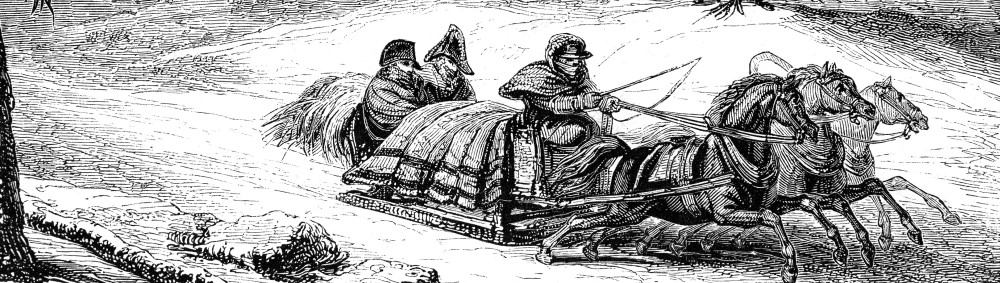
If I was planning to invade Russia with a massive land army (Napoleon went in with 635,000 men and emerged with about 20,000) I would set off in the middle of winter.
“But zat is madness your Highness,” they would say. “Even the simplest peasant in from Bordeaux knows that Russia in winter is well below freezing. Zey will turn to ice. Zey will die like flies. It cannot be done…”
With a knowing smile I would calmly explain my plan: by setting off in winter everyone would make sure that not only were the men suitably attired; but they’d be well trained and we’d make damn sure we had the right supplies.
Not only would we be prepared for winter – we would learn from it and eventually master it, as the Finns did when their small force beat the Soviet Union’s massive invading army in 1940. It would give us time to deal with the myriad of unforeseen problems that would emerge, such as an effective defence when camping out in the frozen wilderness.
And we’d learn from the mistakes of previous invading dictators by not assuming the whole thing would have succeeded by the onset of winter.
And when the Spring came it would be met with such delight and relief that the whole army would get a morale boost. Onwards we would march, to Moscow and beyond…
My own winter campaign
Right now I’m in Brighton and it’s freezing. It’s not minus twenty but I wish it was, as then there would be no moisture in the air; dry cold makes me feel inspired and motivated while the damp cold of Britain is the worst.
The temperature hovers just above ten degrees Celsius and what makes it miserable is that it’s Spring and that means the heating is off. Are British Springs always so cold? (I don’t know, I’ve spent most of my life abroad). I’d rather be in a Russian snowdrift.
Moan, groan, grumble.
My plan for the rest of this year is to go to Bosnia and help re-publish an amazing book of posters that were produced during the Bosnian war (1992 to 1995). The book is called Evil Doesn’t Live Here and it was first published almost 20 years ago; but now it’s out of print and we want to make sure it gets into the hands of young Bosnians all over the world – as it’s an important part of their history and there’s a risk that this war will be forgotten as the Serb/Russian propaganda machine has never stopped pumping out alternative facts about what really happened there.
As soon as I get my second Covid-19 injection I plan to go to Bosnia and get all this organised, and hopefully I can get there in the summer when the weather in that part of the world is amazing; and get the whole project done and dusted before their continental (i.e. bloody freezing) winter sets in. If I do get stuck there next winter it won’t be too bad as they have dry cold rather than our insidious, soul-destroying damp version.
As soon as I post this I’m going on a weekend hike along the south coast, to the Romney Marshes which is a large chunk of wilderness between Brighton and Dover. My flatmate asked why I’m going camping when the weather forecast is bad and I said the only way to deal with shitty weather is walk into it. If you try and hide from it, as I’ve been doing all week, huddling over my laptop, it creeps up on you and gets into your bones. By walking all day you generate enough heat to stay warm in all weathers – even a Russian winter.
Let me know how you handle the weather in the comment box below. Even the smallest comment is most welcome. Lotsaluv, Rupert
by Rupert Wolfe Murray | 22 Feb, 2017 | Opinions
Soviet Russia was a very visual place, for all the wrong reasons. The colours were dark and gloomy, the people were listless and misshapen (air hostesses and officials tended to be huge while gymnasts and the poor were stick-thin). These were the images that we were shown by Hollywood and the media. They weren’t false but they were selective and didn’t get across the main thing — the atmosphere.
I’ve just seen a rather brilliant film called Bridge of Spies. It was written by the Coen brothers, directed by Spielberg and starred Tom Hanks. It’s the story of the U2 spy-plane incident and the exchange-of-spies that followed. Most of the action is set in East Berlin.
They did a good job of re-creating the look of life in the Soviet Bloc — and I say this as someone who visited East Berlin, in 1986, when it was still under Communist rule — but they didn’t really get across the feel of it. In particular the ever present feeling of fear. As a visitor to East Berlin in 1986 I sensed it; I knew that they could arrest me, imprison me, accuse me of anything, detain me forever, on a whim. I also knew they were unlikely to do so as I wasn’t a spy (I didn’t even have a job) even though I sometimes fancied myself as the next James Bond.
The actor who really steals the show in Bridge of Spies is Mark Rylance. He plays Rudolf Abel, the Russian spy who gets exchanged for Gary Powers (the captured U2 pilot). He won an Oscar for best supporting role but also managed to get across something of the dead-soul feeling of life under Communism. His character is melancholic, resigned to his fate, unfazed by arrest, interrogation, repatriation and a possible execution. It may sounds boring but it’s not; it was a brilliant performance and it’s no wonder that Rylance is being touted as one of Britain’s greatest actors.
However, he doesn’t get across the feeling of the Soviet Bloc as well as an actor who would be the first to admit he wasn’t as good on stage as Mark Rylance.
Enter Rupert Everett
I’m not sure what to say about Rupert Everett as an actor. All I know him for is playing a voice in Shrek 2 (Prince Charming), a butler in a film about a monkey called Dunston and the Edwardian headmistress in a crappy remake of St Trinians. He plays fops, dandies, aristocrats and upper class twits — and is probably an essential ingredient to casting directors as there is an endless need for such characters.
What I can say about him is that he’s a great writer. I’m reading his autobiography — Red Carpets and Other Banana Skins — which has this Daily Mail quote on the front page: “Funny, outrageous and extremely well written.” Everett’s description of his early life are brilliant and his description of his homosexuality, in an age when it was still quite taboo, very honest. He’s self-deprecating about his own talents and would be harsher on himself than any critic. But he gets a bit boring when he writes about the life of excess with famous Hollywood stars and he drops names as if they are confetti.
What about Russia? You may be wondering.
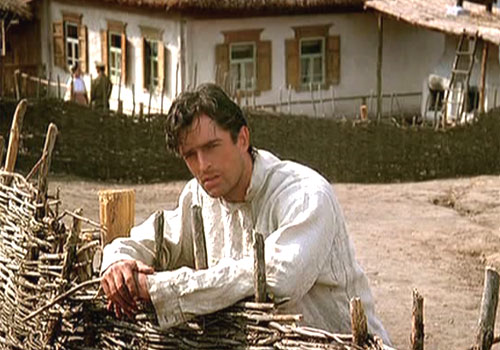
Rupert Everett did make a film about Russia. He played the lead role, Grigor, in Slowly Flows the Don, a classic Russian story in the civil war which took place in the 1920s. It was directed by legendary filmmaker Sergei Bondarchuk, friend of Stalin and director of Mosfilm. The movie was a Soviet-Italian co-production and, like many films made under in the Soviet Union, had access to whole divisions of soldiers. Bondarchuk is famous for his production of War and Peace and with this film he was presumably aiming for something similar.
But it was not to be. Communism crashed, his soldiers deserted, the Italians went mad and the rushes ended up in a basement in Naples, embroiled in legal difficulties. It was never released.
When will I get to the point? Here it comes:
The whole point of this article is to introduce some passages about Russia that Rupert Everett wrote in his autobiography. These short descriptions, his impressions of Moscow in the early 1990s, get across the feel of the Soviet Bloc more effectively than anything I have read or seen on film.
Here’s an extract of what Everett wrote in his 33rd chapter:
“There was a dead feeling in communist Russia. It banged into you as you stepped off the plane. Men in uniforms with blunt dull faces, tiny and cruel under enormous hats, went through my belongings item by item, endlessly examining a bottle of soy sauce, or a bag of rice. (I had brought a trunk of provisions). Others stood in groups with glassy, lobotomised eyes…
“Miles and miles of crumbling tower blocks surrounded the city…Everything was falling to pieces. A porch hung precariously over a front door. Windowpanes were held together by tape and newspaper…
“Inside, the crumbling studios were caked with years of mud and dust. Pipes with big rusting taps grew out of the ground, like living things, and ran along the walls and up over the street before diving back into the earth…
“It was exhausting but this was communism. It had hit them over the head and now it hit me over the head. One had to slow down or die trying.”
This seems authentic to me. You may be wondering who the hell am I to say it is authentic when I didn’t even visit Russia under Communism. I base my view on travelling through East Germany, Poland, Czechoslovakia, Hungary, Yugoslavia, Romania and Bulgaria, when they were all still part of the Soviet Bloc. During that trip in 1986 I had the same impressions as Everett describes in his book.
For me, Everett’s description reminds me of my own experiences in the Soviet Bloc. Just like Slumdog Millionaire was the first India film that reflected the atmosphere from my visits to India between 1984 and 1987.
Rupert Everett went to the Soviet Union and when he left, a year later, it was called Russia. He admitted that he was “vastly unsuited to the part in which I had been cast” — and it is this honesty, and lack of any attempt to explain what was going on politically, that makes his writing so valuable.
I wonder what else he’s written?
Photo credit to Russian Film (This photo shows a whole other side of life in the Soviet Bloc — in a village. The irony of these villages is that the ancient rural culture was preserved better under Communism than Capitalism for the simple reason that Communism had less money and therefore less ability to uproot people from their land and send them into cities. For that reason I miss Communism. Since its departure this village culture is vanishing fast and this makes me very sad).

