by Rupert Wolfe Murray | 3 Jun, 2021 | Journeys
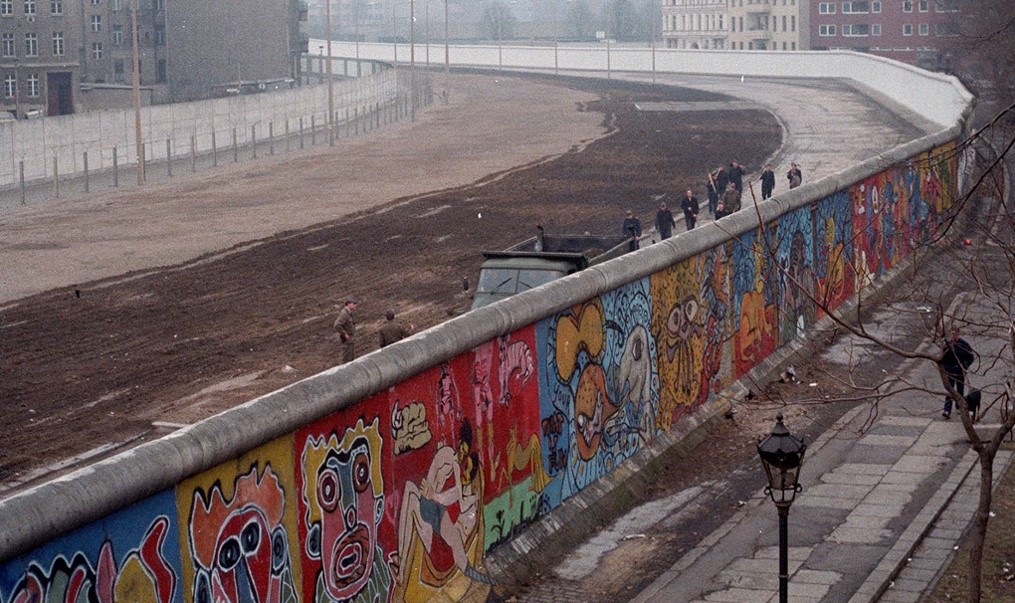
East Berlin was controlled by the Russians until 1989. It no longer exists. I spent some time there many years ago, on my way to Asia. This is how I described it in my first travel book, 9 Months in Tibet.
Berlin back then was entirely surrounded by a high security wall and guarded round the clock by dogs, landmines and thousands of heavily armed soldiers. The whole thing was a bizarre hangover from the Second World War. In 1945 Germany had been occupied by the allied powers and in the areas controlled by America, Britain and France free elections were allowed – and that part became known as West Germany, or the Federal Republic. The Russian army controlled the eastern part of the country – East Germany, officially known as the Democratic Republic of Germany – where Russian-style elections took place and Communism was imposed.
As it was located deep within the Russian zone, one would have thought that Berlin should have become a Communist-controlled city like Dresden or Leipzig. For some reason that I never really understood, Berlin was divided up between the allied powers and this resulted in the western part of Berlin becoming an island of Capitalism in a sea of Communism. The status of West Berlin was backed up by American military muscle, and their nuclear arsenal. By the time I got there the political situation was relatively settled and the city functioned well. It was connected to West Germany by an airport and a fenced-off motorway that was so heavily guarded that you couldn’t stop anywhere without East German troops appearing.
My impression of West Berlin was that it was populated by artists, gays and drifters. If you wanted to avoid the military draft in West Germany you moved to Berlin where that particular law didn’t apply. The West German government was worried about the city becoming depopulated so it offered incentives like this so people would go and live there. We stayed with a Scottish artist called Fiona, a friend of my skateboarding brother Moona. We visited art galleries which I got bored of pretty fast. I was more interested in the nightlife, which started after midnight and went on until nine in the morning. I had never seen anything like it. In Britain the pubs all closed at 11pm, thanks to a law from the First World War that was designed to keep the workforce sober, but in West Berlin there was no such thing as closing time. And the pubs weren’t the smoky, crowded, noisy pits I was used to – they were more like art galleries with smoked-glass tables and great music. They served beer in large, elegant brandy glasses.
My friend Christian was gone after a few days and I was left on my own, feeling a bit disorientated and not quite sure how to start my epic journey round the world. Fiona lived alone in a big flat and said I could stay as long as I wanted.
The most interesting part of the city was East Berlin, the Communist controlled sector, where the architecture was verging on the grotesque. Getting there was exciting. You had to pass through what was probably the most famous border crossing in the world: Checkpoint Charlie. On the western side there were no passport controls at all, just relaxed American soldiers. On the eastern side there were scores of armed military officials who checked passports, searched bags and took the whole thing very seriously. Anyone caught trying to escape from the Communist part would be hunted down by dogs, blown up by landmines or shot. There was an exhibition at Checkpoint Charlie documenting some of the more dramatic escape attempts. People used to dig tunnels, hide in cars and risk their lives to escape the restrictions of East Germany.
One evening on the Eastern side I passed a pub – a thin room, full of smoke, packed with people and roaring with voices – and it reminded me of pubs in Scotland. So different from the smart but staid pubs in West Berlin. The only thing I missed about Scotland was the pubs. To me they represent community.
Berlin has a big underground railway system, the Metro, which was built before the city was divided up by the Allied Powers. An agreement had been made at some point whereby the western side controlled the metro system and the Communist side blocked access to it for their citizens. I wasn’t aware of any of this at the time but I was stunned when the train didn’t stop at an underground station that seemed to be lit with just one fluorescent strip and looked like it hadn’t been swept in years. I saw soldiers in stylish grey jackets which reached down to their hips, thick belts round their waists and high black boots. They each carried a short machine gun on a strap round their shoulders and stood menacingly on the platform with their legs apart, looking at our carriage intently. The Metro had been a popular escape route – people would hang onto the bottom of trains so that they could find freedom in the west.
One of the main reasons I spent so much time in Berlin was to get visas for all the countries I planned to go through: Poland, Czechoslovakia, Hungary, Romania, Bulgaria, not to mention Iran, Pakistan, India and China. I had started this process over the previous few months – visiting spooky embassies in London. The Romanian Embassy was in a huge Victorian villa and looked like something out of a Dracula movie. Getting visas is a time consuming process but the one thing I didn’t have in the UK was time, as I was so busy making money driving a truck. I suspect that if my friend Christian hadn’t insisted I come to Berlin I might never have left. Berlin proved to be a useful staging post where I could prepare for the next leg of my journey. I didn’t need to think about a Chinese visa until I got to Hong Kong — if I ever got there; it still seemed so impossibly far away and the money I had brought with me no longer seemed like such a vast hoard.
The first challenge was to get a visa for the Islamic Republic of Iran, a country that stood right in the middle of my planned hitchhiking route. Iran had been taken over by Islamic Fundamentalists in 1979 and they didn’t have a very good impression of us Brits. Our colonial history there is a shameful one and I wasn’t sure they would give me a visa at all. But I had to try. Several weeks later I stood in the snow outside the Iranian Embassy, clutching my passport with a fresh visa in it. It was time to move on.
Just before leaving Berlin I had an attack of fear and paranoia. It happened late one night in Fiona’s flat, which was large and empty. Fiona was out, as she was most nights. The rooms were cold and dark and the street lights were casting strange shadows. I was smoking a joint on my own and contemplating the future. I had smoked a lot of pot over the last few years and I believed it had made me more aware, but I knew it had also made me lazy and disconnected from university.
I started to feel paranoid. The more I smoked the more scared I became – a horrible, crawling feeling in my stomach and on my skin. The Iranian visa was the spark: around the visa stamp was a lot of Arabic writing and I became convinced that this was my death sentence which said This is a British spy! Arrest him immediately! I imagined being hauled off to a crowded dungeon, put in chains, starved, screamed at, flogged in public, tortured and eventually decapitated.
The Iranian fear was avoidable as I had a choice: I didn’t have to go there. I could fly over Iran. No sooner had I decided to do just that the next shock came marching in: I was trapped in this city and it was surrounded by the Red Army. What if the Russians decided that I was not allowed to leave? Maybe they had talked to the Iranians? Surely they would lock me up and throw away the key?
Fortunately, I managed to sleep and by morning my living nightmare was just a memory. Something good came out of this episode: I gave up smoking cannabis. I realised that if I was going to hitchhike across Europe and Asia it wasn’t in my best interest to use a drug that could make me feel so scared. It wasn’t until that morning in Berlin in 1986 that I realised the importance of giving up dope. I tried some many years later, in the basement flat of a doctor friend in London, but the demons of paranoia came on strong and I realised that I must give up this shit for good.
It was time to hit the road but I was running out of cash. I had spent too much time in this damned city. Even though I was living frugally and wasn’t paying rent, the cash was dripping through my fingers as if it were sand. What could I do? How could I earn some money? The last thing I wanted to do was call home and say Mummy! Please help! I’ve run out of money. It would have been so humiliating. I didn’t know enough German to be able to get a job in Berlin and I wanted out of this town. It was becoming suffocating. I looked at the map and considered my options: Poland, Czechoslovakia, Austria, Hungary; not much chance of getting a job in those parts. The only modern capitalist city on my route was Vienna: Hmm…I wonder…Could I get a job there?
Now that I was finally away from home I had so many questions. Why was I planning to travel by train? Wasn’t I supposed to be hitching? Why was I planning a route through South-East Europe? Wasn’t that a long and complicated way to get to China? How much would all the visas cost? What about exchange rate losses? Why not get the train to Moscow? I could get the legendary Trans-Siberian Express, stop off in Mongolia, and then arrive in Beijing dusty and experienced in the ways of the traveller. I didn’t have a neat answer to my choice of route but I did want to see as many of those strange East European countries as possible.
If I didn’t make some money soon there was no way I would get anywhere near China. I had underestimated how much things cost. I was down to $200 and I needed to build up my stash to over $2,000 before proceeding eastwards. This became my formula: when the cash dropped below $200 I had to get a job; when more than $2,000 was saved – hit the road. Would I be able to get a job in Vienna?
German words are so long, the language seemed impossible and I doubted I could ever learn it. I was also studying Mandarin Chinese with the aid of a book from the 1930s and I remember thinking: Chinese is easier to learn than German – it’s just a series of monosyllables; whereas German words are really long and almost impossible to remember.
Germany has one of the best railway systems in Europe but the trains it deployed for going east, into the Communist world, were old and run-down. My impression of the Communist Bloc, a vast stretch of the northern hemisphere, was that all the nations were the same. They were all toiling under Moscow’s rule, uniformity in all things was the order of the day; they wore the same clothes, drove the same cars, did the same things, learned the same Communist-inspired history and took their orders from Russia. If you had asked me: Why on Earth would you visit such a boring place? I would have told you that I wanted to see for myself how dreadful it really was and if this impression of uniformity was really true.
#
This is an extract from my first travel book 9 Months in Tibet. You can get the eBook here: 9 Months in Tibet eBook: Wolfe-Murray, Rupert, McCall Smith, Alexander: Amazon.co.uk: Kindle Store
by Rupert Wolfe Murray | 20 May, 2019 | Journeys
I felt so lucky to have been asked to look after Roger and Isabella’s flat and I was determined to take this responsibility seriously. The flat had two rooms, a huge bedroom-cum-living room, with a wide array of windows, and a kitchen. Tibetans tend to decorate with loud, home-made colours and the wooden pillars in the main room were painted red and blue while the roof timbers were yellow. I recognised the floor as it was similar to the one that I had seen Diane working on for a few hours in the Jokhang – mud and gravel that had been thumped down by women wielding small tree trunks. Not only are these floors warmer than concrete but all the feet that gently rub them makes them shiny and beautiful. There were only two stoves and the one in the main room was too small to heat up the space, so I spent most of my time in the kitchen, where Roger had thoughtfully wired up a set of speakers.
Even though I only had three hours of teaching a day I continued to find the work exhausting. I wasn’t sure if this was due to the illness or, as I suspected, because teaching is a very tiring job. It felt more exhausting than carrying heavy furniture up and down staircases in Edinburgh or working on a building site. By lunchtime I would be shattered, but also feeling satisfied. I needed to conserve energy, and it was freezing outside, so I stopped teaching the nurse and cut back on teaching Sir Woo. After a few days I invited Je Yang round and we would spend the evenings talking and listening to Roger’s huge collection of tapes. Then I ran into Diane and Frenchy who told me about the police raid at the Cheese Factory: everyone had been thrown out and the manager was carried off to the police station for under-charging foreigners. The Americans had moved to the Plateau Hotel which they hated because it was modern, concrete, cold and expensive. Diane had fallen out with Frenchy and they argued incessantly except, curiously, when I invited them round to my new flat. Both of them were sick with the illnesses that bedevilled foreigners in Tibet: giardia and bronchitis.
When I saw what a rotten teacher Big Jack was I realised that there had been no point in the job test as they obviously chose their replacement teachers on a whim. Big Jack was always late and he’d never prepare his lessons. I found myself helping him out, filling the gaps and trying to cover up for him. He reciprocated by offering me advice on diet, another of his areas of expertise, and he explained the different qualities that vegetables have and how steaming is better than boiling. This was all news to me. I had no idea that tomatoes are full of acid, peanuts are full of fat and milk creates phlegm in the throat. I didn’t invite him round to the flat, telling him that I wasn’t allowed to have visitors, hoping he wouldn’t see Je Yang, Diane and Frenchy coming round most evenings. We would sit round the yak-dung stove cooking a pot of soup and explain to Je Yang that life in the west isn’t as idyllic as he’d been led to believe. Je Yang didn’t believe the anti-American propaganda he’d been taught; he believed that once you made it to the west money and happiness inevitably followed. I was keen to destroy that image and Diane and Frenchy were the ideal means of doing so. They would talk for hours about racism, corruption, inequality and, most extensively, about AIDS.
Je Yang had a morbid fascination with AIDS and Diane and Frenchy’s doom-laden prophecies set his mind spinning. On the one hand the disease appalled him but on the other he couldn’t help feeling that this was some kind of divine retribution for all the bad things the western world had done. We would furiously debate the AIDS issue every evening, each one of us strongly defending our positions, and the only thing that we all agreed upon was that mashed potatoes taste great.
The sickness I was recovering from must have lowered my immunity – by the end of that week I had both giardia and bronchitis. These illnesses were nothing compared to hepatitis but I had to get rid of my chesty cough and the appalling stomach. Diane described how giardia had made her stomach swell up to the size of a basketball, she would rush to the toilet and then piss and fart down the hole. They would both explain these gruesome details endlessly. Giardia, I was told, is a type of bacteria that forms cysts in your duodenum (the bit just below your stomach) and when these burst they produce sulphuric gases. The Tibetan medical cure was said to be effective, but time consuming, and the modern cure was two grammes of a powerful antibiotic called Tiniba, a drug that Diane swore by.
– But you gotta remember, she said, to take a second dose a week later in case you’ve missed some of those fuckers the first time round. They lay eggs you know and you gotta nuke those fuckers before they can get you again.
I didn’t have the energy to deal with the Tibetan hospital again so when the basketball belly hit I downed a couple of tabs of Tiniba which promptly wiped out the infection. Frenchy then gave me two tabs of Bactrim which, he swore, would get rid of the bronchitis. It worked.
Even among the foreign oddballs and eccentrics who would turn up in Lhasa every week, Big Jack stood out. His thick woollen clothes, big beard and Mujahedeen hat made him the butt of all jokes, at least in my circle. But he was so big and fierce-looking that nobody had the courage to say anything mocking to his face. He had latched on to the cheesecake women and was one of their salesmen. He was good at this because he was pushy and intimidating and people thought they would get thumped if they didn’t cough up. I knew where he hung out so I was able to avoid him but we came into contact at class time.
One morning I went to Roger’s class and was surprised to find some officials from the Tibetan Political Consultative Conference there. These were the people who had set up the class but this was the first time I’d actually seen more than one of them. They nervously informed me that Tibetan TV wanted to come and film us for their news show, was that okay? Until that moment I had no idea that there was a TV station in Tibet and if they wanted to film us that was fine by me. They left and I started teaching. Twenty minutes later another bunch of officials came in, but this lot burst in the door arrogantly, set up their cameras and started filming. I carried on as normal. When they moved next door to film Big Jack we could hear his voice becoming louder and louder; I stopped teaching to go and look and all the students followed. We peered into the next room and there was Big Jack, shouting at the top of his voice as if he was giving the Sermon on the Mount to a gathering of thousands. That evening I went to Sir Woo’s place as he was the only person I knew who had a TV set. He was happy to let me in but there was a power failure, so we missed the chance of seeing Big Jack look ridiculous on TV.
Every Saturday we would teach a song. It was simple, fun and they would learn new expressions and improve their listening skills. Isabella would play the Beatles and Bob Marley, and other favourites from the sixties, but I thought Flower Power might be a bit over their heads so I started using jazz songs. The problem was Big Jack; he never prepared for his classes and without preparation you just can’t use a song for teaching purposes. I offered to help him and he seemed willing, so I prepared a Fats Waller song for him and explained the technique that I had learned during my English teaching course in England:
– Write the lyrics on a piece of paper, identify any difficult words in the lyrics that they might not know – and teach these words before you play the song. Then write the lyrics on the board with some easy words missing, and write an underscore where the words are missing. Then play the song a few times and tell them to fill in the missing words. It’s easy and they usually enjoy it.
When Saturday came round Big Jack was late again. When he did show up, looking hung-over, the class were making a hell of a din and they greeted him with a slightly mocking tone as they had obviously come to realise that he was something of a joke figure. This was the rowdiest class that we had and it contained several tearaway monks, all teenagers, as well as some wild girls. I could hear them joking about his beard and hat and hoped he didn’t understand (his grasp of Tibetan was worse than mine). Gruffly, he began writing the lyrics up on the board in a handwriting style that was illegible, even to me. The song starts like this:
– Dina, Dina, is there anyone finer?
– In the state of Carolina
– If there is, show her to me.
I could hear the class growing more restive and I put my head through the door. He was in the process of explaining the meaning of Dixie eyes blazing and I could see some of the students laughing openly in front of him.
– Everything okay? I asked.
– Yeah, he hissed, with eyes of fury, I can handle the little bastards.
I went back to my class, not knowing what was best to do. I heard a crashing sound, shouting, a murmur of voices and then total silence. I went in and found Big Jack on his own, all the students had walked out. He was red-faced and furious, stomping up and down the room.
– What happened?
– Those little fuckers! Nobody fucks with me! Next time I’ll really beat the shit out of him! You gotta be tough with these guys.
Then he grabbed his stuff and, without another word, threw open the door and marched off in disgust. I went back to my class and carried on teaching the difficult words associated with my song. I later found out that he had grabbed one of the monks, thrown him against the wall and threatened him with his fists. On the following Monday morning the leaders were waiting for him. They told him not to come back.
#
This is an extract from 9 Months in Tibet — the eBook — which will be published soon. If you’d like to reserve a copy just email me at wolfemurray@gmail.com (or post a short comment under this article). To see feedback to the paperback edition, click here.
by Rupert Wolfe Murray | 13 May, 2019 | Journeys
This is chapter 34 of my Tibet memoir in which I was laid low (I thought I was dying) by hepatitis, for which western medicine has no cure.
A few days later I got hit by a shockwave of illness and it was so bad that I was convinced I was about to die. All I could do was lie in bed and drink water. Fortunately Joga’s place was empty that day and I tried desperately to convince myself that I was fine, but the signs of hepatitis were hard to ignore: brown urine and yellow eyes. For two days I lay there, trying to get used to the feeling of being so ill, trying to accept it, trying to convince myself there was nothing wrong with me. This was the worst possible time to get sick: Roger and Isabella were both going off on a trek together and they had asked me to be Roger’s replacement teacher; it was the best job opportunity that had come up yet so I couldn’t stay in bed. But I was too weak to get up.
A day before the appointment at the class I staggered up to the Chinese Hospital – a Herculean feat – and sat by the window of my student’s room. I was too exhausted to teach and could barely talk. She assumed I was hungry and offered a plate of thick curry and pickles, but the smell turned my stomach even though I hadn’t eaten for days:
– You no eat?
– I can’t eat. Today I can’t teach! I feel very sick. I must see a doctor.
– Okay, we go see best doctor man in hospital.
With a sense of purpose that I found exhausting, she led me out of her block, up the road and into the Chinese Hospital – which I hadn’t actually visited thus far. It looked modern enough from the outside but inside it looked terrible: dirty, chaotic and with a cold, unwelcoming atmosphere. The doctor took my pulse, told me I had a common cold and gave me some aspirins. I returned to Joga’s, feeling like it had been a wasted journey and was so burned out by the exertion that I spent the rest of the day asleep. Joga’s place was full of her middle-aged lady friends who made sympathetic noises, but Joga was both sharp and sensitive and she knew what was needed: she shooed her friends out and banned others from coming for the next few days, giving me some welcome relief. I still couldn’t accept the fact that I had the dreaded hep. I was in denial: This can’t be happening to me!
The next morning was the job test and I dragged myself over to the Shata building, an ancient courtyard where Isabella and Roger lived and where the classes were held. I slowly made my way up the stairs, knocked on their door and was invited in to join them for breakfast. The smell of frying food was too much; I went straight to the toilet, located at the end of the landing and puked violently into the slit in the floor, inhaling a terrible smell from the cesspit that filled up the room below. Nothing came out. My body went through the heaving gesture of vomiting but there was nothing to puke except some watery gobs of sticky phlegm.
– You look rough, said Isabella back in the apartment. You don’t have to do this you know?
I didn’t know her well enough to know that she meant it. I had spent days working up the energy and determination to go through with this test, which was crucial – I was convinced that my very survival depended on it.
Downstairs in the big classroom the students were lively and pleased to see me. They were laughing and expecting me to join in but I just slumped into a chair, croaked out some words to explain my state and asked them to be quiet and read their books. They understood immediately and settled down to read. I felt they were on my side and that maybe I could actually pass this test. Towards the end of the class the head teacher came in and I stood up and started teaching some parts of the book. This seemed to satisfy him and he left. I slumped back down again thankfully and the rest of the class passed by uneventfully. For a moment I thought I was beating this illness but when I got back to Joga’s place I felt worse than ever and I knew there was no way I could maintain this charade of pretending to teach. On the way back I bumped into Paola who noticed the yellow eyes immediately and said:
– You look horrible. You go to Tibetan Hospital. They will help you.
I had considered going to the Tibetan Hospital but I was sceptical. Wasn’t it based on the medieval system of wind, bile and phlegm? How could it possibly help? But Western medicine has no cure for hepatitis so why not try Tibetan medicine? I was too exhausted to even think about it. I had seen the Tibetan Hospital and it was big and crowded. I didn’t have the energy to hustle my way in there and I would need a translator. I tried to think about these problems in Joga’s place which was now deathly quiet, but I couldn’t focus and I drifted off into a long state of delirium.
Joga took action. She had met my Chinese friend Je Yang, who had come round to see the place, and she was impressed with him. While I slept she sent out her lady friends to search the town and locate him. I was awoken by a series of prods and there he was, Je Yang, sitting at the end of my bed rather sheepishly, refusing Joga’s offer of tea or chang. He said:
– I’ve come to take you to the Tibetan Hospital. Let’s go. I laboriously got up and followed him across the old town.
There was a big crowd in the Tibetan Hospital and we both took up our positions; me by the bike rack where I was dry retching into the undergrowth and Je Yang inside, arguing with the doctors and nurses, trying to get an appointment. Eventually we got to see a doctor, a young man who was speaking in rapid Mandarin to Je Yang. I was told to roll up my sleeve and he took my pulse with three fingers on each wrist, concentrating hard for what seemed like ages. Then he asked about symptoms and everything I said he would just nod as if to confirm his diagnosis. Je Yang translated:
– The illness you have, what you call hepatitis, is a typical illness that comes up at this time of year, at the change from autumn to winter. A lot of people get ill when the seasons change. This one is to do with the bile, you have a bile imbalance. He says your illness is well-known to them and common for this time of year.
The doctor then gave me some evil-looking black pills, which looked suspiciously like dried sheep shit, and sent us on our way. As we were leaving I asked if I needed to follow a particular diet and he said no. I was willing to try the sheep shit pills, I would have tried anything, but I was still sceptical about Tibetan medicine.
Back at Joga’s place I sat with my glass of boiled water and chewed the first of the black pills. They tasted horrible – musty, gritty and sharp – but they didn’t make me vomit and I swallowed them down faithfully. I lay down on the bed, expecting nothing, and wondering what I could do next; no health insurance, no western doctors here, no hope? Three hours later I woke up feeling fine and by evening my normal energy levels were back. I couldn’t believe it, the Tibetan medicine was working – and I had only taken one pill. Was this a dream? Was this possible? I was still sceptical and expected to wake up the next morning feeling as ill as I’d felt all week, but by morning I was better than ever. Complete recovery.
And good fortune had smiled on me on the work front too. I got the job as Roger’s replacement. Also – against stiff competition from their old friends – they asked me to look after their apartment which was the ideal convalescence home. Their flat was upstairs at the Shata courtyard which was, I learned, a former palace. The courtyard had been turned into simple flats and the whole place was rather run down, but Roger and Isabella’s flat had some of the elegance of the old days; curious wooden beams and a long sweep of windows that stretched the length of the apartment itself. It was spacious, comfortable, full of interesting books and, best of all, private. I couldn’t understand why they had gone off on a trekking trip in winter but it was the ideal place to cook the only thing I was able to hold down – boiled vegetables.
There had been a lot of debate about who would be the replacement teacher for Isabella and I had pitched in with my view that Frenchy would be ideal; although I knew him as a reprobate he could make himself look respectable if he had to, and he was great with the students. I had seen him with them at the party and he’d been lively and stimulating. But they chose Big Jack, another depraved American. Big Jack was a pain in the neck and I didn’t like him from the start. He styled himself as an intellectual and had spent time studying Tibetan culture at Dharamshala, the capital of the Tibetans in India, seat of the Tibetan Government in exile and home of the Dalai Lama. He was a far bigger know-it-all than any other traveller I had met. He claimed to have trekked across large parts of Tibet and he considered himself the font of all knowledge regarding the country. What made it worse was that he was also a macho man; he was big, had a beard and he wore a Tibetan Khampa cloak, belted at the waist, and a brown woollen Pakistani hat. I think he tried to imitate the style and swagger of the Khampas. Big Jack’s problem was that he had no sense of humour – the saving grace of the real Khampas. He was also a bad teacher: rigid, impatient and liable to fly off the handle. I was sure the students hated him, but they were far too polite to say so.
I do have to thank Big Jack for giving me an introduction to Tibetan medicine, one of the many subjects he could drone on about for hours. I was thirsty for knowledge of this mysterious science that had cured me of the dreaded hep. What caught my imagination was the idea that wind, which is one of the key elements, is believed to be a horse which carries the body. A week earlier I would have mocked such an idea but now I was open to it. Perhaps the most impressive thing about Tibetan medicine is the way they diagnose illness, by reading a pulse. When westerners read a pulse they are simply counting the heartbeats, but it takes a Tibetan doctor years to learn how to read a pulse properly. The Tibetan doctor use three fingers and they develop a sensitivity so fine that each of their fingers picks up two separate pulses. In other words, they are reading six pulses at the same time.
When I first heard that they use the ancient classifications (or humours) of wind, bile and phlegm as the basis for their medical system I couldn’t take it seriously – this approach to medicine went out in the Middle Ages. This is their method of diagnosing illnesses. When they take a pulse they are reading the wind, bile and phlegm levels of a patient and they detect illnesses by spotting imbalances in one of these humours. The pills are interesting too. I had assumed they were some kind of herbal remedy but their main ingredients are minerals. Traditionally, Tibetan doctors would spend several weeks a year on horseback gathering rare plants, roots and minerals. Mixing the ingredients and making the pills is an ancient science.
I later found out that Tibetan Medicine dates back to a mythical age when eight Medicine Buddhas wrote down about 80,000 different illnesses – from the past, present and future. Tibetan Medicine is well developed in India, where they teach it in monasteries, and where it has been credited with successfully treating cancer and also AIDS, a disease they claim to have known about for hundreds of years. In India and the in the west Tibetan medical practitioners keep a low profile and make no public claims about its effectiveness.
I went back to the Tibetan Hospital a few times to try to garner more insights, but nobody spoke English. One day I came across an old doctor in robes who must have been in his nineties. He had a spring in his step and a sparkle in his eye. He stopped me in the corridor, greeted me, introduced himself as Dr Puntsok and asked where I was from. When I told him he smiled enthusiastically and beckoned me to follow. We went through corridors, up stairs and into a distant storeroom where he rummaged around and pulled out a little glass bottle that he showed to me proudly. It said Bicarbonate of Soda and was obviously very old, perhaps dating back to colonial times. I took the bottle, looked at it and wondered what I was supposed to do. Translate the label? Maybe he had heard me say I am from Bicarbonate of Soda? I looked round but he was gone.
#
This is an extract from 9 Months in Tibet — the eBook — which will be published soon. If you’d like to reserve a copy just email me at wolfemurray@gmail.com (or post a short comment under this article). To see feedback to the paperback edition, click here.
by Rupert Wolfe Murray | 11 May, 2019 | Journeys
This is chapter 33 of my Tibet memoir in which I make friends with a Chinese guy who’s English was not only self-taught but it was a lot better than many native speakers.
One of Sir Woo’s visitors stood out from the others. Not only was he taller than the rest but he was quiet and thoughtful and showed genuine interest in what I was teaching:
– How do you do? he said in perfect BBC English. My name is Je Yang, I am a friend of Sir Woo and I too am from Shanghai.
– Hi there, my name’s Rupert.
– Glad to meet you.
– Where did you learn such good English? I presume you went to private school and university in the UK. Or Hong Kong?
– Not at all. I taught myself.
– What do you mean? You didn’t go to an English school? You must have had a great English teacher. I’ve never met a Chinese person who speaks English as well as you. How did you do it?
– Like I said, I taught myself. I’ve never had an English teacher. I’ve never been anywhere except Shanghai, where I am from, and here, where I work. I did used to listen to the radio and that helped with the pronunciation.
Even in Britain it’s unusual to meet someone who speaks English so well. Most Brits have an accent that indicates their class or their region, and however well foreigners master our language – and some know it better than we do – I don’t remember ever meeting anyone who spoke it as fluently as Je Yang. He had been to the technical university in Shanghai and worked as an engineer at the Tibet Electric Company (no, they didn’t need an English teacher) and said that getting a job here meant that he got a better salary so it was a good opportunity to save money. He wore old fashioned sunglasses when outside and when he took them off I could see that he had gentle eyes. He looked rather shy at first but he was full of ideas and concepts that he wouldn’t have dreamed of mentioning to the rowdy mob outside Sir Woo’s place.
When someone is eager to learn the results can be electric. That was the case with Je Yang. We would meet often and talk for hours. They weren’t lessons – there was no lesson plan, curriculum or text books – and I didn’t charge him; they were more like wide ranging conversations. I was hungry to learn about China and he wanted to improve his knowledge of English peculiarities. I would think back through my life, searching out all the weird and wonderful expressions that I had squirreled away in my memory, and we would discuss them. I had heard a lot of sayings over the years and I would squirrel them away in my memory. He was delighted with the phrase Bob’s your uncle! and especially my story about Sheila, the secretary at Canongate Publishing who would say Mary’s your aunt! as a refrain.
Only now were all these expressions coming out and I was amazed at how many I knew. I had a glimpse into the massive warehouse of information stored away in my memory – information that I’m not aware of and barely use. What made it particularly interesting was that I wasn’t quite sure if my explanation of each expression was the correct one, so we would debate it, look it up in his dictionary and sometimes accost British or American travellers for their view on whatever expression we were debating that day.
Just when I was starting to form the impression that Je Yang was something of an innocent, he told me he had a private business interest. Private business? In Communist China? Isn’t that illegal? He shrugged off the suggestion and told me about his friend in the Government Unit that had access to a bus that had been forgotten about. The bus driver didn’t have to report to anyone, didn’t have to do a particular run and basically worked for himself. He had made a deal with Je Yang that involved running foreign tourists from Lhasa to the Nepalese border, stopping off at important Tibetan monasteries on the way. He explained that the bus wasn’t exactly new but they were able to undercut the official tour operators, and so the travellers were getting a good deal. The tourists could, of course, get the local bus but that was a two day marathon to the border and if you wanted to visit a monastery en route you had to get off the bus and chance your luck hitching through the wilderness. It seemed that Je Yang’s bus made everyone happy.
But Je Yang had a problem. He told me that dealing with these foreigners made him unhappy and nervous, especially the French who were always complaining. He said the Americans could also be very difficult.
Some days later I found myself sitting with Je Yang on a hotel balcony outside the Travellers’ Co-op, waiting for the thirty people who had signed up for the next bus trip to come and buy their tickets. I was terrified; I had never dealt with so many strangers before and my hands were shaking. This is more scary than teaching I thought. Je Yang was right, the travellers were tough, pushy and suspicious – and his attitude of meek servitude only encouraged them. Most of them had travelled through India or China to get here (the consensus was that it was much harder to travel through China). They were hard-bitten and experienced and all of them had been ripped off at least once. I could understand their reluctance to hand over a hundred yuan to a pair like us. Two weeks later we were doing the same thing and before long I had got the knack of it. I realised that however rude and tough I tried to be, nobody seemed to mind. It reminded me of a quote from Napoleon, who apparently said: If the King is a nice man the reign is a failure.
My routine in Lhasa had changed completely. Most lunchtimes I was teaching at the Chinese Hospital – doing more eating than teaching – and evenings were taken up with Sir Woo. I was still staying at Joga’s place but it was almost impossible to relax there. Many times I wanted to stretch out on my bed for a few minutes but there were always a couple of burly warriors on it, cheerfully insisting I drink another cup of chang. At weekends I would climb onto Joga’s flat roof and read novels by Henry Miller, whose description of decadent Americans in Paris in the 1930s seemed to resonate with the life I was currently living.
Perhaps it was due to the altitude, or the fact that I hadn’t worked for so long, but I felt continuously exhausted. Often I would go to the Cheese Factory and stretch out on Frenchy’s bed for a few minutes. They had finally got their own room, which had become a wasteland of half-eaten food and all sorts of rubbish. The cold was really settling in with a vengeance and their borrowed paraffin heater was in constant use – not that it made any difference as the cold air leaked in through the windows, the ceiling and the thick stone walls. There was nobody on the Cheese Factory terrace anymore, everyone was inside trying to keep warm – many of them crowding into Diane and Frenchy’s room in the vain hope that a large number of bodies would result in warmth. They were all eager to know what it was like staying with Tibetans but I didn’t tell them much; I didn’t have much to tell, and I certainly didn’t invite any of them round in case they tried to muscle in on my space.
Diane and Frenchy both seemed obsessed with health matters. She was convinced that AIDS was a major epidemic that would end up destroying everyone. She said that if you slept with one person it could bring you into contact with over a thousand people, a claim that didn’t make much sense to me. My view was that the media had distorted the risks of AIDS, as they had done with herpes before that, but she dismissed me as an ignoramus and shut me up by quoting statistics. Frenchy was more concerned with hepatitis, an illness that was much closer to hand, in fact just next door four people had it. We called the next room the Hep Ward and noticed that everyone who went to stay in it seemed to catch it – not that this stopped the never-ending stream of travellers looking for a cheap bed. Jake, an English guy we had known for months, was now called the Yellow Man. Italian Paola, who had sad eyes and long black hair, claimed to have been cured by Tibetan medicine.
– Bullshit, cried Frenchy. Hepatitis doesn’t have a cure. Everyone knows that. Paola’s bullshitting herself. With hep you just stop eating oil and alcohol and sit and wait. That’s all you can do.
Larry, another American with an opinion, said he’d heard that a lot of people had been cured of hepatitis and other illnesses at the Tibetan Medicine Hospital. He said that Tibetan medicine is an ancient tradition that seems to get really good results. I didn’t pay much attention to these discussions and Frenchy dismissed it out of hand – he dismissed Tibetan medicine as alternative, and said all alternative medicine was hocus-pocus. I would make the occasional provocative remark to try and keep the discussion going.
Paola was different from the Cheese Factory crowd in that she didn’t hang around in the rooms all day, moaning and groaning. She was intrigued by Tibetan religious culture and seemed to know a lot about it, although she rarely spoke. Her favourite spot was right in front of the Jokhang, the main Tibetan temple in the centre of the old town, where she would spend hours talking to people in fluent Mandarin. As a relaxing contrast to my other activities, I was spending more and more time at the Barkhor, walking the network of streets that surrounded the temple, as the pilgrims did. It was a good place to have conversations; you could walk and talk. One evening I was walking past the front of the Jokhang with Frenchy and we saw Paola, who turned to me dreamily and offered us a sliver of dried cheese – white cheese that had been hardened to rock and then cut into little slivers, probably with a cleaver considering how hard the stuff was. I had seen this stuff before but never tried it so I took one, thanked her, popped it in my mouth and tried to get some taste out of it. We walked on and Frenchy hissed into my ear:
– You idiot. She’s had hep! I laughed off his suggestion and thought how sad it must be to go through life with this kind of hypochondria.
#
This is an extract from 9 Months in Tibet — the eBook — which will be published soon. If you’d like to reserve a copy just email me at wolfemurray@gmail.com (or post a short comment under this article). To see feedback to the paperback edition, click here.
by Rupert Wolfe Murray | 9 May, 2019 | Journeys
This is chapter 33 from my Tibetan memoir, in which I manage to avoid the law (and the backpackers) and stay with local Tibetans…
Although the Import Export people didn’t give me a job everything started happening at once. Life seems to work this way; once inside the magic circle you’ll find anything is possible, but getting inside it often seems impossible. The key is coming across the right people and impressing them, but quite how one goes about that is something of a mystery.
Things really started moving after meeting Asheya, whom I was introduced to at the new Kailash restaurant – the first place in town that played music. Asheya was extremely small, but he was solidly built and had a round face and warm, beaming eyes. He was middle-aged, lived in Kathmandu where he dealt in carpets and antiques and spoke fluent English. His family was from Lhasa and, for the first time in decades, he was able to visit them. He was much warmer than the other exiled Tibetans I had come across and was from a different generation to the disco-dancing crowd I had met thus far. Initially I was suspicious of his interest in me, although taking full advantage of it, and wondered what his ulterior motives were. Did he want something? If so, I never found out what it was.
He listened to my plea – I want to stay in Lhasa but I need cash, a job, and also a place to stay so I can get away from some annoying Americans. Although my demands were simple enough most people I spoke to seemed to have a problem understanding me. Maybe they didn’t want to? Perhaps helping a foreigner was too risky? Asheya got it in one go, thought about it for some time and told me to come back to this same restaurant the following evening.
When I returned the next evening I wasn’t expecting anything and I wouldn’t have been surprised if he hadn’t turned up at all. Not only did Asheya show up, he came into the restaurant with two young ladies. These lovely ladies, he announced grandly, are your new students. They were Tibetan nurses from the big Chinese hospital on the north side of the city, both wanted to learn English and were willing to pay seven yuan an hour fee – each. I couldn’t understand why these two could pay me when Elliot’s whole class had refused. This was a real break; I knew that the big hospital had at least one English teacher and maybe this was a way in. Maybe I could get hired there? I thanked Asheya, spoke to the ladies and arranged to meet up with them three times a week.
The second amazing thing that Asheya did that day was to arrange my accommodation at his sister’s place. This was going beyond kindness as I knew it was illegal for Tibetans to accommodate foreigners and I had never heard of it happening in the city. He assured me that it was no problem, nothing special and wasn’t a risk. It was with a sense of glee that I went back to the Cheese Factory that evening and met Diane and Frenchy:
– Guess what? I’m moving out!
– Moving out? You can’t move out. You’ve just got your own room.
– I’m sick of it here. I’m sick of you guys.
– Hey, we like it here. We like this Little America.
– Well, I’m outta here.
– You Limeys are crazy. Where the hell ya’ going anyway?
– I can’t tell you.
– Why the hell not?
– Because.
Asheya’s sister was called Joga and she lived down a stinking alley not far from the Cheese Factory. The following day he led me down the narrow alley and we followed the open sewer which led into an earth-covered courtyard which had a ramshackle well in the middle. Asheya cheerfully pointed to the well and told me it was the only source of water. Did the sewage water leak into it? There were four low, shack-like houses around the yard and Joga lived in the smallest of them. We went into a tiny room with a mud floor, two small benches and a dresser. It was so low that I had to bend almost double. We sat on one of the benches and Joga served us drinks.
Joga was much smaller than Asheya. Although he never talked about it I could see that she was disabled: her spine was only about six inches long and twisted. She had a kind face and served us drinks with no trace of self pity. She could walk around with a strange gait and she managed perfectly, walking with her own particular gait. She spoke no English but seemed happy enough to have me to stay. She pointed to the narrow bench that we were sitting on and said that would be my bed. I was delighted. Even though the place was a dive – even my Tibetan friends said so when I invited them over – and the smell from the sewer was appalling at times, I was so glad to get in with a Tibetan family that I would have put up with anything. I had been hoping to get a job but had never even thought that I would also be able to live with Tibetan people.
Joga and Asheya were Khampas, he explained, from the Kham region of Tibet which used to stretch far into the Chinese province of Sichuan. The curious thing was that the Kham people tend to be huge, and they make themselves seem bigger by their bulky cloaks, their big hats, their big mouths and their swaggering walk. When I first turned up with my rucksack I was introduced to three burly Kham warriors who were sitting on the benches drinking chang. They all had big grins on their faces and insisted I share a drink with them.
A constant stream of Kham visitors came to Joga’s place and even though they were a noisy, drunken rabble they always treated her – and me – with the utmost respect. They would shout and curse at each other constantly, sometimes even strike each other to emphasise a point; but for them Joga was a princess. Every evening the room was full of chattering Khampas who had no intention of leaving. Not only was my bed inaccessible but when they sat on it they lifted up the blankets and sat directly on the sheet which, as a result, was always grimy. There were usually about six people in the room every evening, a mixture of big Khampas and Joga’s local women friends. Their main activity was telling jokes, none of which I could understand but I got into the atmosphere and appreciated the burst of laughter and applause at the punch line. The murky white drink they call chang was being poured constantly and every time I would take a sip of the sour brew my cup would be immediately refilled, even if I refused insistently. I learned that if you didn’t want to drink you simply don’t touch the stuff.
Joga’s place was always dark – the room had only one tiny window and it was usually blocked by a huge Khampa. This was a sharp contrast with the Chinese hospital where I would teach English in a room full of light. The nurses’ room had features I had never appreciated so much before — big windows, a clean concrete floor, running water and a kitchenette. There was only one student when I got there, the other one was apparently busy with her new boyfriend. No problem, this one was friendly, attentive to my basic lessons and would always make me a delicious lunch. She was pretty in a natural way but she ruined her appeal by applying too much make-up. I wondered if she fancied me? Did she put make-up on for my benefit? What was I supposed to do? The idea of sex with a local scared me, I had never heard of a foreigner doing it and hated to think what the consequences would be. The suppressed sexual tension between us contributed to a good atmosphere in our series of lessons-cum-lunches.
The next thing that happened was that Isabella gave me a job, as if by magic. She had a new evening student, a Chinese tailor called Sir Woo, but she didn’t have time to teach him because every evening she was running the Travellers’ Co-op. Would you be an angel and teach him for me? she had asked.
Without hesitation I accepted, delighted to have added another student to my slowly growing list. Sir Woo was small and lively and came from the great city of Shanghai, my eventual destination. He lived and worked in a small box that had been knocked together in the Chinese part of town. It was a space about the size of an entrance hall, enough to have an opening to the street and do his tailoring work. His bed consisted of a board that had been tacked under the ceiling. This space doubled up as our teaching room and the only way in was through the hatch that opened up towards the street; I had to climb in, which was fine by me. Despite the miniscule scale of his operation Sir Woo seemed to make plenty of money, most of which he sent home, and he always paid my fee on time. He later told me that he made 30,000 yuan a year which was ten times what the average Tibetan earned.
Teaching Sir Woo was fun because he was desperate to learn and animated in his responses, even though his pronunciation was appalling. It was also an opportunity to get an insight into the Chinese side of the city and learn some more of their language. His hatch was open to the street and, during our lessons, his friends from Shanghai would crowd round and watch us in awed silence, trying to hold back their giggles. As soon as we took a short break there would be an explosion of humorous chatter. The idea of Sir Woo learning English made them crack up with laughter. I learned about the textile business in Lhasa and how it is monopolised by people from China’s east coast, Shanghai in particular, and I understood that the hopeful traders and exiles who had come up from Nepal and India to trade clothes really didn’t have a chance.
#
This is an extract from 9 Months in Tibet — the eBook — which will be published soon. If you’d like to reserve a copy just email me at wolfemurray@gmail.com (or post a short comment under this article). To see feedback to the paperback edition, click here.

