by Rupert Wolfe Murray | 19 Apr, 2020 | Journeys
My heart goes out to everyone who’s stuck at home feeling bored and worried.
I’m the only person on the train from Brighton to London. Usually you can’t find a seat at this time of the morning (10:42 departure).
The only people at the station were railway workers and a lone policemen who took a long look at me and decided I wasn’t worth questioning (I was trying hard to look as if I belonged there, hoping he wouldn’t ask why I was pushing a bicycle and trailer).
The ticket inspector looked unfriendly but wasn’t. He was probably just bored, as most people are in this strange time of the virus. I’m standing in front of the ticket barrier, wondering if he’ll open it and let me through without asking for my ticket. He does.
I wonder why the trains are still running if nobody’s travelling? I ask the inspector: “Who’s using the trains these days?”
“Key workers and fare dodgers,” he says. Where did this term “key worker” come from? Sounds like another way of saying Locksmith.
“Fare dodgers?” I asked, “What …?”
“People who don’t have any business being on the trains…”
I walk onto a vast empty platform, feeling quite strange, as if I shouldn’t be there. I’m expecting the policeman to put his hand on my shoulder at any moment.
The train is eerily empty and spotlessly clean.
We stop at station after station and the disembodied lady’s voice comes on and tells me where I am. Nobody gets on. Nobody gets off. There’s nobody at any of the stations except Gatwick Airport where I open the door and stare down the platform – and yes, I see someone; about 200 yards away a figure in fluorescent yellow is bending over a bin.
As we go through the London stations – Clapham Junction, London Bridge – where millions of people normally pass through every day, I see more fluorescent jackets; some look officious and others push a brush. The brush pushers look more relaxed.
I’m surprised Gatwick is so empty as I’d read in a paper that about 15,000 people a day fly into Britain, none of whom are checked for signs of the virus. Britain’s approach to the virus seems over-reliant on the private sector bailing us out: Boris’ hapless government are hoping that Google’s new App will save us; apparently it will beep every time you go near someone who’s admitted to having had the virus. But isn’t that going to make those who’ve had it into instant pariahs? The former boss of MI6, Sir John Sawers, said in the FT: “What’s being envisaged [for contact tracing] would go beyond what we used for security purposes.”
But I don’t let the ramblings of politicians worry me as there’s nothing I can do about the fact that the global economy has been shut down because of our insatiable appetite for meat. All I can do is observe things and, I must confess with a certain amount of guilt (shouldn’t I be depressed and worried?), that I find the whole thing absolutely fascinating.
Perhaps the most interesting thing that has happened is that a simple message – don’t go out – has been picked up by virtually every nation on earth and over seven billion people are staying at home. It shows the incredible power of the media. Some people worry that it’s a plot to control us, but what these people don’t see is that it’s based on consensus; if an overwhelming majority of people didn’t see the point of this lockdown there’s no way it could be enforced. Imagine if they tried to do repeat this trick to stop global warming, which is an even bigger threat than this virus, by banning fossil fuels – it wouldn’t get anywhere.
St Pancras and Kings Cross
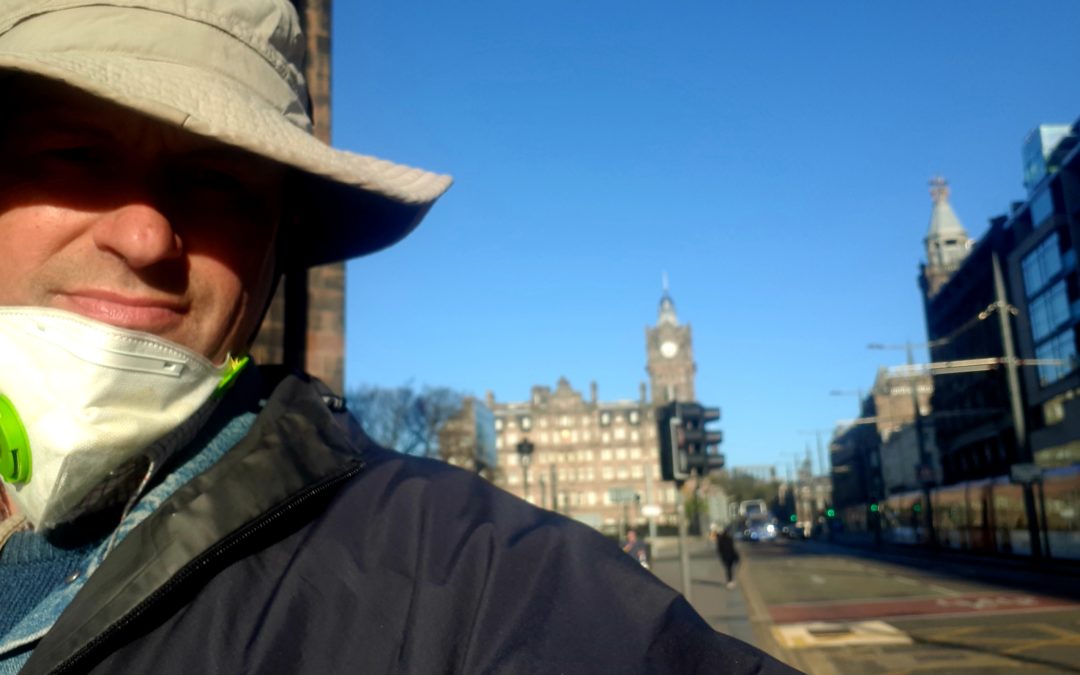
I get off the train at St Pancras and see one or two other passengers emerge from what I thought was “my” train. They all wear masks, as do I, and hurry off. Nobody seems to want to talk or even exchange a glance. Someone checks my ticket at the exit barrier and, as I head along the grand concourse of shops, a policeman approaches me; we’re both heading towards each other like in a cowboy movie. I look ahead, going over my cover story in my head (“I’m going home!”), and he walks straight past without even glancing my way. The policeman looks like he’s about 16 years old (apparently, when you think the policemen look young it means that you are getting old).
The main road outside St Pancras and Kings Cross isn’t as empty as I had expected. A few buses, trucks and Lycra-clad men on bikes. Some sign of life.
There’s a bored-looking a guard on the entry to Kings Cross Station but he doesn’t ask me anything as I saunter in with as much “purpose” as I can muster up. There are about 20 people in the whole station, a mixture of “key workers” (whatever they are) and worried-looking passengers. None of us passengers speak to each other. The only person who’s friendly is an Italian station official who tells me the 13:00 to Edinburgh is leaving at 13:30, and not to worry about my reservation as “there will only be about five people on the train.”
The fluorescent clad “key workers” have a gruff banter between themselves. Truncated comments, jokes and gestures are communicated across the station in short bursts. I tried to follow what they were saying but couldn’t. They were communicating in a way that was bypassing us ordinary folk; easy enough when you consider that most of us are consumed by worry.
I find the experience of being in this empty station quite stimulating, almost exciting, but I can’t understand why. I gradually realise that it reminds me of travelling in foreign locations where everything is different – and therefore of great interest. It’s similar to the feeling I get when reading a dystopian novel, when all the things we know about our society have been swept away and a new system has been created.
I remember visiting the Bosnian city of Tuzla during the 1992-95 war; the streets were empty and everyone was hunkered down at home, or in trenches on the front lines. It also reminded me of Tibet in 1986 when there were so few vehicles that people would stand in the middle of the main street and have lengthy conversations. I’m feeling some of that sense of wonder I get when travelling in a place where the normal, western system of life doesn’t apply.
But there’s something else. How can I describe this modern station with scores of empty shops and all the high-tech lighting still functioning? It’s far too well-designed and clean to be in a poor country, or in a post-apocalyptic world, which is what it initially felt like.
Then it struck me; it’s like a huge art gallery which has a few bored officials making sure you don’t do anything untoward, and a handful of visitors who are staring with deep concentration at … the departures board.
The Italian was right; the Edinburgh train only has about five people on it. We all have our own carriage, and I sprawl out over a big table: laptop, papers, book, phone, charging cables, water, lunch. It was a brand-new trains made by Hitachi, the Japanese company that makes electronics. It has the look and feel of a brand new car, a high-end type. I’m in the lap of luxury. The only thing missing is the drinks-and-snacks trolley but I can live without that and am grateful for not wasting money on bad coffee and junk food.
I read my friend’s manuscript about Dracula (“the real story, ” he claims), eat yesterday’s lentil stew, have a nap and, four hours later, arrive in the capital of Scotland which is eerily empty. The only thing moving in the 1-mile sprawl of Princes Street are a few buses – and they’re all empty.
Why am I travelling?
Over the last week I’ve taken a bit of flak from my Facebook friends after asking what’s the best way to get to Edinburgh: train or bike (as in bicycle touring, with trailer and camping gear).
Many of those who responded didn’t answer the question but said “don’t go!”, asking why I plan to break the rules of the lockdown. Some suggested that I just want to go on a jolly. But I did respect their view and didn’t do what I really wanted to do – cycle up the east coast of England and camp on empty beaches every night. That would have been a jolly masking a valid reason to travel.
But I can’t blame them for giving me a hard time as I should have explained why I came to Edinburgh.
It’s quite simple; due to the virus, the flat I own in Edinburgh is now empty and I’m going to live in it for a while as I can’t afford to pay rent in Brighton and have an empty flat in Edinburgh (which is a main source of income for me).
The other reason is to live on my own, in other words self-isolate better. In Brighton I was renting a flat from my aunt and she’s in her seventies; every time I go to the shops I touch all sorts of surfaces and could bring the virus back.
As soon as the situation changes, and I get new people into my flat, I’m going to hit the road with my touring bike and trailer and do that east-coast route; it will hopefully be mid-summer by then and maybe the beaches will still be empty and there will be nobody to complain about a rogue cyclist putting up a tent where he’s not supposed to.
#
Postscript; when looking up the population of the world I came across this compelling website, which shows the minute-by-minute growth of the global population. At the time of writing, a total of 17,688,444 people have died in the world thus far. Two minutes later I checked the figure again and it is now at 17,688,580. If my back-of-the-newspaper maths is correct, 146 people just died.
I find that constantly moving statistic fascinating, but also rather macabre, and wonder if it helps put the corona virus pandemic into some kind of perspective. I think not.
#
If you haven’t yet got a copy of my new travel book you can get it here: Himalayan Bus Plunge — & Other Stories from Nepal
#
Let me know what you think about all this in the comments section below. You can also use this space to share your own corona virus story. How have you been handling it? How are you feeling? What do you think will happen next?
by Rupert Wolfe Murray | 6 Apr, 2020 | Journeys
At first I was like Trump – in denial – but when it became clear, except to the most diehard conspiracy theorists, that this wasn’t just another seasonal flu I realised that self-isolation and lockdown were essential.
“Easy,” I thought, “I’ve been here before. I’ve lived in post-revolution Romania and post-war Bosnia. I can keep calm in a crisis and I’ve experienced nationwide food shortages. Surely the NHS will value this experience when assembling teams to deal with the crisis.”
Then came the call for NHS volunteers and, along with about 700,000 others, I applied. But they only requested minimal information (name, address, driving licence number) and I wasn’t surprised that there was no reply. If they’d had a more detailed form they could have worked out our skills, experience and availability and assigned us to nearby hospitals, but now they have over half a million application forms and it will take them until Doomsday to go through them all. I also applied to a private sector ad, for “NHS IT Volunteers”, as well as a local charity, – but no response from either of them.
All this has made me face up to reality which is that my aid agency days are over, and they were so long ago (1990 to ’95) that any recruiter would think I’m deranged to think I could apply for something similar in this day and age.
In preparation for my heroic career as a “front line” NHS volunteer I set up camp in my aunt’s little garden in Brighton (I rent her attic-flat). The idea was that I’d return from a 12 hour shift in the Accident and Emergency department, or driving ambulances at high speed through an empty city, and live in the garden in order to not bring the virus into the house. I dug a compost toilet, eat all my meals outside, sleep in a tipi tent and avoid going inside the house.
But my call from the NHS never came and I’ve moved on.
I think everyone has time to reflect these days and one of the things I’ve realised is that my rush to become an NHS volunteer is only partly a desire to help people; it’s also an urge to escape the boredom of isolation. It’s much more exciting to become part of a team in a crisis than being stuck in a garden for weeks on end.
It was also an attempt to escape my real purpose in life, which I recently told myself was to write books. The truth is that this time of lockdown and isolation is an ideal moment to finish all the books I’ve written but not yet published. All I have to do is focus on writing, editing and publishing every day, work out the intricacies of self-publishing on Amazon (they’re surprisingly simple if you have patience) and avoid distractions.
But when faced with a new creation, a new book, all sorts of fears come to the fore – will it be a failure? – and it’s so much easier to give in to procrastination, rush off to an emergency where the action and excitement will suck me in and enable me to postpone doing what I really should be doing.
So here I am, in my aunt’s pottery studio, writing this article and about to self-publish the paperback edition of my new travel book on Nepal. Next up is a book on Romania and soon after that I’ll dust down and finish off a book about the evils of international adoption.
My intention is to get all the books I’ve written but not published out there, in the public domain, so that I can forget all about them and move on. I’ve got so many ideas for new books, and can write them quickly, but the problem is I get bogged down in the Dreaded Swamp of Procrastination – where thousands of great books have met their doom. I don’t have Writer’s Block, I have what could be called Publisher’s Block – I find the production and especially the promotional side really depressing and tend to avoid it, resulting in finished manuscripts sitting around for years.
During this current crisis, and thanks to the NHS for not dragging me into their chaos, I’ve been able to find the time – and the determination – to overcome this block. Every day this week I’ve been working on Amazon’s Kindle service where all the tools to self-publish and promote a book are available for free. All it takes is a bit of patience and, most importantly, the will to banish the demon of procrastination back to his pit.
A key factor in enabling me to write was the realisation that my books don’t need to succeed – this simple truth hit me with the power of a revelation. It really doesn’t matter if nobody buys them, if they disappear without trace on Amazon’s vast sprawl. That’s not the point. My aim is just to share a story and then move onto the next one. Feedback is important but I mustn’t let a lack of it hold me back. I imagine comedians and musicians playing to empty halls and carrying on anyway despite the vote of no confidence. They must go on to the next gig or they wouldn’t be artists.
The real key to writing is very simple: self-discipline. What this means in practice is sitting down and writing for up to four hours a day. It’s really hard to actually do this as there are distractions everywhere and the evil twins of procrastination and complacency can often seem so very attractive; but once you get going it become self-perpetuating; a daily routing gets easier the longer you do it.
Every book I’ve seen about How to Write mentions this four hour a day rule and I’ve known about it for about 30 years. But I’ve allowed myself to get distracted by emergency situations, difficult jobs, complacency and, in recent years, the galaxy of online entertainment that is waiting in my pocket. My whole life nearly went by without having written a word, without having left any stories behind.
Two things have changed all that and enabled me to write, publish, rinse and repeat. First of all this coronavirus pandemic has kept me in the same place for long enough to stop making excuses and face up to my life’s purpose.
The second thing that has kicked me into gear is a rather dubious deal I’ve made with a writer friend, who also struggles with the evil twins and is sitting on a pile of great, unpublished, gems. I told him “If I don’t write four hours a day I will pay you £40. If I write one hour a day I’ll pay you £30; in other words I’ll pay you £10 an hour for every hour I don’t write.”
The final thing that has turned me from couch-potato into productive writer-cum-self-publisher is turning off the phone, which I do every evening and it only get turned on after I’ve done my 4 hours a day (usually about lunchtime). Considering how many distractions are in a modern phone, and how easily it sucks you in during a moment of weakness, this really helps me focus. And when it comes to turning the thing back on again I assume there will be a ton of missed calls and unanswered messages but no – during this lockdown, at least in my experience, people are communicating less.
My writer friend probably thinks I’m insane but it’s actually working like a dream. The last thing I want to do is give him any money at all, let alone £40 a day – in this time of economic shutdown it would be madness – and it’s motivating me more effectively than anything I’ve tried in the last 30 years. This is the third day I’ve been doing it and I’m approaching my third hour today; and my last hour will end neatly at 1.20PM which is exactly lunchtime.
If you’ve read this far I’d really appreciate it if you would buy my new travel book on Amazon: Himalayan Bus Plunge, and other stories from Nepal.
Every time someone buys a copy it’s like a vote of confidence, another member of the audience for that struggling musician, and a review is like when a particularly keen fan comes up to the performer afterwards and tells him how much he enjoyed it. Even bad reviews are good because it shows that people are engaging, and that’s all we can expect.
I did say I don’t really care if people buy the book and that’s true – but an equally valid truth is that it would be wonderful if people did.
N.B. The image used with this article was the first cover proposal by the Maria Tanasescu. The trouble with working with great designers like Maria is that one has to choose from a series of great designs and it’s difficult and painful. Looking at this image now I’m thinking “this is better than the one I chose…”
by Rupert Wolfe Murray | 20 Mar, 2020 | Reviews
Here’s the press release for my new travel book:
Escape the virus (at least for a few hours) with Rupert Wolfe Murray’s new travel book: Himalayan Bus Plunge — And other stories from Nepal.
In his introduction to Wolfe Murray’s first travel book, Alexander McCall Smith wrote: “We are there with Mr Wolfe Murray, experiencing his discomfort and anxiety, but sharing, too, his insights.”
Read about the author’s fear of going off a cliff on a rickety Nepalese bus, his horror of going home (“Culture Shock!”), and meet a unusual cast of characters: a gardener who translates for aid agencies; a brain surgeon who drives like a demon; and the Tibetan doctor who diagnosed the author’s fever as “fire in the belly”.
“My original aim was to offer travellers to Nepal a complement to the Lonely Planet type guidebooks,” said Rupert Wolfe Murray, who is currently based in Brighton. “Then along came Coronavirus and I was told now is a terrible time to publish a travel book as nobody is making any travel plans. I’m sure that’s true but I also think this is a good time to publish as people are stuck at home looking for something new to read.”
Pre-publication feedback:
“Stories that are funny and always compelling. Rupert Wolfe Murray is a throwback to an earlier bolder time, like finding Hemingway alive and well on Oxford Street.” Chris Stephen, journalist and war reporter
“Your written prose is strong and well crafted. You have a very interesting personal history in the Himalayas and a deeply involved, embedded brother there. This adds rare insight.
“You connect to people but keep an almost third person perspective: unemotional observation of those with whom you interact. I came away with a deeper understanding of the region.”
Peter Mair, Retired Federal Prosecutor (USA)
#
If you’d like to get copy of this new book on Nepal just click here.

