by Rupert Wolfe Murray | 13 Oct, 2019 | Journeys
1963. Leeds
I was born in a house with wooden floors and an open-plan kitchen. It was located in a rural area by Leeds called Little London. I have flickering memories of a white coat with bloodstains, people standing around and a little sink.
1968. Scottish Highlands
A big unheated house in the middle of nowhere. I found endless entertainment in the rhododendrons, the trees and the burn – until I was dragged, kicking and screaming, to a faraway school.
1977. Scottish Lowlands
Another big house in the middle of nowhere. By now I’d learned to survive in the hostile environment of school and recover in the flowing hills around our home. I’d also learned to smoke.
1984. The Golden Triangle. Thailand
Trekking through the jungle with my mother. We stayed in a hut made of split bamboos in a traditional village. Below the single room stood the buffalos. An old man laid us on the floor and passed the opium pipe. I had an insight: the traditional, village way of life is ideal.
1987. Tibet
One month on horseback, illegally riding through Eastern Tibet. Every evening we’d find a village and beg for hay for the horses and a shelter for ourselves. It worked. Village people and nomads are generous in spirit and will help a traveller in need.
1992. Romania
A village in northeast Romania called “Top of the fields.” We live with a village family and renovate the orphanage (a big house on the hill). The family have a hectare or two where they grow all the food they need. They also have a pig, a cow, dogs and chickens — and grandchildren. They have it all. I come with plastic bottles and they turn them into pots and funnels. I come with newspapers, cans and other waste and it’s all used. There’s no such thing as rubbish.
2017. Scottish Lowlands
My mother is dying and I come home in a vain attempt to help. I try to work out a way of living in the British countryside but it doesn’t work. Although it’s been emptied of people there’s no room for me. I try to find a balance between doing the garden and working on my PR consultancy projects, but they cancel each other out. You must focus on one or the other. Is British rural life dead? Can it be revived?
2019. Central London
London is in revolt. The centre is blocked by tens of thousands of protesters who demand the government tell the truth about our impending extinction. We’re camping here for 10 days as the government promote their token gestures, the press mocks us and people hurry by.
I have the answer – living off the land with the help of modern technology, and making the economy strictly local – and supporting traditional lifestyles all over the world. Nature is ingenious and it’s by far the best manager of the earth. These are the trump cards, and the missing ingredient, in the discussions about how we need to re-organise ourselves and save the environment.
#
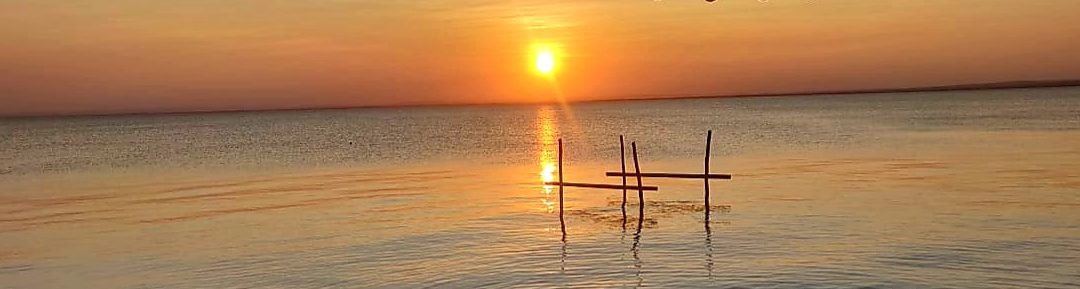
Thanks to my brother Magnus Wolfe Murray for the photo which is from Mozambique. It’s not exactly what I was looking for but it is rural and it does the trick — showing the beauty that can be found in most villages. My brother works on aid projects in Mozambique and you can check out his blog here. He’s quite ashamed that his blog is so out of date, but what’s there is absolutely fascinating — the first article is called “How to rebuild 100,000 houses”, which is typical of the sort of projects he does.
A version of this article was published in The National newspaper in Scotland on 13/10/19.
by Rupert Wolfe Murray | 4 Oct, 2019 | Opinions
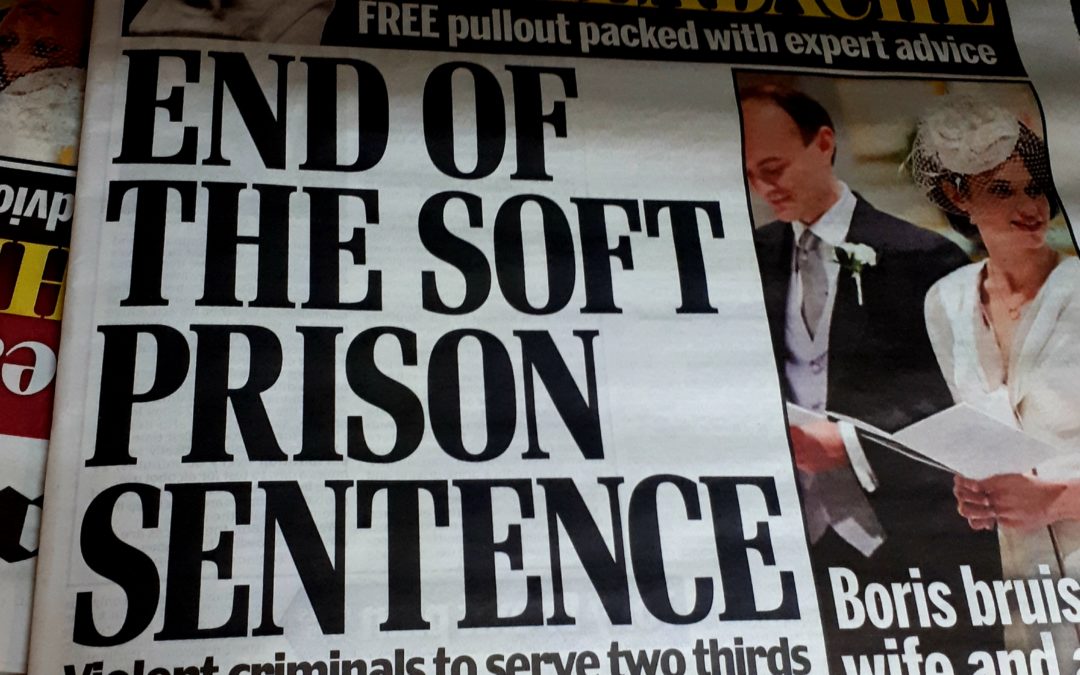
This week, in the English village of Flore, I was quite shocked by the tabloid headlines about increasing prison sentences and realised that Boris Johnson is similar to Slobodan Milosevic: he is a blatant opportunist. Both of these leaders can be explained by this single word: opportunism.
I’m not saying that Boris is planning to carry out any of the atrocities that Milosevic organised, or that he is “responsible for the most violent, destructive and genocidal wars since the Holocaust during World War II” — to quote the Urban Dictionary. He’s a funny chap, would be a great dinner party guest and I really don’t think he has some evil masterplan to exploit us all on behalf of big business. But he’s still an opportunist, as some kids are who will use any opportunity to get what they want. He’s using harsher prison sentences to appeal to the tabloids, and peoples’ base instincts.
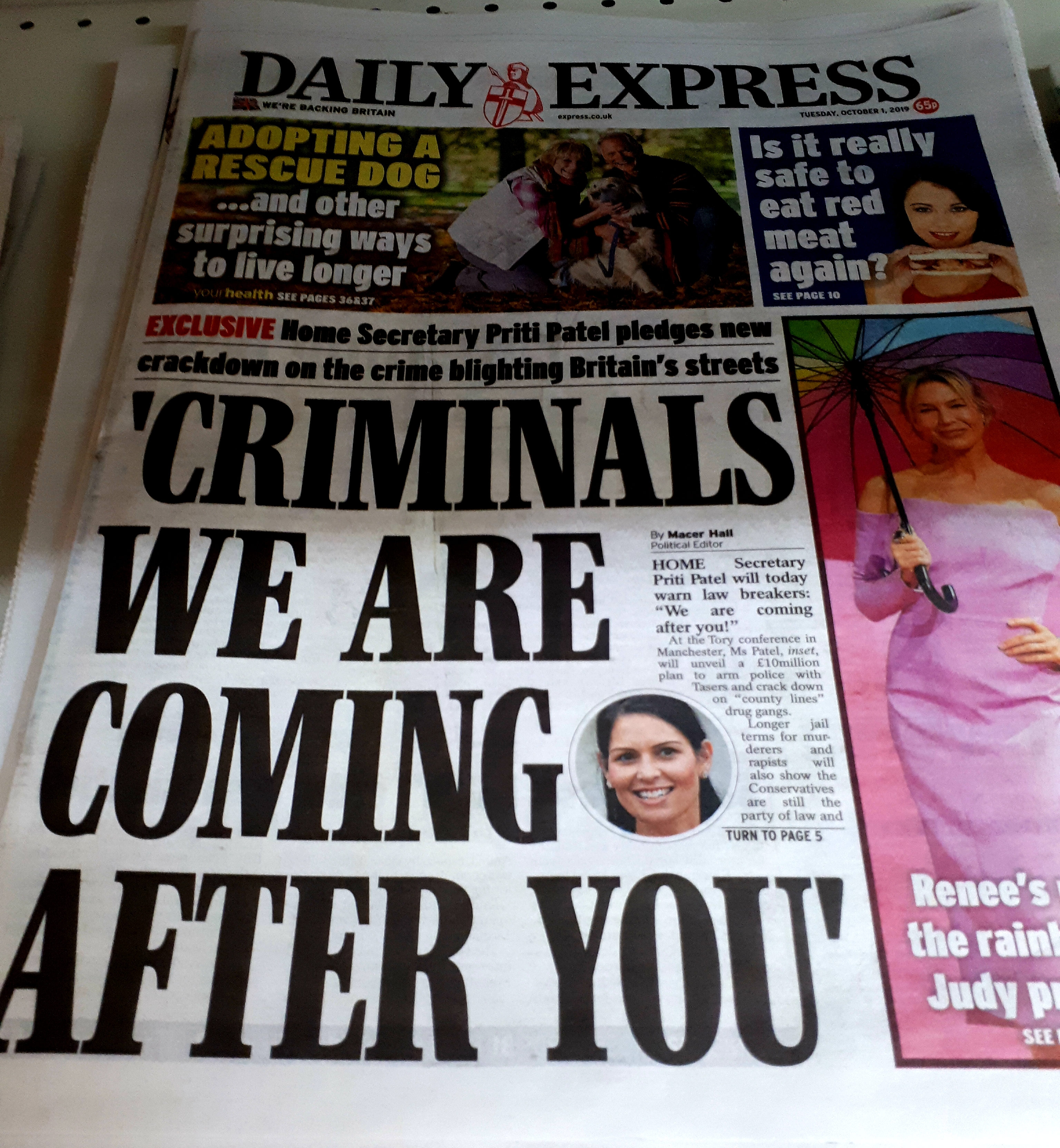
Check out this cover from the Daily Express of the 1st of October 2019:
Milosevic the opportunist
I spent a few years in Bosnia, just after their civil war (1992-95), trying to work out how it all went so wrong and who was to blame. My conclusion was that Milosevic started it but the Croat leader (Tudjman) soon followed suit and carried out a series of atrocities; and even the Bosnian Muslims weren’t as innocent as they’re sometimes portrayed.
The Urban Dictionary’s description of Milosevic is quite funny and generally correct, but they’re wrong to say “Milosevic the son-of-a-bitch wanted all of Yugoslavia for his own rule.” What really happened was that Milosevic wanted to control all parts of the former Yugoslavia that had a Serbian minority — and this idea gave him a greenlight to invade, terrorise and occupy chunks of Bosnia and Croatia and treat Kosovo like a rebellious colony. Once he’d carved out his chunk of those countries (about 51% of Bosnian territory and about 20% of Croatia) he would happily let the other ethnicities run what was left. With American help, the Croatian army were able to expel the Serbs but 51% of Bosnia is still controlled by an ethnically pure Serb entity.
The opportunist part of all this is quite clear: Milosevic became president of Serbia in 1989, just as the whole Yugoslav construct was falling apart. He initially tried using Communism as a method of rule but found that it wasn’t working. He would have considered a western democratic method but, presumably, assumed it would have been too difficult to get the masses on board — so he turned to nationalism.
Nationalism made, and then destroyed, both Milosevic and Yugoslavia. The methodology was simple and, because it was based on fear, was incredibly popular. Serbs were told they were being victimised by the Albanians (in Kosovo), the Croats, the Bosnian Muslims , as well as the Americans and Germans. With such an array of apparent enemies it didn’t take much to cook up a storm of fear and anxiety — leading to Milosevic authorising a series of military actions (seizing chunks of neighbouring countries) as a pre-emptive strike.
Boris as opportunist — this week’s evidence
Ever since Boris changed sides in the Brexit referendum, after he wrote that Brexit could result in the “breakup of the UK”, it’s been clear that he’s an opportunist; in other words he has no real moral compass and just goes with what he thinks will bring him more power.
This weeks announcement from the Tory Party conference that they’ll make sure people stay a lot longer in jail fits this behaviour perfectly: on the one hand the Tories know perfectly well that the prisons are full to bursting and that jail time is a complete waste of time as those who emerge are marginalised and turn to crime in order to earn a living. But they also know that the public have been stirred up by endless tabloid stories of crime and a politician who promises a a harsh crackdown will get votes.
It seems to be working. His opportunism translates easily into optimistic promises of throwing money at health, police and education; and his nonsensical approach on Brexit doesn’t seem to matter as we’re all bored to the back teeth of it and just want it over. I checked the YouGov polling data today and it says Johnson is “the most popular Conservative politician” today, with a rating of 33%.
What’s most interesting about this is that some of the most extreme dictators would curry favour with their populations with spendthrift policies like this. Hitler ordered that the public shouldn’t be deprived of anything during the war, whereas in Britain the whole population had a military-type routine imposed on them.
Equally interesting is that the most famous opportunist of the twentieth century was probably Benito Mussolini who started out as a Marxist and then turned to fascism as he was able to use it more effectively to appeal to people’s most basic instincts.
Why are they so relaxed?
A final point is that all of these nationalist/opportunistic leaders — and I’m thinking about Putin in this category — seem to go about things in such a relaxed style. None of them seem to suffer from the stress that other politicians do (just think of Theresa May compared to Boris). Milosevic never seemed to be rattled and he was expert at dismissing, and ridiculing, the endless accusations of atrocity that came his way. As with Putin, he was always ready with a conspiracy theory regarding who was really to blame.
I remember when the Serbs bombed the market place in Sarajevo, killing hundreds, the official Serb story was that the Muslims did it on their own people in order to curry favour with the west. Putin does the same with the Ukraine — he doesn’t admit that he’s done anything except react to American and EU pressure.
I realise you can’t put Boris in the same pot as regards that level of criminality — he’s on a far milder level than the others — but just look at the way he seems to be enjoying the chaos he’s causing over Brexit. In my opinion these opportunists are able to treat the whole thing as a game, which is in fact invigourating rather than stressful. I think their lack of basic morality allows this.
What can be done? All we can do is be aware of the problem, and remember the old adage “knowledge is power”. I’m sure the answer will present itself before long and the pendulum will swing back to a more moral-based politics.
The End.
I wrote this story as I’d been researching prison reform. You might like to see this article I wrote about an incredibly successful experiment in prison reform — so successful that the Scottish government closed it down.
As always, I’d be very grateful for any comments under here.

by Rupert Wolfe Murray | 28 Sep, 2019 | Opinions, Reviews
If a great artist met a convicted murderer I wouldn’t expect much to come of it. In most cases, I assume, nothing more than an ordinary conversation would happen for the simple reason that the prisoner wouldn’t be open to the artist. The prisoner might view the artist with suspicion.
The prisoner might be friendly, he might be grateful for the attention being paid to him, but he wouldn’t risk lowering the barriers that are so essential for his survival on the “inside”.
But when Jimmy Boyle – once known by the Scottish tabloids as “Scotland’s most dangerous criminal” – met Joseph Beuys who, according to The Tate Gallery is “widely regarded as one of the most influential artists of the second half of the 20th century,” the results were remarkable.
The meeting was part of Boyle’s transformation into a celebrated artist, but it’s a complicated story to tell as there are, as far as I’m aware, no written records of the meeting. Also, there’s virtually no written records of the most successful experiment in prison reform I’ve ever heard about – the Barlinne Special Unit, where Scotland’s “most dangerous” criminals were on equal terms with the prison officers and their “therapeutic community” was a runaway success. Luckily, the artworks, press clippings and writings that emerged from the Special Unit are held in various private collections around the country.
Tragically, the reactionary officials in charge of Scotland at the time were embarrassed by the success of the Special Unit and they did nothing to stand up to the daily assaults by the tabloids, who screamed of sex and drugs and luxury for the most violent prisoners in the land. In 1994, 20 years after the unit had opened, it was quietly closed down. Not even the most basic written evaluation was done.
I just checked the website of Scottish Prison Service and the only reference I could find for the Special Unit were the following words in their list of historical events at Barlinne Prison: “1972 Special Unit in Female block (until 1994).” Is that really it? Looking at their website I realise that the only thing that has changed over the last half century is the language they use to present themselves; now the prison service talks about “individuals in our care” and their main slogan is “Unlocking potential. Transforming lives.” As my kids would say with a roll of their eyes, “Really?”
Scotland’s puritan leaders may have thought they succeeded in burying this success story, but it got out. The success of the Special Unit’s therapeutic community model reached less closed-minded governments in Scandinavia and the Netherlands where, according to my sources, similar units were set up. Also, the prison in Hull set up a large art class that was inspired by the Special Unit. Bill Beech, one of the artists who has kept this flame alive, organised the current exhibition of Special Unit artworks in Hull. Apparently, there is also a prisoner at Hull who dresses and acts like Joseph Beuys (presumably he also does experimental art works).
Back to the Boyle and Beuys story…
Before getting to the meeting between Boyle and Beuys I need to describe more background (as I said, it’s a complicated story, but it’s a great one so stay with me).
Both of these men have the most incredible backstories; Jimmy Boyle’s can be read in his two autobiographies – A Sense of Freedom and The Pain of Confinement. What I find most remarkable about these books is his ability to be so open and descriptive about the poverty he grew up in; I had assumed that they were ghost-written as they’re written with such confidence but I asked his former wife, Sara Trevelyan, and she said “No. Jimmy definitely wrote them on his own”.
Joseph Beuys’ backstory reminds me of a Greek myth: a man falls from the sky in a ball of flame; he survives the fall and is buried in snow; later he’s discovered by nomads who wrap him in grease and felt, carry him off, nurse him back to health; he goes on to great things.
The Wikipedia version of the story makes it clear that this story is probably just fantasy, but the known facts are equally incredible: Beuys joined the Luftwaffe (Hitler’s air force); he was stationed in Crimea during the German occupation of the USSR; he was a rear gunner on one of the most terrifying weapons of the Second World War – the Stuka dive bomber. It’s also interesting that the supposedly heartless German’s sent out a search party to find him and the pilot who, according to Beuys’ version, was “atomised” when their plane crashed.
Beuys’s later wrote: “Had it not been for the Tartars I would not be alive today. They were the nomads of the Crimea, in what was then no man’s land between the Russian and German fronts, and favoured neither side…Their nomadic ways attracted me of course, although by that time their movements had been restricted. Yet, it was they who discovered me in the snow after the crash, when the German search parties had given up….I remember voices saying ‘Voda’ (Water), then the felt of their tents, and the dense pungent smell of cheese, fat and milk. They covered my body in fat to help it regenerate warmth, and wrapped it in felt as an insulator to keep warmth in.”
In terms of art, the above story is referred to as Beuys’ inspiration for using a lot of felt and other natural materials, like stone, in his work. The clothes he wore were also influenced by this experience – his trademark clothing was a felt suit, a stick and a felt hat.
In terms of the Jimmy Boyle connection, I see this story as the experience that connected them. What I mean is that Beuys was a form of prisoner in the Second World War, an unwitting participant in a brutal system that had much in common with the guiding philosophy of modern prisons: to remove peoples’ liberty and enforce a rigid daily routine that instils fear and destroys individuality.
I’m not saying that the Scottish Prison Service can be compared to the Nazis in terms of human rights abuses, but you can compare the underlying philosophy which is that denying people liberty and applying a strict military routine is morally justifiable.
My assumption is that these shared experiences – of deprivation, horror, death, redemption – brought the two men together in a deeply profound way that would not have been possible between people who didn’t share those type of traumatic experiences.
Enter the coyote
Joseph Beuys went on to become one of the most influential artists of his age. Beuys’ saw himself as a teacher, or shaman, who could guide society in a new direction.
He was thrown out of the Düsseldorf Art School, where he taught sculpture, for getting rid of the entry requirements and advocating a policy of letting anyone interested into his classes – a direct challenge to the art world’s ethos that art is only for an intellectual elite. His most relevant work in this regard was a performance art “Action” called How to explain pictures to a dead hare, when he explained art for three hours to a dead hare. The idea was to show “the difficulty of explaining things” to people who aren’t educated in the language and history of art – in other words the general public. This was part of his overall belief that “everyone is an artist”.
In the early seventies Beuys was invited to put on an exhibition in the USA. He refused because he was an opponent of the Vietnam War and would not set foot in the country that was perpetuating such horrors on a less technologically advanced people. But the Renne Block Gallery, in New York City, persisted and they came to a compromise out of which a quite remarkable exhibition resulted.
The exhibition was called I like America and America likes me and it had a powerful influence on the American artworld of the seventies, particularly performance art. The idea was that Beuys would not set foot on American soil and so when he arrived at the airport (in May 1974) he was met by an ambulance, wrapped in felt, laid on a stretcher, driven into NYC and carried up to the gallery.
Inside the Renne Block gallery prison-style bars had been built around one of the rooms, creating a sort of cage. Inside that room was some straw and a coyote. Beuys moved in with the coyote and lived with it for three days, wrapping himself in felt and getting a daily delivery of newspapers for the animal to defecate on and chew up. Visitors would come and look at them.
Two powerful slogans emerged from this exhibition: I am the Coyote and The Most Reviled Creature in America. The idea was that Beuys had found common cause with the coyote as being the “most reviled” creatures in America.
Here you can see a photo of Beuys wrapped in felt and the coyote looking on:
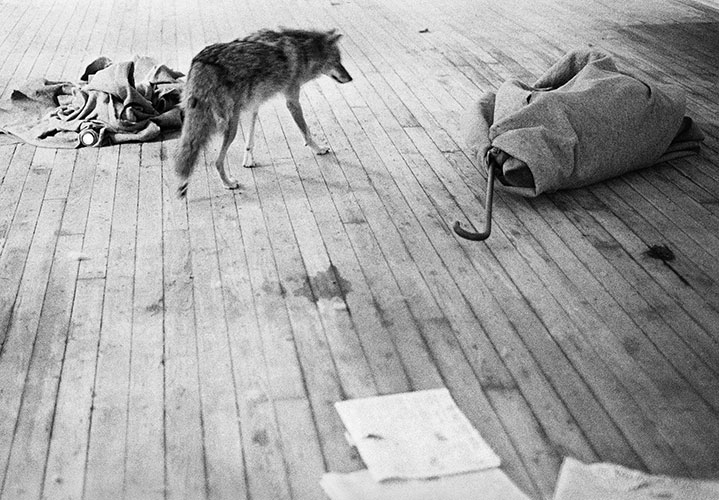
Photo by Caroline Tisdall
This is where my limited knowledge of all this runs out; I wish I knew more the fascinating ideas behind this exhibition but, as with the Special Unit artworks, there’s very little online about it and the people who know are either dead (Beuys died in 1986) or unobtainable (Jimmy Boyle lives between France, Morocco and Thailand and doesn’t answer emails).
But I searched the terms “coyote symbolism” and came across some extraordinary material. According to the Spirit Animal website: “The coyote totem is strikingly paradoxical and is hard to categorize. It’s a teacher of hidden wisdom with a sense of humor, so the messages of the coyote spirit animal may paradoxically appear in the form of a joke or trickery. Don’t be tricked by the foolish appearances. The spirit of the coyote may remind you to not take things too seriously and bring more balance between wisdom and playfulness.”
Did Beuys know about the symbolism of the coyote? It goes a long way to explain his approach which, on the one hand is very down to earth and simple, open to all; but on the other hand he was a very divisive figure who was rejected by much of the art establishment of Germany. Even to this day he is divisive; in 2019 Richard Demarco put on a retrospective of his work at the Edinburgh Festival and to this day people ask: “is this art?”
Jimmy Boyle opens the floodgates
Meanwhile, back in Scotland, a dam had burst – that is how Jimmy Boyle describes his outpouring of creativity when he got into sculpture and writing. In Barlinne Prison’s Special Unit he was able to divert his tremendous energy from fighting the system to creating artworks. But it almost never happened.
One of the best-known stories from the Special Unit was when Boyle arrived the head warder, an enlightened prison officer called Ken Murray, gave him a pair of scissors to open a parcel. To give “Scotland’s most dangerous criminal” a pair of scissors – a potentially lethal weapon – was an act of faith that showed Jimmy Boyle he was being trusted for the first time in years. It worked, and Boyle became one of the leading lights in the therapeutic community where prisoners and staff would together organise their schedule, menu and visiting hours.
Boyle rapidly integrated into the small community of ten prisoners, all of whom had been classified as “most dangerous” but he was nowhere near ready to do art. He later recalled that he saw art as almost something alien, a million miles from the macho culture he’d grown up in.
Scotland’s first art therapist – Joyce Laing – started visiting the unit and tried to get the inmates interested in practicing art. But it wasn’t working: the prisoners would sit round watching but they weren’t engaging. Joyce had decided to give it one last try and then she was going to give up, but before leaving she left a lump of clay and said, “maybe one of you can do something with this.”
When she came back for her last art class, Joyce was delighted to find that Boyle had created a sculpture out of the clay – a stick figure sitting down, surrounded by spear-like bars of a cage. I’m not sure exactly what happened next but the artworks came pouring out; not only sculptures, but also an avalanche of writing – not just the book that made him famous (A Sense of Freedom), but a series of stream-of-consciousness writings on all sorts of materials (paper was in short supply) written in a handwriting that was so small it’s barely possible to read. I’ve seen some of this material in one of the private archives and I’m pretty sure none of it has been published.
Enter Richard Demarco
Meanwhile, over in Edinburgh, Richard Demarco had been organising his own creative flood: he was to the Scottish arts establishment what Beuys was to the Germans – an annoying impresario who didn’t play by the rules, didn’t respect the arts establishment and kept coming up with new ideas, introducing new artists from all over the world and generally shaking things up. If you look at this link, Demarco’s CV-cum-biography, you’ll see the incredible amount of action he created on the Scottish arts scene over the last 50 years. 1974 was a particularly productive year.
Demarco picked up on the creative energy that was coming out of the Special Unit – the first time a prison had allowed such an outpouring of artistic expression – and was allowed to visit the unit with groups of artists. I presume this was also unprecedented and was, no doubt, one of the factors that the Scottish prison authorities disapproved of and used as an argument to shut it down in 1994.
In August 1974 Richard Demarco organised an exhibition in Edinburgh that was part of his sprawling Edinburgh Arts events. The exhibition included some sculptures by Jimmy Boyle who was still, at the time, very much in prison for murder.
Here you can see a photo of Boyle, Demarco and the art therapist Joyce Laing (note the bronze copy of Boyle’s first sculpture on the upper left):
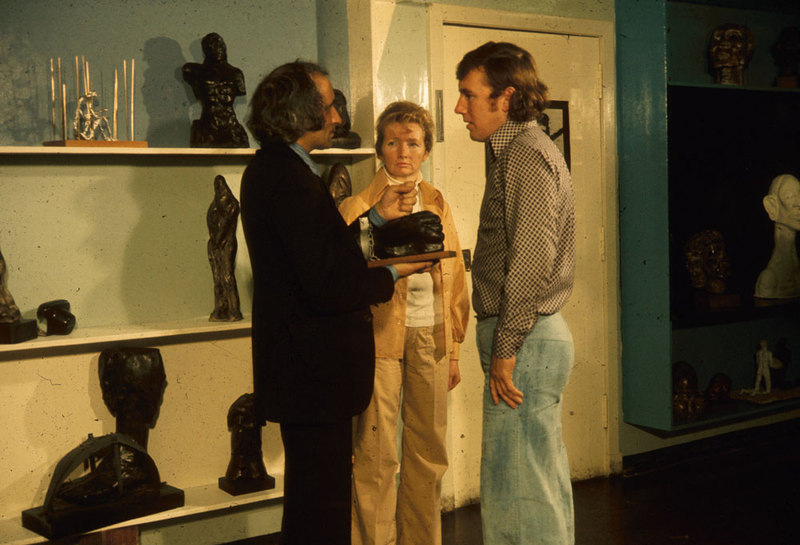
Thanks to the Richard Demarco Gallery for the photo.
The fact that Jimmy Boyle was allowed out of prison to attend this event was, presumably, unprecedented in Scottish prison history – and the forces of reaction at the prison service and Scottish government must have been furious.
The other extraordinary thing that happened at that exhibition was that Jimmy Boyle met Joseph Beuys, who had recently come over from New York after his coyote exhibition.
Boyle had presumably been told about the coyote exhibition by a mutual friend – Caroline Tisdall, an art critic for the Guardian and the photographer at the coyote exhibition. She was also a regular visitor to Boyle in the unit, and one of his most powerful advocates.
The story I heard from one of the artists who had been there was that Boyle went up to Beuys and said “I am the coyote!” I’m sure that those words, and their respective approaches to art, created a powerful bond that broke through all the conventional hierarchies of the art world.
Joseph Beuys went on to do some important work in Scotland. He also visited the Special Unit and represented Jimmy Boyle at a press conference that presented Boyle’s exhibition In Defence of the Innocent, at the Richard Demarco Gallery in 1976.
The most extraordinary thing that Beuys did for Boyle was go on hunger strike in 1980 – in protest at the prison services inexplicable transfer of Jimmy Boyle from the Special Unit to a “normal” prison at Saughton, Edinburgh.
The Scottish Prison Service, still feeling the humiliation that the Special Unit had brought down on them by showing signs of free expression, that they were determined to crack down. They didn’t yet have the political courage to close the unit down – that would happen about 14 years later – but by removing Jimmy Boyle and the enlightened head warder, Ken Murray, they were able to emasculate it. Their public intention was to “test” Boyle and make him “prove” that he could behave properly in a jail with the usual harsh military routines. Boyle survived this episode, but he was no longer allowed to practice his art and have free access to visitors. It must have been devastating and was, I’m sure, one of the factors that resulted in Boyle leaving Scotland soon after he was set free.
Two things bring all these historical events up to date: firstly, almost nothing has happened in terms of prison reform in UK, apart from a PR makeover, and surely the Special Unit deserves looking at in a serious way as they have a lot to learn from the experience (I think they should set up a permanent exhibition and archive in Glasgow).
Secondly, in 2019 there was an exhibition at the University of Hull with some of the artworks that were produced around the Special Unit in that incredible year (1974). I had posted a link to the exhibition but it’s been taken down.
I wrote this article as a supplement to a short piece I published in The Sunday National newspaper, a Scottish newspaper, which is worth looking at as it asks the question, why do we imprison people?
#
Postscript: This article was written from all sorts of fragments I picked up over the last 50 years – starting with my own visit to the Special Unit with my Mother, who published Jimmy Boyle’s books, conversations with Bill Beech who was behind the recent exhibition in Hull and also the scriptwriter for a great film that came out of that period: Silent Scream (1990).
I’d also like to thank Richard Demarco for making these photos available.
I took the above photo outside the exhibition in Hull. It was taken in 1974 and on the left you can see Richard Demarco, the impresario who introduced this prison experiment to the art world. On the right is the great Joseph Beuys.
Finally, here are some really interesting videos
This is an old documentary (1980s) about Jimmy visiting his home turf in Glasgow and asking if opportunities for young people have improved: Jimmy Boyle larchgrove & castlemilk – YouTube
And here’s a conversation between Jimmy and Ricky Demarco, shot in 2018: 1) Demarco and Boyle in coversation Dec 19 version – YouTube
by Rupert Wolfe Murray | 21 Jun, 2019 | Journeys
My friend Dave Barnicle runs a bar in Liverpool. But he’s not your typical bar manager who hires and fires and shouts and chucks people out. In fact, Dave’s bar doesn’t even serve alcohol as it’s one of very few “dry bars” where addicts in recovery can hang out without feeling under pressure to drink. The place is called The Brink and, if you’re ever in Liverpool, I suggest you get some lunch there (the fish n’ chips are epic).
Dave is one of those people who’s searching for the meaning of life. Not satisfied with the Hitch Hiker’s Guide to the Galaxy answer to this question (42) he reads all sorts of impressive books, teaches Qi Gong, runs events and is what I would call a Creative Project Manager.
He recently set up a podcast where he talks to people he thinks are inspiring. I found his first podcast really gripping, even though the subject might seem a bit esoteric. It’s a 90 minute talk with Phil Shepherd about how the brain isn’t the only part of the body with intelligence. It’s one of those life-changing resources that I’ll save and listen to again at future moments.
When Dave asked me if I wanted to be interviewed for his podcast I thought: “Great…Okay…Fame at last…Hang on a minute! Me? Why would he want to interview me?”
Dave answered this question by saying: “I’ll be asking about the journey through Tibet, about your time in Romania, about your time with the military and the subsequent book, your semi-nomadic lifestyle, the trials and tribulations of being an author and trying to get published and self publish.”
Then I thought about something which has been bugging me for over a year: Why haven’t I written any blog articles about what I’ve been up to? I spent much of the last year on houseboats, but not a word has been written about it. Who not?
Now I’m in Liverpool (about to do the podcast) and I’ve just been in Scotland and Romania — shouldn’t I write about that? Shouldn’t I tell people what I’m up to? Apart from anything else, it might help Dave an outline formulate some questions for our podcast.
I’d like to start using this blog as a place to record all the weird and wonderful things I do. I have an interesting life, I’m on the road constantly, working all over the place, and I’d like to share the best moments.
So, without further ado, let’s get on with it…
What have I been up to?
- About three years ago I moved from Bucharest to Liverpool and set up a PR business. But it didn’t work so I closed it down, learned from my mistakes and …
- Went to Scotland where I published my Tibet memoir and promoted it by cycling round the Highlands, selling copies (I had a bike trailer to carry them) and giving talks. I started writing another book on that trip and have been writing ever since (you might like my fairy tale).
- I then went to live with my parents in the Borders Region of Scotland. My mother had cancer and died about two years ago. That was a big blow as she was really the big love of my life — she inspired me and supported me and I still can’t accept that she’s gone. I did a wee book about her and this slideshow of photos celebrating her life.
- At the start of last year (2018) I thought I should get a proper job and ended up working for an insurance company as a copywriter. Needless to say it didn’t last and they spat me out as a misfit; as everyone had said it’s too late for me to change from being a freelancer to a company man. But I learned some interesting things (these companies are sitting on billions of pounds of unclaimed pensions). Also, it brought me down to Reading where I…
- Lived on a houseboat. I spent 6 months moored up in a huge barge (called Marge) in the centre of Reading, writing books and doing freelance PR for Castle Craig Rehab Clinic. Then I was asked to look after a small houseboat which was mobile and I moved down the Kennet and Avon Canal, spent the winter freezing near Devizes, and seeing a lot of my ex and my kids, who are located nearby, and ended up at Bath. I loved living on houseboats and recommend anyone who’s interested to hire one for a weekend. England has restored 3000 miles of its canal network, which used to be 5000 miles long, and there are 80,000 houseboats with people living on them.
- This brings us more or less to the present where three words summarise my recent life: Scotland, Wiltshire and Romania. Let me explain…
- My current job is in Romania where I consult for the EU on energy efficiency; we’re selling the family home in Scotland and I go up there as much as I can to help out; and whenever I go between these two locations I try and stop off in Wiltshire where my kids are located.
That’s it…that’s my last three years in 7 bullet points.
What’s next? My long term plan is to cycle round the world but I need to keep my nose to the grindstone as I’ve got to pay off my debts and that sometimes feels like it’s taking forever.
I’d be really grateful if you would leave a comment under this article. I really appreciate any feedback, even if it’s critical or inane…it’s just a reminded that someone’s reading this stuff and it encourages me to write more.
by Rupert Wolfe Murray | 20 May, 2019 | Journeys
I felt so lucky to have been asked to look after Roger and Isabella’s flat and I was determined to take this responsibility seriously. The flat had two rooms, a huge bedroom-cum-living room, with a wide array of windows, and a kitchen. Tibetans tend to decorate with loud, home-made colours and the wooden pillars in the main room were painted red and blue while the roof timbers were yellow. I recognised the floor as it was similar to the one that I had seen Diane working on for a few hours in the Jokhang – mud and gravel that had been thumped down by women wielding small tree trunks. Not only are these floors warmer than concrete but all the feet that gently rub them makes them shiny and beautiful. There were only two stoves and the one in the main room was too small to heat up the space, so I spent most of my time in the kitchen, where Roger had thoughtfully wired up a set of speakers.
Even though I only had three hours of teaching a day I continued to find the work exhausting. I wasn’t sure if this was due to the illness or, as I suspected, because teaching is a very tiring job. It felt more exhausting than carrying heavy furniture up and down staircases in Edinburgh or working on a building site. By lunchtime I would be shattered, but also feeling satisfied. I needed to conserve energy, and it was freezing outside, so I stopped teaching the nurse and cut back on teaching Sir Woo. After a few days I invited Je Yang round and we would spend the evenings talking and listening to Roger’s huge collection of tapes. Then I ran into Diane and Frenchy who told me about the police raid at the Cheese Factory: everyone had been thrown out and the manager was carried off to the police station for under-charging foreigners. The Americans had moved to the Plateau Hotel which they hated because it was modern, concrete, cold and expensive. Diane had fallen out with Frenchy and they argued incessantly except, curiously, when I invited them round to my new flat. Both of them were sick with the illnesses that bedevilled foreigners in Tibet: giardia and bronchitis.
When I saw what a rotten teacher Big Jack was I realised that there had been no point in the job test as they obviously chose their replacement teachers on a whim. Big Jack was always late and he’d never prepare his lessons. I found myself helping him out, filling the gaps and trying to cover up for him. He reciprocated by offering me advice on diet, another of his areas of expertise, and he explained the different qualities that vegetables have and how steaming is better than boiling. This was all news to me. I had no idea that tomatoes are full of acid, peanuts are full of fat and milk creates phlegm in the throat. I didn’t invite him round to the flat, telling him that I wasn’t allowed to have visitors, hoping he wouldn’t see Je Yang, Diane and Frenchy coming round most evenings. We would sit round the yak-dung stove cooking a pot of soup and explain to Je Yang that life in the west isn’t as idyllic as he’d been led to believe. Je Yang didn’t believe the anti-American propaganda he’d been taught; he believed that once you made it to the west money and happiness inevitably followed. I was keen to destroy that image and Diane and Frenchy were the ideal means of doing so. They would talk for hours about racism, corruption, inequality and, most extensively, about AIDS.
Je Yang had a morbid fascination with AIDS and Diane and Frenchy’s doom-laden prophecies set his mind spinning. On the one hand the disease appalled him but on the other he couldn’t help feeling that this was some kind of divine retribution for all the bad things the western world had done. We would furiously debate the AIDS issue every evening, each one of us strongly defending our positions, and the only thing that we all agreed upon was that mashed potatoes taste great.
The sickness I was recovering from must have lowered my immunity – by the end of that week I had both giardia and bronchitis. These illnesses were nothing compared to hepatitis but I had to get rid of my chesty cough and the appalling stomach. Diane described how giardia had made her stomach swell up to the size of a basketball, she would rush to the toilet and then piss and fart down the hole. They would both explain these gruesome details endlessly. Giardia, I was told, is a type of bacteria that forms cysts in your duodenum (the bit just below your stomach) and when these burst they produce sulphuric gases. The Tibetan medical cure was said to be effective, but time consuming, and the modern cure was two grammes of a powerful antibiotic called Tiniba, a drug that Diane swore by.
– But you gotta remember, she said, to take a second dose a week later in case you’ve missed some of those fuckers the first time round. They lay eggs you know and you gotta nuke those fuckers before they can get you again.
I didn’t have the energy to deal with the Tibetan hospital again so when the basketball belly hit I downed a couple of tabs of Tiniba which promptly wiped out the infection. Frenchy then gave me two tabs of Bactrim which, he swore, would get rid of the bronchitis. It worked.
Even among the foreign oddballs and eccentrics who would turn up in Lhasa every week, Big Jack stood out. His thick woollen clothes, big beard and Mujahedeen hat made him the butt of all jokes, at least in my circle. But he was so big and fierce-looking that nobody had the courage to say anything mocking to his face. He had latched on to the cheesecake women and was one of their salesmen. He was good at this because he was pushy and intimidating and people thought they would get thumped if they didn’t cough up. I knew where he hung out so I was able to avoid him but we came into contact at class time.
One morning I went to Roger’s class and was surprised to find some officials from the Tibetan Political Consultative Conference there. These were the people who had set up the class but this was the first time I’d actually seen more than one of them. They nervously informed me that Tibetan TV wanted to come and film us for their news show, was that okay? Until that moment I had no idea that there was a TV station in Tibet and if they wanted to film us that was fine by me. They left and I started teaching. Twenty minutes later another bunch of officials came in, but this lot burst in the door arrogantly, set up their cameras and started filming. I carried on as normal. When they moved next door to film Big Jack we could hear his voice becoming louder and louder; I stopped teaching to go and look and all the students followed. We peered into the next room and there was Big Jack, shouting at the top of his voice as if he was giving the Sermon on the Mount to a gathering of thousands. That evening I went to Sir Woo’s place as he was the only person I knew who had a TV set. He was happy to let me in but there was a power failure, so we missed the chance of seeing Big Jack look ridiculous on TV.
Every Saturday we would teach a song. It was simple, fun and they would learn new expressions and improve their listening skills. Isabella would play the Beatles and Bob Marley, and other favourites from the sixties, but I thought Flower Power might be a bit over their heads so I started using jazz songs. The problem was Big Jack; he never prepared for his classes and without preparation you just can’t use a song for teaching purposes. I offered to help him and he seemed willing, so I prepared a Fats Waller song for him and explained the technique that I had learned during my English teaching course in England:
– Write the lyrics on a piece of paper, identify any difficult words in the lyrics that they might not know – and teach these words before you play the song. Then write the lyrics on the board with some easy words missing, and write an underscore where the words are missing. Then play the song a few times and tell them to fill in the missing words. It’s easy and they usually enjoy it.
When Saturday came round Big Jack was late again. When he did show up, looking hung-over, the class were making a hell of a din and they greeted him with a slightly mocking tone as they had obviously come to realise that he was something of a joke figure. This was the rowdiest class that we had and it contained several tearaway monks, all teenagers, as well as some wild girls. I could hear them joking about his beard and hat and hoped he didn’t understand (his grasp of Tibetan was worse than mine). Gruffly, he began writing the lyrics up on the board in a handwriting style that was illegible, even to me. The song starts like this:
– Dina, Dina, is there anyone finer?
– In the state of Carolina
– If there is, show her to me.
I could hear the class growing more restive and I put my head through the door. He was in the process of explaining the meaning of Dixie eyes blazing and I could see some of the students laughing openly in front of him.
– Everything okay? I asked.
– Yeah, he hissed, with eyes of fury, I can handle the little bastards.
I went back to my class, not knowing what was best to do. I heard a crashing sound, shouting, a murmur of voices and then total silence. I went in and found Big Jack on his own, all the students had walked out. He was red-faced and furious, stomping up and down the room.
– What happened?
– Those little fuckers! Nobody fucks with me! Next time I’ll really beat the shit out of him! You gotta be tough with these guys.
Then he grabbed his stuff and, without another word, threw open the door and marched off in disgust. I went back to my class and carried on teaching the difficult words associated with my song. I later found out that he had grabbed one of the monks, thrown him against the wall and threatened him with his fists. On the following Monday morning the leaders were waiting for him. They told him not to come back.
#
This is an extract from 9 Months in Tibet — the eBook — which will be published soon. If you’d like to reserve a copy just email me at wolfemurray@gmail.com (or post a short comment under this article). To see feedback to the paperback edition, click here.

