by Rupert Wolfe Murray | 9 Dec, 2023 | Opinions
I think the best thing we can do about the nightmare being inflicted onto the people of Gaza is to write to our Member of Parliament. Let them know where you stand. I wrote to mine, Peter Kyle MP, over two weeks ago but he’s not replied. Normally MPs reply quickly but when it comes to Israel, British politicians seem to go into a kind of coma.
I’d be really interested to know what you think about the situation, and/or my letter. You are far more likely to write something interesting than my MP, who is obviously caught in the US-driven policy of blindly support apartheid and would probably only send me a polite but dismissive reply.
Here’s what I wrote:
Dear Mr Kyle,
I was impressed that you didn’t vote against the SNP’s parliamentary motion calling for a ceasefire in Gaza, and I have a related question for you: do you think the Labour Party should call for a ceasefire?
As a new resident in Hove I was looking forward to voting for you in the next General Election, as I had heard you are a good MP, but I won’t do this if Labour doesn’t drop its unconditional support for Israel’s extreme nationalist government. If you were to support Israel’s progressives, the ones who want peace through dialogue with moderate Palestinians, the Labour Party could set an international precedent: a way to support Israeli people without condoning the actions of an extreme government.
Surely you can see that the Israeli government is carrying out collective punishment on Palestinian civilians in the wake of Hamas’s terror attack? The Israeli policy towards the Palestinians is clearly apartheid and even David Cameron, when he was PM, described Gaza as an “open prison”. Israel is proud of its democracy but it applies cruel military law to those living in Gaza and the West Bank.
I’ve been reading about the historical background to the conflict as, I believe, understanding the past helps us to navigate the present. In Simon Sebag Montefiore’s book Jerusalem he describes how this great city was fought over for centuries by Jews, Christians and Muslims. In ancient times the conquering party would often massacre the victims, but not always: sometimes they would show clemency and toleration. Palestine was ruled for over 400 years by the Muslim Ottoman Empire and they were relatively tolerant towards their Jewish and Christian minorities. They certainly didn’t wall them up in ghettos as happens now. It strikes me that the current Israeli government is acting like one of those ancient empires, when punishing whole populations was quite normal. But why do our governments support such barbaric practices?
The other book I’m reading offers a useful background to the situation and I recommend it: The Question of Palestine by Edward Said. This book answers a question I’ve had for a long time: how can progressives/liberals/left wingers in the West be so blindly supportive of Israeli policies that break so many of the human rights they apparently believe in? He also explains that Israeli Zionism is, in fact, a colonial project that enforces a different set of laws on its subject peoples.
In my opinion, the NATO powers were quite right to stand up to Russia in Ukraine, but the diplomatic advantages we gained by this is being thrown away by the double standards we are showing in Israel/Gaza. We all know the US government is under pressure from their Jewish and evangelical lobbies, and our conservative government will blindly follow whatever Washington DC does, but it’s sad to see that this rationale also applies to the Labour Party. Not only is this against what most Labour voters apparently believe, but it makes us look cowardly and craven on the international stage.
A recent article in Al-Jazeera says, “The Labour establishment has always been complicit in the oppression of the Palestinian people, but their moral corruption on Palestine is not representative of the contemporary Labour grassroots.”
I would be grateful if you could let me know what your position on Gaza is, but please don’t trot out the Israeli government talking point about their right to defend themselves. That is the most ridiculous statement I’ve heard, as nobody is saying they don’t have that right. What we’re saying is you don’t need to carpet bomb a whole population if you’re going after a few terrorists.
With kind regards
Rupert Wolfe Murray
by Rupert Wolfe Murray | 28 Feb, 2023 | Journeys, Other People's Stories, Stephanie Wolfe Murray
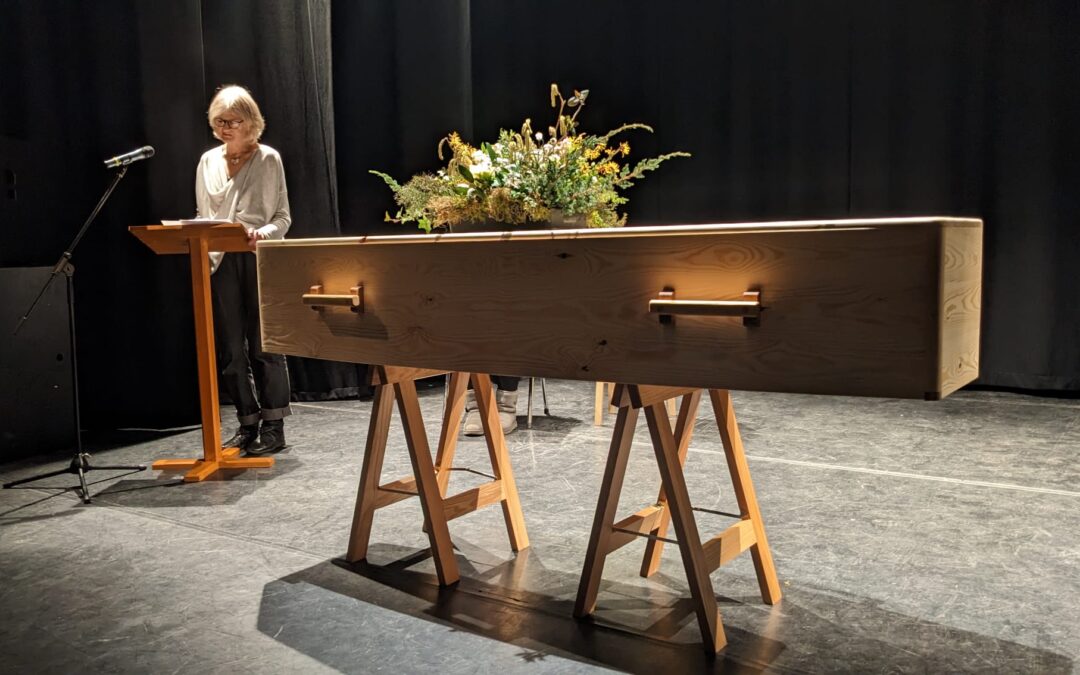
First of all, I want to ask if you’ve seen this film we made of my Dad, using footage from the sixties and some video shot about 10 years ago when he was obsessed by hens and living with my Mother again.
Secondly, if you’re interested in my Dad you might like to see this article and especially the 57 comments that are posted below it. It was a blog-based appeal for testimonials about him and they show dimensions of my father’s life that we never knew. (more…)
by Rupert Wolfe Murray | 18 Jan, 2023 | Opinions
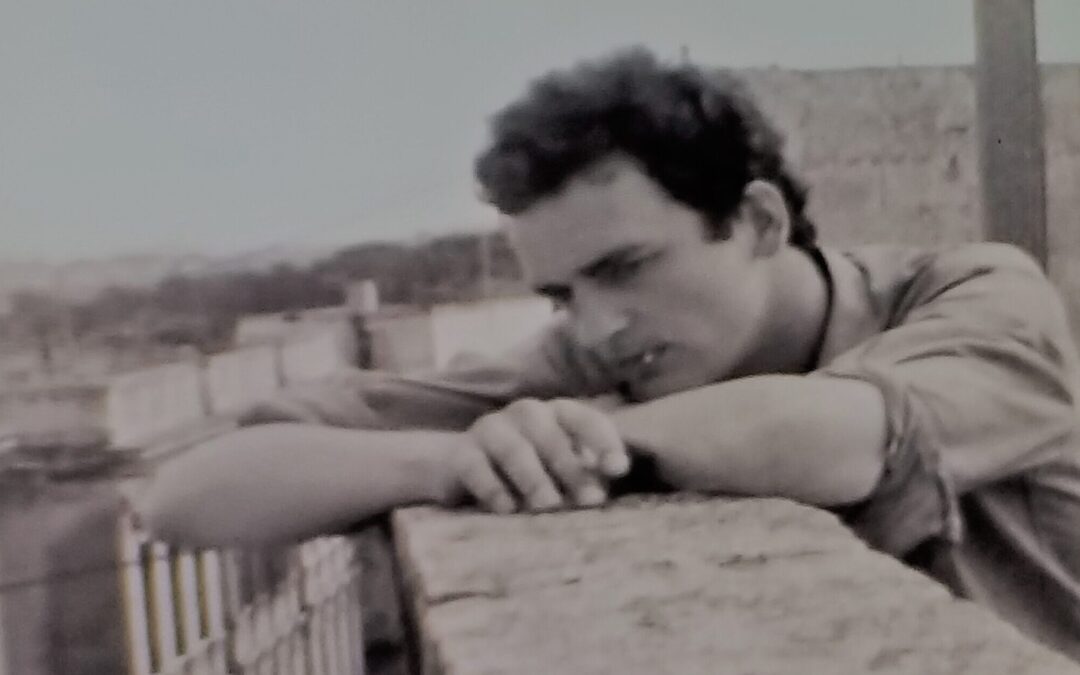
I wrote this blog post just after my father died, at home, on the west coast of Scotland, in January 2023.
I’m in a state of shock but also not surprised as he lived his life in a state of wild defiance of the conventions and norms of ordinary life, and hated the idea of being looked after or helped by others. He loved people but hated officialdom.
On the one hand I want to sum up his extraordinary and eccentric life — I want to explain his charm, his writings, his ability to listen to children, his interests, games, passions and collections — but I’m at a loss. I’m stuck. I have so much to say but at the same time I don’t want to write anything as I need time to process my confusion and grief.
This is where you come in. Perhaps you have a poignant memory of Angus Wolfe Murray, the author, publisher, film critic and specialist in the transportation of fine arts. Did you know him? Were you impressed by his conversation, style and unique outlook on life? Can you comment on his transition from the upper class values of his parents into the bohemian lifestyle he brought us up in?
Last time I made an appeal like this was just after my mother died in the summer of 2017. I wrote a short blog post asking for comments, anecdotes and memories about her and suddenly there were over 25 brilliant pieces of writing — many of which made their way into a little book we rushed into print for her memorial service. You can see the PDF version of it here.
So please add a comment below. And please realise that a sentence will do fine, pithy little statements can be great. Short is sweet and long is lovely. It’s all good. This is the place to share your memories, however fleeting or fragmented, of Angus Wolfe Murray.
And I hope to see you at his funeral, which will take place at 11am on the 9th of February in the Eastgate Theatre, Peebles, in the Scottish Borders. We want to get as many folk as possible there, to celebrate his love for people.
Postscript (several weeks later): I am bowled over by the incredible comments that have come in about our Dear Departed Dad. Thanks so much to you all; it’s not easy writing about such a complex character. These comments are giving us a new insight into a man who we took for granted, and also drove us crazy in his final years. I’m so proud he had such a positive impact on so many people’s lives. I think the most memorable quote about him is this: he was ‘a woodland faun in human frame’; a cricketer friend then added the quip “Did fauns wear frayed denim jeans…with “multi-coloured patches?”.
There’s a lot of cricketing stories here and one of the contributors, Tim Wilcock, wrote that “Angus told me once that he was at Eton with one Henry Blofeld.” As every cricketer will know, Blofeld went on to become a legendary cricket commentator for the BBC (and also the name of the Arch Villain in the James Bond books). Some years later Wilcock met “Blowers” and asked him if he remembered Angus Wolfe Murray. Of course he did, and said they played a match together at Lords. Wilcox then found an old record of the match, sent it to me, and I put it into this slideshow of my Dad-as-schoolboy-cricket-star with his brother Jimmy.
If you want to contact me, about any of this, just email me at wolfemurray [at] gmail.com. Lotsaluv, Rupert Wolfe Murray, Flore, Northampton Shire, January 2023
by Rupert Wolfe Murray | 1 Feb, 2022 | Bosnia, Journeys, My books
I’m working on an epic book that’s coming out in May this year: Bosnian War Posters, by Daoud Sarhandi. It’s an incredible collection of propaganda and art that he and Alina Wolfe Murray, my ex-wife, collected just after the war in Bosnia Herzegovina. It’s taken a long time to come to life but that’s another story.
The posters are arranged chronologically, with long captions, and it tells the story of Bosnia’s war. Young people in Bosnia Herzegovina are particularly interested because they don’t learn about the war in school – it’s too recent, too raw, too politicised – and they want to learn about it so they can avoid the mistakes of their parents. Young Bosnians also want to see how people communicated before the internet.
Many of the older Bosnians I’ve met, those who have experienced the war, don’t seem very interested in it; on the one hand they want to forget, while on the other hand they can’t stop thinking about it (or so I’m told).
Could we do books like this in other war-torn countries?
The reason I’m putting this article together is that I got a very inspiring audio messages from the author, on WhatsApp. It was in response to a discussion about possible future projects we could do in other parts of the world. “Surely”, I asked Daoud Sarhandi, “we could repeat what we did in Bosnia-Herzegovina? Surely there would be great material in other war zones, as good as what we had found in Bosnia?”
Daoud’s audio message (which I’ve transcribed below) gave me the insight I’d been looking for; it answers the question I’ve been asking myself: what makes our book, Bosnian War Posters, unique?
This is what Daoud said:
“The thing about Yugoslavia is that all the stars were aligned. We were in the right place at the right time, in a country which had a conscious design memory – or history – connected with Europe and Russia. One of our contributors, Bojan Hadžihalilović, says the war happened just before the internet and social media came into its own. I think the great poster campaigns the world witnessed in the past are over. Bosnia may have been the last war that used posters to such effect.
“Artists like Began Turbić, Asim Đelilović, and others are valuable as their posters and concepts are original, unique, and self-generated. I was recently thinking about doing a similar book about the Spanish Civil War as some of the work is beautifully drawn and designed. However, Spanish Civil War posters were produced by propaganda agencies on both sides rather than individual artists. They were just churning out very formulaic stuff and you actually learn very little from this material about the war as a whole, or what the people were really feeling. That’s not true about the posters we found in Bosnia Herzegovina. I think Began Turbić’s work, for example, is stunning compared to anything that came out of Barcelona or Madrid.
“Also, the only surviving Spanish Civil War posters are from the conquered cities. There’s almost nothing from small places and nothing independent left. This is not true of the material we found in Bosnia Herzegovina, as we were able to visit the most remote locations just after the war as well as scores of individual artists.
“What we found is absolutely unique. Not only in terms of Bosnia-Herzegovina, but in terms of world heritage. I can’t think of any war in history that generated such a rich heritage of original poster art, and the interesting thing is that it was genuinely independent in that most of the work we collected was produced by individual artists, working alone, and the government and army seemed to ignore them. It was a moment in time that’s not going to come back. It was something that doesn’t happen everywhere and probably will never happen again.
“In 2004 I went to Palestine to investigate doing a poster book about the Israeli/Palestine war. I travelled with an expert in the field, Dana Bartlett, an American design professor teaching in Prague. She’d already done an art book on some of those posters called Both Sides of Peace. At my suggestion, we went to do another book, a bigger one, and I spent two months in Palestine, mostly in Ramallah, talking to artists and designers, as I had done in the former Yugoslavia (in 1997/98). I thought I could repeat the process in Palestine.
“But all I found was visual dross. A lot of great people, for sure, and some great artists – but no inspiring design. What I found was loads of photoshopped posters with the words Islamic Martyr in Arabic, and a young guy holding up an AK47. After you’ve seen a hundred of these posters – which are more of less the same – you realise there’s no story of design here. I understand it culturally, and I respect it, and in its own way it is interesting, but it isn’t artistically inspiring or even very educational.
“But my Palestinian trip wasn’t wasted as I ended up making a great documentary film, The Colour of Olives.
“Sophisticated design doesn’t really happen in most countries. You could go to loads of conflict zones – Iraq, Syria, Rwanda, Yemen, wherever – and I’m sure you wouldn’t find much – you wouldn’t find a body of design work expressing lots of different aspects of the experience. You might find one or two artists doing something interesting, or quirky, but you wouldn’t find enough for a book. And then you’d have to know a lot about the war. To do what we did with the captions, you’d have to know all the ins-and-outs of that conflict.
“Islamic countries are particularly problematic in this design regard, which is why Bosnia Herzegovina was such a unique situation because there’s an Islamic element in this very special European country. But Islam generally is not very encouraging about modern graphic design. It’s just a fact. If you look at the history of Islamic art, it’s mainly decorative. When I met graphic designers and illustrators in Palestine they complained to me about this, that Islam doesn’t doesn’t like art to be confrontational. Art in Islamic countries celebrates the divine; flowers, symmetry, and non-human representation. You get lots of floral motifs, and calligraphy, and very little that is confrontational in the way that western audiences understand it. It’s a different thing altogether.
“Could we do a poster book in Lebanon? I doubt it. Syria? I don’t think so. What’s more I’ve got no motivation to do a big investigation, going round knocking on doors in another country. I don’t have the energy for that, plus I have a young family that I can’t just leave.
“I’m very, very proud of Bosnian War Posters. As a book it’s beautiful and we managed to save so much of the Bosnian’s wartime experience that would undoubtedly have been lost. As far as I know, we were the only people going around collecting all this material in a systematic way. I think the Bosnians didn’t quite appreciate its value, plus they were exhausted after the conflict. They’d had enough of the whole bloody mess. Sometimes outsiders see things that locals don’t in this regard – the distance helps. I knew from the go get that it was all very special and I’m glad we helped to preserve this bit of their cultural heritage.”
What’s unique about this book of posters?
There is a second part to answering this question: putting it into context. This was done rather brilliantly by Carol A. Wells, who runs the Center for the Study of Political Graphics in Los Angeles. She wrote a foreword which puts the book into historical and artistic perspective:
“It is not surprising that so many artists made posters during the Bosnian War as they are one of the most accessible, easily disseminated, and popular art forms to express conflict and resistance. What may surprise those who are seeing these posters for the first time is their variety, abundance, and often extraordinary design…
“Although few of these Bosnian posters are well known, many of them may look familiar because they incorporate images from advertising, fine art, film posters, album covers, and popular culture…
“The Bosnian posters in this book incorporate Western art from prehistoric to Renaissance, from Pop to Punk. The referenced art includes work by Massacio, Durer, Leonardo, Picasso, and Warhol. Posters that were originally made for World Wars I and II, and the Spanish Civil War, were ‘redesigned’ for the Bosnian War. The familiarity of these shared cultural references draws us in.”
#
Artists in Bosnia Herzegovina were able to draw on this rich history of ancient and modern art as many of them had been through a classical education at Sarajevo’s renowned School of Art, where great art is studied over many years. I was at this art school recently and can confirm that it’s still going strong — and the students I met are very keen to see our new book of wartime posters.
My own interpretation of the Bosnian War posters is that it was the only way that artists in Bosnia-Herzegovina could protest about what was happening. As electricity was heavily restricted, the only mass media they had occasional access to was the radio. These shortages made the poster all the more powerful as a means of communication. The same didn’t apply to the other warring parties, Croatia and Serbia, which had fully functional mass-media and national propaganda systems. Although we collected some posters from these countries, very few wartime posters were produced as they didn’t really need them. But we got a few from the start of the war in Croatia as well as some interesting magazine covers from Belgrade.
What I didn’t appreciate until very recently was the level of freedom Bosnian artists had to express themselves – which is ironic considering that the Bosnian people were effectively hemmed in, geographically, by their enemies. They were imprisoned by external forces but their spirits were free.
A Sneak Peak
Finally, I’d like to share with you a couple of images from the book, and I’ll quote from Carol Wells’ foreword which puts them into context:
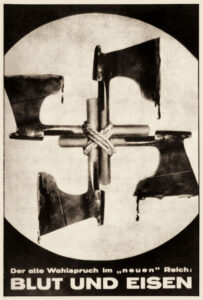
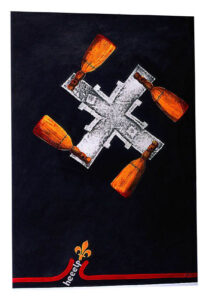
“A poster titled ‘HEEELP’ by Began Turbić used photomontage to transform an Orthodox Christian-style cross into a swastika by attaching traditional peasant-made brushes to the ends of the cross. Sixty years earlier, the German artist John Heartfield used this technique to create a swastika out of four bloody axes. Heartfield’s 1934 work was ironically titled ‘Blood and Iron,’ which was the motto of the Third Reich.
“Heartfield was one of the originators of photomontage, and made many anti-fascist magazine covers and posters using this technique. Turbić’s use of photomontage to create a swastika thus connects the past with the present. The average viewer may not have known this reference, but it would have been recognized by other political poster makers, as Heartfield is often considered one of the earliest designers of mass-produced protest posters.
-
-
John Heartfield’s 1934 poster “Blood and Iron”
-
-
Began Turbic’s Bosnian wartime interpretation.
Find out more
We’ll be launching a crowdfunding appeal soon, to offer discounted copies of the book to Bosnians everywhere as well as anyone who supports this great country. If you’d like to get more information about this please send me (Rupert) an email: wolfemurray@gmail.com
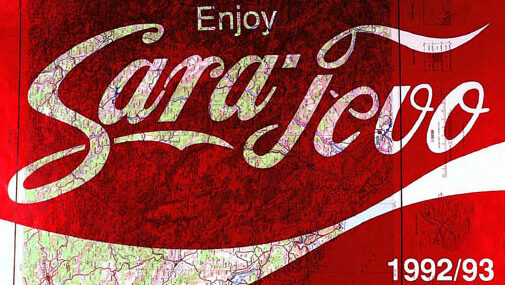
The headline photo of this article was produced by Trio studios during the war. It’s a re-interpretation of the Coca-Cola symbol and it’s printed on the back of an old army map, as paper was in such short supply.
If you’d like to see more of the Bosnian War Posters just follow this hashtag on Instagram: #bosnianwarposters
As always, I’d be most grateful if you could leave a comment under here. All feedback is useful, every voice is valid and every perspective is true to itself. I’m particularly keen to hear from young Bosnians as I’ve been so impressed by those I’ve met so far. I intend to give more talks in Bosnian schools when I go back to Bosnia Herzegovina later this month.
Finally, if you’d like to know why I got involved in this project, see this article: Why I moved to Bosnia
by Rupert Wolfe Murray | 11 Jan, 2022 | Journeys, Opinions
Daniel Craig was a good actor before he got turned into a bad-tempered robot for the Bond films. A great film he starred in, before the Bond franchise gobbled him up, was Layer Cake. It’s one of those clever-witty-vicious crime films that the English are quite good at. Daniel Craig plays a hip, likeable London-based cocaine dealer who does “one last job” before retiring. This is a tried and tested formula in film – the hero does one last job before dropping out of his life of crime – but, as you can imagine, there’s no way that the scriptwriters are going to let our hero retire quietly into wealthy obscurity.
I’m thinking about this plot because it’s a good way to explain why I moved to Bosnia Herzegovina. Although there are some big differences between me and Daniel Craig’s character – I’m not a bigshot coke dealer and not about to retire – there is a similarity which is that I’m trying to finish doing what I would call my “normal” work in consultancy, PR and publishing projects. In short, I’m doing one last job before getting into a life of independent travel, volunteering and writing books.
The job? Raising money to publish a book that contains a unique collection of posters that were made during the Bosnian war. There are a few Croatian and Serb posters but most of them are by Bosnian artists, graphic designers and various organisations that wanted to protest about their nation being ripped apart by the neighbours – as Poland was in 1939 as a result of the Nazi – Soviet pact. The author — Daoud Sarhandi — has assembled the war posters into chronological order and written long captions that tell the story of each one. The effect is a graphic history of the war and it’s relevant to young Bosnians as they don’t get taught about the Bosnian war in their schools — the issue is to recent, too close to the bone, too divisive — and all the young people I’ve met in Bosnia Herzegovina seem really keen to get the book, get an objective/graphic view of the war and learn from their parents’ mistakes. I interviewed over 30 young people in Sarajevo, Mostar and Tuzla and found a remarkable lack of hate towards the other ethnic groups in their country. This gives me a lot of hope.
The reason for telling you all this is because, just before leaving the UK, an English friend called Gwen asked me why. In particular, why will I be raising money for a book about posters that were made during the Bosnian War (1992 to 1995)? “If you’re going to raise money,” she said, “it would be good to know the background. Answering the ‘why’ question is a good place to start.” Gwen used to run environmental NGOS so she knows what she’s talking about when it comes to fundraising.
You might be wondering what it is about this Bosnian poster book that made me uproot myself from England, where I had a good life. The simple answer is that when Daoud Sarhandi told me that he’s working on this poster book I wanted to be part of it. My first response to hearing that he was working on a book of Bosnian War Posters I offered to fundraise for it. Illustrated books like this are very expensive to produce and getting some heavy-duty cash behind it is essential.
Having worked on many NGO and consultancy projects over the years I’ve developed a sort of sixth sense in knowing if a project is good or not. It’s a sort of instinct and is rather like that first impression one has upon meeting someone – is this person inspiring, or to be avoided? It’s the sort of instinct I used to ignore, only to later realise that “if only I’d listened to my gut instinct I wouldn’t be in this mess now.” I’ve worked on so many bad projects and it’s essential to avoid getting involved with one that will only bring frustration, as the people in charge are unable to listen to new ideas (this is perhaps the most common problem). Even if you’re getting well paid, you’ll probably lose about two years of your life working on it.
So, when Daoud said he’s re-doing his Bosnian poster book I instinctively took two decisions: to fundraise for it and to move to Bosnia Herzegovina. I knew there was no chance of raising money for this book in UK, where it would be competing with a million other good causes, and the only place I’d stand a chance is Sarajevo where they’d appreciate its relevance. The idea of hawking it round London and the big western capitals was deeply demotivating, and even if I did get a big grant I’d be subsequently beholden to the donor agency and drowned in their bureaucracy (foreign aid and development work, of which grant funds are part, has become depressingly bureaucratic). This book represents a part of Bosnia’s heritage – posters that were produced by over 40 Bosnian artists as a reaction to the war – so it makes sense that Bosnians fund it rather than one of the international grant funds. This book needs to develop its local roots rather than be another bright idea imposed from outside.
Daoud didn’t ask me to fundraise for it (and this, in itself, is a sign of a good project) but I knew the book needed it and assumed there would be nobody else vying for this non-job (i.e. voluntary) position. It was an instant, instinctive decision that became embedded in my plans for the future. It took me over 6 months to disentangle myself from a comfortable life in the UK: I sold my van, got rid of my precious touring bike, gave away my books and all the excess baggage one builds up – and above all made sure I wasn’t leaving any loose ends behind. I came to Bosnia Herzegovina at the end of July 2021 and don’t know how long I’ll stay. When people ask, I say, “for as long as it takes.”
What’s interesting for me in answering the question – why did I come to Bosnia Herzegovina? That instant decision to support the poster book, was buried deep under a whole pile of other stuff, like an important piece of furniture that’s somewhere under a house that had suddenly collapsed. I had to pick through the debris, sift through lots of other, more superficial, reasons for coming here (escaping from Brexit-land), in order to find that kernel of decision making that was at the heart of it. I’d written an earlier draft of this article, then discarded it in frustration as I hadn’t found the real reason. Now I realise that as soon as I took the decision to work on the poster book it immediately became part of my future plan – to move to Bosnia Herzegovina – but the actual decision making process was so quick and instinctive that I really struggled to find it when someone asked me the most simple of questions: why?
Another reason for moving to Bosnia Herzegovina is that I used to live here, just after the war, for two and a half years. It was a tale of riches to rags and back to riches. During the Bosnian War my NGO/charity, Scottish European Aid, grew huge in the Tuzla region, doing water supply infrastructure under the dynamic leadership of my brother Magnus. Although I was in charge of the NGO back in Scotland, we didn’t manage to get out hands on even 1% of the millions that Magnus was raising for his water engineering projects. I was like a waiter in a smart restaurant who handles big payments but gets paid peantus. So I resigned, got the bus to Sarajevo just after the war ended (winter 1995), spent my last pennies on getting a bus to Tuzla, where a friendly soul had offered accommodation. There’s nothing as motivating as being flat broke in a strange foreign city (ask any immigrant) and within a year I was making a fortune by writing, publishing and selling books to the vast American army that had just landed at Tuzla airport.
Making lots of money for me, myself and I doesn’t feel right so I set up a new NGO/charity with my wonderful mother and we distributed English language books to schools and libraries all over the land. For two glorious years we didn’t need to go cap-in-hand to the donor organisations as we were raising all the money we needed by selling my books to the NATO troops. The last project we did was to finance Daoud Sarhandi to drive around the country collecting Bosnian War posters from local artists, designers and printers. He did this with my very-well-organised ex wife, Alina, and a brilliant photographer called Stephen Gordon. I left Bosnia Herzegovina in early 1998 and never returned until now (2021). Coming back has a curious feeling of homecoming; the first week was a confusing rush of disjointed memories and new impressions.
Thinking about the difficulty of finding the real reason for coming here, and exposing my own decision making process, brings me back to that great English film Layer Cake. Criminal organisations have a strict policy of never keeping a record of their decision making process, for the simple reason that it can land them in jail. Everything is done verbally on the basis of trust (“honour among thieves”). One of the best things about being a non-criminal is that I can be open about all aspects of my life without fearing the consequences. I’ve got nothing to hide.
If you’d like to see some samples from our poster book, which we’ll be publishing next year, follow this link: My Publications | Daoud Sarhandi (jimdosite.com)
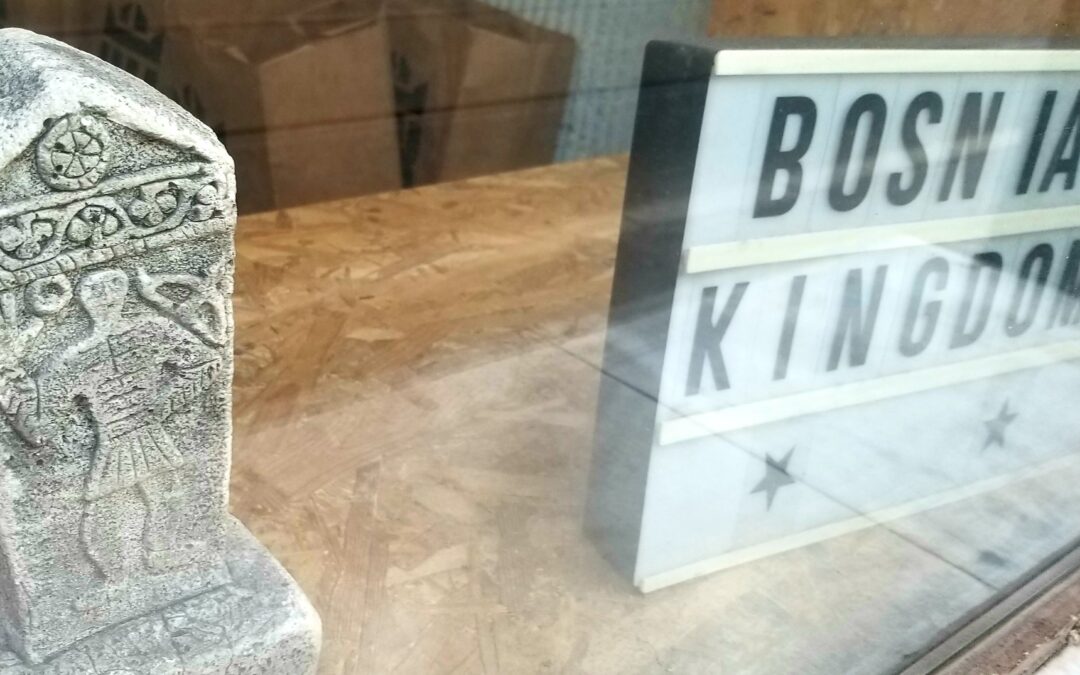
I took the photo that illustrates this article in Sarajevo in July 2021. Bosnian Kingdom is the name of a shop.
As always, I’d be very grateful for any comments — however negative, long or crazy they may be. The truth is that us wannabe writers couldn’t go on without feedback.
I first published this article in August 2021, but re-posted it in January 2022 with some revisions. It still stands as the most relevant article about why I’m currently based in Bosnia Herzegovina.

