by Rupert Wolfe Murray | 11 Jan, 2022 | Journeys, Opinions
Daniel Craig was a good actor before he got turned into a bad-tempered robot for the Bond films. A great film he starred in, before the Bond franchise gobbled him up, was Layer Cake. It’s one of those clever-witty-vicious crime films that the English are quite good at. Daniel Craig plays a hip, likeable London-based cocaine dealer who does “one last job” before retiring. This is a tried and tested formula in film – the hero does one last job before dropping out of his life of crime – but, as you can imagine, there’s no way that the scriptwriters are going to let our hero retire quietly into wealthy obscurity.
I’m thinking about this plot because it’s a good way to explain why I moved to Bosnia Herzegovina. Although there are some big differences between me and Daniel Craig’s character – I’m not a bigshot coke dealer and not about to retire – there is a similarity which is that I’m trying to finish doing what I would call my “normal” work in consultancy, PR and publishing projects. In short, I’m doing one last job before getting into a life of independent travel, volunteering and writing books.
The job? Raising money to publish a book that contains a unique collection of posters that were made during the Bosnian war. There are a few Croatian and Serb posters but most of them are by Bosnian artists, graphic designers and various organisations that wanted to protest about their nation being ripped apart by the neighbours – as Poland was in 1939 as a result of the Nazi – Soviet pact. The author — Daoud Sarhandi — has assembled the war posters into chronological order and written long captions that tell the story of each one. The effect is a graphic history of the war and it’s relevant to young Bosnians as they don’t get taught about the Bosnian war in their schools — the issue is to recent, too close to the bone, too divisive — and all the young people I’ve met in Bosnia Herzegovina seem really keen to get the book, get an objective/graphic view of the war and learn from their parents’ mistakes. I interviewed over 30 young people in Sarajevo, Mostar and Tuzla and found a remarkable lack of hate towards the other ethnic groups in their country. This gives me a lot of hope.
The reason for telling you all this is because, just before leaving the UK, an English friend called Gwen asked me why. In particular, why will I be raising money for a book about posters that were made during the Bosnian War (1992 to 1995)? “If you’re going to raise money,” she said, “it would be good to know the background. Answering the ‘why’ question is a good place to start.” Gwen used to run environmental NGOS so she knows what she’s talking about when it comes to fundraising.
You might be wondering what it is about this Bosnian poster book that made me uproot myself from England, where I had a good life. The simple answer is that when Daoud Sarhandi told me that he’s working on this poster book I wanted to be part of it. My first response to hearing that he was working on a book of Bosnian War Posters I offered to fundraise for it. Illustrated books like this are very expensive to produce and getting some heavy-duty cash behind it is essential.
Having worked on many NGO and consultancy projects over the years I’ve developed a sort of sixth sense in knowing if a project is good or not. It’s a sort of instinct and is rather like that first impression one has upon meeting someone – is this person inspiring, or to be avoided? It’s the sort of instinct I used to ignore, only to later realise that “if only I’d listened to my gut instinct I wouldn’t be in this mess now.” I’ve worked on so many bad projects and it’s essential to avoid getting involved with one that will only bring frustration, as the people in charge are unable to listen to new ideas (this is perhaps the most common problem). Even if you’re getting well paid, you’ll probably lose about two years of your life working on it.
So, when Daoud said he’s re-doing his Bosnian poster book I instinctively took two decisions: to fundraise for it and to move to Bosnia Herzegovina. I knew there was no chance of raising money for this book in UK, where it would be competing with a million other good causes, and the only place I’d stand a chance is Sarajevo where they’d appreciate its relevance. The idea of hawking it round London and the big western capitals was deeply demotivating, and even if I did get a big grant I’d be subsequently beholden to the donor agency and drowned in their bureaucracy (foreign aid and development work, of which grant funds are part, has become depressingly bureaucratic). This book represents a part of Bosnia’s heritage – posters that were produced by over 40 Bosnian artists as a reaction to the war – so it makes sense that Bosnians fund it rather than one of the international grant funds. This book needs to develop its local roots rather than be another bright idea imposed from outside.
Daoud didn’t ask me to fundraise for it (and this, in itself, is a sign of a good project) but I knew the book needed it and assumed there would be nobody else vying for this non-job (i.e. voluntary) position. It was an instant, instinctive decision that became embedded in my plans for the future. It took me over 6 months to disentangle myself from a comfortable life in the UK: I sold my van, got rid of my precious touring bike, gave away my books and all the excess baggage one builds up – and above all made sure I wasn’t leaving any loose ends behind. I came to Bosnia Herzegovina at the end of July 2021 and don’t know how long I’ll stay. When people ask, I say, “for as long as it takes.”
What’s interesting for me in answering the question – why did I come to Bosnia Herzegovina? That instant decision to support the poster book, was buried deep under a whole pile of other stuff, like an important piece of furniture that’s somewhere under a house that had suddenly collapsed. I had to pick through the debris, sift through lots of other, more superficial, reasons for coming here (escaping from Brexit-land), in order to find that kernel of decision making that was at the heart of it. I’d written an earlier draft of this article, then discarded it in frustration as I hadn’t found the real reason. Now I realise that as soon as I took the decision to work on the poster book it immediately became part of my future plan – to move to Bosnia Herzegovina – but the actual decision making process was so quick and instinctive that I really struggled to find it when someone asked me the most simple of questions: why?
Another reason for moving to Bosnia Herzegovina is that I used to live here, just after the war, for two and a half years. It was a tale of riches to rags and back to riches. During the Bosnian War my NGO/charity, Scottish European Aid, grew huge in the Tuzla region, doing water supply infrastructure under the dynamic leadership of my brother Magnus. Although I was in charge of the NGO back in Scotland, we didn’t manage to get out hands on even 1% of the millions that Magnus was raising for his water engineering projects. I was like a waiter in a smart restaurant who handles big payments but gets paid peantus. So I resigned, got the bus to Sarajevo just after the war ended (winter 1995), spent my last pennies on getting a bus to Tuzla, where a friendly soul had offered accommodation. There’s nothing as motivating as being flat broke in a strange foreign city (ask any immigrant) and within a year I was making a fortune by writing, publishing and selling books to the vast American army that had just landed at Tuzla airport.
Making lots of money for me, myself and I doesn’t feel right so I set up a new NGO/charity with my wonderful mother and we distributed English language books to schools and libraries all over the land. For two glorious years we didn’t need to go cap-in-hand to the donor organisations as we were raising all the money we needed by selling my books to the NATO troops. The last project we did was to finance Daoud Sarhandi to drive around the country collecting Bosnian War posters from local artists, designers and printers. He did this with my very-well-organised ex wife, Alina, and a brilliant photographer called Stephen Gordon. I left Bosnia Herzegovina in early 1998 and never returned until now (2021). Coming back has a curious feeling of homecoming; the first week was a confusing rush of disjointed memories and new impressions.
Thinking about the difficulty of finding the real reason for coming here, and exposing my own decision making process, brings me back to that great English film Layer Cake. Criminal organisations have a strict policy of never keeping a record of their decision making process, for the simple reason that it can land them in jail. Everything is done verbally on the basis of trust (“honour among thieves”). One of the best things about being a non-criminal is that I can be open about all aspects of my life without fearing the consequences. I’ve got nothing to hide.
If you’d like to see some samples from our poster book, which we’ll be publishing next year, follow this link: My Publications | Daoud Sarhandi (jimdosite.com)
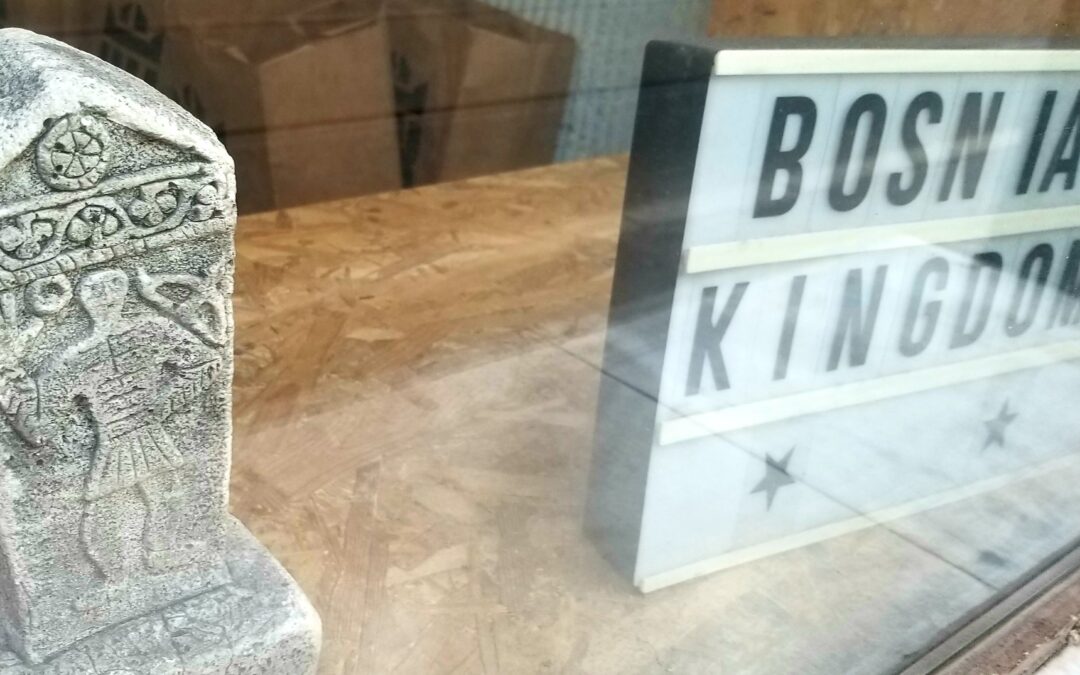
I took the photo that illustrates this article in Sarajevo in July 2021. Bosnian Kingdom is the name of a shop.
As always, I’d be very grateful for any comments — however negative, long or crazy they may be. The truth is that us wannabe writers couldn’t go on without feedback.
I first published this article in August 2021, but re-posted it in January 2022 with some revisions. It still stands as the most relevant article about why I’m currently based in Bosnia Herzegovina.
by Rupert Wolfe Murray | 24 Nov, 2021 | Journeys
I’ve just been travelling round the Balkans and want to share my impressions in the hope that you will feel inspired to do the same. Accommodation, transport and food are cheap, the people are friendly, parts of it are stunning (see the photo below) and it’s as safe as anywhere in the world.
Here’s a photo I took from a bus window in the southern part of Serbia, the Sand Jack region where people of the Muslim faith are in the majority. If I could take such a nice photo from the bus window, using my old phone, imagine what you could do on the ground with a decent camera.
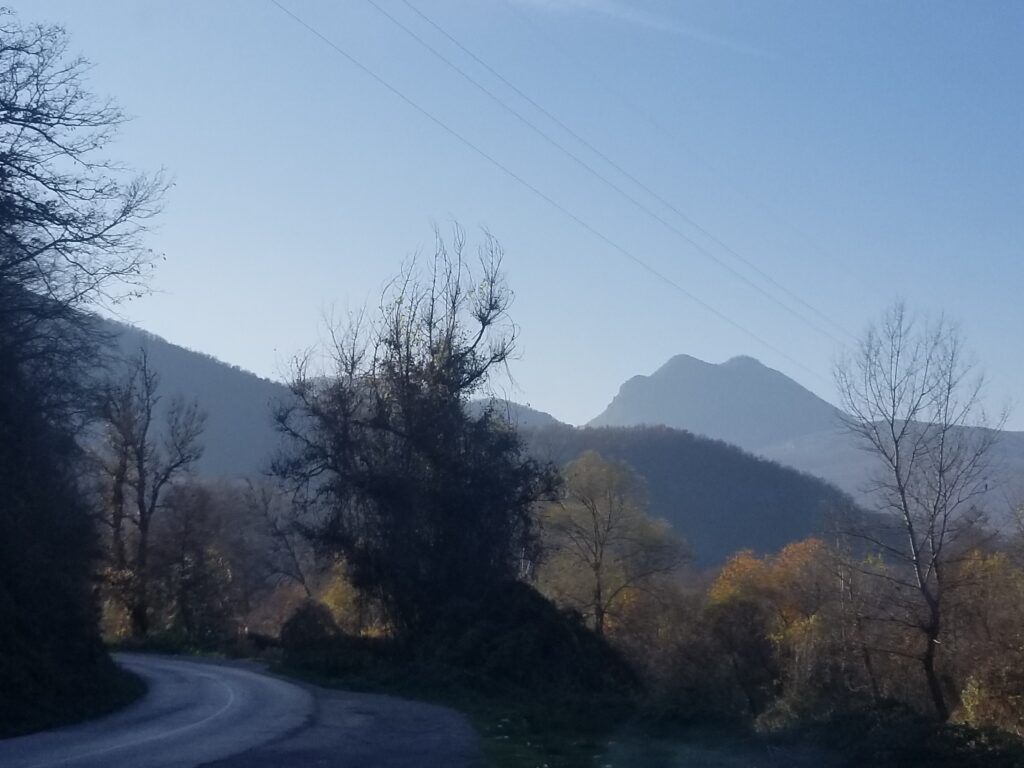
Photo of the Sand Jack by Rupert Wolfe Murray
I’m currently living in Sarajevo and I went to visit some friends in Bucharest. The quickest overland route is via Belgrade. I decided to come back a longer but more beautiful route: through Bulgaria, North Macedonia, Kosovo and the Sand Jack region of Serbia. It was a big loop through the Balkans.
What’s the Best way to travel round the Balkans?
This depends on your approach and budget. If you’re loaded and like to avoid strangers you’ll want to hire a car but if you’re like me – skint but always open to meeting new people – there are only two options: bus and train. Buses are the main option in the former Yugoslavia and although they’re cheap please don’t rely on bus information you find online as it’s almost certainly out of date. I got into the habit of arriving at a bus station and immediately buying my next bus ticket. Trains are also cheap, but slow and only really an option in Romania and Bulgaria, as there aren’t many train lines in Greece or the former Yugoslavia.
Hitching is a useful back-up method for when the bus doesn’t go in your direction, as happened when I tried to get from Belgrade into Romania (you can read about that experience here). I love hitching as it’s a good way of meeting people, learning a few words in a new language, and (sometimes) getting an insight into the driver’s dysfunctional country. Most people I’ve met in the region are friendly, interesting, cynical and fun. But, if you’re hitching, offer them some money – the equivalent of a bus fare – and I’m ashamed to say that I didn’t offer my last driver anything when he took me from the Serb/Romanian border into Timisoara.
Is it safe to travel in the Balkans?
Even though the Balkans are beautiful – lots of ancient cities, spectacular mountains, and beaches to die for – many people think it’s dangerous. It was dangerous during the Bosnian and Croatian wars but that finished over 25 years ago and the people of this region are far less aggressive, on the streets, than you would experience in the UK – where aggro seems to be baked into our DNA. I’ve travelled around the Balkans many times over the last 30 years and I can’t remember once feeling scared, even during the Bosnian war when I visited the city of Tuzla twice.
In my experience, the most friendly people in the Balkans are the Romanians and the least friendly are the Bulgarians. Overall, they’re quite polite even if they can be a bit rude and cold in restaurants and shops. If you ask a young person directions on any street in the Balkans the chances are high that they’ll speak decent English and be keen to practice it. They’ll also look after you – there’s an ancient tradition of looking after guests – and that’s why I can assure you that travelling in the Balkans is totally safe. You’ll be safer in the Balkans than you would be on a Friday night in many British cities I can think of.
5 reasons why I love hostels
If you’re like me and living on a low budget the only real option is to stay in a hostel, but some people hate the idea of sharing a room with smelly strangers and they worry their stuff will be robbed – which doesn’t happen as a sort of collective security goes on in shared rooms: nobody wants their gear nicked so they’re not going to steal yours. It’s the same process at work in offices: people don’t steal each others stuff as an unspoken system of mutual respect is at work.
- Hostels are dirt cheap
The only cheaper option is to camp, and I like camping even more than hostels; but the Balkans is crap for camping as it’s illegal in some countries (I’m looking at you Croatia), frowned upon by locals and there’s very few campsites around.
Having just stayed in a series of hostels in the region, I can tell you that the average price for a bed in a shared room is about 7 Euro. A good place to book a bed is on Hostelworld as you don’t have to register or download their App. The website Booking.com are muscling into this market but they piss me off as they have cancellation fees and keep trying to force me into hotels.
- Hostels have a sense of community
Even when I have money to blow on a hotel I’d rather stay in a hostel as there’s something sad and lonely about a middle-aged guy shutting himself into a hotel room (why do I think of prostitutes?) Sure, if you’re a couple I can understand why you’d prefer your own room but, let’s face it, most couples don’t really need that intimacy that was so wonderful during their honeymoon; I think many of them would prefer to chat with friendly travellers, but are so stuck in the routine of booking their own private room at four times the price that changing it would be unthinkable.
I live and travel on my own and am rarely lonely. I love being with people and like working somewhere where there are people around, like a shared hub-type office, or even a café. I like being around strangers even if they don’t want to talk to me.
Hostels give me a sense of community. When I recently stayed in a hostel in Bucharest there were two other people in the room. I’ve no idea who they were as we didn’t talk once over a period of 3 days. There were no bad vibes, no unfriendly glances, but we all kept to ourselves and had very different sleeping times. My point is that it’s nice to be around other people and the hostel is a great place to experience that. Usually there are a mix of friendly people and those who want to keep to themselves. Over time, I’ve learned to tell the difference and only engage if I think the other person really wants to. In this way I can enjoy a sense of community – and anonymity.
- Hostels can be really interesting
I think most hostels are really different from each other but most hotels, especially the posh ones, are the same. In a hotel you always have a “them and us” scenario which starts as soon as you walk in the door and talk to the receptionist; she may be friendly and polite but you can’t get away from the fact that she’s doing a job, following a set of rules (one of which is to not get too friendly with the clients), and serving you. In the hotel restaurant it’s the same – people are serving you and you can’t really break away from the master/servant dynamic.
This dynamic is usually absent from hostels where the staff sometimes live in one of the shared rooms, alongside the rest of us, and in the evening they hang out with the more gregarious guests. When I stayed in a hostel in Sofia the receptionist/manager invited me to a noisy party on the top floor; I didn’t go but I did appreciate the invite. In the bigger hostels, the people working there are often travellers getting free accommodation in return for some reception duty – and they’re keen to chat with you as soon as the formalities are out of the way.
Because hostels are sometimes just the size of an apartment, they don’t need as much real estate as a hotel. As a result they’re often in superb locations. In all these cities I recently visited all the hostels were located in the city centres, at a quarter of the price of a hotel.
Interesting hostel experiences on my recent trip through the Balkans: in Bucharest the hostel was full of immigrant workers from Sri Lanka – a really gentle crowd, with none of the macho tendencies of some Balkan men; in Belgrade the overweight receptionist had a shouting match with a skinny woman from Hong Kong (both of whom seemed to be long-term residents and were like an old married couple); in Skopje the hostel was located in the vast basement of a hotel and 100 Japanese-style cubicles had been built – offering much more privacy than is usually available in a bunk bed. I thought it a brilliant idea to locate a hostel within a hotel as they can attract two very different types of clients. And it feels great to experience the up-market services on offer at the hotel while only paying a fraction of the normal hotel price. In the Skopje hostel, I wandered into the hotel spa and got a cheap massage from an Albanian lady who’d been trained in Switzerland.
Perhaps the most interesting thing about hostels is the people. When sharing a room with others you’re bound to come across some weird and wonderful characters. On this trip the person who stands out most in my memory was a skinny Irishman in Prishtina, with the mad eyes and straggly beard of a hermit. At dawn a mobile phone rang in the bed above me and this chap leapt out of bed, stark naked, and screaming: “Turn that bloody thing off! I’ve paid good money to stay here… ” The phone was silenced and the guy above didn’t say a word, the Irishman got back into bed, and I went back to sleep.
- Hostels are a lot better than they used to be
Hostels used to be really grim. In the UK they were the simplest form of accommodation, rather like military barracks, and in Eastern Europe they were even worse. All that has changed but many people seem to assume that they’re still grim, filthy and dangerous.
What’s happened is that business people have realised there’s good money to be made from cheap accommodation; you don’t need to be a rocket scientist to work out that big bucks can be made by packing 8 to 12 people in a room, especially in the Western capitals where (hostel) prices are treble what they are in the Balkans. But these investors have to offer something more than an old style bunkroom so they’ve unleashed the architects and now you can find some really beautiful hostels, especially in the fancy Western capitals. In North London we once stayed in the cells of an old police station; I think it’s called The Clink. In Brussels I stayed in a superbly converted old beer factory, with hundreds of beds.
A lot of hostels also use the language of the surfer dude when writing notices, toilet and kitchen rules, and all the information they need to convey. In Timisoara, where I stayed in a small but beautifully designed hostel, there were little blackboards everywhere with instructions written in the voice of a Californian stoner. Although this tone is sometimes a bit annoying, it’s better than the dense legalese texts you find in hotels.
Even the worst hostels – and there are some really crap ones around – have a basic kitchen and cooking your own meals can save you a King’s Ransom.
- Hostels are a good place to write books
Writers need to find a quiet, peaceful place to write their next epic. How is this possible, you may be wondering, in a hostel where the young crowd (and the hostel management) may be partying late into the night? I once had a really well-paid job for the EU in Bucharest, with enough cash to stay in a hotel. But I chose to stay in a scruffy city-centre place called Midland Hostel as I liked the community and didn’t mind the noisy rabble who would drink and smoke on the balcony until God knows what time in the morning.
Within the late night action at the hostels I have found the ideal working place: early mornings in the kitchen. As far as I’m concerned the later my fellow-residents go to bed the better as they’re likely to get up really late – and that means that I’ve got the whole place to myself in the morning. When I stay in hostels I try and get up as early as possible, ideally around 5am, and for the next four hours the chances are that the only person I’ll see will be the cleaning lady – or, in the case of the Midland Hostel in Bucharest, it was the manager himself who showed up early and cleaned the place.
Travelling gives me energy
At the end of my journey I got back to Sarajevo, but I was buzzing with energy that two weeks of travel had given me. I had to keep going and so I went to Split, Croatia, for the weekend, using the one good train line in Bosnia – Sarajevo to Mostar – and then the bus. It was great to get a glimpse of the sea and I took a decent photo which shows the Dalmatian Coast, i.e. when the mountains fall into the sea. Here it is:
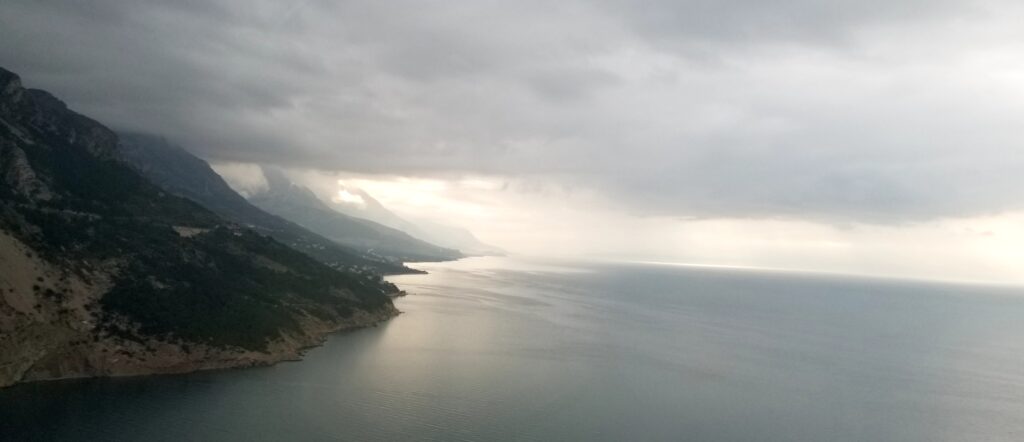
Croatia’s Dalmatian Coast by Rupert Wolfe Murray
Postscript: My Airbnb Nightmare
Until I reached Novi Pazar, in Serbia’s Sand Jack region, all my experiences with Airbnb were good. Airbnb apartments are more expensive than hostels, and usually better. But when I got to Novi Pazar I soon realised that the only options were Airbnb or an expensive hotel. The Airbnb place I booked only cost 12 Euro and the other option was a hotel where it cost 50 Euro for a room.
But my Airbnb experience in Novi Pazar was bizarre. The listing made it sound great and I saw images of a modernised chalet on a hill, very central and dirt cheap. What could possibly go wrong? First of all, finding the place was difficult as the address had no sign or street number on it, but that was the least of my problems and is normal for Airbnb. The host, who was bursting with friendliness at getting a guest (I was his first), told me to wait in his family’s cafe/bar while he went to sort out the accommodation. Then he locked the door, turned off the lights and vanished for almost half an hour. He’d left me in a dingy bar with his friends and a big TV screen blaring out the news. I later found out that all pubs, bars and restaurants had to close at 9pm due to some law in Serbia that was supposed to stop the spread of Coronavirus – quite how, I’ve no idea but I didn’t care; I just wanted to sleep.
Under normal circumstances, I don’t mind being stuck in a shitty bar for half an hour but it helps if they tell you why you’re having to wait for so long. But the real problem was that one of my host’s friends was obviously a madman: every time the newsreader would say something he would scream and shout at the TV with such insane rage that he looked like he was ready to kill. Was this the sort of Serb extremist who would go into Bosnia and Croatia and kill innocent people? Luckily he didn’t even notice me, which was lucky as I am a citizen of one of the countries that bombed Serbia in 1999.
Eventually my grinning host returned, didn’t seem to even notice his raving lunatic of a friend, and said “follow me.” My grasp of Serbian/Bosnian/Croatian is basic, but fine for this kind of circumstance.
He then led me to the back of the house and pointed to a metal fence, which we had to climb over; my host said his neighbour had promised to cut through it but hadn’t done so. This was my first inclination that this guy’s building project was nowhere near finished. We were then standing at the bottom of a mud cliff, with rough notches dug into them. Bricks had been placed in these notches but they weren’t fixed and so each step was a wobble; luckily there were a few saplings to grab hold of. I had a big rucksack and struggled to make it to the top, and only did so because I have some rock climbing experience; I couldn’t imagine how a family could get up there or an older person. This path is dangerous and I assume that Airbnb don’t bother inspecting the properties that they list, and neither does the local authority. Do they just leave it to the reviewers to warn others it’s dangerous and unfit for human habitation?
When we reached the top of the cliff he proudly showed me his shed. At first glance it looked fine but on closer inspection I realised the thin boards that the walls were made of had gaps between them and the freezing night air was whistling in. I asked him if it was insulated and he said “of course” and pointed to a thin sheet of plastic that was wrapped round the building. He obviously has no idea what thermal insulation is.
The bed was built on a high platform but it was so rickety I thought I might crash to the floor; it would been lethal for a couple or an overweight person. The only way he could heat the place was to balance an electric blow heater on the bed; but the heat was pouring out of the gaps in the walls so I had to keep it on all night, at the risk of burning the whole place to the ground. If only I’d had a four-season sleeping bag I could have slept on the floor in great comfort, but I had to make do with his smelly bedding and my own summer sleeping bag.
The best bit was the bathroom which was just a pile of junk lying around outside. He’d collected an old bath, toilet and sink, plus boxes of tiles and all the other stuff you need for a bathroom, and it was lying around outside, exposed to the elements. It looked like a bomb had gone off, scattering the items around the muddy hillside. My host pointed to the junkpile and said with a grin: “Bathroom!” That was one of his few words of English. I didn’t know if I should laugh or cry.
Luckily I got away in one piece and considering how friendly the host was I didn’t want to write a review on Airbnb, as it could only be devastating. But then he sent me messages saying I hadn’t paid him – not realising you can’t stay in an Airbnb without paying for it first, on the App, but the payment takes a few days to reach the host – he started sending me angry text messages. Maybe he would unleash his ad friend and hunt me down? So I unfriended him on social media and posted a review on Airbnb.
In my review I wrote, “This place is unfit for human habitation…it’s like sleeping in a shed…it should be withdrawn from Airbnb.”
Over two weeks have passed since I stayed at that place in Novi Pazar. I just checked the Airbnb site and can confirm that the hellhole I stayed at (Vikendica Sanac) is still listed as a viable accommodation option. This proves, to me at least, that Airbnb don’t give a damn about their listings. How could they if they let a place that is dangerous, and reported as such by my review, still be available online?
All of which goes to show that the best option, for those at the low end of the travel budget spectrum, is to stay in a hostel. It has to be said, however, that most Airbnb options are really good and the dive I stayed in was an exception.
A final word: I’ve just heard the news that 46 people were killed on a bus travelling on the same route I just went on, from Bulgaria into North Macedonia. My heart goes out to the families of those unfortunate victims. I’m really sad about it. I know the buses in this region are generally old but the drivers are usually good and there’s never been such a big tragedy like this in the region. I don’t understand how it happened. Hopefully it will lead to stricter measures regarding the old buses that connect the cities of the Balkans.
Thanks for reading this article, which is far longer than I had planned. I’d really appreciate it if you would add a comment below, even if it’s short or critical. If you have any questions, or would like any advice about travelling in the Balkans, or independent travel in general, this is the perfect place to ask — the comment section below — as then it’s available to anyone else who may be interested.
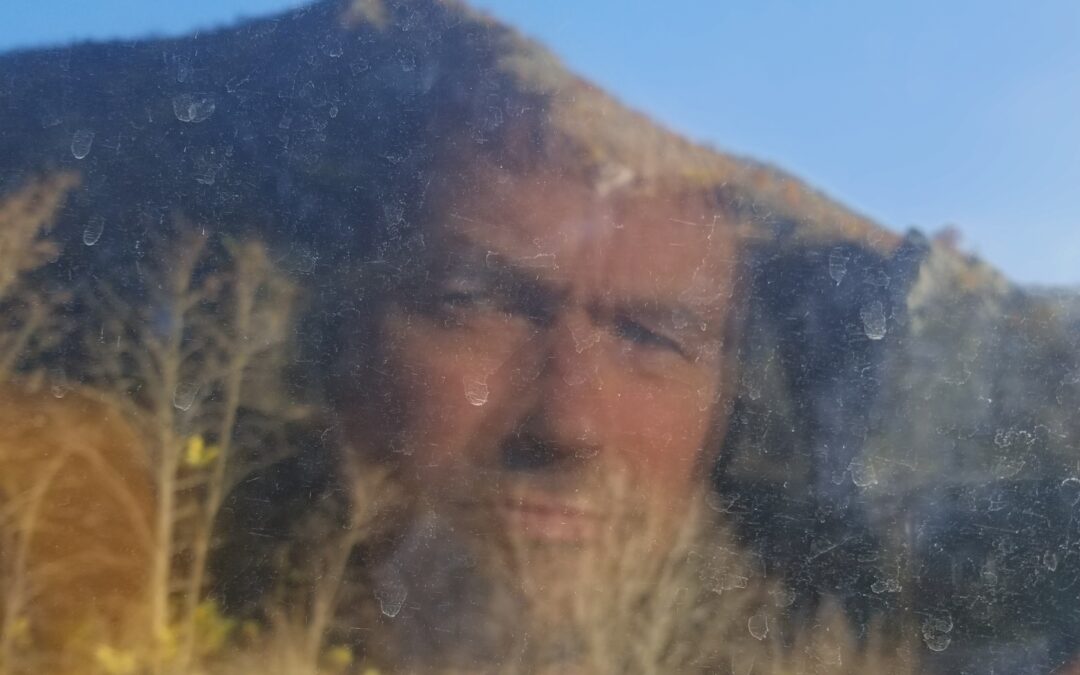
Final, final, final note: the main photo of this article (my reflection in a bus window, against a backdrop of a mountain) was taken on a bus across the Sand Jack region of Serbia. Although I cropped this photo I didn’t edit it otherwise, and you can see the dirty marks on the window. The other photos in this article were also taken from bus windows, which I find remarkable as so many times I’ve taken landscape shots and been disappointed. I guess photography is all about being in the right place at the right time, i.e. when the light is just right.

